Last Updated on October 6, 2026 by Umar Farooq
What causes pressure washer low pressure? Pressure washer low pressure is almost always a water-path problem, not a broken machine. Work along the path in order: water supply, inlet filter, garden hose, nozzle, air in the pump, unloader valve, then pump wear. Nine times out of ten the fault is a clogged nozzle, a starved water supply, or a dirty inlet screen — all of which you can fix in under fifteen minutes with no tools.
Pressure washer low pressure is the single most common complaint homeowners have, and the good news is that the expensive causes sit at the very end of the list. This guide walks the water path from the spigot to the spray tip in the same order a service technician would. Follow it top to bottom and stop as soon as pressure returns.
Fast Triage: Match Your Symptom to the Likely Cause
Before you take anything apart, find your exact symptom in the table below. The symptom pattern narrows the cause faster than random part-swapping.
| What you see or hear | Most likely cause | Check this first | Typical fix time |
| Weak, wide spray from day one | Wrong nozzle fitted, or machine is low-GPM | Nozzle colour and spec sticker | 2 minutes |
| Pressure drops the moment you pull the trigger | Water supply cannot keep up | Spigot fully open, hose diameter | 5 minutes |
| Pump surges and pulses on and off | Air in the pump or a failing unloader | Bleed the pump first | 10 minutes |
| Strong for 30 seconds, then fades | Supply tank or spigot flow too low | 5-gallon bucket test | 5 minutes |
| Sudden total pressure loss mid-job | Clogged nozzle or split hose | Nozzle orifice, hose burst | 5 minutes |
| Pressure fine, but water spits and coughs | Restricted inlet filter | Inlet screen at the hose fitting | 5 minutes |
| Loud rattling pump, oily drips | Worn valves or seals | Pump oil colour | Shop repair |
| Fine spray but no soap | Detergent siphon, not pressure | Black nozzle fitted? | 2 minutes |
If your machine produces literally nothing — not weak water, zero water — stop here and read why a pressure washer has no water coming out instead, because running a dry pump destroys it in seconds.
Three Patterns of Pressure Washer Low Pressure
Every low-pressure complaint falls into one of three timing patterns. Identifying yours removes roughly two-thirds of the possible causes immediately.
Pattern 1: It Never Had Full Pressure
If the machine has been weak since the first day you used it, you almost certainly do not have a fault. You have a sizing or setup mismatch. A 1,700 PSI / 1.2 GPM electric unit genuinely cannot strip a driveway, no matter how healthy the pump is. Check the spec plate, check that you fitted a high-pressure nozzle instead of the black soap tip, and confirm the wand is locked fully into the gun. Brand-new machines also ship with air trapped in the pump, which fakes a weak-pressure symptom until you bleed it.
Pattern 2: Pressure Dropped Suddenly Mid-Job
A sudden drop while you are working means something blocked or broke. The candidates are a clogged nozzle orifice, a split high-pressure hose, a blown O-ring at a fitting, or debris that reached the inlet screen. Sudden faults are mechanical and local — they are rarely pump wear, because pumps degrade slowly over months, not in one afternoon.
Pattern 3: Pressure Fades After a Few Minutes
Fade is a supply or heat problem. The machine starts strong because the hose and pump are full, then weakens as it drains that reserve faster than the spigot refills it. This is the classic signature of a half-open valve, a long thin hose, a partially closed shut-off at the gun, or a well pump that cannot sustain flow. Heat causes the same fade: recirculating water past a stuck unloader heats up, and hot water lowers viscosity and pressure. If the machine also stalls, read about a pressure washer that keeps shutting off.
Before You Fix Anything: Is the Machine Really Weak?
A large share of “low pressure” cases are healthy machines used with unrealistic expectations. Two quick tests settle it.
The 5-gallon bucket test. Disconnect the garden hose from the machine, put the free end into a 5-gallon bucket, open the spigot fully, and time how long the bucket takes to fill. Divide 5 by the time in minutes to get your supply GPM. A bucket that fills in 60 seconds gives you 5 GPM, which is plenty. A bucket that takes 2 minutes and 30 seconds gives you only 2 GPM, which will starve most gas machines. Your supply must exceed the machine’s rated GPM, and Briggs & Stratton specifies a minimum of 20 PSI and 4 GPM at the tap for typical consumer units, according to their low pressure troubleshooting guide.
The cleaning-unit check. Cleaning power is PSI multiplied by GPM, not PSI alone. Two machines with identical 2,000 PSI ratings clean at very different speeds if one moves 1.2 GPM and the other moves 2.4 GPM.
| Machine class | Typical PSI | Typical GPM | Cleaning units | Realistic use |
| Light electric | 1,600 | 1.2 | 1,920 | Cars, patio furniture, bikes |
| Mid electric | 2,000 | 1.4 | 2,800 | Siding, small decks, fences |
| Heavy electric | 2,300 | 1.8 | 4,140 | Decks, light driveway work |
| Entry gas | 2,800 | 2.3 | 6,440 | Driveways, large siding jobs |
| Mid gas | 3,200 | 2.8 | 8,960 | Concrete, surface cleaners |
| Pro gas | 4,000 | 4.0 | 16,000 | Commercial, all-day use |
If your machine sits in the top row and you are trying to clean concrete, nothing is broken. Compare the honest limits in our guide to how much GPM a pressure washer needs.
Step 1: Check the Water Supply First
Open the spigot all the way — half-open taps are the most common cause of fade. Then check the whole supply chain: a splitter valve left partly closed, a quick-connect with a check valve inside it, an inline filter on a well system, or a frost-free spigot with a failing internal washer. Municipal supply pressure usually sits between 40 and 70 PSI, which is fine, but flow matters more than pressure. If your bucket test came in under 4 GPM, fix the supply before touching the machine.
Well systems deserve extra attention. A well pump that cycles on at 30 PSI and off at 50 PSI delivers uneven flow, and a pressure washer draws hard enough to keep the well pump running continuously. If pressure surges in a slow rhythm of 20 to 40 seconds, your well pump cycle is the cause.
Step 2: Clean the Inlet Filter Screen
Every pressure washer has a small mesh screen where the garden hose connects. It exists to stop grit reaching the pump, and it clogs with sand, rust flakes and hard-water scale. Pull it out with needle-nose pliers, rinse it under a tap, brush it with an old toothbrush, and check it is not torn. A torn screen lets debris into the pump, which is how minor neglect turns into an expensive valve failure.
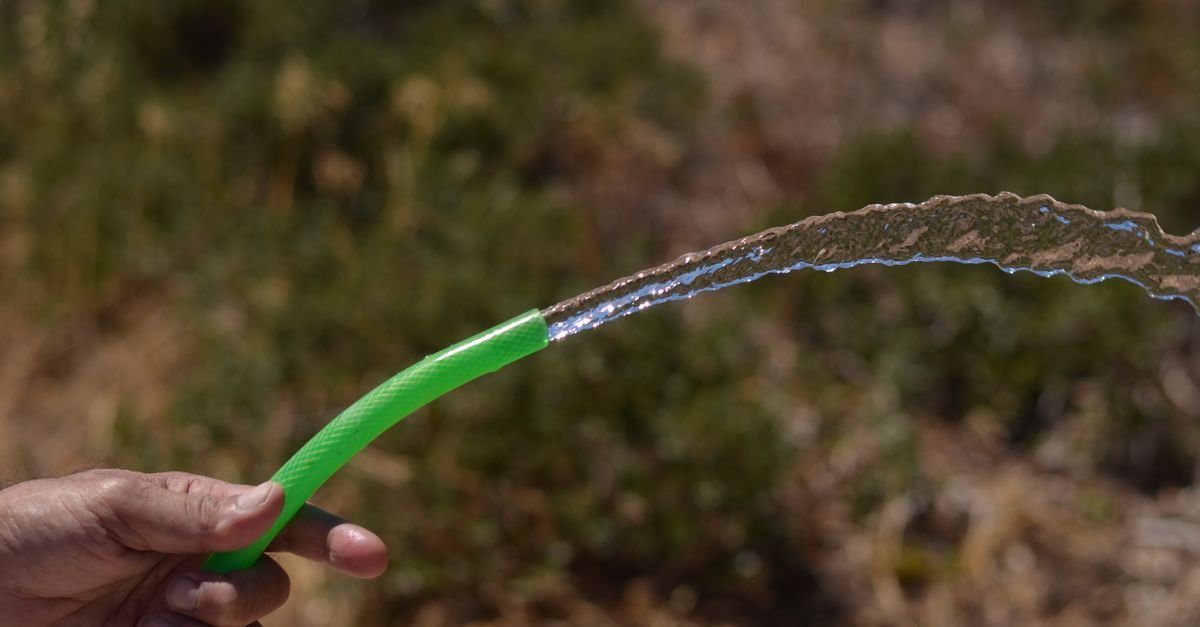
Before reconnecting, run the garden hose alone for 30 seconds into the grass. Hoses that sat over winter often push out a slug of rust and sediment, exactly as shown above. Flushing that out first keeps it out of the fresh screen.
Step 3: Fix Garden Hose Kinks, Length and Diameter
The garden hose is a silent pressure killer. A 100-foot half-inch hose can physically not deliver what a 3.0 GPM machine demands. Diameter matters far more than most people expect.
| Garden hose inside diameter | 25 ft run | 50 ft run | 100 ft run |
| 1/2 inch | ~12 GPM | ~9 GPM | ~6 GPM |
| 5/8 inch | ~22 GPM | ~17 GPM | ~11 GPM |
| 3/4 inch | ~30 GPM | ~23 GPM | ~15 GPM |
*Approximate free flow at 40 PSI supply pressure. Real figures drop with age, kinks and fittings.*
Use 5/8 inch as the minimum, keep the run under 50 feet, and lay the hose flat with no coils on the reel. A hose left coiled on a reel while in use restricts flow badly. Also inspect the high-pressure hose for a bulge or a pinhole spray — a leaking high-pressure hose bleeds off pressure invisibly under the jacket.
Step 4: Inspect the Nozzle for Clogs and Wear
The nozzle is the most frequent single cause of pressure washer low pressure. A partial clog narrows the orifice and the pump pushes back against it, so the machine may sound strained. Remove the tip, and clear it with the cleaning pin supplied with the machine. Husqvarna is explicit in its nozzle cleaning guide that you must use the supplied pin and never a nail or piece of wire, because a hard object deforms the orifice permanently.
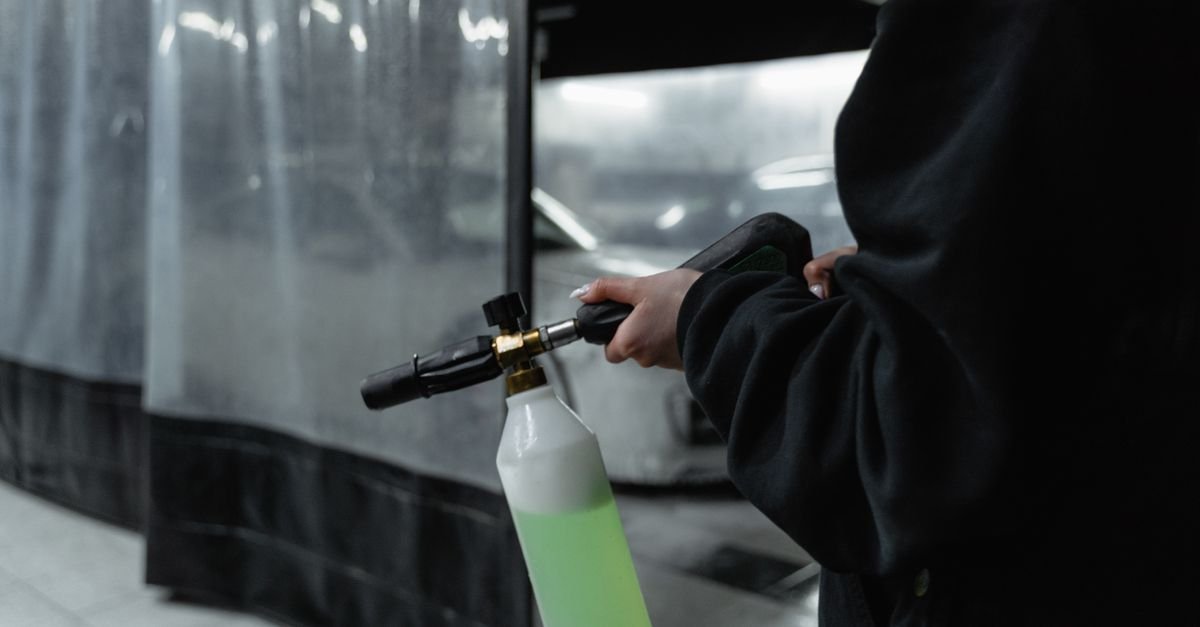
Worn nozzles cause the opposite problem. As the orifice erodes it grows wider, flow rises and pressure falls, and the spray fan loses its sharp edge and turns misty. A quick test: if pressure is low but the pump sounds relaxed rather than strained, suspect wear. If it sounds strained, suspect a clog. Fitting the wrong orifice size does the same thing, so match the tip to your machine.
| Machine GPM | 2,000 PSI | 2,500 PSI | 3,000 PSI | 3,500 PSI |
| 2.0 | 3.5 | 3.5 | 3.0 | 3.0 |
| 2.5 | 4.5 | 4.0 | 4.0 | 3.5 |
| 3.0 | 5.5 | 5.0 | 4.5 | 4.5 |
| 4.0 | 7.0 | 6.5 | 6.0 | 5.5 |
*Approximate nozzle orifice numbers. Fitting a tip one size too large can cost several hundred PSI.* For fan angles and colour codes, see the full pressure washer nozzle chart. If clogging keeps recurring, the cause is upstream — read why a nozzle keeps clogging.
Step 5: Bleed Trapped Air Out of the Pump
Air is compressible; water is not. A pump with an air pocket cannot build pressure and typically pulses or surges. Bleeding takes two minutes:
1. Turn the machine off completely.
2. Connect the garden hose and open the spigot fully.
3. Remove the nozzle from the wand.
4. Squeeze and hold the trigger until water runs out in a smooth, steady stream with no spitting. This usually takes 30 to 60 seconds.
5. Keep the trigger held and start the machine.
6. Refit the nozzle only once pressure is steady.
Husqvarna’s no-water service note makes the same point and adds the critical warning: if no water flows at all, switch off immediately rather than continuing to crank, because a dry pump is damaged within seconds.
Step 6: Test the Unloader Valve
The unloader valve diverts water back into the pump when you release the trigger. When it sticks — usually from scale or debris — it can dump water back permanently, so you get flow but almost no pressure. Symptoms include normal water volume with a weak, floppy spray, and a pump that gets hot quickly because the same water recirculates.
On most consumer machines the unloader is a brass assembly on the pump head with an adjusting screw or knob. Turning that screw is not a repair — it masks a fault and over-tightening it can spike pressure above the hose’s safe rating. The correct action is to remove the valve, clean the piston and spring, replace the O-rings, and reassemble. If you are not comfortable doing that, it is a low-cost shop job.
Step 7: Hunt Down Leaks, O-Rings and Loose Fittings
Any leak between the pump and the nozzle costs pressure. Start the machine, pull the trigger, and walk the whole line with a dry cloth: garden hose coupling, inlet fitting, pump outlet, high-pressure hose at both ends, gun inlet, and the wand joint. A leak that only appears under trigger pressure will show as a fine mist or a wet ring rather than a drip.
Rubber O-rings are the usual culprit and cost very little. Replace them as a set rather than one at a time, and smear a trace of silicone grease on each one so it seats instead of pinching. Also check that the quick-connect collar clicks fully home — a wand seated only halfway leaks internally and reads as pressure loss.
Step 8: Engine Speed, Motor Power and Extension Cords
A pump only makes rated pressure at rated speed. On gas machines, confirm the throttle is on FAST, check that the engine is not bogging under load, and service the air filter and spark plug. A restricted air filter alone can cost 10 to 15 percent of engine RPM, and a machine that is also hard to start may have a fuel issue — see why a pressure washer won’t start.
On electric machines the usual culprit is the extension cord. Voltage drop starves the motor, the motor slows, and pressure falls. Many manufacturers ban extension cords entirely for this reason.
| Machine amp draw | 25 ft cord | 50 ft cord | 100 ft cord |
| 10 A | 16 AWG | 14 AWG | 12 AWG |
| 13 A | 14 AWG | 12 AWG | Not advised |
| 15 A | 14 AWG | 12 AWG | Not advised |
Plug directly into a dedicated GFCI outlet whenever you can. If you are choosing between platforms, our electric vs gas pressure washer comparison covers the practical trade-offs.
Step 9: Worn Pump Valves and Seals
If everything upstream checks out, the pump itself is worn. Axial cam pumps on consumer machines are typically rated for 60 to 100 hours of use; triplex pumps on professional machines commonly run 500 hours or more before a rebuild. Warning signs are milky or grey pump oil, which means water has entered past the seals, a loud knocking under load, and pressure that has fallen gradually over a season rather than suddenly.

Worn inlet and outlet valves are the most common internal failure. Freezing damage is the second, because trapped water expands and cracks the pump head — which is why winterising your pressure washer is the highest-value maintenance task you can do. Briggs & Stratton’s storage guidance covers fuel treatment and pump saver oil in detail.
Detergent Mode and Other False Alarms
Three setups produce a perfectly healthy machine that appears to have no pressure. First, the black soap nozzle is a low-pressure tip by design — it drops pressure deliberately so the detergent siphon can draw. Second, an adjustable dual-lance wand left in the low-pressure position does the same thing. Third, some machines drop to low pressure automatically when the detergent selector is engaged.
If soap is your actual issue rather than pressure, the fix path is different; see pressure washer soap dispenser not working. Also worth checking: a surface cleaner attachment splits flow across two or four jets, so each jet is inherently softer than a single wand tip. That is normal, not a fault.
Repair Difficulty, Time and Skill Level
| Fix | Time needed | Skill level | Tools required |
| Open spigot fully | 1 min | None | None |
| Swap to correct nozzle | 2 min | None | None |
| Clean nozzle orifice | 5 min | None | Cleaning pin |
| Clean inlet filter screen | 5 min | None | Pliers |
| Replace garden hose | 5 min | None | None |
| Bleed air from pump | 5 min | None | None |
| Replace O-rings | 15 min | Beginner | O-ring kit |
| Service unloader valve | 45 min | Intermediate | Wrenches, O-rings |
| Rebuild or replace pump | 2 hrs+ | Advanced | Full tool set |
Work down this list in order. The first six rows cost nothing and resolve the large majority of cases.
How to Stop Pressure Washer Low Pressure Coming Back
Prevention is mostly about water quality and storage. Rinse the inlet screen every three or four uses. Flush the detergent circuit with clean water for two minutes after every soap job so residue does not crystallise inside the siphon. Never run the machine in bypass — trigger closed, motor running — for more than a minute or two, because recirculating water heats fast and cooks the seals.
Store the machine somewhere it cannot freeze, and if that is impossible, run pump saver antifreeze through it before the first frost. In hard-water areas, an inline garden-hose filter costs very little and dramatically reduces scale in the nozzle and unloader. Finally, keep a spare nozzle set and an O-ring kit on the shelf; both are cheap and both prevent a lost afternoon.
FAQ
Why does my pressure washer have pressure for a second, then lose it?
That short burst is stored pressure discharging, not stored water running out — the hose stays full throughout. Water is very slightly compressible and a rubber hose stretches, so a pressurised hose holds energy the way a drawn bow does. Open the trigger and that energy leaves as a few seconds of full-pressure flow, and after it is gone you are living on whatever the tap can actually deliver. That is why the fade takes seconds rather than minutes. Run the 5-gallon bucket test, open the spigot fully, and switch to a 5/8-inch or 3/4-inch garden hose under 50 feet long.
Can a garden hose really cause low pressure?
Yes, and it is one of the most underrated causes. A 100-foot half-inch hose delivers roughly 6 GPM of free flow, and far less once it is kinked or coiled on a reel. Any machine rated above 2.5 GPM will be starved by that setup.
How do I know if the nozzle is worn rather than blocked?
Listen to the pump. A blocked nozzle makes the pump strain and sound loaded because it is pushing against a restriction. A worn nozzle lets water through too easily, so the pump sounds relaxed while the spray fan turns wide and misty instead of sharp.
Is it safe to turn the unloader valve adjusting screw?
Not as a fix. The screw sets the pressure the unloader trips at, and winding it up can push pressure past the safe rating of your hose and gun. Clean or rebuild the valve instead, and leave the factory setting alone unless a technician is calibrating with a gauge.
Does cold weather cause pressure washer low pressure?
Cold water itself is fine and slightly denser. The real cold-weather risk is freezing damage: water left in the pump expands and cracks the head or splits a valve, which shows up as permanent low pressure the following spring. Drain and store the machine before the first frost.
Should I use a booster pump or a water tank?
A tank fed by gravity will not work for most consumer machines, because they need positive inlet pressure. If your supply is genuinely weak, a buffer tank with a small booster pump feeding the washer is the correct arrangement, sized to deliver more GPM than the washer consumes.
How many hours does a pressure washer pump last?
Consumer axial cam pumps typically last 60 to 100 hours of running time. Triplex pumps found on professional machines often exceed 500 hours before a rebuild. Running in bypass, running dry and freezing all shorten those numbers dramatically.
Why is pressure fine on the wand but weak with my surface cleaner?
Surface cleaners split the flow across two or four jets, so each individual jet is softer than a single wand tip. That is expected. If the surface cleaner is much weaker than it used to be, check the individual jets for clogs and confirm the bar spins freely.
Can hot water lower pressure?
Yes. Water above about 100°F reduces pump efficiency and accelerates seal wear on machines built for cold water. If your machine has been recirculating in bypass or the supply hose has been baking in the sun, let it cool and feed it cooler water.
Start at the Spigot and Finish at the Pump
Pressure washer low pressure is a diagnosis you can nearly always make yourself, because the fault has to sit somewhere on a short and completely visible water path. Start at the spigot, confirm real supply flow with the bucket test, clean the inlet screen, use a fat short garden hose, then clear or replace the nozzle. Those five checks resolve the overwhelming majority of cases for free.
Only after all of them pass should you look at the unloader valve, leaking O-rings, engine speed and finally pump wear. Match the symptom timing to the pattern — never had it, lost it suddenly, or fades over minutes — and you will skip most of the guesswork. Keep the inlet screen clean and never let the pump freeze, and pressure washer low pressure becomes a problem you diagnose once and rarely see again.