Last Updated on September 25, 2026 by Umar Farooq
A pressure washer runs rough for five reasons, and the quickest way to separate them is to notice what the load was doing at the moment it happened — because this is the one engine in your garage whose load swings from everything to almost nothing every time you let go of the trigger.
That is what the search results leave out. A mower meets a load that changes slowly. A pressure washer meets a pump that is either forcing water through an orifice you could lose in a coat pocket or spinning it round in a circle achieving nothing, switching between the two several times a minute all afternoon. Some of what gets called running rough is an engine following that faithfully, in public, while its owner reaches for a screwdriver. The rest is real, and one of the five causes is not in the engine at all.
One boundary first, because two symptoms end up under the same word. If your machine has settled into a *rhythm* — a repeating rise and fall you could tap your foot to, holding its beat regardless of what you do with the trigger — that is a cycling fault with its own causes, and the surging diagnosis runs it properly. Rough is ragged. Surging has a metronome.
When a Pressure Washer Runs Rough, the Word You Use Matters
People bring seven different words to this problem and the parts counter will happily sell a carburettor for all seven. They are not synonyms, and sorting them first saves more time than any single test below.
| What people call it | What they are describing | Where it usually points |
| Running rough | General unevenness with no clean rhythm | Fuel metering or mixture |
| Missing | Dropped firing, a hole in an otherwise steady note | Ignition, or a partly blocked jet |
| Stumbling | A brief sag when the load changes, then recovery | Lean low-speed circuit |
| Hunting | Engine speed drifting up and down on its own | The governor loop, or the load it chases |
| Bogging down | Speed falls and stays down while the trigger is open | Hydraulic load, not the engine |
| Spluttering | Wet, irregular running, an exhaust note that gargles | Rich mixture, or water in the fuel |
| Uneven | Everything above, described by someone being polite | Start at the top of this page |
Then narrow it by timing rather than by sound. Watch three moments: the first minute after a cold start, a minute idling with the trigger shut, and thirty seconds with the trigger held fully open on a wide tip aimed at the lawn. Rough in one of the three and fine in the others is a diagnosis in itself. Rough in all three is usually mixture, and mixture is cheap to investigate.
Four faults sound like this one and are not. Backfiring is a bang through the exhaust or intake, a timing or shutdown event rather than a metering one. A machine that only runs with the choke held on is saying the carburettor cannot deliver enough fuel unaided. A machine that ran in October and will not behave in April is a storage problem. And a stuck pump check valve never touches the engine at all.
Some of the Unevenness Is the Governor Earning Its Keep
The small-engine internet describes the governor as a part that either works or has failed. The industry that builds governors describes it as something else entirely, and the difference decides whether you have a fault at all.

Woodward has been in the speed-control business since before small engines had carburettors, and its reference manual puts the job in one sentence: a governor “senses the speed (or load) of a prime mover and controls the fuel (or steam) to the prime mover to maintain its speed (or load) at a desired level”. Your engine has a fixed throttle setting and flyweights pushing against a spring. Load rises, speed falls, the flyweights relax, the spring wins, the throttle opens.
The same manual names what goes wrong with a loop like that, and the name is the one people arrive using as a symptom. Feedback exists because it “prevents large overshoots or undershoots of speed which is known as hunting, and stabilizes the engine.” Hunting is not a component. It is the loop overshooting — which is why a lean idle circuit, a stretched spring, a sticky linkage and an oscillating water load can all sound identical from the far end of the garden.
So, the framing that matters on this machine: the load genuinely does change, violently, several times a minute. Squeeze the trigger and the pump goes from bypass to full delivery in the time your finger takes to move. The note drops, the governor opens the throttle, the speed comes back. That dip and recovery is the system working — well under a second, once per trigger pull, steady on either side of it.
Two things are not normal. Speed still wandering after several seconds with the trigger held wide open and nothing else changing: the load is constant, so the engine has no excuse. And a hunt that keeps the same rate whether the pump is loaded or not, which was there before you first pulled the trigger — that is the governor oscillating on its own account, usually driven by a lean low-speed circuit. While the engine is off, move the throttle arm by hand as well. It should feel like one connected assembly, not a collection of parts that have agreed to travel together.
I went looking for a published figure for how many RPM a healthy machine should lose when the trigger opens. There is not one. Every number in circulation is a forum post wearing a lab coat, so I will not invent a threshold: one dip, quick recovery, steady on both sides.
Rough at Low Load, Smooth at Full Throttle
This is the most diagnostic pattern on the page, and most people already have the evidence without realising it counts. The machine idles badly, stumbles as the trigger first opens, then runs perfectly once it is working hard.
A carburettor is not one fuel circuit. It is several, handing over as airflow through the venturi rises. At low load, fuel is metered through the idle and low-speed passages — the smallest drillings in the part, fine enough that a film of varnish measured in thousandths narrows them meaningfully. At full throttle the main jet takes over, and that is a much larger hole with much more tolerance for being slightly dirty. A partly blocked low-speed circuit therefore gives you exactly what you are hearing, and it is why a machine passes the “well, it runs” test in the driveway and falls apart at part load.
What puts varnish there is fuel that sat. Kawasaki Engines publishes a shorter trigger than the makers usually quoted on this: “If storing fuel for more than two weeks, use a fuel stabilizer to prevent gasoline breakdown.” Two weeks, not two seasons. The same page allows E10 in any of its engines and draws the line hard above it, because “E-15, E-85, and other blends can damage your small engine and void your warranty.”
Three checks, cheapest first:
1. Run it on known-fresh fuel. Drain the tank, put in two litres bought this morning, give it five minutes. If the roughness softens you have your answer. If nothing changes, you have eliminated the cheapest cause for the price of a walk to the petrol station.
2. Apply a little choke to the rough running. A lean circuit enriches and smooths out inside two seconds. If choke makes it worse, the mixture was already rich and the next section is yours.
3. Loosen the fuel cap and listen. A blocked cap vent pulls a vacuum in the tank and starves the carburettor gradually, which reads as an engine getting rougher the longer it runs.
If fresh fuel and choke both point at the carburettor, the strip and clean is a real afternoon’s work, documented properly elsewhere rather than summarised badly here. The routing is what matters on this page: rough at low load, better at full throttle, unchanged by fresh fuel, improved by choke. That is the pilot circuit, and it needs solvent rather than adjustment.
A Restricted Air Filter Tells on Itself
The air filter is the one cause here that arrives with a confession. A carburettor meters fuel against airflow, so choking the air side without touching the fuel side makes the mixture rich by definition.
Rich has a signature and it is not subtle: dark smoke under load, a fuel smell round the exhaust, soot on the plug, and a machine that idles acceptably but sags the moment it is asked for real work. That last detail is the useful one. An element passing just enough air to idle can be badly short at full throttle, so the fault shows under load and hides at rest — the opposite pattern to the low-speed circuit above, and that contrast is worth more than either symptom alone.
A pressure washer earns this faster than anything else in the garage, because it stands inside its own airborne spray lifting grit off whatever it is cleaning. Hold the element up to daylight; if you cannot see sky through it, it is finished. A foam element also has to be oiled to filter at all and a paper one cannot be washed, both covered in the guide to the pressure washer air filter along with a service interval shorter than almost anyone assumes.
One test with one warning attached. Pull the element out, run the machine fifteen seconds, listen. If the roughness clears, the filter was the restriction. Fifteen seconds is the whole permission — an engine with no filter inhales everything around it, and on a machine that works inside a grit cloud that is not theoretical.
Give the Spark Plug Two Minutes, Not Two Weekends
A tired or wrongly gapped plug will certainly make an engine miss, and it is worth ruling out early because it is quick — but a plug is a poor suspect and an excellent witness, so take it out and look at it rather than replacing it on principle. Light tan and dry means the plug is fine and the fault is elsewhere. Dry black soot sends you back to the air filter and the choke position. Wet, chalky white, blistered, or electrodes worn round each point somewhere different, and the full reading, the gap argument and the self-cleaning temperature that explains why a pressure washer fouls plugs faster than a mower are in the guide to the pressure washer spark plug. Read it, gap it to your engine’s own published figure rather than a class average, and move on.
The Pump Is Half the Story When It Bogs Under Load
Every page ranking for a rough-running pressure washer treats this as an engine question. On this machine the engine is bolted to a positive-displacement pump, and the pump decides how much work the engine has to do.
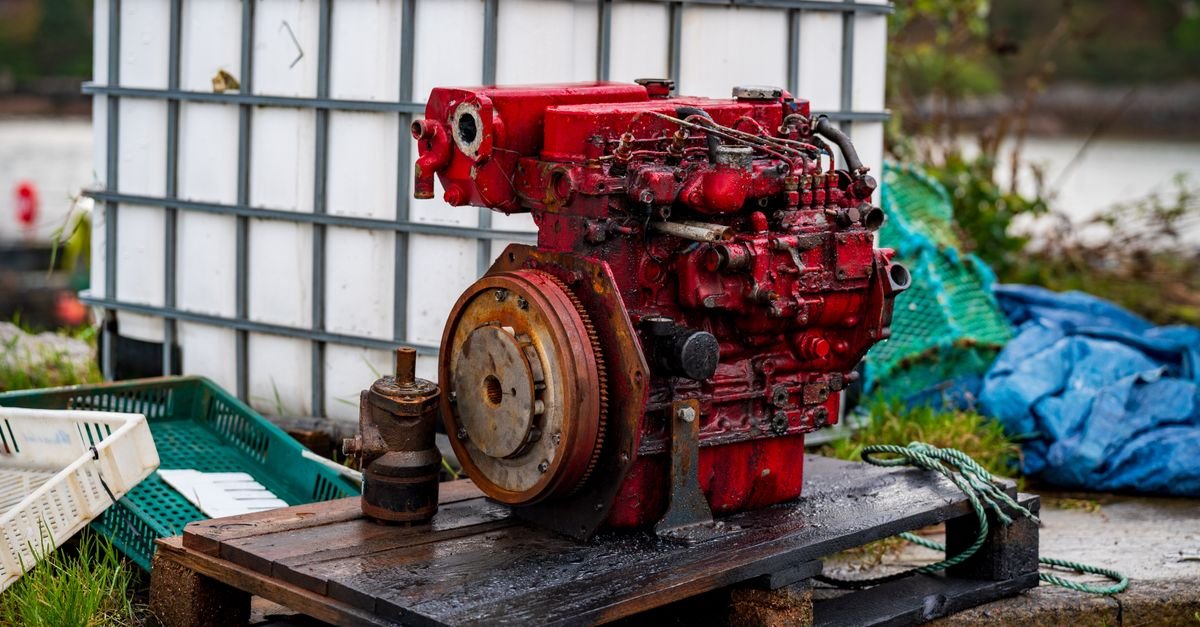
Start with the symptom that separates this from everything above. Bogging is not roughness. The engine does not stumble or miss. It loses speed when the trigger opens, holds that lower speed steadily while you spray, and recovers the instant you let go. A clean, steady, low note under load is an engine at full throttle that cannot make the power being asked of it. Nothing about the fuel or the spark is wrong. The demand is wrong.
The standard that governs how these machines are rated says so, in the dullest possible language. PWMA PW101-2010 defines the engine condition behind the label as “Loaded rpm: For engine driven units, the governed rpm while spraying water at system-rated conditions”, requires makers to record “Design engine rpm: _____ at rated psi and gpm” alongside the nozzle size, and specifies that units “shall be tested after break in and with production hose, gun, wand, and nozzle as intended for sale” (PWMA PW101-2010). Read as a homeowner: the number on your machine was measured with one particular tip fitted and the engine holding one particular speed. Change either and you are off the map the rating was drawn on.
Three things push the demand up, all on the water side.
The nozzle is too small. Pressure exists because the tip resists flow, so a smaller orifice means higher pressure, and higher pressure at the same flow means more horsepower from the engine. Tips are numbered for capacity, not only for spray angle, and a bargain set bought off the colour chart can easily be sized for a machine with less flow than yours. The test takes a minute: take the nozzle off completely, hold the trigger open, listen. With no orifice there is almost no back pressure and almost no load. If the engine runs cleanly at full speed like that and bogs the moment a tip goes back on, the fault is hydraulic and the engine is innocent. Then fit the black soap tip, the widest orifice in the set. If that runs clean too, you are shopping for a tip rather than a carburettor.
The unloader has been wound up. The adjustment sets the pressure at which the valve dumps flow back to the pump inlet. Wind it up and working pressure rises, and so does the power the engine must produce to sustain it. A machine adjusted once to cure a weak spray and bogging ever since is an ordinary sequence — the second symptom was created by the fix for the first.
The pump is bigger than the engine. Horsepower demand climbs with both flow and pressure, so a replacement pump chosen on its printed numbers can ask for more than the engine can give. The engine bogs, speed falls, flow falls with speed, and the machine settles well below the figure stamped on the pump. That case has its own diagnosis in the guide to a new pressure washer pump with no pressure.
Which brings me to the one opinion on this page. If your machine bogs under load, buy a nozzle set matched to its rated flow before you take a single screw out of the carburettor. The tip is the only part of a pressure washer that sets working pressure, the standard that rates these machines names the nozzle on the same form as the engine speed, and a mismatched set costs a few dollars against an afternoon of solvent and very small springs that were never the problem. The carburettor is the glamorous suspect. The tip is the part that was measured at the factory.
FAQ
Why does my pressure washer run rough only when I pull the trigger?
Because pulling the trigger is when the load arrives. A single dip and a quick recovery is the governor doing its job. A drop to a lower speed that holds while you spray is bogging, and it points at nozzle size, the unloader setting or a pump the engine cannot carry rather than at the fuel system.
Is it normal for a pressure washer engine to change speed while I work?
Yes, and more normal here than on anything else with a small engine. The load goes from full to near-nothing every time you release the trigger and the governor follows it. One clear dip as the trigger opens, a quick recovery, a steady note either side: healthy. Wandering that continues while the load sits still: not.
Can a dirty air filter make a pressure washer run rough?
It can, and recognisably. A restricted filter makes the mixture rich, so you get dark smoke, a fuel smell and a machine that idles tolerably but sags under load. Hold the element up to daylight, and if no light comes through, replace it. Fifteen seconds with the element out is a fair test, not a way to finish the job.
Why does my pressure washer run rough at idle but fine at full throttle?
Because those are two different fuel circuits in the same carburettor. Low load runs through very small passages that varnish narrows first; full throttle runs on the main jet, a much larger hole. Rough low and smooth high is the signature of a partly blocked low-speed circuit, and stale fuel is nearly always what put it there.
Will old petrol make a pressure washer run rough even if it still starts?
Yes, and starting is a poor test of fuel. Kawasaki tells owners to stabilise fuel stored more than two weeks. Fuel that sat over a winter burns badly and leaves deposits in the smallest passages long before it blocks anything outright, so the engine starts, idles unevenly and never quite settles.
My engine bogs down but does not miss or stumble. Is that the same problem?
No, and the distinction is the most useful one here. Missing and stumbling are combustion faults — the engine is failing to fire cleanly. Bogging is a power fault: it fires perfectly and cannot make enough. A clean, steady, low note under load is a demand problem, so look at the nozzle, the unloader and the pump first.
Can an electric pressure washer run rough?
Not in the engine sense, because an induction motor has no governor, no carburettor and no spark plug. It turns at the speed the mains gives it or it stops. What gets called rough running on an electric machine is nearly always hydraulic — an irregular spray, a pulsing wand, a motor labouring against a restriction — and that diagnosis starts on the water side.
Load Is the Question, Not the Noise
Every cause here answers the same question differently: what was the engine being asked to do at the moment it misbehaved? Rough at low load and clean at full throttle is a low-speed circuit full of varnish. Rough everywhere, smoky, worse under load, is a filter choking the air side. Rough in a way that wanders while the load sits still is the governor oscillating on its own account. And a clean, steady, unhappy low note that only ever appears with the trigger open is not the engine at all — it is a pump asking for horsepower nobody agreed to supply.
So before the toolbox comes out, spend three minutes making the machine misbehave on purpose: trigger shut, trigger open, nozzle off, choke on. Four conditions, four notes, and one of them will not match the others. That is the one to chase, and it is a considerably better use of a Saturday than taking the carburettor off to find out it was fine.