Last Updated on September 25, 2026 by Umar Farooq
If the engine runs perfectly and the pump does absolutely nothing — no water, no pressure, not a sound from the pump end — a broken pressure washer pump coupler is the mechanism to check first, because the drive between the two has come apart and the pump is simply no longer being turned. A sheared shaft key, a crumbled coupling spider, or a pump that has worked loose on its shaft all land the same way: an engine doing its job into thin air.
This is one of the very few pressure washer faults that identifies itself. Most of them arrive as a fog — weak spray, a bit of pulsing, water sometimes. This one is binary. The machine sounds completely healthy and produces nothing, and there is no partial version of it.
There is a second, quieter piece of news in that, and I will come back to it: the drive did not give up for no reason, and the part that broke is usually the messenger rather than the problem.
Engine Perfect, Pump Silent: What That Combination Rules Out
A running engine is a lot of free diagnosis. Fuel is reaching the carburettor, the spark plug is firing, the air filter is passing air, and the oil level is high enough that the low-oil switch has not intervened. Every one of those is a separate article’s worth of trouble you no longer have.
What matters is the *second* half: not just that the pump produces nothing, but that it produces nothing quietly. A pump that is being turned makes noise. Plungers move, valves click, water sloshes. Silence at the pump end while the engine holds its revs means the pump is not turning at all, and almost nothing else on the machine arranges that.
Here is how the neighbouring faults actually present, because people arrive at this page having ruled out the wrong things:
| What you hear and see | What it usually is |
| Engine steady, pump silent, no water, no vibration at the pump | The drive — key, coupler or spider |
| Pump chattering or rattling, air spitting from the wand, no steady flow | A supply or priming fault |
| Full flow from the wand, no force behind it | The nozzle, the unloader, or worn pump valves |
| Good pressure for a few seconds, then it fades and stays faded | Bypass, or a supply that cannot keep up |
| Engine bogging, labouring, or stalling as soon as you run it | A pump that has seized rather than a drive that has failed |
That last row is the important one, and it is the flip side of the same coin. A drive that has failed *disconnects* the engine from the pump, so the engine has nothing to do and sounds unloaded. A pump that has seized with the drive still intact does the opposite — the engine fights it and either loses, stalls, or shears something within the next few seconds.
Three faults people reasonably suspect here, and why each one looks different. A machine that will not prime is still turning its pump, so you get noise, spitting and intermittent water rather than nothing. A machine that loses pressure a few seconds after the trigger opens was clearly making pressure a moment ago, which a disconnected drive cannot do. And a stuck check valve inside the pump leaves the pump turning, so you get flow, a pulse, or a hammering noise — not silence.
One more distinction worth naming once. On a belt-drive machine, a broken belt gives you this exact symptom for a completely different reason, and that diagnosis lives on the page about pressure washer belt slipping. If there is a sheet-metal guard between the engine and the pump, start there instead. If the pump is bolted nose-to-nose against the engine with nothing in between, you are in the right place.
The check itself takes a minute and costs nothing. Stop the engine and pull the spark plug lead off. Put a chalk or marker line across the join between the pump and the engine, or across the exposed shaft if you can see one. Refit the lead, run the machine for a few seconds with the water on and the trigger held, shut down, and look. If the mark on the pump side has not moved while the engine ran, the drive is broken and nothing inside the pump is worth investigating yet.
What a Pressure Washer Pump Coupler Is on Your Machine
“Coupler” is doing a lot of work in most searches. People use it for whatever joins the engine to the pump, and on pressure washers that turns out to be three quite different arrangements with three different things to look at. It is also the word the industry uses for the quick-connect fittings on your hose, which is why searching for it returns four pages of brass plugs.
| Arrangement | What it looks like | What actually fails |
| Hollow-shaft direct drive | Pump slides straight onto the engine crankshaft, four bolts, nothing between them | The shaft key shears or walks out |
| Flanged direct drive with a bell housing | Pump has its own solid shaft, joined inside a housing or adapter | Key, set screw, or a flexible element inside the housing |
| Spider (jaw) coupling | Two toothed hubs with a rubber star between them, pump on its own feet | The rubber spider perishes or shreds |
The first is what almost every gas homeowner machine uses, and it is simpler than people expect. There is no separate coupler part at all. The pump is bored hollow and slides onto the engine’s crankshaft the way a socket goes onto a ratchet, and the entire drive is one small rectangular steel key sitting in a matching slot cut into both. Annovi Reverberi describes exactly this arrangement in the manual for its RMV series pumps — the pump “spins at 3400 RPM in a direct drive system coupled with a gasoline engine”, with a matching flange that connects to “most 3/4″ shaft 1.1 – 5.5 HP engines” and a hollow shaft that goes over the crankshaft rather than meeting it end to end.
The second is the same idea with an adapter in the middle, usually because the pump was not designed for that engine. A bell housing bolts to the engine face, the pump bolts to the bell housing, and somewhere inside there is either another key or a small flexible element doing the joining. You cannot see any of it without taking the housing off.
The third is the one people picture when they hear “coupler”, and it turns up mostly on larger frames and commercial skids: a toothed hub on each shaft, and a moulded rubber star wedged between them so the teeth never touch. That star is the part that dies.
Knowing which one you own decides the next twenty minutes, so settle it before you undo anything. Four bolts around a pump sitting flat against the engine means the key. A visible gap between engine and pump with something in it means a coupling.
Take the Four Bolts Off and Look at the Key
On a hollow-shaft machine this is the whole job, and it is less intimidating than it sounds. Spark plug lead off, water off, four bolts out, pump pulled straight off the shaft. The key will either be in its slot, in two pieces, lying in the bottom of the pump bore, or somewhere on your driveway.
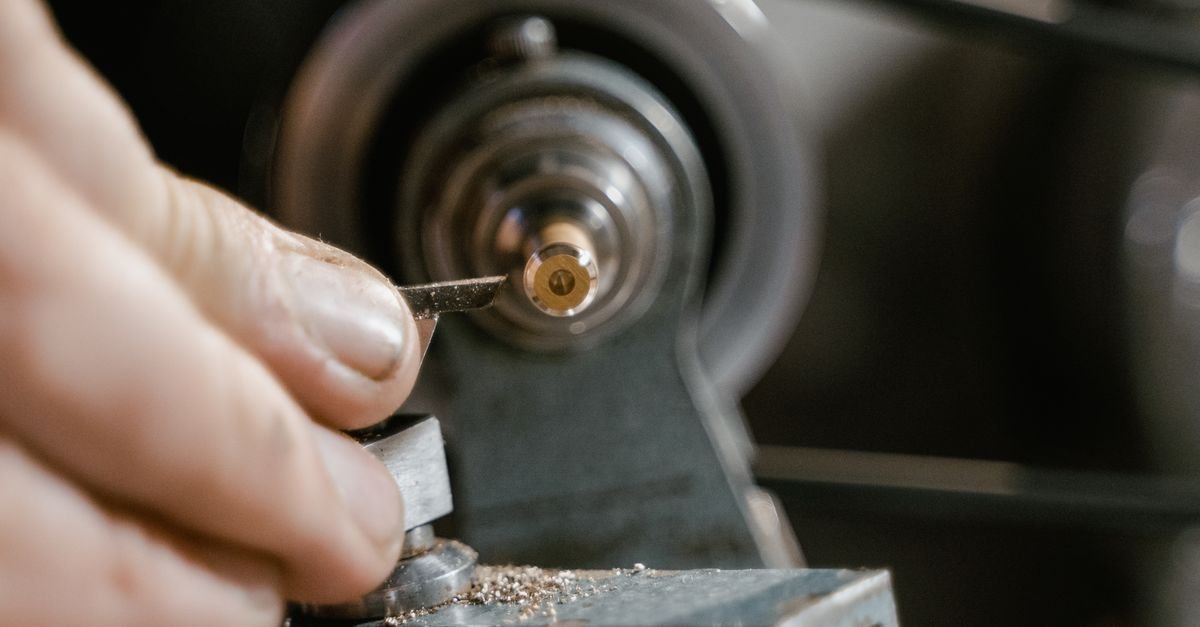
It is worth knowing how small this part actually is, because the size explains everything that follows. Key dimensions are not a manufacturer’s whim — they come from a standard, and the standard scales the key to the shaft. Under ANSI B17.1, the key cross-section and the depth of the slot are both fixed by the shaft diameter, and in the square-key series the width and height are equal. A shaft between 0.625 and 0.875 inches — which covers the 3/4 inch crankshaft on most gas pressure washers — takes a 3/16 inch square key. Roughly a quarter of the shaft diameter, which is the general relationship across the whole table.
So every bit of torque your engine makes, on all 3,400 revolutions it turns each minute, crosses from engine to pump through a bar of plain steel about the width of a matchstick. Held in your hand it looks far too small for the job. It is not, until something makes the job bigger.
What to look for, in order:
- A key in two pieces, or visibly stepped. The classic shear: the key has been cut through on the plane where the two keyways meet, and the halves have slid past each other. Sometimes it is a clean break; more often it is smeared and rolled over like a coin that has been driven across.
- A key that is intact but loose. It walked out of the slot rather than shearing. Look for scoring along the shaft where it has been travelling, and check whether a set screw was meant to be holding it and has backed out.
- The keyways themselves. This is the check people skip, and the one that decides whether a new key is a fix or a postponement. Run a fingernail along the slot in the crankshaft and the slot inside the pump bore. Both should be crisp rectangles. If either has rounded shoulders, raised burrs, or a bell-mouthed opening, the key has been hammering in an oversized slot, and the next one will shear sooner than the last.
- The shaft and the bore. Bright rubbing marks all the way round mean the pump has been spinning freely on the shaft, which is a separate kind of damage and usually means the bore is no longer a working fit.
Annovi Reverberi’s troubleshooting table for the same pump family puts the key and the set screw together in one remedy — “Check key and tighten set screw” — and lists it against a knocking noise rather than against a total loss of drive. That ordering is informative. A drive on its way out usually knocks before it goes quiet, which means the machine very likely mentioned this to you a few sessions ago.
The Rubber Star That Perishes Quietly
If there is a gap between your engine and your pump with a visible joint in it, you have a jaw coupling, and the part doing the work is the moulded elastomer star wedged between the two sets of teeth. Lovejoy, which has been making them for about a century, describes the job plainly: the legs of the spider “serve as cushions between the torque force of the driving jaws and the resistance of the driven jaws”. Metal never touches metal. The rubber carries everything, and absorbs the shocks on the way through.
Rubber ages. It takes a permanent squash — compressive set — and the industry publishes the line at which that matters: when “permanent set reduces the element’s original thickness by 25%, it provides a visual signal that the element should be replaced”. Lovejoy also names what accelerates it, and every item on the list is a description of a pressure washer’s life: internal heat build-up in the elastomer under cyclic loading, high ambient temperatures, and “oil, chemical or atmospheric exposure”. A spider bolted next to a hot single-cylinder engine, spattered with detergent, and left in a shed for eight months of the year is not having a sheltered existence.
The failure sequence is worth knowing, because it explains a noise you may have been ignoring. Jaw couplings are built to be failsafe — when the spider goes, “the driving jaws simply advance to contact the driven jaws directly, and the coupling continues to function (albeit with considerable noise and accelerated wear)”. So a shredded spider does not stop the machine on the spot. It gives you a stretch of metallic clattering while steel jaws bang against steel jaws, and only once those have chewed each other round does the drive finally let go. If the machine has sounded like a bag of spanners for a fortnight, that was the warning.
Inspecting it takes a screwdriver and good light. Undo the guard, look for black crumbs or rubber dust in the bottom of the housing, and try to rotate one hub against the other by hand with the plug lead off. A healthy coupling has a small amount of springy give and then stops. A dead one rotates freely until the jaws clunk together. Check the jaw faces while you are in there — if the driving faces are rounded or hammered, putting a new spider into a chewed-up housing buys you a short season and another set of crumbs.
Why Did It Break? Ask the Pump, Not the Key
Here is the opinion, and it is the only thing on this page I would argue about: do not fit a new key or a new spider until you have turned the pump over by hand. The drive is the cheapest and weakest link in the chain between engine and pump, and it is what gives way first when something downstream stops turning freely. Fitting a replacement without finding out what that something was is not a repair. It is buying a second identical failure, usually inside the first minute of running.
The test takes thirty seconds. Spark plug lead off, pump separated from the engine, and turn the pump’s shaft — or the wobble plate visible in the bore on a hollow-shaft pump — by hand. It should move with a light, even resistance and a faint rhythmic feel as each plunger comes up. Any of these means you have found the culprit rather than the victim:
- It will not move at all. The pump is seized. On a machine that has been through a cold winter, the overwhelming favourite is ice, and everything about what to do next is on the page about a pressure washer frozen pump. Corrosion after a long damp storage gets to the same place more slowly.
- It turns, but stiffly, or it catches at one point in the rotation. Packings that have dried out and taken a set, a plunger dragging in hardened seals, or a crankcase bearing starting to fail. Stiffness is the version that shears keys gradually rather than all at once.
- It turns freely and feels normal. Then the drive failed on its own terms — a key that had been working loose for months, a spider that reached the end of its life, or a set screw that backed out. Fit the new part with a clear conscience.
There is a fourth cause that does not show up on a hand test, and it catches people who have just finished a repair. If the discharge side of the pump is blocked — a completely plugged nozzle, a valve jammed shut, an ice plug in the outlet — then a positive-displacement pump is being asked to push water into a sealed passage, and the torque needed climbs immediately and steeply. The drive is the first thing to notice.
One honest note, because I went looking for this specifically. The trade universally describes the shaft key as a deliberate sacrificial part: soft on purpose, sized to give way before the crankshaft or the pump does. It is a tidy explanation and the mechanism behind it holds up — the key is plain low-carbon steel, it is by far the smallest cross-section in the drive, and it is the cheapest thing on the machine to replace. What I could not find is a manufacturer or a standard saying that shearing is the key’s design intent. ANSI B17.1 sizes keys; it does not describe them as fuses. So take the mechanism, which stands on its own, and treat the fuse story as workshop consensus rather than something anybody has printed.
The wider point survives either way. Lovejoy’s own advice when replacing a spider is to “give thought to why the previous spider failed” rather than simply fitting another one, and that instruction transfers to the key without modification.
FAQ
How do I know if my pressure washer pump coupler is broken?
Run the machine for a few seconds and watch whether the pump end moves at all. The giveaway combination is an engine that sounds completely unloaded — it does not dip or labour when you pull the trigger — alongside total silence and no vibration at the pump. Mark the join between pump and engine with chalk, run it briefly, shut down, and see whether the mark on the pump side has moved.
What causes a pressure washer shaft key to shear?
Something made the pump harder to turn than the key could manage. In practice that is a seized or stiffening pump — ice, freeze damage, dried-out packings, a failing bearing — or a blocked discharge that leaves the pump pushing water into a sealed passage. A key can also fail from being loose for a long time, hammering in a worn keyway until it rolls over rather than breaking cleanly.
Can I just put a new key in and run it?
Only after you have turned the pump by hand and found it free. If the pump is stiff or seized, a new key will shear within about a minute and you are back where you started, minus the afternoon. Check the keyways as well — if the slots in the shaft or the pump bore have rounded shoulders, the new key is sitting in an oversized hole and will not last either.
What is the difference between a pump coupler and a quick coupler?
They share a name and nothing else. A quick coupler is the push-fit brass or steel fitting that joins your hose, gun and nozzles together. A pump coupler is the mechanical drive connection between engine and pump, hidden behind the mounting flange. Searching for one reliably returns the other, which is why this fault is harder to research than it ought to be.
Is a broken coupling the same as a broken belt?
The symptom is identical — engine running, pump doing nothing — but the machines are not. Belt drive has a guard and a gap between engine and pump, each sitting on its own feet with a pulley on its shaft. Direct drive bolts the pump flat against the engine face. Work out which you own before you order parts, because the failure and the fix have nothing in common.
How often should a coupling spider be replaced?
There is no hour figure; the published test is condition rather than age. The criterion the trade uses is compressive set, and Lovejoy’s stated threshold is a 25% reduction from the element’s original thickness. In practice, look at it whenever the guard is off for anything else, and replace on evidence: rubber crumbs in the housing, slop between the two hubs, or the metallic clatter that means the jaws have already started meeting each other.
A New Key Is the Second Half of the Job
The satisfying thing about this fault is how cleanly it resolves. Four bolts, a look, and you know. There is no guessing, no sequence of increasingly expensive parts, and no possibility that it was the nozzle all along.
The unsatisfying thing is that the broken part is rarely the broken thing. A key shears because a pump stopped turning easily. A spider shreds because it was cooked, soaked or simply old. Neither event is random, and the only real mistake available to you here is to replace the small cheap part, enjoy forty seconds of a working machine, and hear it stop again.
So turn the pump by hand before you order anything. If it spins sweetly, fit the key, push the pump square against the engine face, and get on with your afternoon — and if you are putting a whole replacement pump on rather than just a key, the commissioning checks for a freshly fitted pump are a different list worth reading first. If the pump fights you, the cheapest part on the machine has just handed you the real diagnosis, which is a favour, even if it does not feel much like one while you are standing there holding half a key.