Last Updated on September 25, 2026 by Umar Farooq
A pressure washer wand leaking at either of its two joints is an O-ring, and you can have that sorted before the kettle boils; a pressure washer wand leaking from somewhere along the tube itself is corrosion working outwards, and that lance is scrap — there is no acceptable repair for a pressurised tube with a hole in it.
Those are genuinely the only two answers, which makes this one of the easier faults to be certain about. The catch is that people diagnose it by looking at the puddle, and a lance is a metre of smooth metal held at an angle, so water that started at the gun end arrives at your boots having said nothing about where it came from. Dry the tube first. Then it will tell you.
The Wand Is Three Parts, and Only Two of Them Are Joints
Strip the romance out and a lance is a pipe with a fitting at each end. That is the whole component, and each of the three pieces fails for its own reasons.
The gun end. Usually an M22 threaded nut, sometimes a 1/4-inch quick connect, and on several brands a twist-lock collar. It seals on a rubber ring, not on the thread.
The nozzle end. Almost universally a 1/4-inch quick-connect socket: a bore, a ring of detent balls, a spring-loaded collar and a single O-ring sitting deep inside.
The tube between them. Small-bore pipe, typically 4 to 6 millimetres internal diameter. On consumer machines it is zinc-plated carbon steel, often with a moulded plastic sleeve over the first third so you have something to hold that is not freezing. Commercial lances are stainless, sometimes with an insulated wrap for hot-water work.
The bore is the detail that surprises people. Your garden hose is 12 or 13 millimetres inside; the lance is a third of that. That is fine — the nozzle at the end is a fraction of a millimetre, so the tube only has to deliver flow rather than restrict it. But it does make the lance the narrowest part of the waterway before the tip, which matters in a minute when we get to what lives in there.
One more thing to fix in your head: the two joints do not take the same O-ring. The nozzle-end socket takes the small 1/4-inch coupler ring; the gun end takes whichever ring suits an M22 fitting or a coupler, and the M22 ring is a different animal again. Sizes, cross sections and the truly baffling way sellers label them are in the guide to pressure washer hose O-rings. Buy an assortment. Everyone ends up with an assortment.
Take the Lance Off and Find Out If It Was Ever the Lance
Before anything else, run the test that nobody runs, because it takes forty seconds and it eliminates half the internet’s advice.
Shut the machine down, close the tap, point the gun somewhere dull and squeeze until the water stops. Now take the lance off entirely and push a nozzle straight into the gun’s own outlet — most guns accept a tip directly, because the gun outlet and the lance’s nozzle socket are usually the same 1/4-inch quick connect. Start up and pull the trigger.
- The leak is gone. It was the lance, or one of the lance’s two joints. Everything below is for you.
- The leak is still there. It was never the lance. You are looking at the gun, and there are six separate places a trigger gun lets water out, including a valve seat that decides whether the machine has a working off switch at all.
- The leak moves to the gun outlet and gets worse. The gun outlet’s own ring is missing or damaged, and the lance was partly masking it.
If you own a second lance, or a friend does, swapping it in is the same test from the other direction.
Two faults look like this one and are not. Water at the barrel between the hose and the gun handle is the gun’s swivel, a static O-ring on a part that only turns when your wrist does. And a tip that physically launches out of the wand is not a leak at all — that is a retention failure in the quick connect, covered in why a pressure washer nozzle blows off, and the O-ring that goes missing with the tip is a passenger rather than a cause.
Why Is My Pressure Washer Wand Leaking at the Gun End?
Because somebody tightened it. That is not a joke at the reader’s expense — it is the single most common sequence in this fault, and it runs like this.
The joint weeps a little. You snug it up and the weep stops, which teaches you that tightening is the fix. A season later it weeps again, so you snug it harder, and this time you fetch a spanner. Now the ring is squashed flatter than its groove, part of it has been forced out into the clearance gap between the two fittings, and it has taken a permanent set in that shape. From here the joint only seals when it is over-tightened, so you keep over-tightening it, and you are on a ratchet with exactly one destination.
Generac’s own assembly instruction is four words long on this point: “Connect lance to spray gun and hand-tighten” (Generac, power washer owner’s manual). Not torqued. Not spannered. Hand-tight, because the rubber does the sealing and the thread is only there to hold the two faces near each other. The same manual lists “inspect spray gun and assembly for leaks” under its *every eight hours or daily* column, which tells you what the maker expects to be happening at that end of the machine.
So when the gun-end joint weeps, in order:
1. Bleed the pressure and take the joint apart. Look in *both* halves with a torch. The ring often stays behind in the mating fitting, and reassembling leaves you with two rings in one groove and none in the other.
2. Replace the ring rather than inspecting it. A ring squeezed flat for two seasons is not a reliable witness to its own condition.
3. Grease it and go back to hand-tight. If hand-tight now leaks when it used to hold, the faces or the thread have been distorted, and the lance is the cheaper half of the pair to replace.
4. Check the plastic collar if you have one. Several consumer lances use a moulded plastic nut at the gun end. Over-tighten one of those and it does not stretch, it splits — usually a hairline crack along the thread that you will only find by flexing it in good light.
There is one honest exception to the no-spanner rule. Every time you release the trigger the water column stops against a closed valve and the assembly takes a small pulse, and threaded joints do back off under that over a season. The answer is to check the joint by hand each time you set up, not to pre-emptively crush the ring in April against a loosening that has not happened yet.
Water Around the Nozzle, Not Out of It
The nozzle-end leak has a very particular signature and it is easy to read once you know it: a fine mist or a thin fan ringing the outside of the tip, rather than anything coming out of the front. It appears the instant you squeeze and vanishes the instant you let go, because everything forward of the trigger valve is only pressurised while you are actually asking for water.
That ring of mist is almost always the socket’s O-ring, and it wears differently from every other ring on the machine. The rings at the hose ends sit still and age. This one has a brass plug dragged in and out across it every time you change a tip, which is abrasion rather than ageing — so a wand used with all five colours in an afternoon accumulates wear that a wand left on the green tip does not.
Grit makes it worse, and the lance is unusually good at holding grit: a narrow horizontal dead-leg with a step change in diameter at the nozzle socket, so sand that arrives with the water settles out exactly where the sealing surface is. Manufacturers know it. Generac’s remedy for a nozzle restriction spells the procedure out — relieve the pressure, “remove nozzle from lance,” use a paper clip to clear the orifice, then “remove lance from spray gun and back flush thoroughly” before reassembling. Back flushing the lance is the step everyone skips. (It is also the only technical document I have read that specifies a paper clip as the correct tool, which I find quietly reassuring about the whole industry.)
If the mist persists after a new ring and a back flush, look at the socket. A scored bore, or a collar that no longer snaps forward briskly, is a coupler at the end of its life — and a replacement 1/4-inch socket screws onto the end of the tube for a few dollars.
A Lance That Weeps Through Its Own Wall Is Scrap
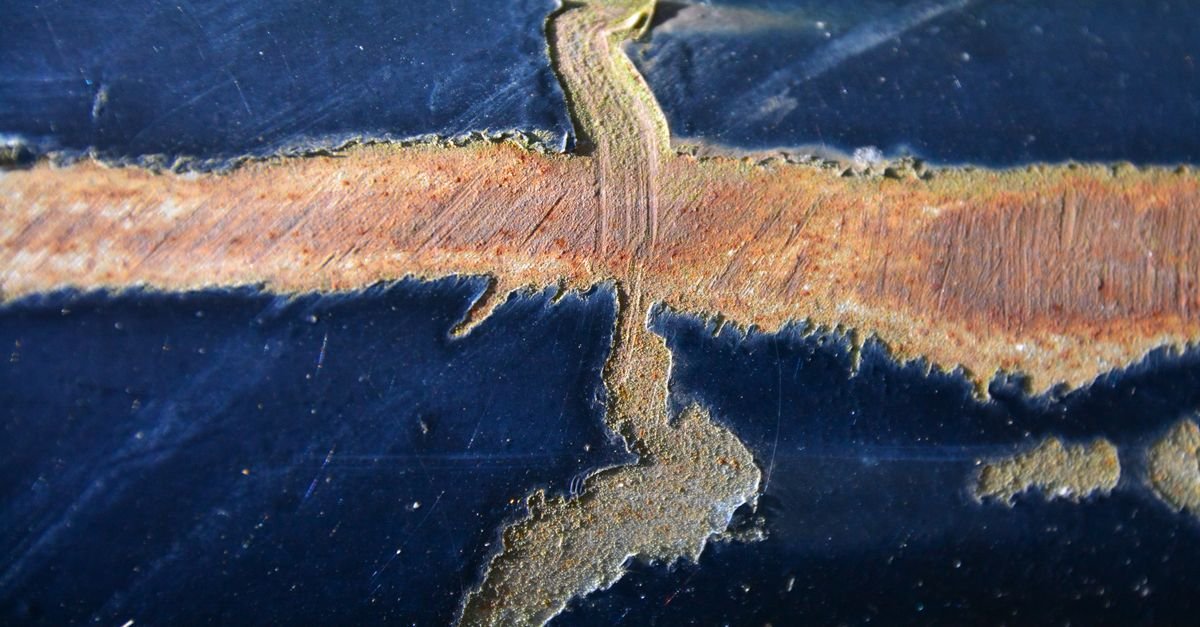
Here is the one that changes the answer completely, and the test for it is trivial. Dry the entire tube with a cloth, run the machine, and watch the metal rather than the fittings. If water appears from a spot with no joint within an inch of it, the tube has a hole in it.
Two mechanisms get you there, and they belong to different lances.
Plated carbon steel rusts from the inside out. The zinc on a consumer lance is thin, the inside of the tube is the last place it goes on well, and every time you finish a job you hang up a sealed steel pipe with water in it. Generac’s storage instruction names the part explicitly — disconnect everything and “drain water from hoses, spray gun, and lance” — which reads like housekeeping until you realise it is the only corrosion control the tube gets.
Stainless pits. Stainless does not rust in the ordinary way; it fails locally, and the trigger is chloride. The Specialty Steel Industry of North America is direct about where that chloride comes from: “localized corrosion such as pitting and crevice corrosion of stainless steels generally occurs in the presence of halide ions, typically chloride (e.g. coastal and deicing chloride salts… hydrochloric acid; bleach – sodium or calcium hypochlorite; and other chloride compounds)” (SSINA, pitting and crevice corrosion). Bleach, by name. If you clean siding, fences or a north-facing patio, you run sodium hypochlorite through that tube and then stand it in a corner still wet.
The same page also explains why this failure hides where you would least expect: “crevice corrosion occurs at locations where oxygen cannot freely circulate such as tight joints, under fastener heads and in other circumstances where the pieces of metal are in close contact,” because inside that gap the environment “becomes depleted of oxygen, enriched in chlorides, and acidified.” Your tube is swaged or crimped into its end fittings. That is a tight joint with restricted circulation — so the likeliest through-wall point on a stainless lance is the inch of tube hidden under the collar, and a leak from there looks exactly like a joint leak until you take the fitting off and find the metal underneath has gone. Nor does it creep politely once started: “once initiated the growth rate of the pit can be relatively rapid resulting in deep cavities and even through-wall attack.”
So the opinion, and I will not hedge it: a lance weeping through its own wall gets replaced, not repaired. No epoxy, no solder, no self-amalgamating tape, no hose clamp over a patch. Every one of those will hold, for a while, and then let go under a pressure pulse while you are holding the thing — which is the one part of the machine where that matters most. Generac’s rule for the analogous component is the right rule here too: “DO NOT repair high-pressure hose. Replace with hose that meets or exceeds maximum pressure rating of unit.” A lance is a pressure-containing part on the operator’s side of the shut-off valve, and it gets the same treatment. A new one costs roughly what a takeaway does.
Extra Joints You Bought Without Noticing
Some wands leak more than others for a reason that has nothing to do with luck, and it is worth counting before you conclude your machine is cursed.
A plain one-piece lance has two joints and two O-rings. Add a two-piece extension and you have inserted a third quick connect in the middle of the tube, so three rings. Fit a dual lance — the twin-tube kind with a twist collar for high and low pressure — and you have added a moving internal seal that shifts a sleeve to open a bypass. A telescoping lance is the extreme case: a sliding seal that has to hold full line pressure at any extension, plus a clamp collar taking bending load from two metres of wet aluminium.
That sliding seal deserves naming, because it is the only genuinely dynamic seal on the whole wand. Everything else out here is a static ring squeezed between two faces that never move relative to each other. A telescopic seal slides along a tube, and a sliding surface picks up whatever grit is on it, which is why telescopic lances have a reputation for weeping at the mid-section within a season or two of gutter work.
My position is unglamorous: buy the simplest lance that reaches the thing you are cleaning. Two joints beats five, and a fixed extension beats a telescopic one if you only ever work at one height. That is arithmetic rather than a preference — every joint you add is a ring, a gap and a place for sand to sit, and none of them improve with age. If you already own the telescopic one, keep the extension collar clean and dry it before it goes away. That is most of the battle.
Finding a Pinhole Without Putting Your Hand In It
Now the part that is genuinely worth reading twice.
A hole in a lance wall is not a hole the way a hole in a garden hose is. The orifice is tiny and irregular, the pressure behind it is full line pressure, and the jet that comes out is finer than anything in your box of coloured tips. Often you cannot see it at all against a wet tube. What you notice is that one side of your glove is soaked.
The threshold that matters is lower than most people expect. A 2022 emergency medicine teaching case states it plainly: “ejection pressures must be at least 100 pounds per square inch (psi) to penetrate human skin” (Fortuna et al., Journal of Education & Teaching in Emergency Medicine, PMC10332702). A homeowner electric machine runs around 1,800 PSI and a mid-range gas machine around 3,000, and the tube wall sees all of it. The same paper notes that patients arriving straight after one of these injuries “classically present with small puncture wounds,” which is the whole problem — a mark that looks like a splinter does not feel like an emergency.
So borrow the method the hydraulic trade has used for decades, and do not improvise on it:
1. Shut the machine off, close the tap and squeeze the trigger until nothing more comes out. Dry the whole lance.
2. Restart with the wand braced or clamped so it points somewhere harmless and you are not gripping the suspect section.
3. Pass a piece of stiff card or a scrap of plywood slowly along the tube, an inch or two off the surface. A pinhole jet marks the card, and the card takes the jet instead of you.
4. Never run a hand, a finger or a fistful of rag along a pressurised line looking for a leak. This is the exact practice the hydraulic guidance exists to stop. A rag does not help; it soaks, and the jet goes straight through it.
If the jet has already broken skin, that is an emergency room visit today rather than something to look at tomorrow. Outcomes in the injection-injury literature turn on reaching surgical debridement within about six hours, and nothing about the size of the entry wound tells you which case you are.
FAQ
Why is my pressure washer wand leaking where it connects to the gun?
That joint is sealed by a rubber ring, not by the thread, so it is a damaged ring, a missing one, or one that stayed behind in the other fitting last time you separated them. Check both halves with a torch, fit a new ring, grease it, and go back to hand-tight. If it will not seal at hand-tight any more, the ring has previously been crushed and extruded and the fitting faces may be distorted.
Can you repair a leaking pressure washer wand?
You can repair the joints and you cannot repair the tube. New O-rings, a clean socket and a replacement quick connect will fix a leak at either end. A pinhole or a weep coming through the wall of the tube itself is corrosion, and a pressure-containing tube with a hole in it gets replaced — patching one with epoxy, solder or tape produces something that holds until it does not.
Should I use PTFE tape on a pressure washer wand connection?
No. M22 fittings and quick connects seal against an O-ring, and tape on those threads only packs the joint out and holds the sealing faces apart, which makes the leak worse. Thread tape belongs on tapered NPT fittings, which is not what either end of a consumer lance uses.
How tight should the lance be on the spray gun?
Hand-tight. Generac’s own assembly step is literally “connect lance to spray gun and hand-tighten,” and the reason is that the ring seals and the thread only holds the faces together. Reaching for a spanner flattens the ring, forces part of it into the clearance gap, and creates a joint that will only ever seal when over-tightened.
Why does water spray out around the nozzle instead of forward?
A ring of mist around the outside of the tip is the quick-connect socket’s O-ring rather than the nozzle. It wears by abrasion, because a brass plug is dragged across it on every tip change, and it is the ring most likely to be sitting on a grain of sand. Replace it, then back flush the lance before you decide anything else.
Is it safe to keep using a pressure washer with a leaking wand?
A weep at a joint is a nuisance and a small loss of pressure, and finishing the patio is a reasonable call. A leak coming through the tube wall is not, because the jet from a pinhole is fine, hard to see, and at full line pressure — and 100 PSI is enough to break skin. Put that one down and order a lance.
Does a leaking wand reduce pressure at the nozzle?
Slightly, and less than people assume — a weeping joint loses a trickle against a couple of gallons a minute. If the nozzle feels genuinely weak, the leak is more likely a symptom of the same debris restricting the tip, or the real fault is upstream in the pump and unloader rather than out at your hands.
The Tube Is the Part You Cannot Fix
Everything on a pressure washer that leaks is either a rubber ring or a piece of grit, right up until it is the metal — and the lance is the one place where that distinction sits in your hands rather than under the machine. So do the boring thing first: dry the tube, take the lance off, put a tip straight into the gun, and find out whether you were ever looking at the right component.
If the water is arriving from a joint, you have a fifteen-cent problem and a good reason to keep a ring kit in the drawer. If it is arriving from the middle of the tube, the diagnosis is finished and so is the lance. A part that tells you plainly which of two answers it is, and costs less to replace than the fuel you would burn arguing with it, is the most cooperative thing on the whole machine.