Last Updated on October 4, 2026 by Umar Farooq
This pressure washer nozzle chart covers all six standard tips. The colors are an industry standard — red is 0 degrees, yellow is 15, green is 25, white is 40, black is the low-pressure soap tip, and the rotating turbo nozzle is usually a separate colored or chrome tip.
The nozzle is the single most important control you have. Changing tips changes the force hitting your surface more than buying a different machine does. A 1,600 PSI washer with a red nozzle will damage things a 3,000 PSI washer with a white nozzle never touches.
Below is the full chart, what each tip is genuinely for, and the part most guides skip entirely: how to read the four-digit number stamped on the nozzle, which is what you actually need when replacing one.
The Complete Pressure Washer Nozzle Chart
| Color | Spray angle | Impact | Use it for | Never use on |
| Red | 0° | Extreme, pencil jet | Isolated tar spots, rust flecks on steel, unclogging | Wood, siding, cars, brick, anything painted |
| Yellow | 15° | Very high | Stripping paint, heavy concrete stains, rust prep | Wood, siding, cars, roofs |
| Green | 25° | Medium | Concrete, brick, pavers, general dirt lifting | Cars, soft wood, stucco, siding (close range) |
| White | 40° | Low | Siding, cars, windows, furniture, final rinsing | Nothing — safest general tip |
| Black | 65° | Very low (~300 PSI) | Applying detergent only | Rinsing (it barely cleans) |
| Turbo | 0° rotating | Very high, wide path | Concrete driveways, heavy patio staining | Wood, siding, cars, roofs, stucco |
The one-line version
White 40° for almost everything. Green 25° when white isn’t enough. Black for soap. Ignore red.
Genuinely — most homeowners could throw away the red nozzle and never miss it. Its only real household job is clearing a blockage, and even that has safer methods.
What the Nozzle Colors Mean
The color coding is standardized across brands, so a green tip from one manufacturer sprays the same angle as a green tip from another. What is *not* standardized is the flow size, which is covered in the next section.
Red — 0 Degrees
A single concentrated stream about the width of a pencil. All of the machine’s force lands on one small point.
It will carve a line into wood, hole vinyl siding, strip paint from a car, and etch concrete — often in less than a second. On a 3,000 PSI machine, it can cause serious injection injuries through skin.
Legitimate uses: a single stubborn tar spot on a steel surface, or clearing something stuck in a drain grate. That’s about it.
Yellow — 15 Degrees
A narrow fan. Aggressive, but spread across a slightly wider path than red.
Use it for: stripping failing paint from masonry, deep-cleaning heavily stained concrete, prepping metal for coating.
Warning: if the building was painted before 1978, do not strip paint with a pressure washer until you have followed lead-safe renovation requirements. Blasting old paint spreads contaminated chips across the yard.
Green — 25 Degrees
The workhorse for hard surfaces. Wide enough to cover ground, strong enough to lift ground-in dirt.
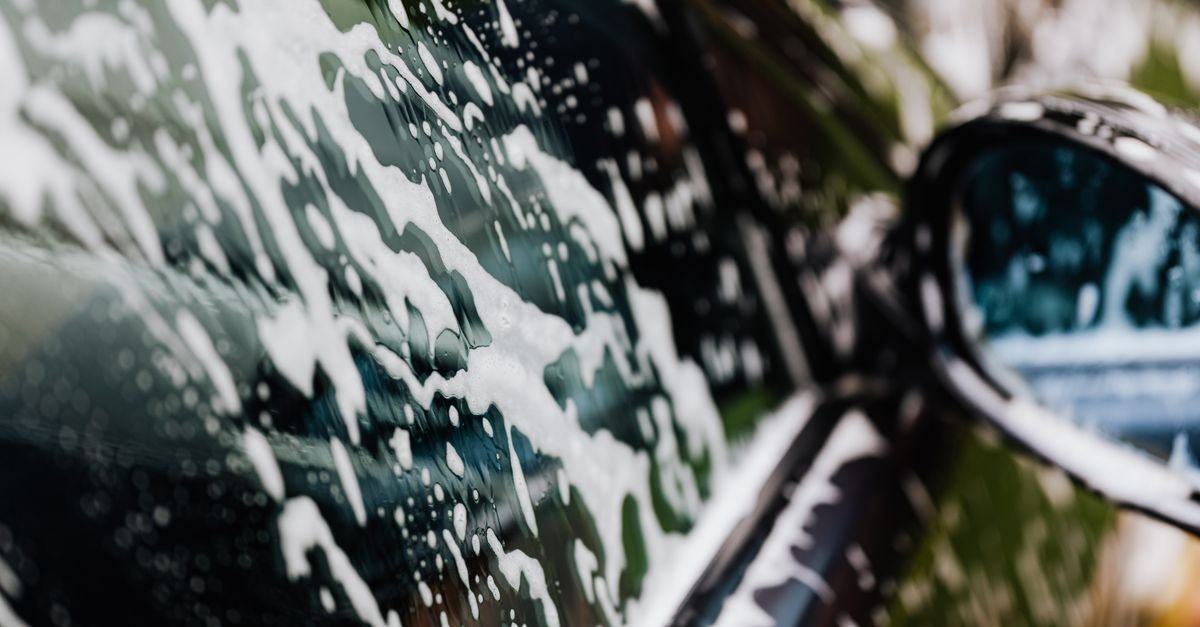
Use it for: concrete patios, sidewalks, brick, pavers, driveways, dirty fence posts, garden tools, mower decks.
Keep it away from: vehicles, soft wood, stucco, and vinyl siding at close range.
White — 40 Degrees
The safest and most useful tip you own. A broad, gentle fan that cleans through coverage rather than force.
Use it for: vinyl siding, cars, boats, windows, patio furniture, decks, screens, and the final rinse of literally any job.
Simple Green’s siding guidance recommends a 25–40 degree nozzle at a minimum 18-inch distance for exactly this reason — see their vinyl siding cleaning method.
Black — 65 Degrees (Soap Nozzle)
The odd one out. Its wide orifice deliberately *drops* system pressure to roughly 300 PSI, which is what allows the detergent injector to draw soap into the stream.
This is why your soap won’t come out. Most detergent systems physically cannot siphon at high pressure. If you have the green or white tip on, no soap will flow no matter how full the tank is. Fit the black tip and it works.
Use it to apply detergent, let the detergent dwell, then switch to white or green to rinse.
Turbo / Rotary Nozzle
A 0-degree jet spun in a rapid cone. You get the cutting power of red across the coverage width of green — roughly 50% faster on concrete than a standard tip.
Use it for: concrete driveways, badly stained patios, garage floors.
Never use it on: wood, siding, stucco, roofs, vehicles, or painted surfaces. It concentrates force exactly like a red tip.
How to Read the Numbers on a Pressure Washer Nozzle
This is the part almost no chart explains, and it is what you need when a nozzle goes missing.
Standard nozzles are stamped with a four- or five-digit code, for example 2540.
- First two digits = spray angle. `25` means 25 degrees (green).
- Remaining digits = orifice size, which sets flow at a reference pressure. `40` means size 4.0.
So `2540` is a 25-degree nozzle in size 4.0. A `4003` is a 40-degree nozzle in size 3.0.
Why the size number matters
The orifice size must match your machine’s flow and pressure. Fit a nozzle that is too small and pressure spikes, straining the pump and tripping the unloader. Fit one too large and pressure collapses — the machine feels weak even though nothing is broken.
| Machine spec | Typical nozzle size |
| 1,500 PSI @ 1.4 GPM | 3.0 |
| 2,000 PSI @ 1.6 GPM | 3.0 |
| 2,500 PSI @ 2.0 GPM | 3.5 |
| 2,800 PSI @ 2.3 GPM | 4.0 |
| 3,200 PSI @ 2.5 GPM | 4.0 |
| 3,500 PSI @ 3.0 GPM | 4.5 |
Always check your manual for the exact size. Buying a generic five-piece nozzle set sized for a 3,000 PSI machine and fitting it to a 1,700 PSI washer is a common reason people think their new machine is defective.
Which Nozzle for Which Surface?
| Surface | Nozzle | Effective PSI target | Distance |
| Car, truck, boat | White 40° | 1,200–1,500 | 12–18 in |
| Vinyl siding | White 40° | 1,300–1,600 | 18–24 in |
| Stucco / EIFS | White 40° | 200–600 | 24 in+ |
| Softwood deck | White 40° or green 25° | 500–1,200 | 12–18 in |
| Hardwood deck | Green 25° | 1,200–1,500 | 12–18 in |
| Composite decking | Green 25° or white 40° | 1,500–2,000 | 12 in+ |
| Brick and mortar | Green 25° | 1,500–2,500 | 12 in+ |
| Pavers | Green 25° | 1,500–2,500 | 8–12 in |
| Concrete patio | Green 25° | 2,000–3,000 | 6–12 in |
| Concrete driveway | Green 25° or turbo | 2,500–3,200 | 6–12 in |
| Asphalt driveway | Green 25° or white 40° | 1,000–1,500 | 12 in+ |
| Applying any detergent | Black 65° | ~300 | 3–6 ft |
Rule of thumb when unsure: start with white, from far away. Move closer before you switch to a narrower tip, and only switch when distance alone won’t do it.
Distance Changes Everything
The nozzle sets the spread. Distance sets how concentrated that spread is when it lands.
Impact force falls off sharply with distance. Roughly speaking, halving your distance quadruples the force on the surface. A green nozzle at 24 inches is gentler than a white nozzle at 4 inches.
This is why “what PSI do I need” is only half the question — see what PSI pressure washer do I need for how nozzle, distance, flow and detergent combine.
Practical approach on any new surface:
1. Fit the white 40° tip.
2. Start 3 feet away.
3. Move in slowly until dirt starts lifting.
4. Stop there. That is your working distance.
5. Only change to green if you reach 12 inches and it still isn’t cleaning.
Adjustable and Variable Nozzles
Many entry-level electric washers ship with a single adjustable tip you twist to change the fan, instead of a set of six.
| Fixed color-coded set | Adjustable single nozzle | |
| Precision | Exact, repeatable angles | Approximate |
| Pressure consistency | Consistent | Varies as it wears |
| Convenience | Must swap tips | Twist to change |
| Durability | High | Internal seals wear faster |
| Soap function | Separate black tip | Usually a twist position |
Adjustable nozzles are convenient and fine for casual use. Fixed sets are more precise and more repeatable, which matters when you are trying to hold a specific pressure on siding or wood. If your machine takes 1/4-inch quick-connect fittings, a fixed set is an inexpensive upgrade.
Cleaning a Clogged Nozzle
A partially clogged nozzle is the most common cause of a machine that suddenly “lost pressure” or produces a split, uneven spray.
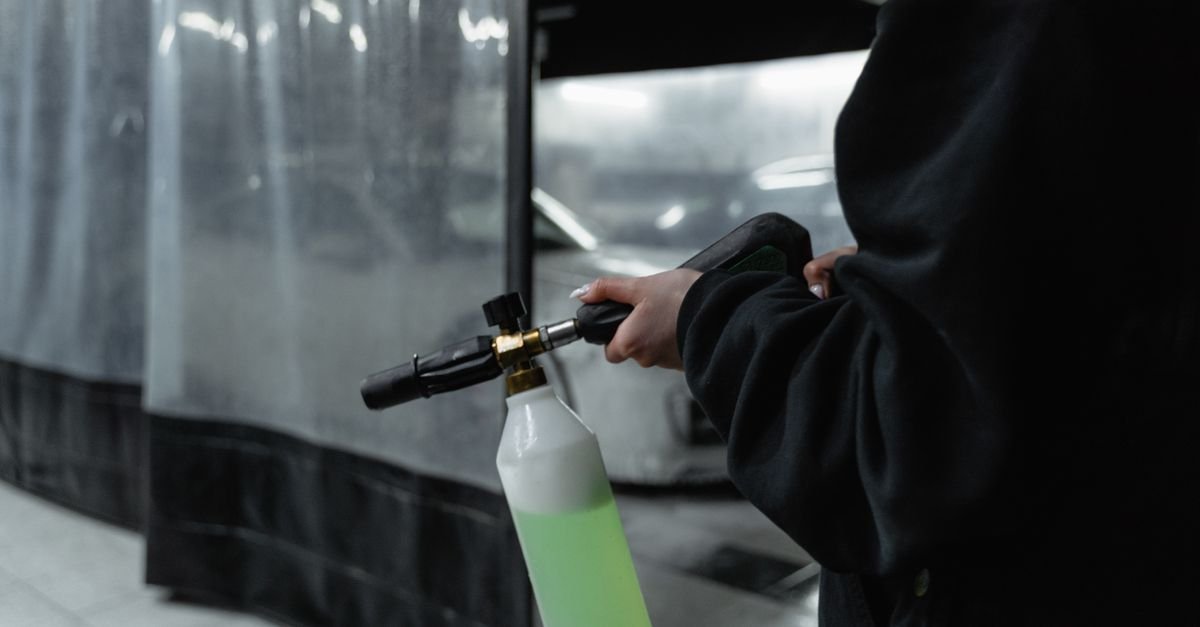
Husqvarna’s official procedure is straightforward: switch off and disconnect the unit, remove the nozzle from the lance, insert the supplied cleaning pin into the opening to clear debris, rinse under clean water, and reattach. They specifically warn against using nails or wire, which can enlarge or deform the orifice — full instructions are in their nozzle cleaning guide.
Signs of a clogged tip:
- Pressure drops suddenly mid-job
- The fan pattern splits or sprays sideways
- The machine pulses or surges
- Water dribbles instead of spraying
Prevention: use an inlet filter, never draw from a bucket of untreated water, and store nozzles in the holder rather than loose in a bucket where grit collects.
If the nozzle is clean and pressure is still low, the problem is upstream — inlet filter, hose kink, or water supply. See pressure washer won’t start for the diagnostic sequence.
Nozzle Safety
- Depressurize before changing tips. Shut off the machine, squeeze the trigger to release trapped pressure, then swap.
- Confirm the quick-connect clicked. An unseated nozzle can launch off the wand under pressure.
- Engage the trigger lock whenever you set the wand down.
- Never point any nozzle at a person, including yourself. Red and turbo tips can cause injection injuries that look like a small puncture while driving water and bacteria deep into tissue.
- Wear eye protection. Every nozzle throws debris back at you.
- Never use a pressure washer from a ladder. The wand kicks back on the trigger pull.
Common Nozzle Mistakes
Reaching for red to work faster. It doesn’t clean faster — it cleans a narrower line and damages more. Coverage comes from wider tips.
Using a narrow tip to reach higher. Narrowing the fan does not meaningfully extend reach. Buy an extension wand.
Leaving the green tip on for the car. The most common source of paint damage.
Wondering why soap won’t flow while using a high-pressure tip. Fit the black one.
Buying a nozzle set sized for the wrong machine. Check the orifice number against your PSI and GPM.
Turbo nozzle on wood or siding. It is a spinning red tip. Treat it accordingly.
FAQ
What does each color on a pressure washer nozzle chart mean?
Red is 0°, yellow is 15°, green is 25°, white is 40°, and black is the 65° low-pressure soap tip. Lower degrees concentrate more force into a smaller area. The colors are standardized across manufacturers.
Which pressure washer nozzle is the most useful?
The white 40-degree tip. It safely handles siding, vehicles, furniture, windows, decks and every final rinse. The green 25-degree tip is second, for concrete and brick.
What nozzle should I use for a car?
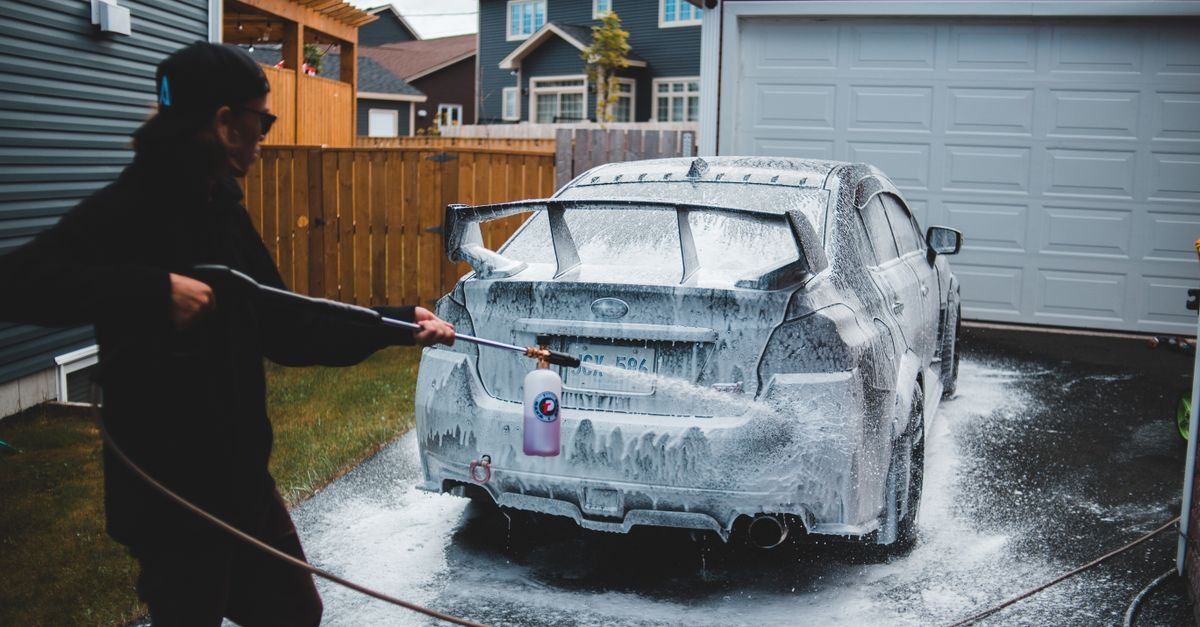
White 40-degree, held 12–18 inches away. Never use red, yellow or turbo on a vehicle. Use the black soap tip to apply foam first.
What nozzle do I use for soap?
The black 65-degree nozzle. It reduces pressure enough for the detergent injector to siphon. High-pressure tips prevent soap from being drawn in at all.
What do the numbers on a pressure washer nozzle mean?
The first two digits are the spray angle, the rest are the orifice size. A `2540` nozzle is 25 degrees in size 4.0. Match the size to your machine’s PSI and GPM, not just the angle.
Is a turbo nozzle worth it?
For concrete driveways and heavily stained patios, yes — it can cut cleaning time roughly in half. For anything softer than concrete, no. It is a rotating 0-degree jet and it will damage wood, siding and paint.
Why is my pressure washer nozzle spraying sideways?
The orifice is partially blocked. Shut down, depressurize, remove the tip and clear it with the supplied cleaning pin, then rinse. Do not use a nail or stiff wire, which can deform the opening permanently.
Can I use any nozzle on any pressure washer?
Only if the quick-connect fitting matches (most homeowner machines use 1/4-inch) and the orifice size suits your flow rate. A nozzle sized for a 3,200 PSI machine on a 1,700 PSI unit will make it feel underpowered.
What nozzle should I use on vinyl siding?
White 40-degree at 18–24 inches, targeting 1,300–1,600 effective PSI. Green 25-degree only from 24+ inches on sound siding. Details in what PSI pressure washer for vinyl siding.
Do I need all six nozzles?
No. White, green and black cover nearly every household job. Yellow is occasionally useful for paint prep. Red is rarely needed and easily misused.
Default to White, Leave Red in the Box
This pressure washer nozzle chart comes down to a simple habit: default to white, step to green only when you must, use black for soap, and leave red in the box.
The nozzle is a bigger lever than the machine. Choosing the right tip and the right distance protects your siding, your deck and your paint far more reliably than choosing a lower-PSI washer would.
And when you replace a lost tip, read the four-digit code — matching the angle without matching the orifice size is why so many replacement nozzles disappoint.