Last Updated on September 25, 2026 by Umar Farooq
Pressure washer pressure too high is almost never the pump deciding to make more pressure. It is a restriction somewhere downstream of it — a nozzle orifice too small for your machine’s flow, a tip half blocked with grit, an unloader wound up to hide a different fault, or a gauge that is quietly lying to you.
A pressure washer pump is positive displacement. It moves a fixed volume of water per revolution and it has no mechanism for volunteering extra. Whatever number you are reading is simply the price of pushing that fixed volume through whatever hole you have left it. Change the hole, change the number.
Which is why “how do I turn the pressure down” has a different answer depending on which of two people you are.
Which Problem Do You Actually Have?
Two readers land on this page with the same words and completely different faults, and the fix for one is irrelevant to the other. Sort yourself first.
“It is damaging what I am cleaning.” Paint lifting, wood furring, a groove in the render, a dull patch on the car. Nine times out of ten this is not excess pressure at all. It is the wrong tip in the wand, a standoff of four inches where the surface wanted twelve, or a material whose published limit is far lower than anyone expected — softwood decking sits at 500 to 600 PSI, which is under a quarter of what a mid-range gas machine does. Your machine is behaving exactly as specified. The specification is just larger than the deck. Start with what PSI pressure washer you actually need for the surface limits, and if you are looking at stripes rather than damage, pressure washer streaks separates a cleaning difference from a texture difference. Neither problem is on this page.
“My gauge reads above the machine’s rated figure.” Different animal entirely. This one is real, it is mechanical, and it is loading every component in the line past the number it was specified around. That reader is who the rest of this is for.
Both readers reach for the same knob. Only one of them is anywhere near the cause.
Rated PSI Is a Bench Number With Ten Percent of Optimism In It
Before you can call a reading “too high”, you need to know what the printed number describes, because it is not a measurement anyone took at the gun. PWMA PW101 is the industry test method for rating pressure and flow, and three of its clauses change how a homeowner should read a gauge.
- It is measured at the manifold, before the unloader. The standard defines maximum pressure as “Pressure measured in the high pressure manifold area, upstream of any regulating or chemical injection devices.” That is the highest-pressure point inside the machine. Any gauge you fit — inline at the gun, or at the pump outlet past the unloader — sits lower in the system than the point the label describes.
- The label may sit about 11% above what the machine measured. Section 7.5: “Pressure and Water flow ratings shall not be greater than the average of the three samples divided by 0.9 (allowable 10% tolerance).” The standard’s own worked example turns a measured average of 2,307 PSI into an allowable rating of 2,550 PSI.
- Spikes are excluded. Section 6.7: “Total stop, trapped, or spike pressure shall not be used when determining the ratings of the unit.” So the bump you see on trigger release is not evidence of anything. A *working* reading above the plate is. (PWMA PW101-2010)
Put those together and the conclusion is useful. The plate number already has the best-case measurement point and a permitted 10% rounding in its favour. If your gauge — further down the line, at a lower-pressure point — still reads above it while you spray, that is not marketing noise. That is a genuine over-pressure.
An Unloader Wound Up to Hide a Different Fault
Here is the sequence that produces most of them, and nobody in it did anything unreasonable.
A tip wears. Orifices erode a little on every job, the hole gets bigger, pressure falls, and the machine starts feeling tired. Nobody replaces the tip, because nothing looks broken. Somebody finds the unloader knob instead and winds it up until the machine feels right again. That works, sort of, because raising the unloader’s trip threshold lets the pressure the worn tip *can* still make get through without the valve intervening.
Then, months later, a new nozzle set arrives. Correct sizes, sharp orifices, full restriction restored — fitted to a machine whose unloader is still set for the worn one. The compensation outlived the fault, and now the gauge is somewhere it has no business being.
Two other unloader faults push pressure up. A seized or gummed piston stops opening into bypass, so the machine dead-heads against a closed gun — that is the version that cracks pump heads. And a replacement unloader left at its factory setting has never met your pump, your nozzle or your hose length, and arrives set for none of them.
The adjustment itself is a procedure with a gauge, quarter turns and a lock nut, and it lives in pressure washer unloader valve adjustment. One thing is worth stating here: land below the pump’s rated PSI rather than on it. The knob is not a volume control, and every quarter turn past correct buys you nothing but spike.
Pressure Washer Pressure Too High? Do the Nozzle Arithmetic First
This is the cause I would check before touching anything, because it is arithmetic rather than opinion, and it takes about a minute.
A pressure washer nozzle’s size number is defined as the flow in gallons per minute it passes at 4,000 PSI. That single convention gives you the whole relationship. The correct size for your machine is:
Nozzle size = GPM × √(4000 ÷ PSI)
And run backwards, the pressure a given tip will produce on your machine is:
PSI = 4000 × (GPM ÷ nozzle size)²
Work a real machine through it. Take a common homeowner gas unit rated 2,800 PSI at 2.5 GPM. Its correct nozzle size is 2.5 × √(4000 ÷ 2,800) = 2.99, so a size 3.0. Check it the other way: 4000 × (2.5 ÷ 3.0)² = 2,778 PSI. The arithmetic agrees with the plate, which is a good sign that the convention is real rather than folklore.
Now fit the next size down — a 2.5, one step, a difference you cannot see by eye:
4000 × (2.5 ÷ 2.5)² = 4,000 PSI.
One step. A 2,800 PSI machine becomes a 4,000 PSI machine, 43% over its rating, on a part that cost four dollars and came in a bag of five. Camspray put the consequence plainly: “If you select a spray tip nozzle that is too small, you may create too much pressure in your pressure washer and overload the pump, resulting in engine shutdowns or electrical issues” (Camspray nozzle size calculator).
The reason this happens to sensible people is that the colour code everyone knows encodes the angle, not the size. Red is 0 degrees whether it is a 2.0 or a 5.0. So a generic five-piece set bought for a 4,000 PSI machine, or a single replacement tip ordered by colour alone, fits your quick connect perfectly and restricts your machine to somebody else’s flow. The stamped code tells you both — 2503 is 25 degrees in size 3.0 — and our pressure washer nozzle chart has the sizes against machine ratings.
If you do not know your machine’s true GPM, measure it rather than trusting the box. Pull the tip out, run the wand into a five-gallon bucket at full trigger, and time it. Five gallons in 120 seconds is 2.5 GPM. That number, and the size stamped on the tip, are the only two inputs the formula needs.
A Half-Blocked Tip Is an Undersized Tip You Did Not Choose
A partial blockage is the same arithmetic, arrived at by accident.
Grit, scale, a fragment of hose liner or a curl of PTFE tape lodges across part of the orifice. The hole is not closed — water still comes out, the machine still runs — but the effective area is smaller than the number stamped on the tip. Take that 2,800 PSI machine again, running its correct 3.0 tip, and remove a fifth of the open area. The tip now behaves as a 2.4:
4000 × (2.5 ÷ 2.4)² = 4,340 PSI.
Nothing was adjusted. Nobody bought the wrong part. A piece of debris the size of a grain of sand added 1,500 PSI to a machine whose hose is rated for rather less than that.
The tells that separate a blockage from a wrong-sized tip are worth knowing, because they point at completely different shopping:
- A blockage is sudden. Correct pressure on Saturday, high pressure on Sunday. An undersized tip is high from the first pull of the trigger after you fitted it.
- A blockage usually spoils the fan. One heavy edge, a split stream, a fan that has gone narrow. An undersized tip produces a clean, correctly shaped, unreasonably hard fan.
- A blockage often comes and goes as the debris shifts. Sizing does not have moods.
- It follows a supply change — drawing from a tank or a barrel, a new hose, a rebuilt fitting, or the first run after winterising.
Clear it by back-flushing: tip out, soak it, blow it through from the outlet side, and run the machine briefly with no tip fitted to flush the wand. What you must not do is open the hole with a wire or a pin. That is the opposite failure, it is permanent, and a new tip is cheaper than the afternoon you will spend regretting it.
When the Gauge Is the Thing That Is Wrong
Before you accept that a machine is over-pressure, it is worth asking whether the instrument telling you so is any good. Mechanical gauges are not precision devices, and the standard that governs them says so out loud.
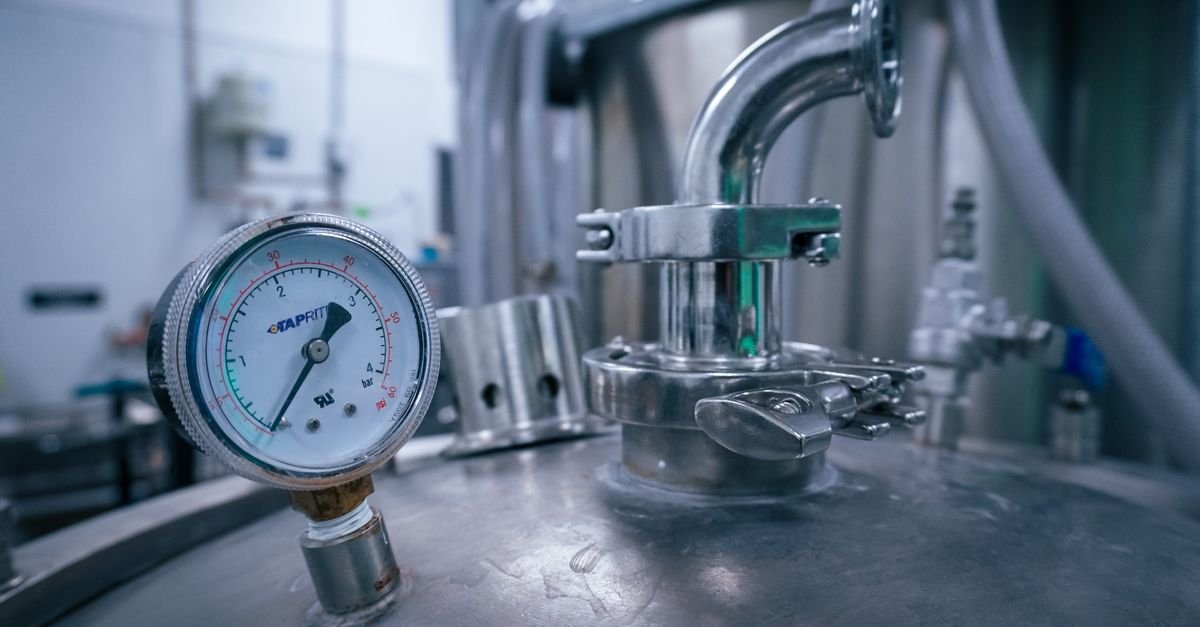
Under ASME B40.100, accuracy is quoted in three bands across the dial — lower quarter, middle half, upper quarter — because a bourdon tube is “typically most accurate near the middle of their range”. Grade A is ±2% / ±1% / ±2% of span. Grade B, the durable and entirely normal grade for a workshop gauge, is ±3% / ±2% / ±3% (Ashcroft on ASME accuracy grades).
Percentages of *span*, not of reading. That is the part that bites. Put a Grade B gauge with a 10,000 PSI face on a 2,800 PSI machine and your working pressure sits at 28% of the dial — the lower quarter, the worst band — where ±3% of span is ±300 PSI. The same gauge is telling you “3,100” and “2,500” with equal sincerity. Fit a 5,000 PSI face instead and 2,800 lands in the middle half at ±2% of span, or ±100 PSI, which is a gauge you can actually argue with.
Three more ways a gauge misleads:
- Dry rather than liquid-filled. The needle whips so hard under pump pulsation that you read the top of the swing and call it the pressure.
- Fitted in the wrong place. A gauge at the pump outlet and a gauge at the gun will not agree, and neither matches the manifold point the rating was measured at.
- Read at the wrong moment. With the trigger closed, you are reading bypass or spike, and the standard explicitly excludes both from the rating. Read while spraying, with your working tip fitted.
The cheap cross-check is the arithmetic you already have. Measure GPM with the bucket, read the size off the tip, and calculate what the pressure ought to be. If the sum says 2,800 and the dial says 4,000, one of those two is a liar and it is not the sum.
The Part That Fails Is Rarely the Part You Were Pushing
This is why the whole thing matters, and it is not the pump you should be worrying about.
A pressure washer is an assembly of parts specified around the same number: pump head and packings, the hose and its two crimps, the quick connects, the gun body, the trigger valve, the wand. Raise the pressure and you raise it on all of them at once. But they do not share a margin, and they do not fail in order of expense.
The pump generally survives, because it is the heaviest thing in the line. What lets go is a hose crimp that has been flexed a thousand times, an O-ring in a quick connect, or the seat inside the trigger valve — components that were fine at the rated figure and are being asked to do 43% more. Most of the time you get a weep at a fitting or a gun that will not shut off cleanly, which is annoying and cheap. Sometimes you get a hose failing under load, which is the version where a pressure washer hose bursting becomes a safety problem rather than a plumbing one. Keep your free hand behind the gun, not in front of it.
And there is a quieter cost. Chasing pressure is usually solving the wrong problem, because PSI is not what cleans. PSI breaks the bond between the dirt and the surface; GPM carries the mess away. Compare by cleaning units — PSI multiplied by GPM — and a 2,500 PSI machine at 4.0 GPM scores 10,000 against a 4,000 PSI machine at 1.5 GPM on 6,000. The second has the bigger number on the box, will take longer on a driveway, and will etch it more enthusiastically on the way through. If you wound the unloader up because a job was going slowly, the honest answer was detergent, dwell time and flow — not another 800 PSI.
FAQ
Why does my pressure washer spray too hard?
Almost always a nozzle restriction rather than a stronger pump. Check the size stamped on the tip against your machine’s GPM and rated PSI, then check the orifice is clear. If both are right, the unloader has been set above the pump’s rating at some point in the machine’s life.
Can too much pressure damage a pressure washer pump?
The pump is usually the survivor. What fails first is whatever in the line has the least margin — a hose crimp, a quick-connect O-ring, the trigger valve seat. The exception is dead-heading, where an unloader that cannot bypass leaves the pump fighting a closed gun, and that does crack heads.
Is it normal for a pressure washer gauge to read above the rated PSI?
On trigger release, yes — that spike is by design and PW101 explicitly excludes it from the rating. While you are actually spraying, no. A working reading above the plate means a restriction or a setting that needs attention.
Will a smaller nozzle make my pressure washer more powerful?
It makes it higher-pressure and no more capable. Flow stays fixed, so you are concentrating the same water into a smaller, harder stripe while loading every component past its rating. Going one size down on a 2,800 PSI machine puts it at 4,000 PSI.
How do I reduce the pressure on my pressure washer without touching the unloader?
Fit a wider-angle tip, or step up one orifice size, or simply back away from the surface. Distance is a genuine pressure control and the only one that needs no parts. Impact falls off quickly with standoff, which is why twelve inches and six inches behave like different machines.
How do I know if my pressure gauge is telling the truth?
Calculate what the pressure should be: measure GPM into a bucket with the tip removed, read the size off the nozzle, and apply PSI = 4000 × (GPM ÷ size)². If the dial disagrees badly with the sum, check the gauge’s range — a working pressure sitting in the bottom quarter of a large dial can be out by hundreds of PSI and still be within its accuracy grade.
Chase the Restriction, Not the Knob
The order that finds it fastest is the order the costs run in. Read the size off the tip and do the sum. Look through the orifice at a light and clear it if it is not a clean circle. Check your gauge is a sensible range for the machine and that you are reading it while spraying. Only then go near the unloader, and go near it with a gauge and quarter turns.
Every one of those four causes is a hole doing something other than what the pump expected. None of them is the machine getting stronger, which is a shame, because that would at least have been interesting.
And if you got here because a knob got turned during a slow afternoon on the patio and you have wondered about it ever since — back it off, fit the right tip, and let the detergent do the part it was always better at.