Last Updated on October 4, 2026 by Umar Farooq
Why does my pressure washer nozzle keep clogging? In almost every case, something is getting past your inlet filter and lodging in an orifice that is smaller than the head of a pin. The four usual culprits are grit from an unfiltered water source, dried detergent left inside the tip, mineral scale from hard water, and a worn or deformed orifice that traps debris it used to flush straight through. Fix the water going in and the clogs stop coming back.
Most people asking this already know how to clear a blockage. That is not the problem. The problem is that the tip clogs again twenty minutes later, or on the next job, or every time they switch to soap. This guide is about stopping the cycle.
What a Clogged Nozzle Actually Looks Like
A blocked tip rarely announces itself. It shows up as a machine that feels like it is dying, which sends people hunting for pump faults that do not exist.
The tell is that the symptom appears suddenly and is tied to one specific tip. Swap to a different colour nozzle; if the machine behaves normally, the tip you took off is the fault.
| Symptom | Most likely cause | Quick confirmation test |
| Pressure drops instantly mid-job | Partial nozzle blockage | Swap tips — full pressure returns |
| Spray splits into two streams | Debris sitting on one edge of the orifice | Hold tip to light, look for a non-round hole |
| Fan sprays sideways or off-centre | Orifice deformed or partly plugged | Compare pattern to a new tip of the same colour |
| Spray pulses or surges rhythmically | Restriction plus trapped air | Bleed the system, then retest |
| Water dribbles with no fan at all | Almost total blockage | Remove tip — flow returns through the wand |
| Pressure fine, no soap | Soap tip or chemical injector blocked, not the pressure tips | Test black tip only |
| Pressure low on every tip | Not the nozzle — look upstream | Check inlet filter and supply flow |
That last row matters most. If every nozzle in the set behaves badly, the nozzle is innocent — read our guide on pressure washer low pressure instead.
The follow-up question everyone asks: can a clogged nozzle damage the pump? Yes, over time. A restricted orifice forces the unloader valve into bypass more often, and recirculating water heats up. Sustained heat cooks pump seals.
Why Does My Pressure Washer Nozzle Keep Clogging? The Root Causes
A nozzle orifice is genuinely tiny. A 2.5 orifice on a 3,000 PSI machine is roughly 1.0 mm across. Sand grains, rust flakes and dried soap crystals are all large enough to bridge that gap. Here is where they come from, in order of how often they cause trouble.
Your Inlet Filter Is Missing, Torn or Blocked
The small mesh screen in your machine’s water inlet is the only thing standing between the pump and everything floating in your supply line. It is also the first part people lose — it sits loose in the threaded inlet and falls out when you disconnect the hose.
Once it is gone, every particle in the hose runs straight through the pump and lands in the nozzle. A torn screen is worse than no screen in one way: it looks present, so you never suspect it. Pull yours out and hold it to the light. Daylight through the mesh, or a coating of brown silt, is your answer.
You Are Drawing Water From a Bucket, Tank or Well
Mains water has already been filtered before it reaches you. Buckets, IBC tanks, rain barrels, ponds and wells have not, and every one of them introduces sediment, algae, insect debris or iron particles directly into the pump.
This is easily the most common cause among people who clean away from a tap. If you draft water, the machine’s built-in screen was never meant to be your only defence.
Sediment Entered the Mains Supply
Municipal water is clean until it is not. After a main repair, a hydrant flush or a burst pipe nearby, the disturbed line pushes rust, scale flakes and sediment through your taps for a day or two. Your kitchen tap has an aerator that catches it; your garden tap has nothing.
If your nozzle started clogging the same week there were council vans on your street, that is not a coincidence.
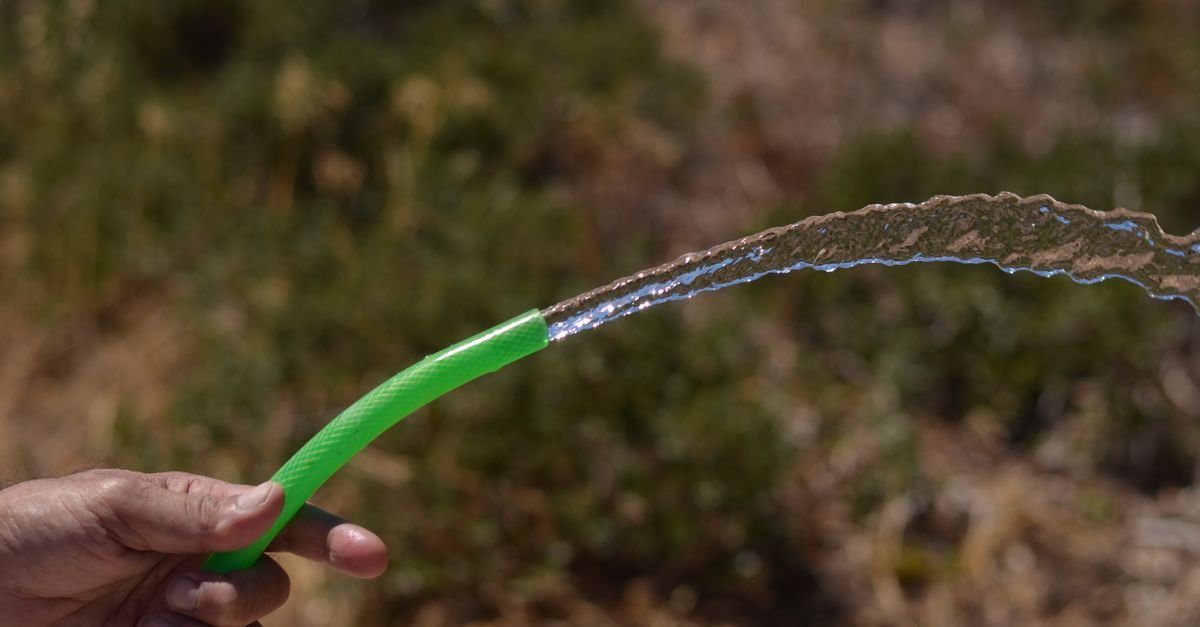
The fix is free: run the garden tap on its own for two minutes before you connect the washer. If the water starts cloudy and clears, you just saved yourself a clog.
Detergent Dried Inside the Orifice
This one catches careful people out. Pressure washer detergents are concentrated, and many contain surfactants that crystallise as they dry. Finish a job, shut down and walk away, and whatever soap is left in the soap tip and injector line dries into a hard film overnight. Next time, that film flakes off and travels straight into the first nozzle you fit.
Husqvarna’s guidance on using a foam sprayer with a high-pressure washer is blunt about this: keep the foam sprayer empty and clean after use, and always rinse through with clean water. Two minutes of flushing prevents the problem entirely. If soap dries inside the injector instead of the tip, you get no foam at all — see our guide on a pressure washer soap dispenser not working.
Mineral Scale in Hard-Water Areas
Hard water carries dissolved calcium and magnesium. Every time water evaporates out of a nozzle, those minerals stay behind as a thin white ring inside the orifice. One session leaves a film you cannot see; two hundred leave a measurable narrowing.
Hardness is measured in grains per gallon (GPG). The standard scale runs soft at 0–3.5 GPG, moderate at 3.5–7, hard at 7–10.5 and very hard above 10.5. Above roughly 7 GPG, scale becomes a real maintenance item. And scale behaves differently from grit: grit clears with a pin, scale has to be dissolved.
Worn, Corroded or Badly Stored Tips
A new stainless or ceramic orifice has smooth walls that debris slides through. A worn one has microscopic pitting that catches particles and holds them.
Older brass tips corrode from the inside, especially if they are stored damp. The green oxide that forms is soft, flakes off, and then blocks the very hole it grew in.
Storage does the rest. If your tips live loose in a bucket with your brushes and hose ends, they collect grit between jobs — you are pre-loading the clog. Tips belong in the holder on the machine or in a closed box.
Damage from past cleaning belongs here too, and it is permanent. If you have ever cleared a tip with a nail, drill bit or straightened paper clip, you may have widened one wall of the orifice. That tip now sprays lopsided and traps debris on the damaged edge forever. There is no repair for it.
Water Source vs Filtration: What You Actually Need
The best predictor of how often your nozzle clogs is where the water comes from. Match filtration to source and the problem largely disappears.
| Water source | Typical contaminants | Filtration you need | Realistic clog frequency |
| Mains tap, modern plumbing | Almost none | Factory inlet screen, checked yearly | Rare — once a season at most |
| Mains tap, old galvanised pipe | Rust flakes, scale | Inlet screen plus 50-mesh inline filter | Every few jobs without a filter |
| Mains tap after main repair | Silt, rust, sediment surge | Flush tap 2 minutes before connecting | One-off spike |
| Garden water butt / rain barrel | Grit, algae, leaf debris, insects | Suction strainer plus 100-mesh inline filter | Every job without filtration |
| IBC tank or portable tank | Settled sediment, biofilm | Floating suction pickup plus 100-mesh filter | Every job without filtration |
| Private well / borehole | Iron, fine sand, manganese | Sediment pre-filter plus inline filter | Constant without pre-filtration |
| Pond, stream or river | Sand, silt, organic matter | Coarse strainer plus two-stage filtration | Every few minutes without filtration |
A quick note on mesh numbers, because they run opposite to intuition: a higher number means a finer filter. 50-mesh catches larger grit and flows freely; 100-mesh catches finer particles but clogs sooner. For garden work, 50-mesh at the inlet is the sensible balance. Go to 100-mesh only if you draft from a tank.
The obvious follow-up: does a filter cost you pressure? A clean one of the right size does not. A packed, neglected one does, and it starves the pump — exactly the fault described in our guide to a pressure washer with no water coming out. Filters help only if you clean them.
How to Clean a Clogged Nozzle the Right Way
Clearing a tip takes two minutes and one correct tool. Doing it wrong costs you the tip.
The Cleaning Pin Method
Husqvarna’s official nozzle cleaning procedure is the one to follow, and every manufacturer’s version is essentially identical:
1. Shut the machine off and pull the trigger to release trapped pressure in the hose.
2. Remove the nozzle from the spray handle.
3. Insert the supplied cleaning pin carefully into the orifice from the front, working it gently back and forth. Do not force it.
4. Rinse the tip under running water, front to back and then back to front.
5. Refit the nozzle securely and test on a low-pressure tip first.
Working from the front matters. You want to push debris back out the way it came, not drive it deeper into the taper.
Never Use a Nail, Wire or Paper Clip
Husqvarna explicitly warns against sharp objects such as nails and wires because they damage the nozzle. The reason is mechanical, not fussy. The supplied pin is sized to the orifice and softer than the orifice material. A nail, drill bit or straightened paper clip is harder, tapered wrongly, and scrapes metal from one wall of the hole.

Once the orifice is out of round, the fan is permanently uneven and the damaged wall becomes a permanent debris trap. This is the most common way people turn an occasional clog into a permanent one. If you have lost the supplied pin, buy a nozzle cleaning kit — do not raid the toolbox.
Backflushing and Soaking Stubborn Clogs
If the pin does not clear it, the blockage is either wedged or it is scale.
Backflush first. Hold the nozzle against a garden hose end and run water through it in reverse for thirty seconds. Reverse flow shifts particles that forward flow only packs tighter.
Then soak. For scale, drop the tip in white vinegar or a proprietary descaler for one to two hours, then backflush again and finish with the pin. Vinegar dissolves calcium carbonate and does no harm to stainless or ceramic. For dried detergent, warm water and a drop of washing-up liquid for twenty minutes usually softens the film.
Then decide. If the tip still will not clear, or the pattern stays lopsided once it does, the orifice is damaged. Replace it.
Why Does My Pressure Washer Nozzle Keep Clogging Again After Cleaning?
The answer is uncomfortable: cleaning a nozzle treats a symptom, not a cause. The debris came from somewhere, and it is still coming. Three patterns are worth recognising.
It clogs again within minutes. The source is upstream and active — a reservoir of debris in your hose, inlet filter or pump manifold, feeding tips one particle at a time. Disconnect the high-pressure hose, run the machine briefly to flush the pump, clean the inlet screen, and flush the garden hose separately before reconnecting.
It clogs again on the next job. Something in your routine is loading it. Almost always this is detergent left in the system, or nozzles stored loose where they collect grit.
It clogs progressively over months, on every tip. That is scale, not debris. Descaling fixes it; picking at it with a pin will not.
There is a fourth possibility with nothing to do with contamination. If a tip seems blocked the instant you fit it, check the quick-connect is fully seated. A partly seated tip sits at an angle in the coupler and mimics a blockage perfectly. Pull the collar back, push the tip fully home, release, then tug to confirm it is locked.
The Prevention Routine That Ends the Cycle
Everything above is diagnosis. This section is the payoff. Four habits eliminate the vast majority of repeat clogs, and none of them takes more than two minutes.
| Task | Interval | Why it matters |
| Flush garden tap before connecting | Every use | Clears sediment surges from the mains |
| Rinse clean water through soap system | Every use, 2 minutes | Stops detergent crystallising in the tip |
| Return tips to the holder, not a bucket | Every use | Prevents grit collecting between jobs |
| Inspect and rinse inlet filter screen | Every 5 hours of run time | Catches a torn or packed screen early |
| Clean inline filter cartridge | Every 10 hours, or per job on tank water | Keeps flow up and grit out |
| Descale nozzles in vinegar | Every 25 hours in hard water; yearly in soft | Removes scale before it narrows the orifice |
| Check fan patterns against a new tip | Every 50 hours | Reveals wear before it costs you cleaning time |
| Full pump-saver and drain-down | Before storage / winter | Prevents residue and freeze damage |
Filter First, Always
If you do one thing from this article, fit an inline filter between your garden hose and the machine inlet. They cost very little, most are transparent so you can see what they have caught, and the cartridge rinses clean under a tap.
Then check the factory screen inside the inlet — most people never have. Unscrew the hose fitting, pull the screen out with needle-nose pliers, rinse it, push it back. If it is torn, replace it.
Flush Detergent Out After Every Use
Fill the detergent tank or foam bottle with plain water, fit the black soap tip, and run on low pressure for two minutes until it draws clean water only. Then switch to a high-pressure tip and run for thirty seconds.
That second step is the one people skip, and it is the one that clears the injector line. Skipping it is why the tip clogs on the next job rather than this one.
Descale on a Schedule in Hard Water
In a hard-water area, put descaling on a calendar rather than waiting for symptoms. Drop the whole set in a jar of white vinegar overnight two or three times a year, backflush, dry, and return them to the holder. It stops the slow, invisible narrowing that makes people think their machine has “lost power” with age.
End-of-season care does the same job. Briggs & Stratton’s winterising and storage guidance covers flushing the detergent system with clean water, draining hoses fully and treating the pump with pump-saver oil — which also leaves the nozzle path clean for spring. Our walkthrough on how to winterize a pressure washer goes step by step.
Clogged Nozzle or a Different Fault? How to Tell
Misdiagnosis wastes more time than the clog itself. Fit each nozzle in turn and squeeze the trigger for five seconds.
- One tip is bad, others are fine → that tip is clogged or damaged. Clean or replace it.
- All tips are weak but flow is strong → the pump is not building pressure. Suspect the unloader valve, worn pump seals, or an air lock.
- All tips are weak and flow is thin → the machine is being starved of water. Check tap flow, hose kinks, inlet screen and hose diameter.
- Pressure builds then collapses repeatedly → likely an unloader or thermal cut-out issue, covered in our guide to a pressure washer that keeps shutting off.
- Nothing comes out at all → air is trapped or the inlet is fully blocked, not the tip.
One more diagnostic is worth knowing: the wrong-size tip imitates every fault above. A tip that is too large for your machine’s flow rate drops pressure dramatically and feels exactly like wear; one that is too small spikes pressure and forces the unloader into constant bypass. If you have mixed tips from different machines, check them against our pressure washer nozzle chart before blaming a blockage.
Remember too that nozzles are consumable. Water at 2,000+ PSI slowly erodes the orifice, so pressure falls and the fan widens with age — and a worn orifice traps debris far more readily, which is why old tips seem to clog constantly.
FAQ
Can I use a paper clip to unclog a pressure washer nozzle?
No. A paper clip is harder than the orifice and is not sized to it, so it scrapes and deforms the hole. Husqvarna specifically warns against nails and wires for this reason. Use the supplied cleaning pin or a purpose-made nozzle cleaning kit.
How do I know if it is the nozzle or the pump?
Swap nozzles. If one tip is weak and the others deliver full pressure, the tip is at fault. If every tip is weak, the problem is upstream — the pump, the unloader, or the water supply.
Does hard water really clog pressure washer nozzles?
Yes, but slowly. Calcium and magnesium left behind as water evaporates build a thin ring inside the orifice. Above roughly 7 grains per gallon, this becomes noticeable within a season or two and needs periodic descaling with vinegar.
Will vinegar damage my nozzle?
Not for normal soak times. White vinegar dissolves calcium scale and is safe on stainless steel and ceramic orifices for a few hours. Rinse thoroughly afterwards and do not leave brass tips soaking for days, since prolonged acid exposure can dull the finish.
Why does my nozzle only clog when I use soap?
Detergent residue is drying inside the tip and the injector line between uses. Flush clean water through the soap system for two minutes at the end of every job, then run thirty seconds on a high-pressure tip to clear the injector.
Do inline water filters reduce pressure?
A clean filter of the correct size does not measurably affect pressure. A packed or undersized one does, and it can starve the pump. Rinse the cartridge every ten hours of use, or every job if you are drawing from a tank.
How often should nozzles be replaced?
There is no fixed hour figure, but most homeowners get several years from a set. Replace a tip when its fan is visibly narrower, uneven or lopsided compared with a new tip of the same colour, or when it will not clear after a soak and backflush.
Should I remove the nozzle before storing the machine?
Yes, and rinse it first. Storing a damp, soap-loaded tip is how corrosion and crystallised residue start. Dry the tips and put them in the holder or a sealed box, and follow proper winterising steps if the machine is going away for the season.
Why does my nozzle clog immediately after I clean it?
Debris is still sitting in the hose, inlet filter or pump manifold and is being fed to the tip one particle at a time. Disconnect the high-pressure hose, flush the pump briefly, clean the inlet screen, and flush the garden hose separately before reassembling.
Fix What Is Feeding the Orifice
So, why does my pressure washer nozzle keep clogging? Because the orifice is roughly a millimetre wide and something upstream keeps feeding it particles it cannot pass — grit from an unfiltered source, sediment surges in the mains, detergent that dried in place, mineral scale, or a worn and damaged tip.
Clearing the blockage is the easy part, and the supplied cleaning pin does it in two minutes. What ends the cycle is fixing the supply: fit and maintain an inlet filter, flush the tap before you connect, rinse clean water through the detergent system after every job, descale on a schedule in hard water, and keep your tips in the holder instead of a bucket of grit.
Do those five things and the nozzle stops being a recurring problem. Skip them and you will be back with the pin next weekend — and eventually with a tip no pin can save.