Last Updated on September 24, 2026 by Umar Farooq
Gutter and drain cleaning means clearing the whole path the water takes — trough, outlet, downspout and the drain at the bottom — because a blockage anywhere in that chain puts the water on your wall. Scoop the trough by hand, clear the outlet, flush the downspout from the bottom up, then run a hose into the drain and go watch where the water actually comes out.
That last step is the one almost nobody does, and it is the one that decides whether the afternoon was worth it. I went through the top-ranking guides for this job before writing, and every one of them ends at the bottom of the downspout, as though the water becomes somebody else’s problem once it is out of sight. It does not. It goes somewhere, and the somewhere is usually about four feet from your foundation.
A Clear Gutter Above a Blocked Drain Is Still a Flood
A gutter is not a container. It is a conveyor with one exit, and the whole assembly only works as far as the first thing that stops it. Trough, outlet, downspout, discharge — four parts, in series, and the system is only as open as its tightest point. Clean the trough perfectly and leave a compacted plug of shingle grit and pine needles in the outlet elbow and you have achieved nothing except a tidier view of the overflow.
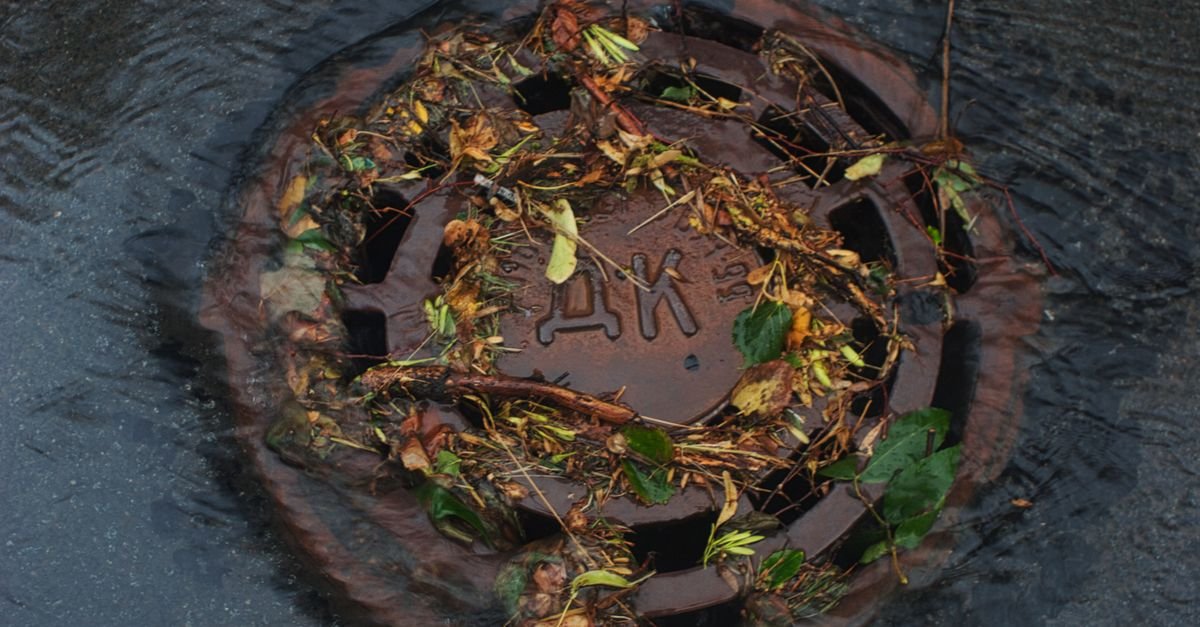
The failure mode is worth understanding because it explains the damage pattern. When the exit is blocked, the trough fills, and a full gutter does three things at once. It goes over the front lip, which is the part you see — water sheeting down the siding, streaking it, and soaking the strip of ground directly against the foundation. It goes over the back edge, which is the part you do not see, running down behind the fascia board and into the soffit. And it sits, standing, against the bottom course of shingles and the drip edge, which is the one place on a roof that was never designed to be permanently wet.
The weight is not trivial either. Water is roughly eight and a third pounds per gallon, and a forty-foot run holding a couple of inches of standing sludge is carrying enough load to pull the hangers out of the fascia over a season or two. Sagging gutters are usually a symptom of blockage rather than a cause of it, which is why re-hanging a sagging gutter without clearing the drain buys you about one storm.
So the honest framing of this job is drainage, not cleaning. You are not tidying a trough. You are restoring a path.
Where the Blockage Actually Sits
Before anyone climbs anything, spend ten minutes with a garden hose and work out which of the four parts is the problem. The symptoms are specific enough to diagnose from the ground in most cases.
| What you are seeing | Where the blockage almost certainly is | How to confirm it |
| Overflow along the whole run, gutter visibly sagging | Trough packed full of debris | Look in it, or run a hose at the high end and watch it pool |
| Overflow at one end only, rest of the run looks fine | Outlet hole or the strainer basket sitting in it | Hose into the trough near that end — it will back up immediately |
| Trough drains, but the downspout only trickles | Debris wedged in an elbow, usually the top one | Tap down the length of the pipe; a plug sounds dull instead of hollow |
| Downspout runs full, water backs up or bubbles at the base | The buried line, or the shoe where pipe meets ground | Hose into the top, time how long until water appears at the outlet |
| Everything flows freely, but the ground is soaked at the wall | Nothing is blocked — the discharge point is too close | Follow the water to where it lands and measure |
That last row catches more people than the others combined. A perfectly clear system that dumps six hundred square feet of roof runoff onto the soil eighteen inches from the wall is not a drainage system. It is a very efficient delivery service.
The hose test on the buried line is the useful one. Feed a running hose into the top of the downspout and time it. Water appearing at the far outlet within a few seconds means the line is open. Water appearing in a slow seep a minute later means it is partly silted. No water at all, plus a downspout that fills up and backs out at the top, means the line is blocked or broken — and a blocked line and a collapsed line feel identical from up here, which is why the next step is to find the cleanout rather than to buy a longer snake.
Gutter and Drain Cleaning, Trough to Outlet
Here is the sequence. It runs downhill deliberately — every step clears the path for the one after it, and doing them out of order just relocates the debris.

Step 1 — Scoop the trough by hand. A gutter scoop, a bucket clipped to the ladder, and gloves. Work away from the downspout so you are pulling debris toward you rather than pushing it into the outlet. Wet leaf pack has the consistency of cold porridge and none of the charm. Get the bulk of it out dry-ish if you can, because it doubles in weight and halves in cooperation once you start adding water.
Step 2 — Clear the outlet and lift the strainer. The outlet is a hole punched in the bottom of the trough, and the strainer basket that sits in it — the wire dome — is where fine material bridges over and sets. Lift it out, clean it, and put your fingers into the hole to check the first few inches of the elbow underneath. This single spot causes more overflow than the entire rest of the run.
Step 3 — Flush the downspout from the bottom. Push a garden hose up from the ground end until it meets the plug, then turn the tap on full. Working upward means the blockage is being pushed out the way it came, with gravity and open pipe ahead of it. Flushing from the top just compacts the plug harder into the first elbow. If the hose will not move it, a drum auger or a length of stiff plumbing snake fed from the bottom will, and tapping the elbows with the heel of your hand while the water runs is surprisingly effective.
Step 4 — Test and clear the buried line. If the downspout goes into the ground, find the cleanout first — a capped vertical pipe near the foundation or along the run. Open it, hose into it, and see whether the water leaves. A cleanout lets you inspect and flush without digging, and if your line does not have one, fitting one is the best hour anyone ever spends on a drainage system. Silted lines clear with water and a snake. Root-invaded and crushed lines do not, and you will know the difference within about thirty seconds of trying.
Step 5 — Flush the whole run and go stand at the exit. Hose at the far high end, full flow, and then walk to the discharge point and watch. You want a steady stream arriving within seconds, at a point well clear of the house. If the volume arriving is obviously less than the volume going in, something in between is still holding water, and you are not finished.
One safety note, because it is the part of this job that actually hurts people. Do not climb a ladder holding a running pressure washer wand. The recoil at the tip is real, it arrives the moment you pull the trigger, and a ladder is a poor place to be surprised. Set the machine up, get positioned, and if the angle needs both hands and a lean, the angle is wrong.
Can You Point a Pressure Washer at a Gutter?
Yes, within limits, and the limits are tighter than the internet suggests. A pressure washer is an excellent gutter *rinsing* tool and a poor gutter *clearing* tool — and that distinction is the whole opinion of this section. Debris comes out by hand, with a scoop. Pressure comes afterwards, to move the fine silt and the staining that the scoop leaves behind.

Here is what you are actually aiming at. A residential gutter is thin coated aluminium, hung on brackets, with its end caps and any joints held by a bead of butyl sealant. Nothing about that assembly is structural, and the sealant is the weak point — it is a flexible gasket, not a weld, and a concentrated jet worked along a joint will eventually find the edge of it and lift it. The outside face is painted metal, which puts it in the same category as painted wood: published guidance for painted surfaces sits around 500 to 800 PSI with a 40-degree tip. I will be straight with you that gutter manufacturers do not generally publish a PSI limit the way Trex does for decking, so that figure is an analogue rather than a spec — but it is the right analogue, and it is a great deal closer than the 3,000 PSI your machine makes at idle.
Practically, that means:
- Outside face and downspout exterior: white 40-degree tip, backed off, moving. Fine. This is the same job as washing the siding it is attached to.
- Inside the trough, after scooping: low pressure, short bursts, aimed *along* the run toward the outlet, never straight down at a joint.
- Down the downspout from the top: fine, and genuinely useful for shifting fine grit once the bulk plug is gone.
- Up under the shingles from the gutter line: never. Not at any pressure.
That last one deserves its own sentence because it is where real money gets lost. The Asphalt Roofing Manufacturers Association is blunt about power washing asphalt roofs — its guidance states that high-pressure washing systems are likely to damage asphalt roofing and should not be used. Standing at the gutter and angling the wand up into the bottom course is the most tempting version of exactly that, because the black streaks are right there. Shingles are lapped to shed water downhill. A jet aimed up-slope goes under the laps, onto the underlayment, and into the decking, and you will find out about it next spring. If the roof edge needs cleaning, that is a soft wash job, and there is a full method in the guide to cleaning roof shingles without pressure washing.
For tip selection generally, the pressure washer nozzle chart covers which colour does what. The short version for this job: white, or the black soap tip. If you have reached for the yellow one, you have mistaken this for a concrete job.
Follow the Water to Its Exit
The point of the whole exercise is not a clean gutter. It is water landing somewhere it cannot hurt anything, and that is a question about the last ten feet, not the first forty.
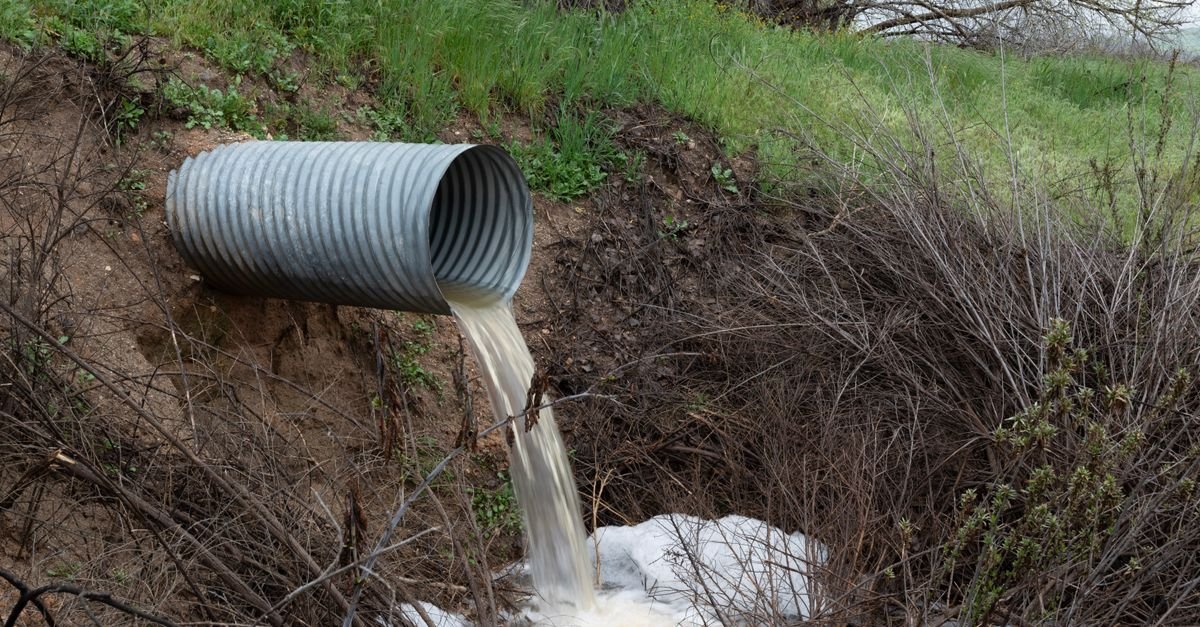
There are only a handful of legitimate destinations. A splash block or an extension carrying water out past the foundation backfill and onto ground that slopes away. A buried line running to daylight at a lower point on the property. A dry well or infiltration pit sized for the roof area feeding it. A rain barrel, which the EPA notes captures water from a roof and holds it for later use, reducing what flows off your property — though a barrel needs an overflow route of its own, or it is just a bucket that fills up during the exact storm you needed it for. Or, where the local system takes it, a connection to the municipal storm sewer.
What matters in all of them is distance and slope. The soil immediately around a foundation is backfill — disturbed, looser than the undisturbed ground around it, and it settles toward the wall over the years. Discharging into that strip puts water in the most permeable path available and points it straight at the footing. Get the outlet clear of it and make sure the ground it lands on falls away from the house rather than toward it.
One thing worth knowing about that storm sewer, if that is where yours ends up. Stormwater in a municipal separate storm sewer system is often discharged, untreated, into local water bodies — there is no treatment plant in between. That is a good reason not to flush a gutter through with bleach or a strong degreaser and send the rinse straight down the pipe. If the trough genuinely needs chemistry rather than a scoop, mix it weak, keep it in the trough, and rinse it onto planting or lawn rather than straight into the pipe.
FAQ
Will a pressure washer unblock an underground downspout drain?
Usually not, and it is the wrong tool for the risk involved. A wand has no way to steer around a bend, the jet loses force fast inside a pipe, and forcing high pressure into a line you cannot see can push a partial blockage into a solid one or blow apart a joint in old, brittle pipe. Open the cleanout and use water volume and a drum auger instead. Pressure is for surfaces you can see.
How can I tell a blocked drain line from a broken one?
Feed a snake in from the cleanout and pay attention to how it stops. A silt or leaf blockage gives gradually, lets the snake turn, and starts draining once you break through it. A collapsed or root-invaded line stops the snake hard at the same distance every time, and no amount of water gets past. If the same spot defeats you twice, the next step is a camera, not a bigger machine.
Do I need to get on a roof to do this properly?
No, and you should not. This is a ladder job worked from beside the gutter, not a roof job. Standing on a roof edge to reach down into a trough puts your weight on the least supported part of the covering, which is also the part most likely to be soft from the standing water you came to fix.
Should I clean the gutters before or after washing the house?
Before. Everything that comes out of a gutter runs down the wall, and if you have already washed that wall you will be washing it twice. The same order applies to the roof and the drive. Work downward, finish at the bottom, and rinse the whole thing at the end — the sequence for the walls themselves is in the guide to power washing your house.
Are gutter guards a substitute for cleaning the drain?
They change what you have to do, not whether you have to do it. Guards keep leaves out of the trough and do nothing at all for the fine silt, shingle grit and pollen that pass straight through mesh and settle in the outlet and the buried line. The downspout and the drain still need testing. What a guard mostly buys you is fewer trips up the ladder, which is a real benefit and not the same thing as a solved problem.
The Job Is Not Done at the Top of the Ladder
Half of this job happens at eye level and the other half happens at your ankles, and the ankle half is the one that saves a foundation. Clear the trough, clear the outlet, flush the pipe from the bottom, test the buried line, and then go and stand at the far end with the hose running and satisfy yourself that what went in is what came out.
If you are up there now with a bucket on one hook and a nagging feeling that the downspout was suspiciously quiet last time it rained — yes, that is the one. Check it before you come down.