Last Updated on September 25, 2026 by Umar Farooq
The correct way to remove moss off a roof is to kill it where it sits and leave it there. Spray a dilute chlorine bleach solution from a pump sprayer — 50:50 with water is the usual trade starting point from a laundry-strength jug, though the strength that reaches the roof depends on what you bought — let it dwell 15 to 20 minutes, rinse gently down-slope at garden-hose pressure, and then let two or three months of weather carry the dead clumps away. You do not scrape. You do not brush. You certainly do not pressure wash.
That last paragraph puts me at odds with almost every result on the first page of Google, including one from a university extension service, and I want to be upfront about that rather than pretend there is a consensus. There is not. What there is, is a mechanism — and once you understand what moss is physically holding onto, the case for keeping your hands off it gets a lot easier to make.
Moss and Algae Are Not the Same Problem
The black streaks running down the north face of your roof and the green clumps sitting along the shingle edges look like the same complaint to a homeowner. They are not even the same kingdom of life, and they damage a roof in completely different ways.
Black streaking is *Gloeocapsa magma*, a cyanobacterium that lives flat in the granule bed and eats the limestone filler in the shingle. It is ugly and it is slow. Moss is a plant. The Asphalt Roofing Manufacturers Association describes it as “a non-vascular plant that obtains water through its leaves, unlike most plants that gather water through its root system,” which is the detail that explains everything else about it. Moss does not need soil, does not need nutrients from the surface it sits on, and does not care that your roof is a hostile mineral desert. It needs shade and it needs water, and it brings its own storage.
| Black algae streaks | Moss | Lichen | |
| What it is | Cyanobacteria | Non-vascular plant | Fungus plus algae |
| Where it sits | Flat in the granule bed | Proud of the surface, at laps and valleys | Bonded flat, grown into granules |
| Depth | Surface film | 10-50 mm thick clumps | 1-3 mm crust |
| Holds water against the roof | Barely | Constantly, like a sponge | Somewhat |
| Lifts shingle edges | No | Yes | No |
| Damage type | Cosmetic, slow UV heating | Structural — moisture, lifting, blow-off | Granule loss on removal |
| Dies in one chlorine treatment | Yes | Yes | Partly, expect repeats |
| Time to shed after dying | 2-6 weeks | 1-3 months | Often never fully |
Read across the “holds water” row, because that is the whole article in one cell. Algae stains a roof. Moss wets it, and keeps it wet, every day, including the days it does not rain.
What Rhizoids Do to a Shingle Lap
Moss anchors with rhizoids — fine, hair-like filaments that thread down into whatever texture they can find. On a roof that texture is the gap between granules and the seam where one shingle course laps over the one below it. The rhizoids are not roots in the plant-biology sense, but they grip like roots, which is the part that matters when you are standing on the driveway with a stiff broom in your hand.
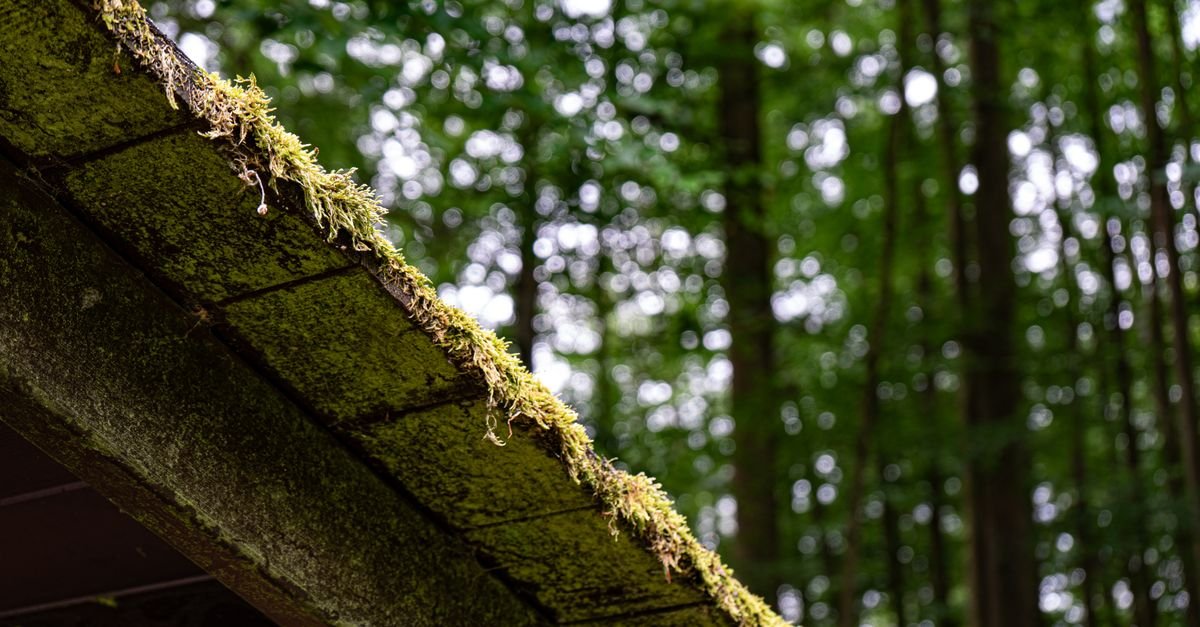
Two failures follow, and ARMA names both of them plainly in its guidance on algae and moss prevention and cleaning for asphalt roofing systems. The first: “Moss can cause the leading edges of the shingles to lift or curl, which increases the risk of shingle blow-off during wind events.”
The second is worse because it is invisible. Moss build-up, ARMA says, “can cause lateral water movement resulting in moisture damage to the roof deck or may even cause leaks.” A shingle roof works because water runs downhill in a straight line and exits at the gutter. A row of wet moss across the slope is a dam. Water reaching it stops, spreads sideways along the course, finds the nearest lifted lap, and goes under. The roof is no longer shedding water in the direction it was designed to shed it, and the sheathing underneath finds out first. Black streaks are a resale-photo problem. Moss is a deck problem wearing a green hat.
How to Remove Moss Off a Roof Without Scraping It
Everything below happens at garden-hose pressure with a pump sprayer. Pick a cool, overcast, still day — heat dries the solution before it can work, and wind puts it on the neighbour’s car.
1. Clear loose debris first, gently. A leaf blower from the ridge, or a soft roof rake pulled down-slope only. You are removing pine needles and leaf litter, not moss. Leave the moss.
2. Soak every plant under the roofline with plain water until the soil is saturated. Pre-wetted foliage dilutes anything that lands on it. This is the single most effective precaution and it costs five minutes.
3. Mix 50:50 laundry-strength chlorine bleach and water in a pump sprayer. Add a small squirt of surfactant if the roof is steep, so the solution clings instead of running straight into the gutter.
4. Apply from the ridge down in overlapping bands. Wet the moss thoroughly — a clump 30 mm thick needs the solution to reach through it, not just glaze the top. Thick moss usually wants a second pass a minute after the first.
5. Wait 15 to 20 minutes. ARMA specifies at least 15 and no more than 20. Re-mist any area that starts drying. Do not let it dry on the shingle.
6. Rinse down-slope at hose pressure with a plain spray nozzle, ridge toward gutter, never up under the laps.
7. Rinse the plants again, then the siding, walkways and driveway before any overspray dries, and flush the gutters so dead growth does not sit in them and stain the fascia.
Then you stop. That is the step people struggle with, and it is step seven.
The Two Ways Force Turns a Moss Problem Into a Roof Problem
Here is my one strong opinion, and it is the reason this article exists.
Every popular guide to roof moss tells you to brush or sweep it off before treating. Oregon State University’s extension service is explicit about it: “Use a brush or broom to remove the moss. I suggest either a standard bristle scrub brush or a stiff broom” (OSU Extension). That is a credible institution giving clear advice, and I am not going to pretend otherwise.
The shingle manufacturers disagree, in capital letters. ARMA’s bulletin on algae discoloration of roofs says “DO NOT use a power washer or any type of brush or broom to clean algae from the roof surface.” I read that three times, because it is unusual for an industry body to shout. They had shouted.
I side with the manufacturers on asphalt, for a mechanical reason: the rhizoids are threaded into the granule bed, so anything that pulls the moss pulls granules with it. The moss comes off in a satisfying mat and the granules come off in the mat. You have traded a green roof for a bald one, and granules are the only thing standing between the asphalt and ultraviolet light.
Force fails a second way, and this one is specific to moss rather than to shingles in general. Live moss is saturated. Hitting a wet clump with a pressure washer, or dragging a broom up-slope through it, drives that water sideways and upward under the courses — exactly the lateral movement ARMA warns about, except you are doing it deliberately and at 2,000 PSI. On asphalt shingles the safe pressure is not low. It is none.
If you own a pressure washer and the temptation is real, the honest version of the method is in our guide to cleaning roof shingles without pressure washing, which covers the delivery options in more detail. On concrete the calculus is completely different, and a machine is genuinely the right tool — see removing moss from a concrete driveway. Concrete does not have granules and does not have laps. Your roof has both.
Dead Moss Weathers Off on Its Own Schedule
Dead moss looks terrible. It goes brown, then grey-white, then straw-coloured, and for about a month your roof looks worse than it did before you treated it. This is the point at which a lot of homeowners decide the chemical did not work and go and buy a broom, which is how a successful treatment turns into granule loss three weeks after the fact.
It worked. Moss that has lost its rhizoid grip dries out, shrinks to a fraction of its wet volume, becomes brittle, and gets lifted off by rain and wind over roughly one to three months. Thick clumps in a shaded valley take longer than a thin film on an exposed slope. Nothing has gone wrong; you are just watching a slow process at normal speed.
There are two things worth doing during that window. Check the gutters after the first few good rains, because that is where the debris ends up and a downspout packed with dead moss will back water up under the eave — which is the same conversation as gutter and drain cleaning, just with a different source of blockage. And resist the urge to help. If a clump is still sitting there after three months and it genuinely bothers you, a soft-bristled brush worked *down-slope only*, on dry dead moss, with no pressure behind it, is the most I would do — and ARMA would still rather you did not.
The reward for patience is that this does not come back next spring. Force removes what you can see. Chemistry kills what you cannot, which is why the treated roof stays clear for years while the blasted one greens up in one wet season.
Metal at the Ridge: What Zinc and Copper Actually Suppress
Moss is far more sensitive to dissolved metal than algae is, which is why the strip-at-the-ridge trick gets talked about mainly in moss country. Rain crossing a zinc or copper strip picks up trace ions and carries them down the slope. Below the strip, spores struggle to establish. Above it, nothing happens at all, which is the detail people discover after fitting one halfway down a roof.
| Zinc strip | Copper strip | Algae-resistant shingles | |
| Effective against moss | Strong | Strong | Moderate |
| Typical coverage below | A few feet to roughly 15 feet | Similar, often longer-lived | Whole roof |
| Lifespan | Proprietary strips around a year; heavy galvanized flashing decades | Very long | Roof life |
| Fixing required | Nails or lifted shingles | Nails or lifted shingles | None — built into the granules |
| Runoff concern | Toxic to fish and aquatic life | Toxic to fish and aquatic life | Minimal |
| Best fitted | At roof replacement | At roof replacement | At roof replacement |
Notice that the bottom row says the same thing three times. ARMA’s position is that “adding zinc or copper strips to an existing roof is not recommended since this will require either applying the strips with exposed nails (which can cause leaks over time) or breaking the sealant bond.” You are choosing between fastener holes in a water-shedding surface and unsticking the adhesive strip that keeps shingles down in wind. Neither is a good trade to avoid some green.
So metal is a decision you make when the roof is being replaced, not a Saturday project. If your roof is within a few years of replacement anyway, ask the contractor about algae-resistant shingles with copper-bearing granules instead — same chemistry, no fasteners, no broken seals, whole roof covered rather than fifteen feet.
One caveat that gets left out of most guides: metal ion runoff is genuinely toxic to aquatic life. If your downspouts feed a pond, a stream at the property line, or a rain barrel you water vegetables from, that runoff is not a neutral side effect. Route it away or skip the strips.
The Branches Are the Reason It Came Back
Moss needs shade and sustained moisture. A roof in full sun dries within an hour of rain stopping and moss cannot get a foothold on it. A roof under a maple stays damp until mid-afternoon, and in the Pacific Northwest, often not even then.
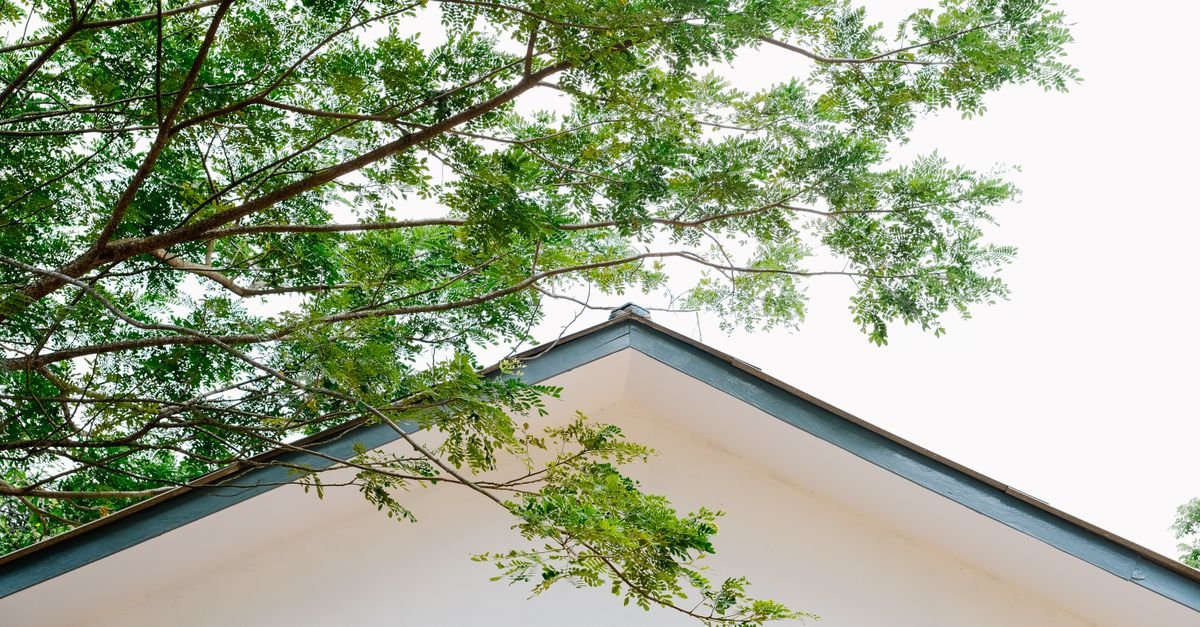
ARMA describes the double hit precisely: “Overhanging tree branches provide additional shade and drop debris on the roof that further holds in moisture and acts as a food source for moss.” Shade is half of it. The other half is the organic litter — needles, leaves, seed cases — that collects in valleys and along laps, rots down into a thin compost, and gives moss somewhere soft and permanently wet to sit. A north-facing slope under a conifer is not a roof with a moss problem. It is a very expensive terrarium.
The fix is arboricultural, not chemical. Cut back branches to open the roof to direct sun, prioritising whatever overhangs the north or shaded elevation, and clear the valleys and gutters at least twice a year so litter never gets a chance to break down in place. If you treat the roof and do not touch the tree, you are on a two-to-four-year cycle forever. If you open the roof to the sun, the same treatment can hold for the better part of a decade.
When Moss Has Already Won
There is a point past which cleaning is the wrong decision, and it is worth knowing where it is before you spend a Saturday on a ladder.
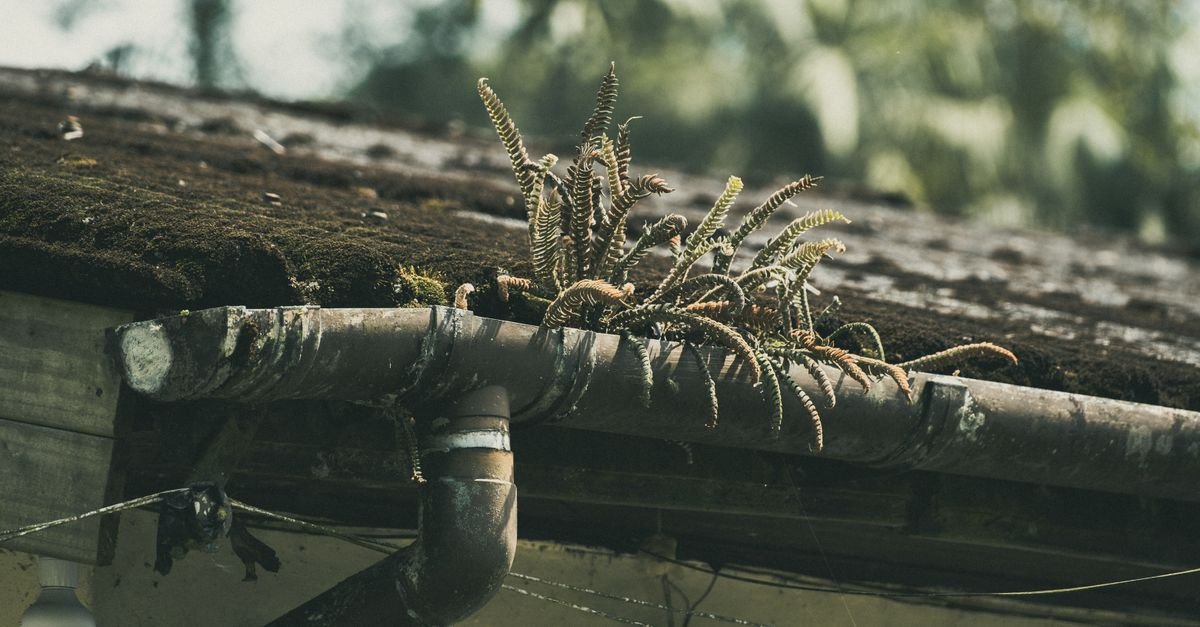
If the moss has thickened enough to support other plants — ferns, grass, tree seedlings — the mat has been holding water against that deck for years, and the question is no longer how to clean it. It is what the sheathing underneath is doing. Get someone in the attic with a torch looking for staining, soft spots and daylight before anyone gets on the roof at all.
| Situation | What to do |
| Light green film, roof under 10 years | Treat and wait; trim branches |
| Thick clumps at laps, roof 10-15 years | Treat from a ladder at the eave or hire a soft wash |
| Curled or lifted shingle edges visible from the ground | Treat, then have the lifted courses inspected |
| Ferns, grass or seedlings growing on the roof | Inspect the deck from inside before anything else |
| Shingles brittle, roof past 20 years | Price a replacement; do not walk on it |
| Two storeys, or pitch above 7:12 | Hire it out regardless of how bad the moss is |
Age is the quiet variable in that table. Shingles go brittle over time, and past about fifteen years the act of walking up there to clean can crack the tabs you were trying to save. Treat from a ladder set at the eave with a pole sprayer, or pay someone with the reach to do it from the ground. The roof does not care how it got the solution, only that it got it gently.
FAQ
Will moss damage my roof or does it just look bad?
It damages it. ARMA states that moss causes shingle leading edges to lift or curl, raising the risk of blow-off in wind, and that moss build-up causes lateral water movement that can reach the roof deck or cause leaks. That is a structural complaint, unlike black algae streaking, which is largely cosmetic.
Can I pressure wash moss off a roof if I use a low setting?
No. Asphalt shingle roofs have no safe pressure setting — the manufacturers’ ceiling is garden-hose pressure, and even the lowest setting on a consumer machine sits well above it. Pressure strips granules and drives water up under the laps, which is the exact failure moss was already causing.
Should I pull the moss off by hand first?
I would not, and neither would the shingle manufacturers. The rhizoids are threaded into the granule bed, so a clump that comes away cleanly usually takes granules with it. Kill it in place, then let weather do the lifting over one to three months.
How long does it take for moss to fall off after treatment?
Roughly one to three months, depending on thickness, exposure and rainfall. It turns brown within days, dries and shrinks over a few weeks, then sheds gradually. The ugly middle stage is normal and is not a sign the treatment failed.
Does vinegar kill roof moss?
It will kill thin surface growth and it is safe around plants, but it is weak on established clumps and offers no lasting suppression. On a roof carrying real moss it buys you a season at best. Chlorine solution with a proper dwell is what actually kills the organism through the full thickness of the mat.
Will zinc strips remove moss that is already there?
No. Metal strips suppress new growth in the wash-down zone below them; they do nothing to a mat that is already established. Kill the existing moss first, and treat the strips as a prevention measure for afterwards — ideally fitted when the roof is next replaced.
How often does a mossy roof need treating?
Every two to four years if the shade stays, and considerably longer if you open the roof up to sun by cutting back overhanging branches. Trimming is the variable that changes the interval, which is why it is worth doing before the next treatment rather than after.
Is moss worse on the north side of the roof?
Yes, in the northern hemisphere. North-facing slopes get the least direct sun, stay damp longest after rain, and are where moss almost always appears first. It is usually the elevation to treat most heavily and the one to prioritise when deciding which branches to cut.
Kill It, Then Let the Weather Lift It
Moss is the only thing growing on your roof that is actually costing you money, and it is also the one thing on there you must not touch. That sounds contradictory until you picture the rhizoids: they are wound through the granule layer, so every clump you pull off takes a patch of UV protection with it, and every jet of water you aim at a saturated mat pushes that water sideways under the courses.
So the method is slow on purpose. Fifty-fifty bleach and water from a pump sprayer, fifteen to twenty minutes of dwell, a gentle rinse down-slope, and then two or three months of doing nothing while the roof looks worse before it looks better. Cut the branches that put it in shade, clear the valleys twice a year, and save the zinc for the day the roof gets replaced.
If you are reading this standing at the bottom of a ladder holding a stiff broom, put the broom down. The moss has been up there for four years. It can wait another twenty minutes while the sprayer does the part that actually works.