Last Updated on September 25, 2026 by Umar Farooq
To power wash your house properly you work one elevation at a time, follow the shade around the building, and treat every soffit vent, light fitting, outlet and window head as a hole rather than a surface — which is why a whole house takes most of a day rather than the afternoon everybody budgets for.
Washing one wall is a technique problem. Washing a house is a logistics problem that happens to involve water. The wall itself is the easy bit — it is flat, it is big, and it forgives a lot. Everything sticking out of it does not.
Plan the Lap Before You Pull the Trigger
Two things decide your route around the house, and neither is the dirt. The first is gravity: anything cleaned high up sends its dirt down over whatever you cleaned below it, so the gutter line comes before the wall underneath. The second is the sun. Detergent needs five to ten minutes on the surface and must not dry there, so the elevation baking in full afternoon light is the one that will streak on you. Follow the shade round the house and the chemistry gets to do its job unsupervised.

Put together, the lap looks like this:
1. Start on whichever elevation is in shade now, and plan the others in the order the shade will reach them. On most houses that means the north wall first thing and the west wall last.
2. Gutter faces, fascia and soffits on that elevation, before anything below them.
3. The wall itself, in sections of about ten feet, detergent up and rinse down.
4. Trim, fixtures and penetrations as you come down — window and door casings, light fittings, vents, outlets, the meter.
5. Foundation, porch, steps and the strip of path at the base, which collect everything that ran off the wall.
6. Walk that elevation while it is still wet, then move round and repeat.
Siding technique itself — which pressure, which tip, which material — is a separate question with real numbers attached, and it does not compress into a bullet. Vinyl generally sits in the 1,300–1,600 PSI band with a 25- or 40-degree tip, and what PSI a pressure washer needs for vinyl siding has the full working. If you want the failure modes rather than the numbers, whether you can pressure wash vinyl siding covers those.
Everything That Sticks Out of a Wall Is a Funnel
Walk the perimeter and count them before you start. An ordinary three-bedroom house has two to four exterior outlets, three or four light fittings, a dryer vent, a bathroom fan vent, a range hood vent, soffit vents along both eaves, a gable vent or two, an air-conditioning line set through the wall, a meter box, a hose bib, and the head of every window and door. Thirty-odd openings — and the siding between them is the only part of the house designed to be rained on.

The rule at every one of them is the same: the tip must never be lower than the thing it is pointed at. Not level — below. If the wand is beneath a soffit vent and you squeeze the trigger, the vent is doing exactly what it was built to do, which is let air in. It cannot tell the difference between air and 1,500 PSI of soapy water.
Item by item, that works out as:
- Soffits and soffit vents. Clean them from out at the edge, angled back and down towards the fascia, so the spray runs out of the overhang rather than into it. If a patch will only come off from directly underneath, it comes off with a brush on a pole.
- Gutter faces. Wash the outside face from the side, never from below. The inside is a scoop-and-glove job, and doing it first means the wall underneath only gets cleaned once.
- Fascia and the roof edge. You are now inches from the shingles. The Asphalt Roofing Manufacturers Association is blunt about this — high-pressure washing systems “are likely to damage asphalt roofing and should not be used” (ARMA, Algae Discoloration of Roofs). A wand that wanders up onto the roof edge takes granules off with it.
- Window and door heads. The trim at the top of an opening sits over flashing, and that flashing sheds downward. Spray across the head, not up into it, and keep the tip back. Windows themselves want garden-hose pressure and a 40-degree tip, nothing more.
- Light fittings, outlets and the meter. Tape plastic over them. An outdoor receptacle cover is rated for rain arriving vertically at atmospheric pressure. It has no opinion about a fan jet arriving from below.
- Dryer, bathroom and range vents. Flap-type covers open outward and are held shut by a gravity flap weighing about as much as a teaspoon. Tape them or spray past them.
This is where the one strong opinion on this page goes, and it is not about pressure. If you are not willing to spend the first hour of the job taping, covering and closing things, do not start. The reason is drying, not electricity. The EPA’s guidance on moisture is that wet materials dried within 24 to 48 hours will, in most cases, not grow mould (EPA, A Brief Guide to Mold, Moisture and Your Home). A soffit cavity, an outlet box or the space above a window head will not hit that window. It is enclosed, unventilated on the inside face, and invisible from the driveway. An hour of masking tape against a mould problem you cannot inspect is not a close call.
Plants, Mulch and Where the Water Ends Up
Soak the beds before you mix anything. Wet foliage and wet soil take up far less detergent than dry, for the same reason a wet sponge picks up less water — the capacity is already spoken for. Then rinse everything again at the end, properly, not a token pass.
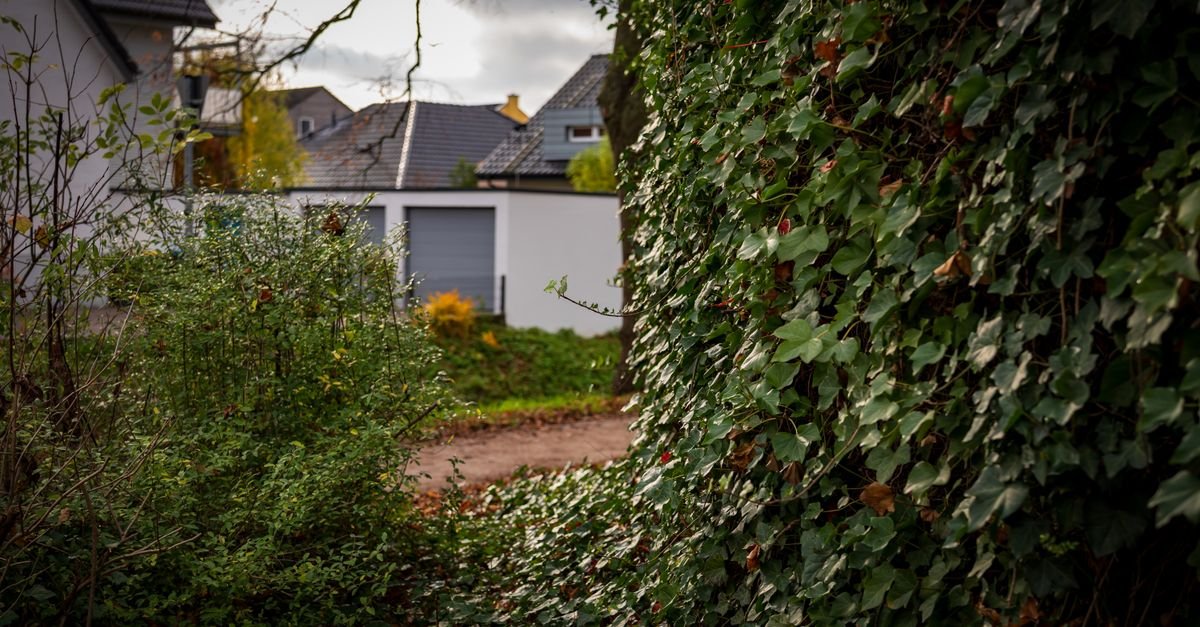
Mulch is the part people forget. Bark floats, and a house wash puts a lot of water down a wall quickly, so the top inch of a bed can end up on the path — a small job to undo and an irritating one. Where a bed sits under a downspout or at the low corner of the house, a weighted tarp is worth the two minutes.
Then there is the water that leaves. House-wash runoff carries detergent, dead algae and whatever was living on the north wall, and on most properties it heads for the drive and then the storm drain. The EPA’s framing is the useful one: runoff “picks up and carries away natural and human-made pollutants, finally depositing them into lakes, rivers, wetlands, coastal waters and ground waters” (EPA, What is Nonpoint Source Pollution?). A storm drain is a shortcut, not a treatment plant.
The fix is free: aim the runoff at grass. Lawn and soil filter and break down a dilute house-wash solution; concrete forwards it unchanged. If the ground falls towards the drive, a rolled towel or a length of pool noodle at the edge of the slab turns the flow back onto the lawn. The water volume itself is not the problem — at 2.5 GPM, two hours of trigger time is about 300 gallons, less than a garden hose run wide open while you scrub. It is the detergent that needs thinking about.
Pick a Day the Detergent Can Survive
The ideal day for a house wash is one nobody would choose for a barbecue: overcast, mild, still and a little dull.
Direct sun is the enemy, not heat as such. Detergent needs to sit wet on the surface for five to ten minutes, and a sunlit wall in midsummer will dry it in two. Dried detergent leaves a streak that is harder to remove than the dirt you started with, and the only cure is doing that section again. This is why following the shade around the house is a real technique and not a fussy detail — it buys you dwell time for nothing.
Wind is underrated. A fan tip at head height in a stiff breeze puts atomised house-wash solution a long way sideways — your car, the neighbour’s car, their open window, their washing — and dries the wall while you work, which compounds the first problem.
Cold has two thresholds. Below freezing the job is off — there is standing water in the hose, the pump and every gap you have just sprayed, and that is how pump heads crack. Above freezing but still cold, the wall stays wet for hours, so stop early enough that it dries before the temperature drops overnight. Late spring and early autumn are the easy windows: long enough days, weak enough sun.
Rain is fine afterwards and terrible during. A shower an hour after you finish is a free rinse. A shower during the dwell dilutes the detergent to nothing, and you will not know it happened until the wall dries unevenly two days later.
If the wall you are worried about is the shaded one with black speckling that comes back every year, that is a biology problem rather than a weather one, and removing mould from vinyl siding deals with why it returns.
How Long It Really Takes to Power Wash Your House
The honest answer irritates people, so here is the arithmetic instead of a number I cannot stand behind.
Take a modest single-storey house with roughly 16 sections of wall at ten feet each. Every section needs detergent applied bottom to top, then five to ten minutes of dwell, then a rinse top to bottom. At the short end of the dwell and with no overlap at all, that is 80 minutes of the day spent waiting rather than working. In practice you stagger it — soap section three while section one dwells — but the waiting does not disappear, it just gets hidden inside the work.
Now add the rest: the water supply check, the perimeter walk, the hour of taping, a test patch somewhere nobody looks, moving the hose round the building three times, the gutters, the second pass on the elevation that did not come clean, the plants before and after, and coiling 50 feet of hose that has developed opinions.
That is a day. Not an afternoon. On a two-storey house with a lot of trim it is comfortably two shorter days, which is the better way round anyway — half a house properly beats a whole house rushed at the point where the light goes and you start reaching.
Machine choice changes the pace, not the plan. GPM is the rinse rate, so a homeowner electric unit at 1.2–1.4 GPM washes a bungalow perfectly well and simply takes longer on a big house than a 2.5 GPM gas machine doing identical work. More PSI does not buy speed on a house — it buys a narrower margin for error at every one of those thirty openings.
FAQ
How often should you power wash your house?
Once a year suits most homes, with shaded and north-facing elevations sometimes wanting twice. Twice-yearly gentle washes are better for the building than one aggressive annual one, because the growth never gets thick enough to need pressure in the first place.
Where should you start on a two-storey house?
On the elevation that is in shade, at the gutter line, and only as high as you can reach with the tip still angled downward. Height is an access problem rather than a pressure problem — an extension wand carries the tip up to the work so the spray stays level when it arrives, whereas standing further back and leaning on the trigger just delivers a weak jet at the worst possible angle.
Do you need to power wash a house before painting?
The surface needs to be clean, sound and dry first, and washing is the usual way there. Two cautions: water driven into the wall must be fully out before paint goes over it, so allow days rather than hours; and if the house predates 1978, assume lead paint until tested, because washing disturbs flaking paint.
What happens if water gets behind a soffit or into a vent?
It sits in a cavity that is enclosed, poorly ventilated from the inside and invisible from outside. Dried within 24 to 48 hours it is usually a non-event; left wet it becomes a mould question. The later signs are staining on an upstairs ceiling near the eaves, a musty smell in the roof space, and insulation that looks flattened in one spot.
Do I need to turn the power off before washing?
Cover and tape outdoor outlets, light fittings and the meter regardless. Switching off the circuits feeding exterior fittings at the panel costs nothing but a walk to the garage and is worth doing. Anything cracked or hanging loose gets fixed before the machine comes out, not after.
Can you power wash windows and window screens?
Windows, at garden-hose pressure with a 40-degree tip, spraying across the glass rather than into the frame. Screens, no — a fan jet will stretch or tear the mesh and can pop it out of its spline. Take screens out, lay them flat, and clean them with a soft brush and a hose.
The Edges Are the Job
The wall is not what you are washing. The wall is forgiving, flat and well understood, and if it were the whole job a house would take two hours and nobody would write about it.
What you are actually doing is walking past thirty openings with a tool that can push water through any of them, and deciding at each one whether the tip is above the thing or below it. Get that right, follow the shade, soak the beds, send the runoff at the grass, and accept that it is a day’s work.
Then walk the last elevation while it is still wet, because a wet house tells you the truth and a dry one has already stopped talking.