Last Updated on September 25, 2026 by Umar Farooq
To power wash porch structures without wrecking them, work top-down — ceiling, then railings, then floor — and treat the floor as painted wood at 500 to 800 PSI through a 40-degree tip rather than as bare decking.
That order is the whole article, and almost every porch guide skips it, because almost every porch guide is a deck guide with the word swapped. A deck is one horizontal plane in full sun. A porch is a small covered room with a floor, two railings, a ceiling and usually a door into your house. Wash the floor first and you will wash it again after the ceiling drips on it, which is a mildly annoying way to spend a Saturday.
The deck numbers still stand — cleaning decks covers softwood, hardwood and the furring threshold. What follows is the part specific to a structure with a roof over it.
Why a Porch Weathers Nothing Like a Deck
A deck lives under the sky. It gets rained on, it gets baked, and it goes silver-grey because ultraviolet light is slowly destroying the lignin at the surface. A porch gets none of that. It sits in permanent shade, catches wind-blown rain rather than vertical rain, and then holds that damp for days because nothing ever reaches it to dry it out.
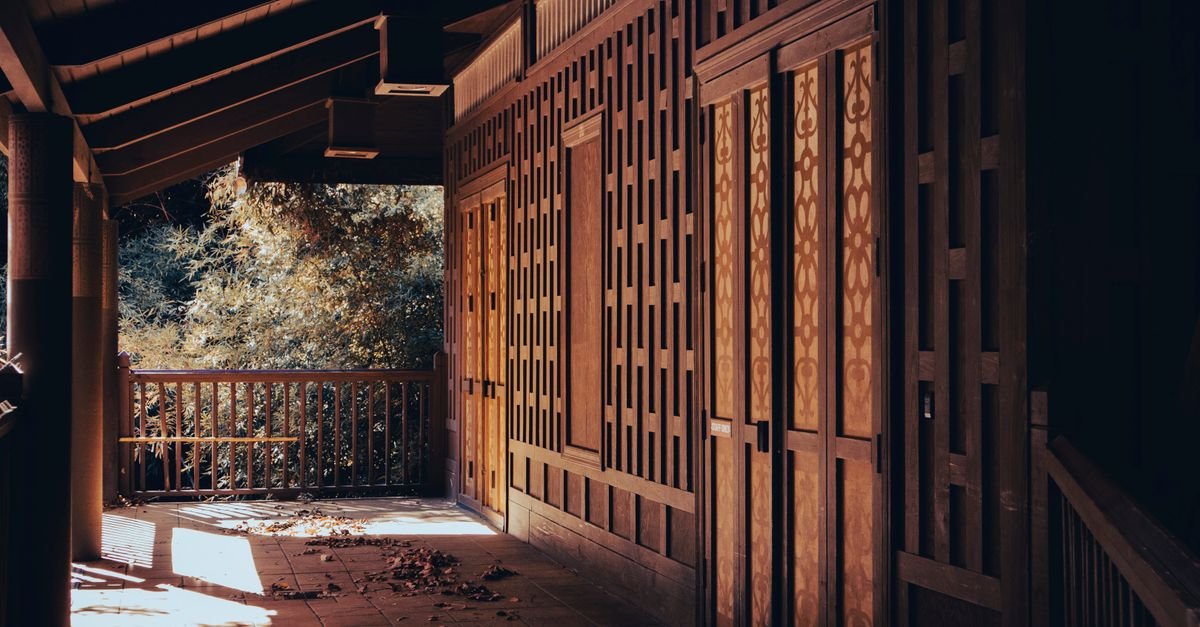
So the two fail in opposite directions. A neglected deck goes pale. A neglected porch goes dark — green in the corners, grey-black along the wall line, furry on the north side of every post. Something is living on it. That gets killed with chemistry and time, not moved with pressure.
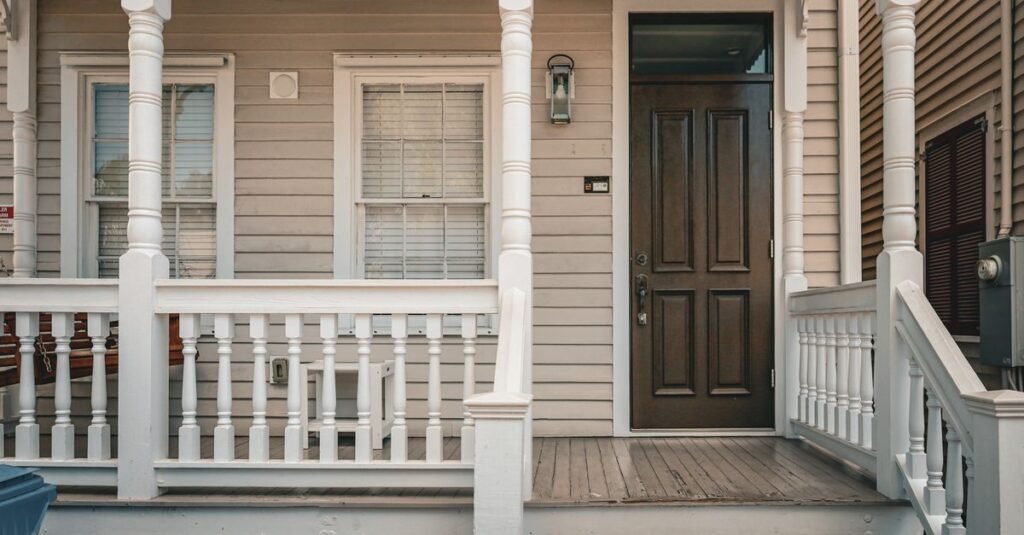
The construction differs too. Porch floors are traditionally tongue-and-groove boards laid tight and painted, sloped very slightly away from the house so rain runs off. Deck boards are laid with gaps precisely so water falls through. Point a wand into a tongue-and-groove joint and the water has nowhere to go but sideways, under the paint film.
Work Top-Down: Ceiling, Then Rails, Then Floor
Gravity is the only scheduling tool you need. Everything you loosen up high lands on whatever is below it, so the sequence runs ceiling, beams and light fixture, posts, railings and balusters, steps, then floor. The floor goes last because it catches everything else.
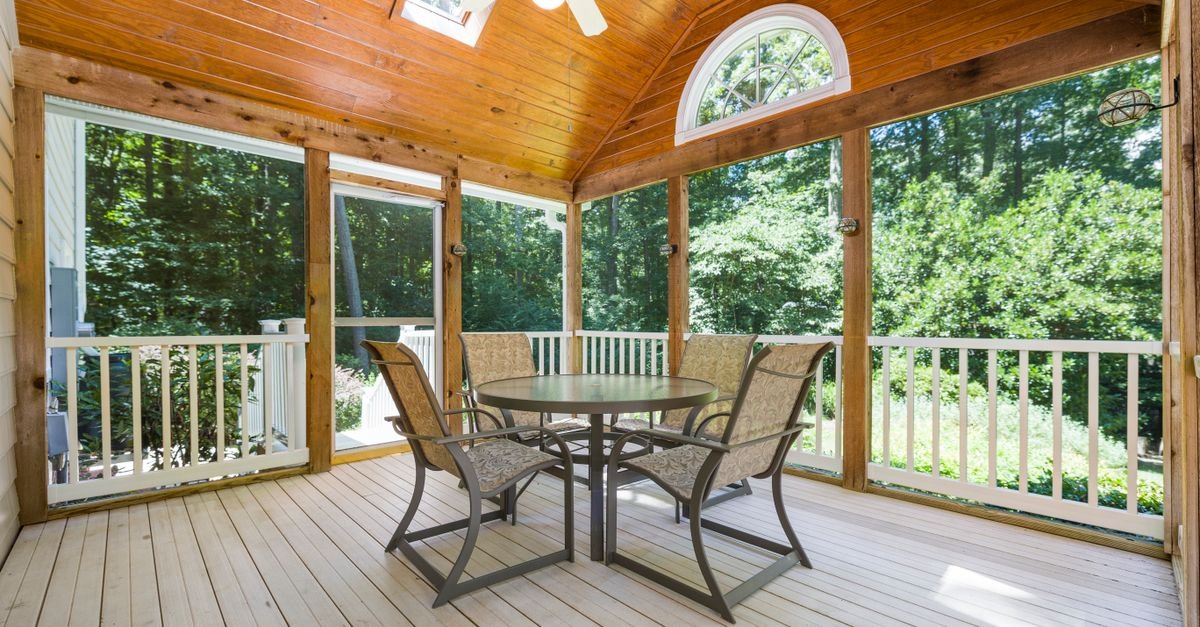
The ceiling is also the part nobody washes, which is why it is usually the dirtiest thing on the porch — webbing, wasp nests and a dusty grey film of whatever the road throws up, on a surface rain never rinses. Take a soft-bristle brush on a pole and a bucket of detergent to it first, then rinse at low pressure with the wand at an angle rather than straight up.
Straight up is worth a specific warning. A porch ceiling is usually beadboard or planking fixed to joists with a void above, and water driven upward into those joints goes into the cavity and does not come back out on any schedule you control. Angle the rinse so it runs across the boards, not into them. If there is a fitting up there, kill the circuit at the breaker and give it a bag and a rubber band rather than a rinse — a porch light is not weatherproof in the direction you are about to spray it from.
Shade Growth vs Sun Growth: What a Covered Porch Actually Grows
Two things control whether anything grows on a building surface: water and light. A study tracking green algae and cyanobacteria on a building through two seasons put it plainly — water availability is the most important factor for these microorganisms to develop, and light is the key factor specifically for the phototrophs. Through a wet, dim autumn and winter, green algae reached 87.1 µg/cm² against 47.3 µg/cm² for cyanobacteria; in the drier, brighter spring both collapsed to around a twentieth of that (building surface study, PMC9987821).
Wet and dim is a covered porch’s permanent condition, which is exactly what green algae and mildew prefer. The black streaking on the roof above is a different organism in a sunnier job, and it stays up there. Your porch gets the green and the grey-black fuzz instead.
Before you mix anything, find out whether the dark patch is even alive. The USDA Forest Products Laboratory publishes the cheapest diagnostic in the trade: put two drops of undiluted household bleach on the discoloured area. Mildew bleaches out in a few seconds. Discolouration that does not bleach is probably dirt, extractives bleed or iron stain, and no amount of sodium hypochlorite will shift it (FPL, Finishing of Wood).
If it is mildew, FPL’s mix is one part household bleach to five parts warm water, never stronger than one to three. Use powdered detergent in it, never liquid — liquid detergents can contain ingredients that react with bleach to give off toxic fumes. Five to ten minutes of dwell, kept wet, does more than any nozzle change you were considering.
Power Wash Porch Boards at Paint Pressure, Not Wood Pressure
Here is where most porches get ruined. Someone reads 500 to 600 PSI for softwood in a deck article, assumes a gas machine backed off a bit will be close enough, and takes the paint off in a stripe. A painted porch floor is not softwood — it is a paint film sitting on softwood, and the film is the weak part. Published guidance puts painted wood at 500 to 800 PSI with a 40-degree tip, and that ceiling assumes the paint is sound. Where the film has already lost adhesion, the number that removes it is far lower, because you are not cutting paint, you are peeling something that had already let go.
| Porch element | Starting PSI | Tip | Notes |
| Painted tongue-and-groove floor | 500–800 | 40° | Sound paint only; test an out-of-sight board |
| Bare or previously stripped floor boards | 500–600 | 40° | Softwood furs above this |
| Painted railings, posts, balusters | 500 (or hose) | 40° | Detergent and a brush is faster than the wand |
| Beadboard ceiling | Garden hose | 40°/soap | Angle across the boards, never up into joints |
| Screens and screen frames | Garden hose only | — | No wand, at any setting |
| Concrete or brick porch slab | 1,000–1,500 | 25° | Watch the mortar, not the brick |
The full breakdown of paint condition, lead-paint testing and what a wand does to a failing film lives in can you pressure wash painted wood. Read it first if your porch floor has paint on it older than you are.
My honest opinion: on a porch the pressure washer is a rinse tool and nothing more. The detergent lifts the mildew, the dwell time does the killing, and the machine carries it away. If you find yourself reaching for a narrower tip, the answer is another five minutes of dwell, not another fifteen degrees of nozzle.
Railings, Balusters and the Problem With Spindles
Railings are where a porch stops being a floor and starts being a furniture-assembly problem. A twelve-foot run with balusters every four inches is something like seventy separate faces, most curved, all painted, none wider than your spray pattern at working distance.
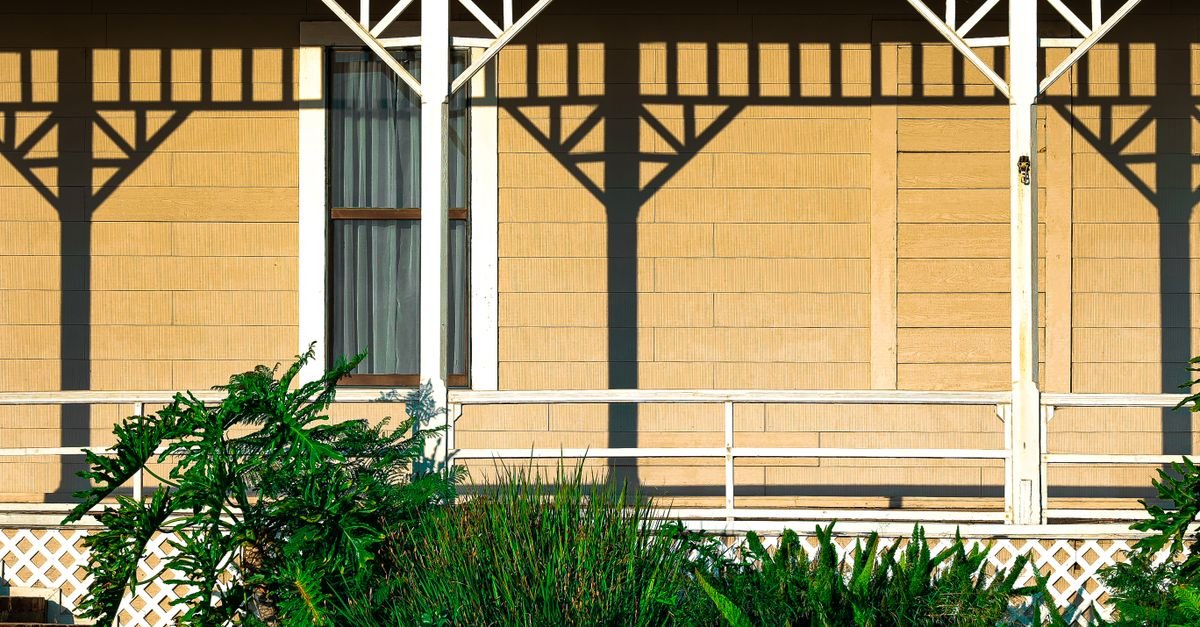
Two things go wrong. The spray simply misses — you can run the wand along a line of spindles and clean the near face of every one while the far face stays exactly as green as it was. And turned balusters have a groove where the profile meets the rail, which holds water; drive a jet into it and the water goes behind the paint at the one joint least able to dry.
So do the rails with a bucket, a brush with some stiffness in it, and the same bleach mix that goes on the floor. Work the detergent bottom-to-top so it does not streak dry paint, let it dwell, then rinse top-to-bottom with the hose. Slower than the wand for the first five minutes, faster for the next forty.
Screens Do Not Take Pressure at All
If the porch is screened, the screens are the one component with no safe pressure-washer setting. Insect mesh is fibreglass or thin aluminium held in a frame by a rubber spline pressed into a groove. It is designed to resist mosquitos, not water at velocity.
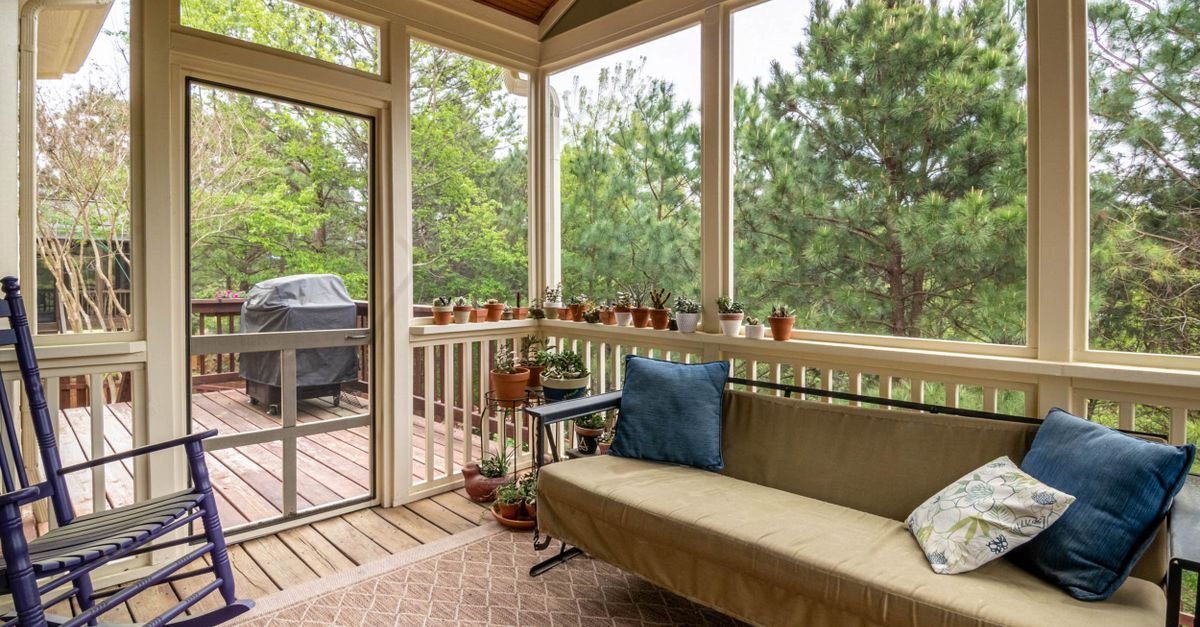
A jet does one of three things, and you find out which only afterwards: punches a hole through the mesh, stretches it so it sags permanently, or lifts the spline out of its groove so the panel goes loose in the frame. None of the three is repairable with a rinse. All three are a re-screen.
Screens get a soft brush, mild soapy water and a garden hose. If they are removable, take them out, lay them flat on a pair of sawhorses, wash both faces and stand them upright to dry where air reaches both sides. That also gets them out of the way for everything else, which is the real reason to do it first.
Your Front Door Is Standing in the Splash Zone
A deck has one side against the house. A porch is usually built around your front door, so the things nearest your spray are a threshold, a weatherstrip, a doorbell, a letterbox slot, a lock, and often an alarm sensor on the inside of the frame.
Wind-driven rain reaches a door at an angle and drains down the face of it. A wand arrives at whatever angle you are holding it, including upward — and weatherstripping is a drainage design, not a seal. Water driven up under a threshold ends up on the subfloor inside.
Tape a bin bag over the doorbell and the lock, keep the wand below the level of the threshold, and never spray toward the house wall. The wall is a separate job with its own rules, covered in cleaning mold from siding — not something to do by accident with overspray from the floor. The border below the porch edge deserves the same thought: soak the plants with clean water before you start a bleach mix and rinse them after, and they will mostly shrug it off.
Is a Gas Machine Safe Under a Porch Roof?
Nobody asks this, because a porch feels like outdoors. It has a roof, sometimes three walls and a screen, and that combination is enough to be a problem.
On 17 May 2012, a 25-year-old boat maintenance supervisor at a Washington State shipyard moved a gasoline-powered pressure washer onto a side deck passageway that had been closed in with plastic tarps, and worked there alone for roughly twenty minutes. A co-worker found him unconscious. He was pronounced dead at the scene, of carbon monoxide poisoning from the engine exhaust (Washington State FACE report 52-44-2018). He was outdoors, on a boat deck, in open air — with tarps around him. Twenty minutes was enough.
A screened porch is not as enclosed as that passageway, and it is not as open as a lawn either. The fix costs nothing: park the machine out on the driveway or the grass, clear of the porch and of any open window, and run a longer high-pressure hose. An electric machine removes the question entirely — and for a job whose ceiling is 800 PSI, electric is already more machine than you need.
Nothing Under a Roof Dries on Schedule
The roof that keeps the porch dry in the rain is the same roof that stops it drying afterwards. No direct sun reaches the boards, air movement under a covered porch is poor, and tongue-and-groove floors have no gaps for water to fall through — so a porch floor that got a proper rinse can still be holding moisture two days later while the deck out the back dried in four hours.
That matters for one reason: paint. If you are washing in order to repaint, the boards need to be dry all the way down, not just dry to the touch, and a porch will lie to you about which it is. A moisture meter costs less than a gallon of porch enamel and removes the guessing; failing that, tape a square of clear plastic tightly to the boards for a few hours and look for condensation underneath. Then help it along — a box fan at one end, pointed along the floor rather than at it, moves more water out of a covered space in an afternoon than a still day does.
FAQ
What PSI should you use to power wash a porch?
Start at 500 PSI with a 40-degree tip on a painted porch floor, and do not exceed about 800 PSI even on sound paint. Railings, posts and ceilings go better with detergent, a brush and a garden hose. A concrete or brick porch slab takes 1,000 to 1,500 PSI at 25 degrees, with the mortar as the limiting factor.
Will power washing strip the paint off a porch floor?
It will if the paint has already lost adhesion, and at pressures well below the published limit for sound paint. Washing does not usually create paint failure — it finds it. If a test patch in a corner lifts flakes at 500 PSI, that floor needed stripping and repainting anyway, and you found out a week early.
Should you power wash a porch ceiling?
Rinse it, do not wash it. Use a soft brush on a pole and detergent, then rinse at garden-hose pressure with the stream angled across the boards rather than driven up into the joints. Beadboard has a cavity behind it, and water forced between the boards has no route back out.
Can you pressure wash porch screens?
No. Insect mesh is held in the frame by a rubber spline pressed into a groove, and a pressure washer will tear the mesh, stretch it, or push the spline out. Screens get mild soapy water, a soft brush and a hose. Take them out and lay them flat if the frames allow it.
Do you wash a porch from the top down or the bottom up?
Apply detergent bottom-to-top so it does not run in streaks over dry surfaces, then rinse top-to-bottom so gravity carries the dirt away from what you have already cleaned. Across the whole porch, the order of operations is ceiling, then posts and railings, then steps, then floor.
What is the best cleaner for a mildewed porch?
For wood, the USDA Forest Products Laboratory recipe: one part 5% household bleach to five parts warm water, never stronger than one to three, with a little powdered detergent. Powdered rather than liquid, because liquid formulations can contain ingredients that react with bleach to produce toxic fumes. Give it five to ten minutes without letting it dry.
How long should a porch dry before painting?
Longer than a deck, and you should measure rather than guess. A covered porch gets no direct sun and very little air movement, and tongue-and-groove boards hold water in the joints. Use a moisture meter, or run a fan along the floor for a day or two, and only open the tin when the boards read dry through rather than dry on the surface.
The Porch Is Four Surfaces, Not One Floor
That is the whole reframe. The moment you stop treating a porch as a small deck and start treating it as a ceiling, a set of railings, a screened wall and a painted floor — four surfaces with four different tolerances — the job becomes obvious. Top-down, chemistry first, lowest pressure that lifts the growth, machine parked out on the drive.
And if you are already standing on a floor with one clean stripe down it and a wand in your hand, the stripe is not the disaster. The disaster is the next forty minutes spent trying to blend it. Back the pressure off, mix the detergent, and do the rest properly.