Last Updated on September 24, 2026 by Umar Farooq
A manual gutter cleaning tool — a moulded scoop, a claw on a pole, a pair of rope-operated tongs — is the only category that reliably removes wet, compacted debris, and it is the category most people skip because it looks too simple to be the answer.
Everything else in that aisle is solving a different problem than the one you have. I went through the top-ranking tool round-ups before writing this, and every one of them sorts the field by how the tool is powered — water, air, suction, hands. That is the wrong axis. The axis that decides whether an afternoon works is what is actually sitting in your gutter, and there are only three answers to that, and only one of them yields to a jet of anything.
Every Gutter Tool Is Solving One of Two Problems
Getting to the debris and getting hold of the debris are separate engineering problems, and almost every tool on the market is excellent at exactly one of them.
Reach is the easy half. A pole is a pole. Extend it far enough and you are standing on the grass looking up at your own gutter, which feels like the whole victory and is about a third of it. The hard half is removal, and removal depends entirely on the state of the material.

There are three states, and they behave completely differently:
- Dry leaf. Low density, high surface area, essentially no cohesion. Individual leaves are easy to accelerate, which is why air and water both move them well.
- Wet leaf pack. The same leaves after a fortnight of rain, matted into a single sheet. Water between the leaves does what water does — it bridges them into one cohesive mat that behaves like a soaked rug, not like a pile of leaves.
- Silt and grit. The bottom layer. Shingle granules, roof grit, pollen and mineral fines, bound into a dense paste that sits below everything else and is adhered to the trough.
That middle state is why so many ground tools disappoint. A jet or an air stream applies force across a surface, and a mat presents one surface and resists as one object. You are not moving a handful of leaves any more. You are trying to slide a soaked rug uphill by blowing on it. The mat is also heavy enough that the force required climbs while the grip available goes to nothing, because the top of it is slippery and the bottom is glued down.
Meanwhile the silt layer is unimpressed by all of it, and will still be there when the leaves are gone.
So before choosing a tool, go and look in the trough — from the ground with a phone on a pole, from an upstairs window, or from the ladder you will end up on anyway. If what you see is loose brown fluff, half the aisle works. If what you see is a flat grey-green sheet that holds its shape when you poke it, one part of the aisle works.
The Scoop Is Still the Only Thing That Moves Wet Pack
A gutter scoop is a moulded plastic blade with two raised sides and a squared leading edge, roughly the width of a K-style trough, on a short handle. That is the entire product. It costs less than a takeaway and it is the most capable thing in this article.
The geometry is doing real work. The squared leading edge slides between the silt and the mat rather than riding over it, which is the difference between a shovel and a rake. The raised sides mean that once material is on the blade it stays there over the distance you have to move it. A garden trowel has neither feature: a pointed tip that punctures instead of separating, and no sides at all, so a trowel-load of wet pack arrives back in the gutter about eight inches from where it started.
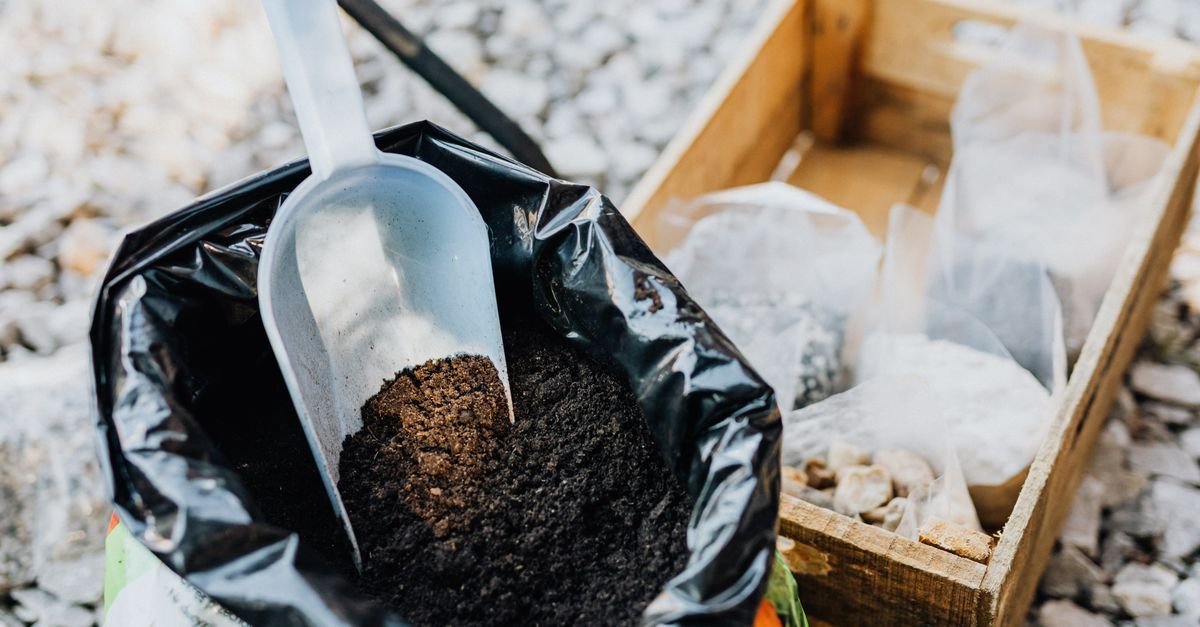
Plastic, not metal, and this matters more than it sounds. Residential gutter is thin coated aluminium — the coil is around 0.027 inches — and that coating is the entire corrosion strategy. A steel blade scores through it, and every score is a line where bare aluminium sits under wet silt for the rest of the gutter’s life. A plastic blade skids across the coating and flexes to the trough profile instead of gouging it.
If you want the cheapest possible version, you already own it: the bottom four inches of a two-litre bottle, cut on an angle, gives you a squared edge and raised sides. That is genuinely the same tool with worse ergonomics. I would rather tell you that than pretend the proper one is magic. Buy the proper one anyway, because the handle starts to matter around the fourth metre, but do not let the lack of one stop you starting this weekend.
The limits are honest ones. A scoop is a contact tool, which means the scoop has to get to the gutter, which usually means you do too. And a scoop leaves the silt film behind — that comes off with water, which is a later section.
Where a Manual Gutter Cleaning Tool Beats a Powered One
Here is the whole field, sorted by the thing that matters rather than by how it plugs in. Read the wet-pack column first; it is the one that decides your Saturday.
| Tool type | How it removes material | Dry leaf | Wet pack | Silt layer | Works from the ground |
| Hand scoop | Blade under, lift out | Excellent | Excellent | Good | No |
| Scoop or claw head on an extension pole | Blade under, drag toward you | Good | Fair — you lose the lifting angle | Poor | Yes, to about 20 ft |
| Rope-operated tongs on a pole | Two jaws close on the mat and grip it | Fair — too loose to grab | Excellent — the mat is one object | Poor | Yes, to about 20 ft |
| Telescoping garden-hose wand | Water flow pushes material along the trough | Good | Poor — pushes the mat into the outlet | Good, once bulk is gone | Yes, to about 12 ft |
| Pressure washer curved lance | High-velocity jet, same mechanism, more force | Good | Poor, and now it is airborne | Excellent | Yes, with an extension |
| Wet/dry vacuum gutter kit | Airflow lifts and carries material up a tube | Good | Poor — the mat will not fragment | Fair when dry | Yes, to about 15 ft |
| Leaf blower gutter attachment | Air stream displaces material over the lip | Excellent | None at all | None | Yes, to about 12 ft |
The pattern is not subtle. Every tool that works by moving a fluid past the debris does well on dry leaf, badly on wet pack, and variably on silt. Every tool that works by putting a physical surface under or around the debris does well on wet pack and cannot reach as far.
So here is my one opinion on this page, and it will annoy anyone selling a kit: this category is sold on reach and judged on reach, and reach is the half you can solve with a stick. The half you are actually paying to solve is grip, and no amount of money buys grip at fifteen feet. A $200 vacuum kit and a $12 scoop are equally useless against a wet mat the vacuum cannot break up — the difference is that the scoop told you so honestly and left you with $188.
What I would buy, in order: a scoop, a bucket with a hook on it, and a pair of tongs on a pole if your gutters are above a single storey. That is under fifty dollars and it covers wet pack, dry leaf and the awkward second-storey run over the conservatory. Everything below this line is about the rinse, which is the last twenty per cent of the job and the part where a pressure washer genuinely helps.
Curved Lances, Telescoping Wands and What Water Can Actually Push
Two different products get described as gutter wands and they are not in the same weight class, so it is worth separating them before deciding whether either belongs in your hands.
The telescoping garden-hose wand is a light aluminium or plastic pole, typically extending from around 40 inches to 70 inches in the cheap ones and considerably further in the better ones, with a U-shaped or rotating head on the end. It runs on mains water pressure — call it 40 to 60 PSI at a domestic tap — and it is best understood as a hose you can aim upward without climbing.
The pressure washer gutter attachment is a rigid curved lance, usually with a quick-connect fitting, that goes on the end of your wand or on a telescoping extension. Same shape, roughly fifty times the pressure.
Both work the same way: the curve puts a nozzle above the trough, pointing down and along the run, and water carries material toward the outlet. That mechanism is excellent on the silt film and on loose dry material. It is poor on a mat, and the failure mode is specific. A jet does not lift a wet mat out of a gutter. It slides it along the trough, intact, until it reaches the outlet, where it stops and becomes a plug — and you have converted a problem you could see into a problem you cannot. The downspout was working fine before you started.
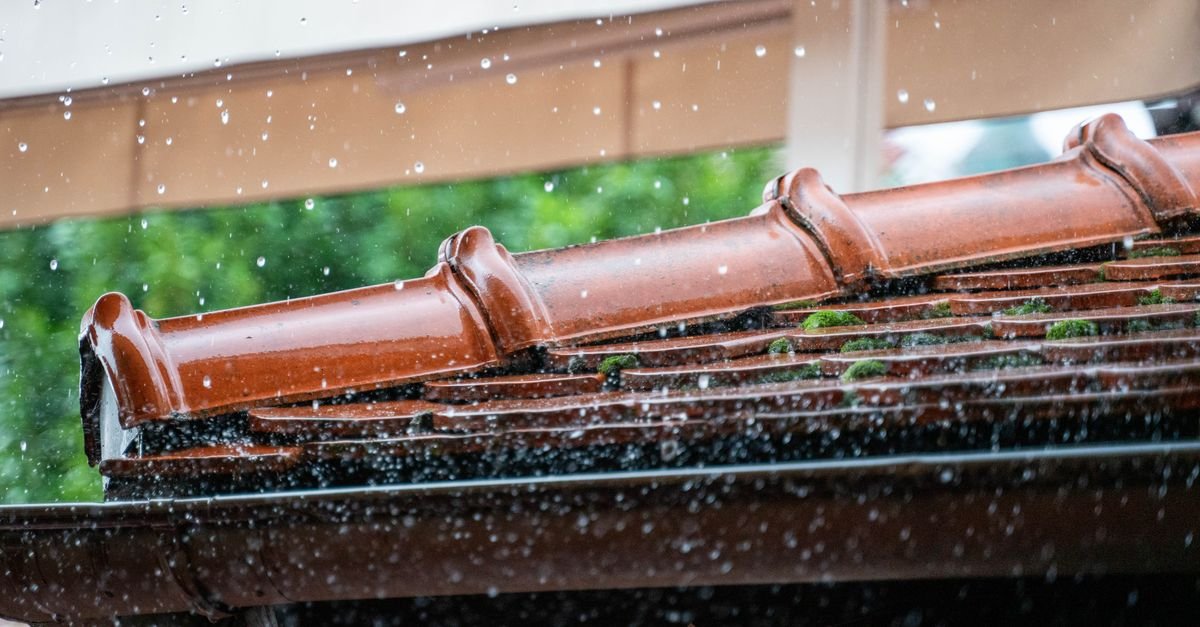
On the pressure side, keep the numbers in view. The outside face of a gutter is painted aluminium, which sits with painted surfaces generally around 500 to 800 PSI with a 40-degree tip. Gutter manufacturers do not publish a limit the way decking manufacturers do, so that figure is an analogue rather than a spec — but it is a great deal closer than what your machine makes at idle. The joints are where it actually goes wrong: every miter, end cap and outlet is held watertight by a bead of sealant, and a concentrated jet worked repeatedly along a joint line will eventually find the edge of it. The pressure washer nozzle chart covers which tip does what. The short version for a gutter is white, or nothing.
Two more things that never appear in the product copy.
First, a lance on a long extension is a lever, and the reaction force at the nozzle acts at the far end of it. A pressure washer wand produces genuine recoil the instant the trigger goes, and absorbing that at the end of twelve feet of pole above your head is a different physical proposition from absorbing it at arm’s length. Long extensions also cost you pressure through the added run, which is covered in pressure washing hose — a hundred feet of skinny bore will quietly take the edge off the very jet you bought the attachment for.
Second, everything the jet removes has to land somewhere, and somewhere is you, the wall you were planning to wash next, and the flower bed. There is no version of this where the debris politely exits the downspout. I have read a lot of cheerful copy about clearing gutters from the ground with a jet and not one line of it mentions that you will be wearing the gutter.
The one thing you must never do with a lance is angle it up under the bottom course of shingles to reach the black streaking. The Asphalt Roofing Manufacturers Association says plainly that high-pressure washing systems are likely to damage asphalt roofing and should not be used, and the grit in the bottom of your gutter is the evidence — those granules used to be on the roof. Shingles are lapped to shed water downhill. Aim up-slope and you are putting water under the laps.
Suction Falls Off Faster Than Anyone Tells You
A wet/dry vacuum gutter kit is a set of rigid tubes, usually with an adapter that steps your 2.5-inch vacuum hose down to something around 1.25 inches, plus a curved end piece that hooks over the gutter lip. On paper it is the perfect tool: it removes material rather than relocating it, and it works from the ground.
In practice it is governed by two numbers that shop vacuums advertise badly. Sealed suction, often given as water lift in inches, is how hard the machine can pull. Airflow, in CFM, is how much air it can move. Lifting debris up a tube needs air velocity, velocity needs airflow, and airflow is exactly what long narrow tubing destroys.
Step a 2.5-inch hose down to 1.25 inches and the cross-sectional area drops to about a quarter. Then add twelve to eighteen feet of that narrower tube, with a bend at the top. Friction loss climbs steeply with length and brutally as diameter falls, so the machine that happily inhaled a workshop floor is now working through a straw with a corner in it. Suction at the business end is a fraction of what the box implied, and the box was not lying — it was measured at the machine.
What that means at the gutter:
- Dry leaf and pine needles: works, and works pleasantly. Needles in particular, which defeat most other ground tools, go up a tube happily.
- Wet pack: no. The mat will not fragment into pieces small enough to enter a 1.25-inch opening, and the first piece that half enters seals the tube.
- Silt when dry: fair. Silt when wet: you are now doing wet pickup, which means pulling the paper filter out or destroying it, and running a slurry through eighteen feet of tube that will clog at the first bend.
- Anything with a twig in it: the twig arrives at the step-down and stops, and so does everything behind it.
There is also fifteen feet of rigid tube to hold above your head, which sounds trivial until the third section. The weight is not the problem. The moment arm is.
Tongs on a Pole Are Better Than They Sound
The rope-operated gutter tong looks like a novelty and is the most underrated thing in this article. Two curved scoop-shaped jaws sit at the top of a pole, a cord runs down to a handle, and pulling the cord closes the jaws.
The reason it works is the exact reason the wands fail. A wet mat is cohesive — that is its defining property, and it is what makes it immune to air and water. Cohesion also means the mat comes out in one piece if you can get hold of it, and two jaws closing on a soaked sheet of leaves is about as good a grip as anything in the trade. The property that defeats every fluid-based tool is the property that makes this one easy.
It is also the only ground-level tool with an honest claim on the second storey, because it needs neither a water line nor a power cord, and the pole can simply be longer.
The real limits, none of which are in the marketing:
- You are working blind. You cannot see whether the jaws closed on debris or on the gutter lip, and you certainly cannot see the silt layer underneath, which you will not be removing.
- Bite volume is small. A forty-foot run is a lot of individual grabs, and each grab is a pull-lower-release-raise cycle.
- It hates dry leaf. Loose dry material is not cohesive, so the jaws close on a third of what was there and the rest falls back in. The tool that owns wet pack is mediocre at the easy job.
- The lever arm is against you. A wet handful at the end of twelve feet of pole is a load on your wrists out of all proportion to its weight.
The fix for the blindness costs nothing. Tape a phone to a spare pole, put it in video mode, and walk the run before and after. Ten seconds of footage tells you whether the trough is actually clear, which is the one question none of these ground tools can otherwise answer. That single trick is the difference between cleaning your gutters and believing you cleaned your gutters.
The Ladder You Are Trying to Avoid Is Also the Honest Answer
This whole product category exists because of one risk, so it deserves a real number rather than a paragraph of caution.
A prospective study followed 134 ladder-fall patients at two emergency departments for six months. Seventy-one per cent of the injuries happened in non-occupational settings — this is a home injury, not a trade one — and of the falls that happened at home, 78% were outdoors. Eighty-six per cent were falls from more than a single metre. At six months, 49% of the group reported a clinically significant deterioration in quality of life (PMC7310734). Half of them. Six months later.
That is the risk these tools are sold against, and it is a real risk, honestly stated. But the pitch quietly overstates how much of it the tools remove, so here is the honest version in both directions.

Ground tools genuinely reduce ladder exposure. Four trips up in a year becomes one, or in a good year none. That is a meaningful reduction and it is worth paying for if the ladder is the part of this job you have been putting off.
Ground tools do not eliminate it. A branch across the trough, a plug set solid in the outlet, a hanger that has let go — those need a hand at the gutter, and no pole solves them. Anyone promising otherwise has not met a silver maple.
And there is a trap in the middle that is worse than either option on its own. Using a long pole tool *from* a ladder combines both risks and adds a third. NIOSH lists the frequent causes of ladder-fall injuries as “overreaching, carrying objects, applying excessive force, slips, and missteps” (NIOSH Ladder Safety App), and a fifteen-foot extension pole with a wet load on the end is the first three of those at once. If you are on the ladder, use the short scoop. The pole tool is for when your feet are on grass.
So the decision is simpler than the aisle makes it look. Single storey, steady on a ladder, gutters you can see into: buy the scoop, skip the rest, own the twenty minutes. Two storeys, or a roof you cannot reach safely, or you are squarely in the demographic that study describes — the honest answer is not a longer pole. It is tongs for the maintenance passes and someone with proper access equipment for the annual one. A contractor costs money once a year. Half a year of degraded quality of life is not a price anyone quotes you in advance.
FAQ
Can you really clean gutters from the ground without a ladder?
Partly, and it depends entirely on what is in them. Dry leaf and pine needles come out from the ground very well with a vacuum kit or a hose wand. Wet compacted pack comes out from the ground only with rope-operated tongs, and only if you accept that the silt layer stays. Nothing from the ground clears a solid plug in the outlet or moves a fallen branch. Treat ground tools as a way to cut the number of ladder trips, not to reach zero.
What is the best manual gutter cleaning tool for wet leaves?
A moulded plastic scoop if you are at the gutter, and rope-operated tongs if you are on the ground. Both work because they put a physical surface under or around the mat. A wet leaf mat is cohesive, which is precisely why jets, blowers and vacuums slide off it or fail to break it up, and precisely why two closing jaws lift it out in one piece.
Does a pressure washer gutter attachment actually work?
It works well at the last stage and badly at the first. Once the bulk is out, a curved lance strips the silt and granule film a scoop leaves behind and rinses the outside face. Used on a full gutter it pushes a wet mat along the trough into the outlet, which turns a visible problem into a hidden one. Clear it by hand first, then rinse.
Can I fit a gutter attachment to any pressure washer?
Usually, since most use a standard quarter-inch quick-connect, but check two things beyond the fitting. Your machine’s GPM sets how much material the water can actually carry away, and a long extension plus a long hose run costs you pressure at the tip. If you are already at the limit of your hose length, adding twelve feet of rigid lance will be noticeable.
Will a leaf blower gutter kit save me buying anything else?
Only if your gutters are genuinely dry when you do it. A blower kit is the fastest tool in this article on dry autumn leaf and completely useless three days after rain. It also relocates rather than removes, so the debris lands on the roof, the wall and the beds, and a fair share of it drifts straight back in. It is a supplement to a scoop, not a replacement for one.
Is a gutter scoop better than a trowel?
Yes, and the reason is geometry rather than quality. A scoop has a squared leading edge that separates the mat from the silt, and raised sides that hold the load while you move it. A trowel has a pointed tip that punctures and no sides, so it carries almost nothing. A trowel is also usually metal, which scores the trough’s coating and starts corrosion you will not see for years.
How long should a gutter cleaning pole be?
Shorter than you think. Useful working reach for a hand-operated pole tool tops out around eighteen to twenty feet, and well before that the lever arm makes precise work impossible — you are holding a wet load at the end of a lever and aiming it at a four-inch target above your head. If the gutter is higher than that, the tool is not the answer. Access equipment is.
Two Tools, One Bucket, and a Realistic Afternoon
The aisle wants you to pick a system. The job wants two things: something with a squared edge and sides to get the material out, and something with water in it to take away what is left. A scoop and a hose cover both, and a pair of tongs covers the height. Everything else in the category is a more expensive way of doing one of those two jobs slightly worse — with the occasional exception of a vacuum kit under a pine tree in a dry week, where it is genuinely lovely.
The attachments worth owning are the ones that change what the machine can do rather than where it can point. A surface cleaner does that for concrete. A curved lance does not do it for gutters. It just lets you aim the same jet upward, and the jet was never the part that was struggling.
If you are at the window right now looking at a gutter with a green stripe along the top of it, and there is a pole tool in the shed that has never quite worked — it is not you. It was never going to lift that. Go and get the scoop.