Last Updated on September 25, 2026 by Umar Farooq
Baking soda for cleaning concrete is a weak option for almost every stain you will find on a slab — not because it is gentle, but because the two things it is physically capable of doing are both feeble, and neither of them is the thing a driveway stain actually requires.
That is not the answer the internet gives, and I understand why. Baking soda is in the cupboard, it costs about a pound a box, and it is the one cleaning product nobody is frightened of. It is also the only thing under your sink that will make a cake rise, which should have been the first clue about how hard it is willing to work.
So rather than hand you another recipe with a cup of this and a squirt of that, here is what sodium bicarbonate actually is, what those properties let it remove, what they cannot touch however long you scrub, and the one version of it that genuinely strips concrete — which is not the one in your kitchen.
Two Properties Do All the Work, and Neither Is Strong
Sodium bicarbonate brings exactly two things to a slab: a small amount of alkalinity, and a small amount of grit. Everything written about it downstream of that is a consequence of those two numbers.

The alkalinity first. PubChem, citing the Merck Index, puts a freshly prepared 0.1 molar solution at 25 degrees C at pH 8.3, and a 1% solution somewhere between 8.0 and 8.6 (PubChem, Sodium Bicarbonate). Put that next to what the job needs. A heavy-duty concrete degreaser is formulated above pH 11. Household bleach sits around 11 to 13. Because pH is logarithmic, a degreaser at 11 carries roughly five hundred times the hydroxide concentration of your baking soda solution. That is not a slightly weaker version of the same product. It is a different category of chemical wearing the same white powder costume.
Then the grit. ARMEX — Church and Dwight’s own blasting-media division, so about as close to a primary source as this gets — states that baking soda “rates 2.5 on the Mohs scale of hardness, just above talc and well below traditional blasting abrasives such as silica sand, mineral slags, and glass beads” (ARMEX, Sodium Bicarbonate: The Softer Blasting Abrasive). Talc is the mineral we define as “scratchable with a fingernail.” Baking soda is one notch up from that.
Two weak properties. That is the entire toolkit, and the rest of this page is just working out what a weak alkali and a very soft abrasive can honestly be expected to shift.
Softer Than Every Single Thing in Your Slab
Here is the part that decides most of it. A concrete driveway is cement paste holding sand and stone. The calcite in that paste sits around 3 on the Mohs scale; the quartz sand and the aggregate sit around 7. Baking soda is 2.5. It is softer than every component of the surface you are kneeling on.
That cuts both ways, and the good half is genuinely good. Baking soda cannot etch a slab. It cannot decalcify cement paste, it cannot open up the pore structure, and it cannot leave a pale ghost of the cleaned area that outlives the stain you were chasing. Compared with the acids and oxidisers people reach for on concrete, that is a real and underrated safety margin. If you have an unidentified mark on a stamped patio and you want to try something that cannot possibly make it worse, this is the powder.
The bad half is the same sentence read the other way. An abrasive can only remove things softer than itself. Rust is iron oxide, harder than bicarbonate. A cured paint film is bonded, not loose. Tyre rubber is plasticiser that has migrated into the pores. Hard-water scale is a mineral deposit with more structure than the powder you are attacking it with. None of these is going to yield to something one grade above talc, and no amount of elbow changes the hardness comparison — it only changes how tired you get.
Then there is the problem nobody mentions in the recipes. Sodium bicarbonate dissolves readily in water. The blasting trade counts that as a feature, because spent soda rinses out of machinery instead of clogging it. On a driveway it means that the moment you add enough water to spread the stuff around, you have dissolved a good share of your abrasive and are now scrubbing with a mildly alkaline solution and a brush. Which is fine — the brush was doing most of the work anyway.
So the realistic abrasion list is short and it is all films rather than stains: a greasy dust layer on a garage step, soot on a fire pit surround, the dull organic film on a shaded path. Anything sitting loosely on top, held on by nothing much. If the mark has soaked in, hardness never enters the conversation, because you cannot abrade something that is four millimetres below the surface.
Is a Baking Soda Paste Worth the Arm on Grease?
Short answer: on a cured oil stain, no, and the dish soap in every version of that recipe is the only ingredient doing anything. On a spill that is still wet, yes — but for a completely different reason than the one the recipe gives.
Lifting oil off concrete takes two mechanisms. Saponification converts fats into soap, and that needs real alkalinity — the kind that lives at pH 11 and above, which is why degreasers are formulated there. Emulsification wraps what is left in surfactant so water can carry it off, and that needs a surfactant. Bicarbonate at 8.3 does not reach the first, and it contains none of the second. Motor oil makes it worse still, because it is a hydrocarbon rather than a triglyceride — there is nothing in it to saponify at any pH. That is a chemistry problem, not an effort problem, and it is covered properly in the guide to whether pressure washing removes oil stains from concrete. For where bicarbonate sits among the families of cleaner that do work, the rundown of power washing chemicals has the map.
The poultice idea deserves its own paragraph, because it is the most plausible-sounding claim on this topic and it is built on a real technique. A genuine poultice works by holding a solvent against the stain long enough to dissolve it, then drawing the dissolved material up into an absorbent carrier as the solvent evaporates. The carrier is the sponge; the solvent is the tool. In a baking soda paste, the solvent is water — and oil does not dissolve in water. So the mechanism has nowhere to start. What you get after four hours is dry baking soda that you sweep up, and a stain that looks slightly lighter because the surface around it is now clean. A poultice with the wrong solvent is a pile of powder having a nap on your stain.
The wet-spill case is different and it is legitimate. Tip a generous layer over fresh oil, tread it into the texture, and it absorbs — exactly the way cat litter, sawdust or cornmeal do, by capillary action into a powder bed. That is absorbency, not cleaning, and it is worth doing within the first minutes because whatever you soak up now never has to be removed later. Clay litter is cheaper per pound and holds more. Baking soda’s only advantage is that it is already open on the counter.
Where Baking Soda for Cleaning Concrete Actually Earns Its Place
Three jobs, and I want to be clear that these are not consolation prizes. On each of them, being weak is the specification rather than the shortfall.
Soaking up a fresh spill. Covered above. The window is minutes, the mechanism is absorbency, and there is no chemistry involved at all.
Acidic smells. This is the use that made the brand, and on concrete it works for a narrow and specific reason: bicarbonate neutralises volatile acids, which is what most sour smells are. Spilled milk gone off in the boot of a car, the residue under a wheelie bin, vomit on a garage floor — those are short-chain fatty acids, and a mild base genuinely converts them into salts that do not evaporate and therefore do not smell. Be equally clear about the limit: it does nothing for alkaline odours. Cat urine that has broken down to ammonia is a base already, and putting a base on it is a way to spend an afternoon. Dog urine on a slab passes through both stages, which is why baking soda helps for about a day and then the smell returns. You need an enzyme product for that, not a pH adjustment.
Neutralising after an acid treatment. This is the one place where pH 8.3 is precisely the point. If you have acid-washed a slab and the run-off cannot be flooded away, you need something that will bring the surface back toward neutral and then stop. A strong base would overshoot and leave you with the opposite problem. A dilute bicarbonate rinse — a couple of ounces to a gallon of water, a few minutes, then clear water — parks near neutral because bicarbonate is a buffer, not a bludgeon. Check it with a pool pH strip before you seal or stain anything.
Notice what is missing from that list. No stain. Not one. Everything baking soda is good for on concrete is either absorbing a liquid before it becomes a stain, deodorising something that is no longer visible, or cleaning up after a stronger chemical did the actual work.
Soda Blasting: Same Powder, 60 PSI and a Nozzle
Which raises the obvious objection: people strip paint and grease off concrete with sodium bicarbonate professionally, and they do it well. So why does the industrial version work when the kitchen version does not?
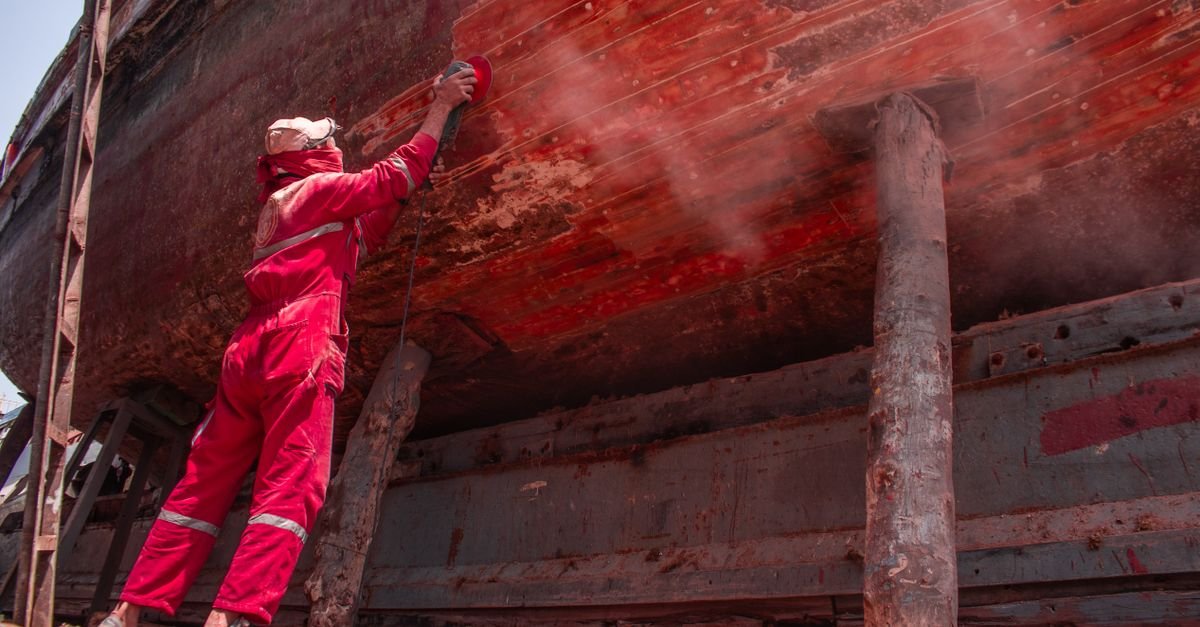
Because the cleaning is not being done by the powder. It is being done by kinetic energy, and the powder is only the delivery vehicle. ARMEX describes the mechanism precisely: delivered “under relatively low pressure, but high velocity, specially formulated sodium bicarbonate crystals shatter upon impact, delivering their energy along the substrate rather than into it.” That last phrase is the whole trick. The crystal fractures on arrival and dumps its energy sideways, which shears a coating off the surface instead of cutting down into it. That is why the same 2.5-Mohs powder that cannot mark aluminium will still take paint off it.
A crystal travelling at blasting velocity carries orders of magnitude more energy than the same crystal under your thumb. Nothing you can do by hand gets within sight of it, and that gap is not one you close with a stiffer brush.
It also has a genuine professional advantage that has nothing to do with cleaning: soda is silica-free. CPWR notes that “milder blasting media like dry ice, baking soda, sponges, and water jets are silica-free and designed to minimize the dust created when the blasting medium strikes the surface” — which matters enormously, because sand blasting generates respirable crystalline silica and that causes silicosis. It is still blasting, mind you. OSHA “requires a type CE NIOSH-certified blasting airline respirator with positive pressure blasting helmet” for any type of blasting, soda included (CPWR Construction Solutions, Abrasive Blasting Media That Reduce Exposure to Silica).
Now the part I want to be blunt about, because it is the search people make next. You cannot do this with a pressure washer. Soda blasting is a compressed-air process with a dedicated pot, a metering valve and a blast nozzle, and the wet-soda versions use a purpose-built head. Feeding bicarbonate through a downstream injector or, worse, a pump means pushing an abrasive slurry through precision valves and seats that are machined to tolerances measured in thousandths. And even if the machine survived, the water would dissolve most of the crystals on the way, so what arrives at the surface is a weak alkaline solution and no abrasive whatsoever. You would have paid for a pump rebuild to apply pH 8.3 water.
The White Film You Have to Rinse Off Afterwards
The last practical thing, and the one that catches people out on decorative slabs: bicarbonate that dries in place leaves a white alkaline bloom. It looks, with real comic timing, quite a lot like the efflorescence a fair number of people were trying to remove in the first place.
It rinses off with plain water, so this is a nuisance rather than a disaster — but it has to be a deliberate step rather than a final wave of the hose. Flood it, work from the low edge upward so the run-off never crosses clean surface, and go a foot or two past where you were working. Concrete flatwork will take 2,500 to 3,000 PSI with a 15 or 25-degree tip if you are rinsing with a machine, and the full set of PSI figures for a concrete driveway is worth a look first, though after something this mild you will not need anything close to the top of that range.
Two reasons it matters beyond appearance. If you intend to seal, coat, stain or paint the slab, a residual alkaline film sits between your coating and the concrete and affects adhesion — and acid-based concrete stains will react with it and give you a patchy result. Rinse properly, let it dry, and check with a pH strip if the job is going anywhere near a finish. And keep the run-off off planting beds where you can: what you are washing away is a sodium salt, and sodium is specifically the ion that degrades soil structure. A small domestic quantity is not an environmental event, but there is no reason to aim it at the roses.
FAQ
Does baking soda damage concrete?
No, and this is its one clear advantage over almost everything else people put on a slab. At Mohs 2.5 it is softer than the cement paste and far softer than the sand and stone in the mix, so it cannot abrade the surface. At pH 8.3 it is nowhere near alkaline enough to attack the binder, and unlike an acid it cannot dissolve calcium out of the paste. The only thing it leaves behind is a white alkaline film if you let it dry, and that rinses off with water.
How long should you leave baking soda on concrete?
For absorbing a fresh spill, an hour at minimum and overnight if you can, because the mechanism is capillary wicking and it is still working while you sleep. For anything you are scrubbing, dwell time changes almost nothing — a weak alkali that is not strong enough to saponify oil at five minutes is not strong enough at fifty either. What matters there is agitation, not patience. Do not let a paste bake dry in the sun, because you will be sweeping up crust instead of rinsing off slurry.
Will baking soda remove oil stains from a driveway?
Not a cured one. Removing oil needs saponification, which requires roughly pH 11 or above, and emulsification, which requires surfactant; bicarbonate has neither. It absorbs a wet spill very well, and every recipe that seems to work on a stain contains dish soap, which is the ingredient actually providing the surfactant. Use a proper alkaline degreaser with real dwell time and a stiff nylon brush instead.
Can you use baking soda on sealed or stamped concrete?
Yes, and it is one of the few things you can. Decorative finishes, acrylic sealers and polished slabs are ruined by acids and dulled by strong alkalis, and bicarbonate is too weak to be either. Use it as a solution rather than a dry-scrubbed paste so you are not dragging grit across a gloss surface, rinse thoroughly, and spot-test out of sight first as you would with anything.
Does baking soda kill algae or mould on concrete?
It knocks back some surface growth and removes none of the colour, which is the same as saying it does not clean it. Black and green staining on a slab is pigment sitting in the pores, and dead algae is exactly as dark as live algae. Lifting organic colour takes an oxidiser, and bicarbonate has no oxidising ability at all. It also does not sterilise the surface, so anything it does suppress comes back with the next wet fortnight.
Is baking soda or washing soda better for concrete?
Washing soda, by a wide margin, if cleaning is the goal. Sodium carbonate is a meaningfully stronger alkali — it will lift light grease that bicarbonate cannot touch, and it is an ingredient in plenty of commercial concrete cleaners for that reason. It is also correspondingly harsher on skin and on sealed finishes, so gloves are not optional and a test patch is. Bicarbonate remains the better choice for the neutralising rinse, precisely because it is weak enough to stop near neutral.
Can I put baking soda in my pressure washer’s detergent tank?
No. Undissolved crystals are abrasive slurry heading for an injector, a pump inlet and a set of valves with tolerances in thousandths of an inch, and anything that does dissolve is pH 8.3 water with no surfactant in it. There is no version of this that cleans, and there is a plausible version that costs you a pump. Use a detergent formulated for downstream injection, with the black soap nozzle fitted so the injector can draw at all.
Reach for the Box When Something Smells or Spills
The reason baking soda stays on every household cleaning list is that it is the only product people already own which cannot hurt anything — and “cannot hurt anything” turns out to be a fairly precise description of “cannot do anything.” At pH 8.3 it is roughly five hundred times less alkaline than the degreaser the job wants. At 2.5 on the Mohs scale it is softer than every mineral in your slab. Those two facts are also the two reasons it is safe, which is a genuinely awkward thing for a cleaning product to have on its record.
Keep it for what it is good at. It absorbs a fresh spill before that spill becomes a six-month problem. It neutralises sour smells that nothing else in the garage will touch. It brings an acid-washed slab back to neutral without overshooting. Those are three real jobs and it does all of them better than the alternatives.
For everything else, buy the strength the stain requires: an alkaline degreaser for oil, an oxidiser for organic colour, oxalic acid for rust. And if you have already spent a Saturday on your hands and knees with a cup of bicarb and a cheerful article about non-toxic cleaning — nothing has been damaged, which is more than several of the alternatives could have promised. Rinse it down, put the box back, and let it get on with the job it was always better at, which is quietly absorbing the smell of whatever is at the back of the fridge.