Last Updated on September 26, 2026 by Umar Farooq
Removing pollen is not stain removal and it is not degreasing — it is moving a few billion small hard shells off a surface, and because nothing in your garage dissolves them, the whole job comes down to how much water you can get to run across the surface and how good your timing is.
That sounds like a small distinction. It is the difference between a wash that lasts until August and one you repeat next Thursday.
I went looking for what pollen actually is, chemically, because every page I read asserted that it sticks and none of them said what it was made of. The answer changed the method. So this page is the chemistry, then the timing, then where the machine helps and the two places it makes things worse.
Removing Pollen: You Cannot Dissolve What Boiling Acid Ignores
Start with the grain. A pollen grain is a living cell inside a two-layer wall, and the outer layer — the exine — is built from a polymer called sporopollenin. It is the reason pollen turns up intact in lake sediment tens of thousands of years old, and it is described in the materials literature as “one of the most chemically inert biopolymers.”
That phrase is doing a lot of work, so here is what it costs to get through it in a laboratory. Researchers who want clean, empty sporopollenin shells for drug delivery and encapsulation have to strip everything else off the grain, and the published protocols for doing it are not gentle: 85% phosphoric acid at 90 to 95 °C for five hours, or 10% potassium hydroxide at the same temperature for five hours, with the material shaken every hour (Facile isolation and analysis of sporopollenin exine from bee pollen, *Scientific Reports*). The shell is what is left afterwards. That is the point of the procedure.
So the honest position on chemistry is unusual for this site, and it runs against the advice I give on nearly every other page. There is no cleaner, acid, alkali or oxidiser sold for domestic use that attacks the thing you are trying to remove. Bleach does not bleach it, because there is no pigment problem to bleach. Degreaser has nothing to emulsify beyond a trace of coating. An acid brightener is aimed at minerals and metal oxides, and a sporopollenin shell has ignored worse.
What a detergent genuinely does here is wet the deposit and hold the grains in suspension long enough for water to take them somewhere else. That is worth doing — a surfactant lowers surface tension so the rinse gets under a dry film instead of beading on top of it, and it stops the suspended grains dropping straight back out as the water slows. But it is a transport aid, not a solvent, and anything sold as a dedicated pollen remover is a surfactant with a season printed on the label.
Which means the useful number on your machine is the one nobody reads. Pressure breaks a bond; there is barely a bond here until you make one. Flow carries material away, and this is a carry-away job from start to finish. A 1,600 PSI machine at 1.4 gallons a minute will clear a pollen-covered wall faster than a 3,000 PSI machine at the same flow, because the deciding factor is the volume of water crossing the surface per minute, not the force at the tip. Put the white 40-degree tip on and leave it there.
The Water You Add Is What Makes It Stick
Now the part that makes timing matter, and the part my own first assumption got wrong. I expected the answer to be that pollen is sticky — that the grains carry an oily coat, and the coat is the adhesive. That is the explanation the botanical folklore offers, and it is not what the measurements say.
Pollen adhesion has been measured directly with atomic force microscopy, and it resolves into two mechanisms: a dry one, dominated by van der Waals attraction and the size of the bumps and spines on the grain, and a wet one, dominated by capillary forces. The wet one is far larger. Researchers measuring grains against a moist surface found the pull-off force rise by a factor of 11.9 over three minutes of contact, against a factor of 2 on a drier surface nearby — and they note that the lipid coat, “traditionally regarded as a kind of pollen adhesive liquid, not necessarily enhances, but rather decreases the pollen adhesion due to weakened water capillarity in some conditions” (Attachment-based mechanisms underlying capture and release of pollen grains, *Journal of the Royal Society Interface*).
Those were flower parts under a microscope rather than vinyl siding, and I am not going to pretend a stigma is a wall. What transfers is the shape of the force balance: water bridges between a grain and a surface are the dominant term, and the bond grows with contact time rather than arriving all at once. Dew, a light shower, a sprinkler that clips the wall, a humid night — all of them supply the water, and then the sun takes it away again and leaves the grains where the meniscus put them.
That gives you a genuinely useful split, and it is the one to sort your surfaces by before you decide on a tool:
- A dry, freshly landed deposit is loose powder. A blower, a soft dry brush or a generous low-pressure rinse takes nearly all of it, and the job is over in minutes.
- A deposit that has been wetted and dried in place, once or twenty times, is a film. It has been consolidated by capillary bridges, mixed with road dust and mineral fines, and it now behaves like a thin crust rather than a dust.
The practical consequence is that the first rinse on a fouled wall is doing something different from the last one. It is re-wetting the crust to break the capillary anchoring that formed as it dried, which takes contact time and no pressure at all. Wet the whole elevation, leave it four or five minutes, then rinse properly. People skip this and reach for a tighter nozzle instead, which converts a five-minute wait into an afternoon.
One thing I am not going to re-argue here, because it is already worked out properly elsewhere: wetting a thick dry layer before you have loosened it makes a paste that then has to be worked back out of whatever it soaked into. That is the whole reason the cleaning window screens method starts with a vacuum rather than a hose, and the logic is identical on textured siding and woven furniture. Heavy dry layer, dry removal first. Thin film, water first.
And a note on direction, because pollen is one of the cases where the house rule needs qualifying. This site rinses top to bottom and the reason is gravity. But rinse water carrying suspended pollen will leave a film where it dries, so water running down onto a dry, already-rinsed panel can put a bloom back on it. The fix is not to invert the rinse — it is to keep the whole panel wet from the start so nothing has a dry surface to dry onto. The full argument for when rinse direction genuinely reverses, and why, belongs to removing graffiti, which is the page that worked it out.
Your Nearest Pollen Station Already Published the Date
Here is the most useful thing on this page, and it is not a technique. If the season is not over, your wash has a shelf life measured in days, and somebody near you is already publishing the number that tells you which it is.
Pollen counts are collected by a real network rather than an app’s guess. The American Academy of Allergy, Asthma and Immunology runs the National Allergy Bureau, whose certified stations report daily airborne counts, and those records are good enough to have carried a continental climate study. A 2021 analysis pulled 60 North American stations across 1990 to 2018, spanning 821 site-years of data, and found pollen seasons starting about 20 days earlier, running roughly 8 days longer, and carrying 21% more pollen, with tree pollen showing the largest increases of any group in spring (Anderegg et al., *PNAS*, 2021).
A short aside on that, because it is the kind of thing this site exists to check. The figure repeated everywhere — university press pages included — is “20 days earlier, 10 days longer, 21% more pollen.” I read the paper looking for the ten and could not find it. The abstract gives a combined “+20 d” for advance and lengthening together; the results section gives advances of about 20 days in start date and lengthening of about 8 days. Eight is the number in the paper. Ten is the number in the coverage. It makes no difference to your washing schedule, and I mention it only because an attributed statistic is the kind people stop checking.
What does matter is how those researchers defined the season, because it is a definition you can apply to your own station’s numbers. They took the season as starting on the first day of the year when the daily concentration exceeded the 30th percentile of that station’s own daily measurements, and ending when the last daily value fell back below it. Not a calendar date. A threshold, relative to your own location’s normal range.
So the tactic writes itself:
1. Find your nearest counting station and watch its daily figures for a week. You are not looking at the absolute number, you are looking at whether it is near the top or near the bottom of that station’s range.
2. While it is high, do the cheap thing only. A hose-off of the two elevations that face the trees, or a rinse of the car, costs a couple of minutes and buys you a week of looking normal. Detergent, dwell and a full wash at that point is work you will repeat.
3. When counts have dropped and stayed down for a fortnight, do the real wash. That is the one that lasts, and on most of the continent it lands in late spring or early summer rather than in the middle of April when the problem is most visible.
4. Note the date it happened in your own garden, because the station tells you the region and your own conifers tell you the rest. Next year you will know within a week.
The awkward corollary is that the moment a pollen film looks worst is close to the worst moment to spend a Saturday on it. That is not a satisfying thing to be told while looking at a yellow windowsill, and it is still true.
Siding, Glass and Paintwork Want Different Amounts of Water
Three surfaces cover almost all of it, and they differ less in method than in how much water they will tolerate and what happens when you get it wrong. None of them needs its own project.
| Surface | What the deposit does there | What to use | The failure to avoid |
| Painted or vinyl siding | Settles in the lap shadow and the textured face, then consolidates into a film over repeated wet-dry cycles | House-wash surfactant, five minutes wet, then a high-flow rinse at 1,300–1,600 PSI with a 40-degree tip | Aiming upward under the laps, or letting the detergent dry on a sunlit elevation |
| Glass and other hard, smooth surfaces | Sits loose on the surface with nothing to key into, so it rinses more easily than it looks | Hose and a soft mop or squeegee; a machine is optional and adds nothing | Wiping dry glass, and finishing with hard water that dries into its own film |
| Vehicle paintwork | Rests on the clear coat, and is then dragged across it by anything you wipe with | Flood rinse top-down first, pH-neutral shampoo, two buckets, dry with plenty of towel | Any dry contact at all — cloth, sponge, sleeve or wiper blade |

The common thread is volume, which is why the machine earns its place on the wall and is close to pointless on the glass. A house has a lot of square footage and a pollen film has to be carried down and off all of it, so flow rate and reach are genuinely doing work a hose does slowly. The PSI limits for each cladding, and the reason an upward angle is the one thing never to do, are set out properly in power washing siding. Glass is the opposite case: pollen has nothing to key into there, so the only real risk is what your rinse water leaves behind when it dries.
The car is where people cause the damage they were trying to prevent, and the mechanism is not chemical. Flood it before you touch it, then keep touching it wet — the full sequence, including why the pre-rinse is the longest step rather than the quickest, is in car cleaning jet wash.
A Mesh Has No Far Side You Can Rinse From
This is the honest limit of the page, and it is a different problem rather than a harder version of the same one.
Everything above assumes you can push water across a surface and have it leave at an edge. A screen, an insect mesh, a solar shade fabric or a vented soffit does not offer that. The deposit is not on the surface — it is in the apertures, and water arriving from one side has exactly two options: carry the grains out the way they came, or drive them through into the weave and out of reach. You cannot flush a filter from one side and expect the debris to come back at you.
A soffit is the worst case because the far side is your roof space. A vented soffit is a deliberate opening, sized by code, and a jet aimed up into it puts water into insulation and framing that has no quick way to dry and no way to tell you it is wet. Pollen on a soffit is a brush job from a ladder, or it waits.
For meshes, the two arguments that matter are already on the site and I am not going to make them twice. How big pollen grains actually are, and why a fine mesh blinds with a film rather than clogging with objects, is measured and sourced on cleaning gutter guards — that page went and found the grain sizes, and the number is smaller than most people assume. And the reason a window screen comes out of its frame before washing rather than being hosed in place is the whole first half of the screens article linked above. Both come to the same conclusion by different routes: the mesh is serviced with access to both faces, dry first, and never with a jet.
The Acid on Your Car Paint Is Not the Pollen
There is a claim travelling with this topic that deserves unpicking, because it is repeated with real confidence and it changes what people do. The claim is that pollen is acidic, that water activates the acid, and that the resulting film etches automotive clear coat — sometimes with figures attached, such as a stated rise in paint-correction work each spring, or forensic analysis finding pollen-derived acids beneath damaged clear coats.
I went looking for the source of those numbers. Every page carrying them is a car wash, a detailer or a coating vendor, and not one of them cites anybody. So I went to the coatings literature instead, and read the *Journal of Coatings Technology* study on acid etch resistance of automotive clearcoats — the paper that developed the laboratory test the industry uses for exactly this failure. Environmental etch, it says, “is believed to be primarily the result of crosslink hydrolysis as a result of acid rain exposure”, and the test medium it settles on is a sulfuric acid solution. The word pollen does not appear in it once. The mechanism the coatings industry has actually characterised, tested and ranked its products against is sulfate, not pollen.
And the chemistry from the first section cuts the same way. A shell that comes through five hours in hot concentrated phosphoric acid is not itself an aggressive acid, and the grain’s interior is proteins, sugars and lipids rather than anything that hydrolyses a crosslinked coating.
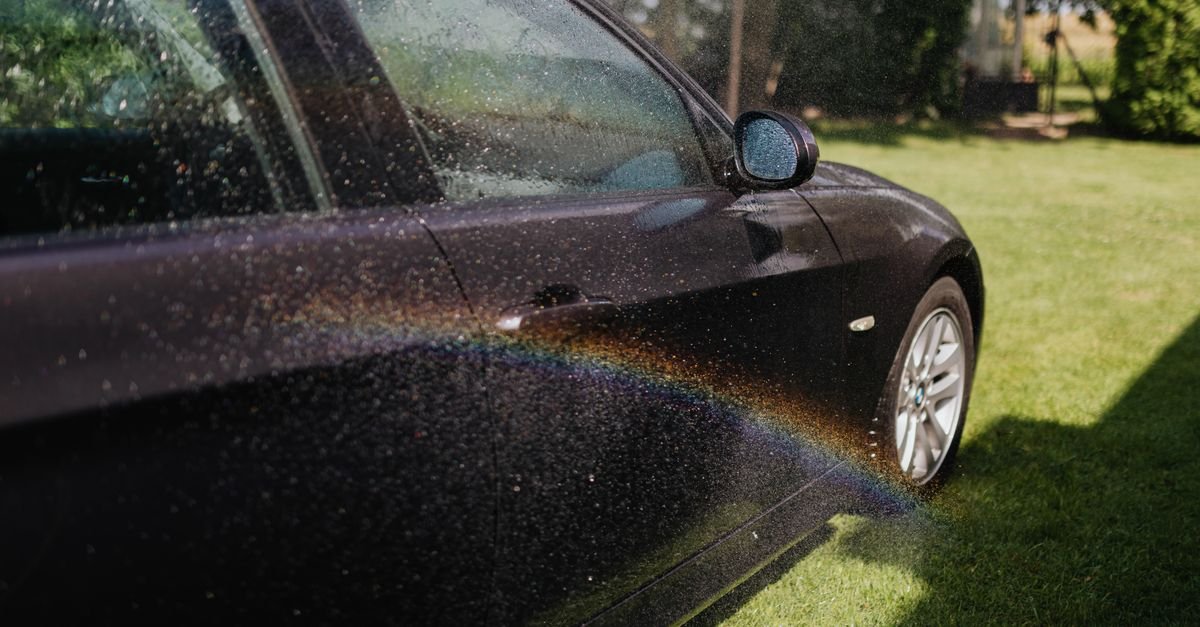
What is well established is the mechanical risk, and it is the one in the photograph above. A pollen grain is a hard particle a few tens of micrometres across, sitting on a clear coat measured in tens of micrometres, and a dry cloth turns it into an abrasive. That is how pollen marks paint: not by eating it, but by being dragged across it. Which makes the correct instruction the same either way — flood it, never wipe it dry — so nobody comes to harm believing the acid story. It is just not true, and a reason you can check beats a reason you cannot.
FAQ
Does a pressure washer remove pollen better than a garden hose?
On a house, yes, but for the flow and the reach rather than the pressure. Pollen is not bonded hard enough to need force; it needs a large volume of water crossing a large area, and a machine delivers that faster than a hose over two storeys of siding. On glass, a car or a single window, a hose does the same job with less risk. If you only own a hose, you are not missing a mechanism — you are just going to be slower.
When is the best time to wash pollen off a house?
After counts at your nearest station have fallen and stayed low for a couple of weeks, which on most of the continent means late spring to early summer rather than the peak in April. Washing at peak means the wall reloads within days. If it looks bad enough to bother you in the meantime, rinse the worst elevations with plain water and save the detergent, the dwell and the ladder for the wash that will last.
Do I need a special pollen cleaner?
No. Nothing dissolves a sporopollenin shell at domestic concentrations, so any product sold for this is a surfactant doing what an ordinary house wash or car shampoo already does — lowering surface tension so the rinse gets under the film and keeping the grains in suspension until the water carries them off. Buy on the surfactant and the price, not on the season on the label.
Will pollen stain siding permanently?
Pollen itself is a deposit and comes off. What people read as a permanent pollen stain is usually one of two other things: a mould or mildew colony that grew in the organic film pollen leaves behind, which is a bleach problem and covered under how to remove mildew from furniture for the same mechanism on a smaller surface, or chalked paint, which is the coating breaking down and not a deposit at all. Wipe a test patch with a dark cloth: a yellow-green dust means pollen, a chalky white film means the surface itself.
Does rain wash pollen off?
Rain scrubs the air, and counts usually drop for a day or so after a real downpour, which is why a wall can look better the morning after. Whether it comes off the surface depends entirely on volume. A heavy rain running properly down a wall carries grains off it. A light shower delivers the water without the runoff, which supplies the half of the mechanism that bonds the film and none of the half that removes it.
Can I pressure wash pollen off window screens or a soffit?
No, and these are the two places to stop. A mesh holds the deposit in its apertures, so a jet from one side drives it into or through the weave rather than back out. A vented soffit is an opening the building code requires, and water driven up into it lands in insulation and framing. Both are brush-and-hose jobs, with the screen ideally out of its frame first.
How often should I rinse during the season?
If your car or your porch matters to you, a plain-water flood rinse once or twice a week through the peak is far less work than one rescue in June, because you are removing the deposit before it has gone through enough wet-dry cycles to consolidate. No detergent, no machine, no drying off. It is the single cheapest thing on this page and it is the one nobody does.
Wash It When the Count Drops, Not When You Notice It
Two facts run this whole topic, and they point in the same direction. The grain is a shell that shrugs off five hours in boiling phosphoric acid, so nothing you buy will dissolve it and the entire job is carrying it away with volume. And the bond that makes an old film hard to shift is water — capillary bridges that formed while the deposit was wet and set as it dried — which means the film gets harder to remove every time the wall gets damp and then sunny, and easier the moment you wet it again and wait.
Put those together and the schedule stops being a matter of taste. Rinse with plain water while the count is high, because you are removing a powder before it becomes a crust. Do the full wash with detergent and dwell once your station’s daily figures have sat near the bottom of their range for a fortnight, because that is the wash that survives the summer. And keep the wand level, the tip white, and the mesh out of it.
The yellow line along the windowsill is an honest signal that the season is still running. Believe it, and do the two-minute version until it stops.