Last Updated on September 25, 2026 by Umar Farooq
How to remove mildew from furniture, in one line: apply a biocide, keep it wet on the surface for a full fifteen minutes, agitate with a soft brush, rinse, and then dry the piece completely — and the material you are standing in front of decides which biocide and how much water it can survive.
That last part is the whole problem. A patio set is rarely one material. It is an aluminium frame, a woven synthetic back, a sling seat, a cushion, and a timber arm rest, and four of those five want different treatment. Treat the whole chair the way you would treat the frame and you will wreck the weave. Treat it the way you would treat the cushion and the mildew will be back before the chair is dry.
Mildew Is Eating the Dirt, Not the Furniture
Mildew is a surface-growing mould. It needs three things: moisture, shade and something organic to eat. On outdoor furniture the thing it is eating is almost never the furniture.
It is pollen. It is leaf tannin washed off the tree above. It is sunscreen, body oil, spilled drink, bird droppings and the fine grey film that settles on anything left outdoors for a season. That layer is the meal. The chair is just the plate.
This is not a theory I assembled. Sunbrella — whose fabric is sold specifically as mould and mildew resistant — publishes that “extended exposure to dirt, debris, and especially humid climates can cause stubborn mold spores and mildew growth to occur” (Sunbrella, cleaning mould and mildew). A mildew-resistant fabric is not a mildew-proof fabric, because the mildew was never interested in the fabric.
Which brings me to the opinion I will defend for the rest of this article: a pressure washer does not remove mildew. It removes the visible colony and some of the dirt under it, at high speed, and leaves behind spores, a soaked surface and a piece of furniture that is now wetter than it has been all year. That is not treatment. That is watering it. What kills mildew is a biocide left in contact with the organism long enough to reach it — and both Sunbrella and Phifer, who between them supply a large share of the outdoor fabric in North America, independently publish the same dwell time: fifteen minutes. I read the two pages back to back expecting them to disagree. They give the identical ratio as well.
That ratio, for what it is worth, is a quarter cup of dishwashing liquid and one cup of bleach per gallon of water. Write it on the bottle.
How to Remove Mildew From Furniture, Material by Material
Work out what you are holding before you mix anything. This table is the routing decision, and the rest of the article is the detail behind it.
| Material | What the mildew is sitting on | First move | Dwell | Pressure washer? |
| Natural rattan, cane, willow | Dirt in the fibre, and the fibre itself | Damp wipe, never a soak | 10 min, re-misted | Never |
| Synthetic resin wicker | Film on the strand, debris in the weave | Dry-debris it first | 15 min | 1,000–1,200 PSI, carefully |
| Sling fabric | Soil film, plus the rail pocket | Spray both faces | 15 min in sun | Yes, under 1,000 PSI |
| Mesh and strap seating | Soil film in the weave gaps | Spray both faces | 15 min | Yes, under 1,000 PSI |
| Cushion covers | Soil on the cover | Check the care label | 15 min | No |
| Cushion foam cores | Water held inside the foam | Squeeze test, then dry | N/A | Absolutely not |
| Powder-coated aluminium | Film on the coating | Soap wash | 5–10 min | Under 1,400 PSI |
| Wrought iron and steel | Film on the coating, plus rust | Soap wash, inspect chips | 5–10 min | Under 1,400 PSI |
| Timber | Dirt, and the wood surface itself | See below | See below | See below |
| Moulded plastic and resin | Film in the surface texture | See below | See below | See below |
Timber — teak, acacia, cedar, painted pine — behaves differently enough to need its own treatment, including species-specific pressure limits and why oiling a mildewed bench makes it worse. That is covered in full in how to remove mildew from wood furniture, and I am not going to give you a worse version of it here.
Moulded plastic and resin has its own quirks too — the yellowing, the stippled texture that holds spores, and the point at which a chair is embrittled rather than dirty. That is in how to clean plastic patio furniture.
Everything below is the material nobody writes about properly.
Wicker and Rattan Split Into Two Different Problems
The word wicker describes a weave, not a material, which is why so much wicker advice contradicts itself. Two pieces of furniture that look identical from the patio door can want opposite treatment.
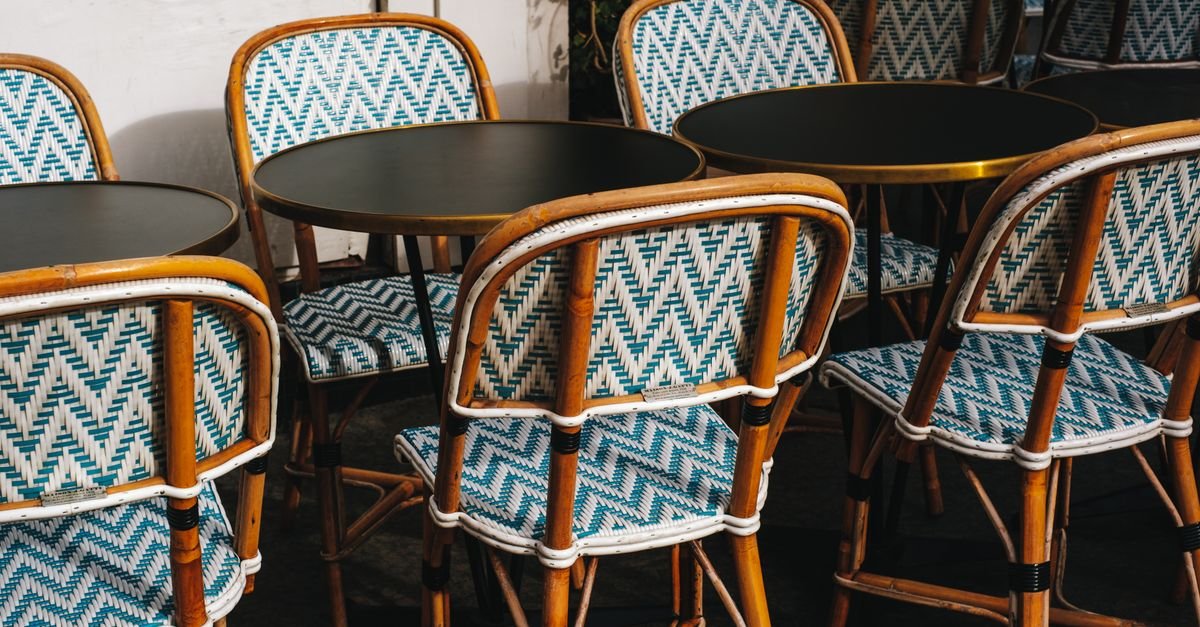
Natural rattan, cane and willow
This is plant fibre, and plant fibre is hygroscopic — it absorbs water, swells, and then shrinks as it dries. Soak a natural rattan chair and every strand in the weave swells against its neighbours. When it dries it shrinks back slightly looser than it started, and the tension that holds the whole weave rigid goes with it. Do it twice and the seat sags permanently. There is no putting it back.
So: no soaking, no hose flooding, no bucket, and no pressure washer at any setting. Vacuum it dry with a brush head first. Then wring a cloth out in a quarter cup of white vinegar to two cups of water until it is barely damp, and wipe. An old toothbrush handles the crossings where strands overlap. Re-mist rather than re-wet, give it ten minutes, wipe again with a clean damp cloth, and then get air moving across it — a fan, or full sun, or both.
Be aware of the limit here. Natural cane is porous, and the EPA’s plain description of porous materials applies exactly: mould “can grow on or fill in the empty spaces and crevices of porous materials, so the mold may be difficult or impossible to remove completely” (US EPA, mold cleanup in your home). If the fibre has gone grey-black through its thickness rather than on its face, you are looking at a refinishing job, not a cleaning job.
Synthetic resin wicker
Resin wicker is HDPE or PVC strand woven over an aluminium frame. It is non-porous, so mildew physically cannot get inside the strand — it is sitting on a film on the outside. That makes it far more forgiving than natural cane and far more annoying than it looks, because the weave hides everything.
Go dry first. A leaf blower or a vacuum brush pulls out the pollen, cobwebs and insect casings that turn to grey paste the moment you add water. Then apply the bleach-and-soap solution, keep it visibly wet for the full fifteen minutes by re-spraying, and agitate in two directions so the bristles enter each gap from both sides. Rinse from the front, from both sides at an angle, and from underneath. Water arriving from one direction only touches one face of each strand, which is why a chair can look clean and still smell.
What Is Actually Growing in a Sling Chair
Here is the part almost nobody covers, and it is the reason sling chairs come back mildewed after a thorough clean.
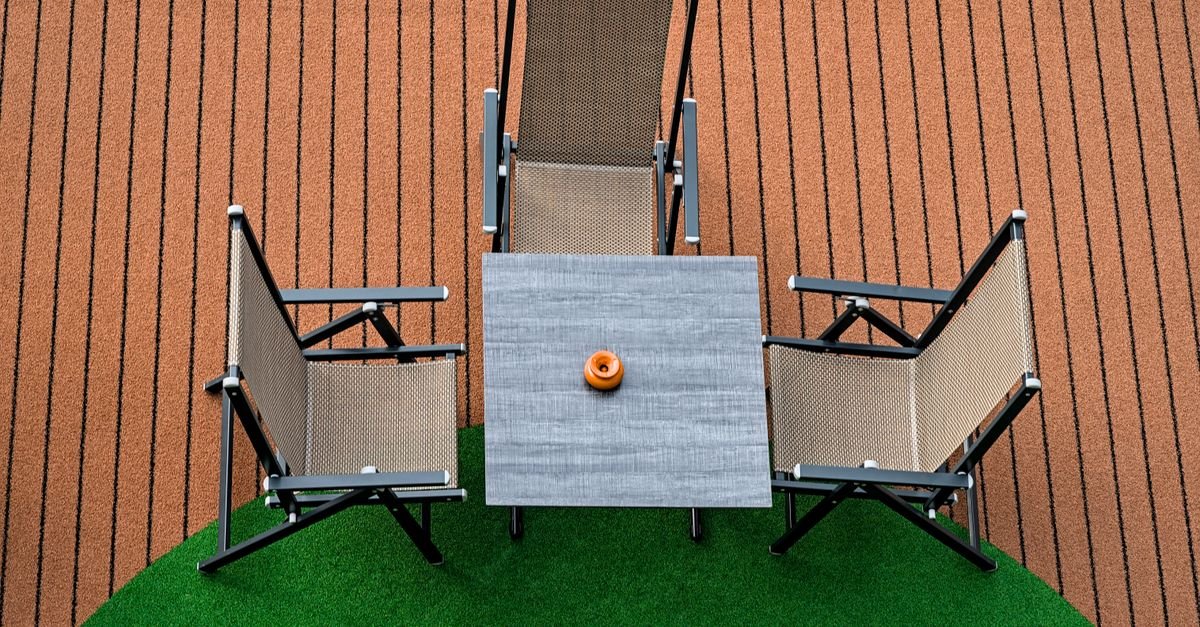
Sling fabric is vinyl-coated polyester, woven on a loom and cut to size. To fit it to the chair, a plastic spline or rod is welded onto each edge of the fabric and slid into a channel running down the inside of the frame rail. That channel is a narrow, dark, permanently shaded pocket with fabric folded into it. It holds water after every rain. It never sees sunlight. Nobody has ever cleaned it.
Look at a mildewed sling chair and you will usually see a dark line running about an inch in from each rail, fading toward the middle of the seat. That is not a stain pattern. That is the colony growing out of the pocket.
Phifer, who weave a large share of the sling and mesh fabric used in North America, publish the treatment for the fabric itself: combine a quarter cup of dishwashing liquid and one cup of bleach per gallon of water, spray it onto the affected areas, let it sit in sunlight for fifteen minutes if you can, then scrub gently and rinse thoroughly (Phifer, fabric cleaning). That handles the face of the sling. For the pocket you need to either back the rail screws off and slide the rail clear, or run a low-pressure stream along the channel from one end and let it carry the growth out the other.
Slings and mesh are also the one seat on the patio where a pressure washer genuinely helps rather than merely being survivable. The fabric is stretched drum-tight and supported on all four edges, so it takes impact roughly the way a trampoline takes it. Stay under 1,000 PSI, use the white 40-degree tip, keep two feet back, and work along the weave rather than across it. Then let it hang in the sun, because a sling dries in twenty minutes and a cushion does not.
The Mildew in a Cushion Is Usually in the Foam
Cushion covers are the easy half of the job and get all the attention. Most outdoor covers are solution-dyed acrylic or olefin, many unzip, and a good number are machine washable cold. Check the label, wash them, and air dry rather than tumble — heat shrinks an outdoor cover just enough that it will no longer go back over the foam, which is a memorably frustrating way to spend a Saturday.
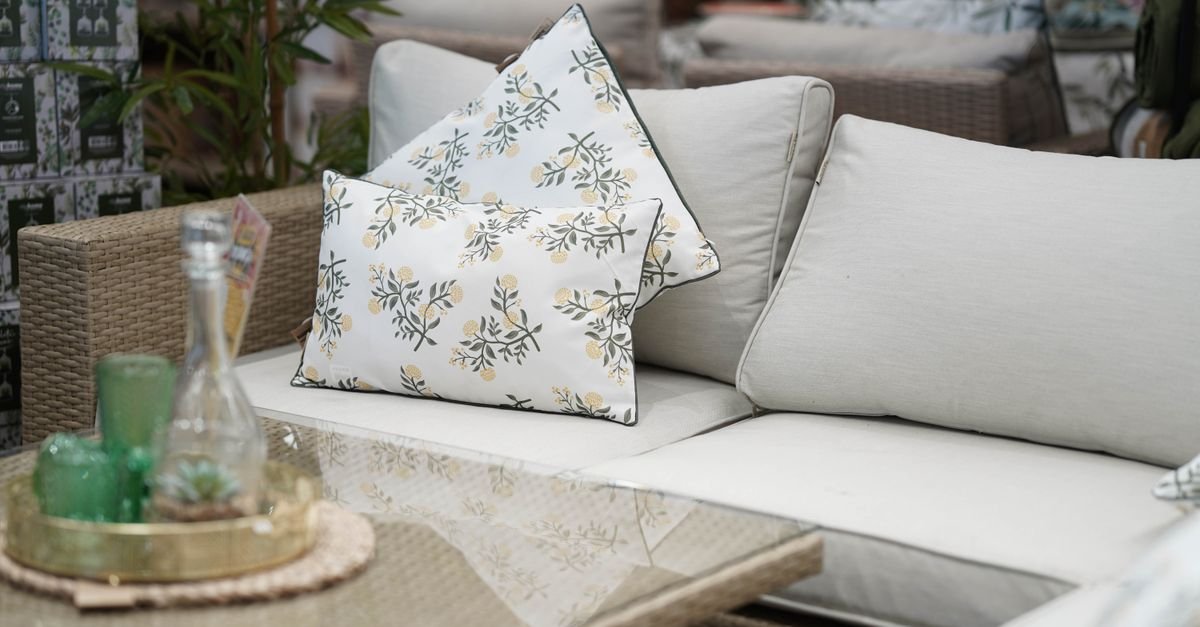
Standard open-cell polyurethane foam holds water the way a sponge holds water, because structurally it is a sponge. A six-inch seat cushion soaked through can take three or four days to dry to the core in ordinary outdoor conditions, and every one of those days is a day a shaded, wet, organically contaminated block is doing exactly what mildew asks of it. Reticulated foam — sold as quick-dry or open-cell drainage foam — has had the cell walls removed so water runs straight through. It drains in minutes.
Find out which you have. Wet a corner, squeeze it, and watch. If water runs out freely, it is reticulated and you can wash the cushion and dry it in an afternoon. If it stays heavy and weeps slowly, it is standard foam, and your entire strategy has to be keeping it dry rather than getting it clean.
The diagnostic for a cushion that already smells: push a fist hard into the centre of a cushion you believe is dry, hold it there for a few seconds, then smell your hand. If it comes back musty, the core is wet and everything you do to the cover is decoration.
Dry cushions on edge, on a slatted surface with air underneath, for two full days. Not flat on the patio, where the underside sits in its own puddle. And if the core is mildewed through, replace the foam. No cleaner reaches the middle of a solid block, a replacement insert costs a fraction of a new cushion set, and the EPA’s point about porous materials applies to a foam cushion even more directly than it applies to cane.
Never point a pressure washer at a cushion. Driving water into foam under pressure is precisely the failure you are trying to reverse.
Powder-Coated Metal and the Water Inside the Legs
Mildew does not eat aluminium and it does not eat powder coat. On a metal frame it is growing entirely on the film of pollen, sap and hand oil sitting on top of the finish, which makes metal the most forgiving material in the whole set. Soap solution, ten minutes, soft brush, rinse. Done.
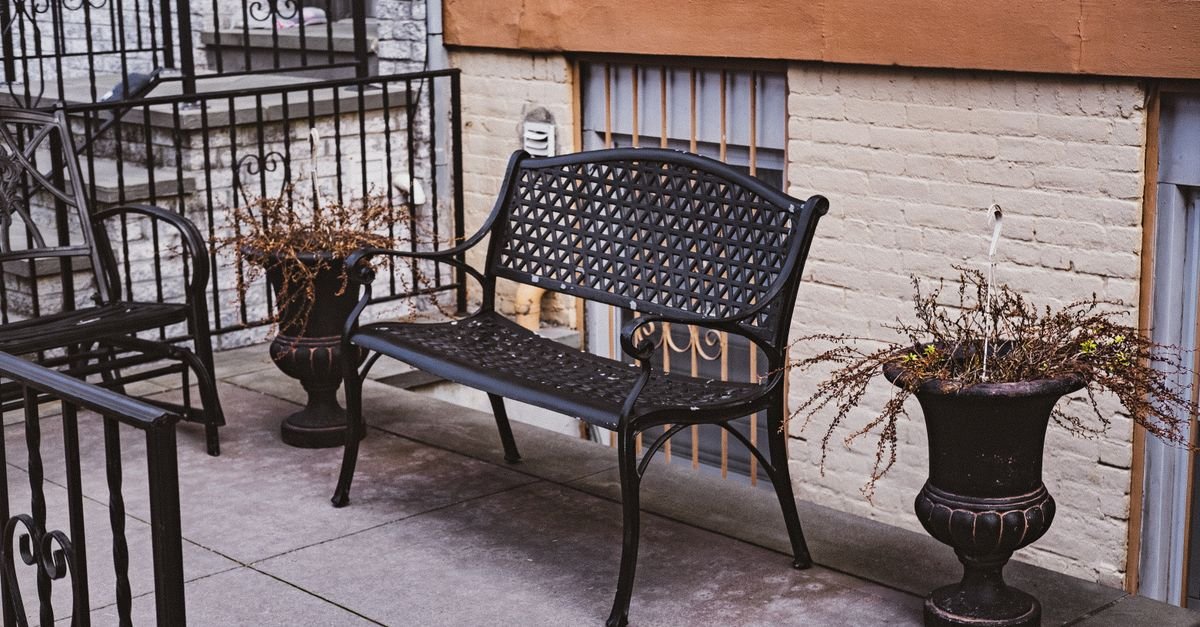
Two things do go wrong, though, and both are invisible until they are not.
The first is chips in the powder coating. Powder coat is the only thing between steel or iron and the weather, and once it is broken, rust spreads underneath it sideways and lifts the coating from below. You will not see it until the coating blisters, by which point the repair is a wire brush and primer rather than a touch-up pen. Go over every chip and scratch after washing, and do not leave bleach solution sitting on exposed bare metal — it accelerates exactly what you are trying to prevent. Keep well under 1,400 PSI and stay a foot back so you are not making new chips while you clean.
The second is the inside of the frame. Tubular aluminium furniture has small drain holes in the feet, and those holes block with dirt, spider webs and insect nests within a couple of seasons. Once blocked, the legs fill with rainwater and stay full. That is the actual source of the musty smell on a metal-framed chair you have already cleaned twice — you have been washing the outside of a container of stagnant water.
Turn the chair upside down. Watch what comes out. Clear each drain hole with a piece of wire before you store the piece for winter. It takes about ninety seconds per chair and it is the highest-value thing in this article.
Where a Pressure Washer Earns Its Place on Furniture
This is a pressure washer site, so I will be direct about how small the machine’s role is here. Mildew is a chemistry problem. Pressure is the rinse step.
| Material | Verdict | Max PSI | Nozzle | Distance |
| Sling and mesh seating | Genuinely useful | 1,000 | 40° white | 24 in |
| Synthetic resin wicker | Workable, carefully | 1,200 | 40° white | 18–24 in |
| Powder-coated aluminium | Workable | 1,400 | 40° white | 12–18 in |
| Wrought iron and steel | Workable, inspect after | 1,400 | 40° white | 12–18 in |
| Natural rattan and cane | Never | — | — | — |
| Cushions and foam | Never | — | — | — |
| Umbrella canopy in place | Never | — | — | — |
Three rules cover the rest. Use the white 40-degree tip and nothing narrower; the green 25-degree tip has no business on furniture, and the red 0-degree tip has no business on a patio at all, unless your goal is a chair with a racing stripe. The full colour code is in the pressure washer nozzle chart if you have inherited a bag of unlabelled tips. Apply solution bottom to top so it does not streak, and rinse top to bottom so gravity is helping rather than fighting you. And if your machine has no adjustment, distance is your pressure control — doubling the distance cuts impact substantially, and on furniture that is almost always enough.
One more, because it is the most common mistake: do not let the solution dry on the surface. A dried bleach solution has stopped working and started staining. Re-mist every few minutes to hold the full fifteen.
Four Habits That Keep It From Coming Back
Mildew removal is reactive. These four are the reason some patio sets never need it.
Rinse the food away monthly. Thirty seconds with a garden hose during pollen season removes the organic layer before it becomes a meal. This is the highest-return habit on the list and it involves no chemicals at all.
Store it ventilated, never sealed. A breathable cover or an airy shed is fine. Furniture wrapped in plastic sheeting is a terrarium, and it will come out worse in March than it went in in November.
Stack dry, and stack with spacers. Chairs nested tightly while damp hold a film of water between every pair of surfaces, in full shade, for months. A strip of timber between them breaks the seal.
Bring cushions in, or stand them on edge under cover. Cushions left flat outdoors under a cover are the single most common source of mildew on a patio set, because the foam never gets a dry day.
FAQ
What kills mildew on outdoor furniture?
A biocide with contact time. Diluted household bleach at a quarter cup of dish soap and one cup of bleach per gallon of water is the ratio both Sunbrella and Phifer publish for outdoor fabric, left wet for fifteen minutes. Oxygen bleach is the gentler alternative for anything you do not want lightened. Pressure on its own does not kill it.
Does vinegar remove mildew from furniture?
It works, but it is slower and weaker than bleach, and it is the right choice in specific places rather than generally. Use it on natural rattan and cane, where you want minimal moisture and no lightening, and on anything whose colourfastness you are unsure of. A quarter cup of white vinegar to two cups of water on a barely damp cloth is the working strength.
Can you pressure wash mildew off patio furniture?
On sling seating, synthetic wicker and metal frames, yes — as the rinse step after the chemistry has done the killing, at 1,000 to 1,400 PSI with a 40-degree tip. On natural rattan, cushions, foam and umbrella canopies, no. And on any material, washing without a biocide first simply relocates the spores and adds water.
Will bleach damage outdoor fabric?
Solution-dyed acrylic and olefin outdoor fabrics are made to take it, which is why the manufacturers themselves publish a bleach ratio. Printed or piece-dyed fabrics are a different matter and can lose colour. Test on a hidden corner — the underside of a cushion, or the back of a sling near the rail — and wait for it to dry before you commit to the whole piece.
How do I remove mildew from natural wicker without ruining it?
Keep the water to an absolute minimum. Vacuum dry, wipe with a barely damp vinegar cloth, work the crossings with a toothbrush, re-mist rather than re-wet, then force-dry with a fan or full sun. The damage from soaking natural cane is permanent and shows up as a sagging seat, not as a stain, which is why people do not connect the two.
Why does my patio furniture still smell musty after I have cleaned it?
Because something is still wet inside. On a cushion it is the foam core. On a metal chair it is water trapped in the frame tubes behind blocked drain holes. On resin wicker it is water sitting in the weave and inside the frame. Cleaning the outside of a wet object does not dry the inside of it.
Is mildew the same thing as mould?
Practically, on furniture, yes. Mildew is the common name for the flat, powdery, surface-growing moulds that show up as grey, black or dark green speckling. The distinction matters far less than the treatment, which is identical either way: kill it with a biocide, remove the food it was eating, and take away the moisture.
How soon does mildew come back after cleaning?
If you removed the growth but left the soil layer and the damp, weeks. If you cleaned properly, dried the piece thoroughly and then rinse it monthly, you may well get a full season. Recurrence is a moisture question, not a cleaning-product question.
Dry It Properly or You Will Be Doing This Again
Every material in this article has a different chemistry, a different pressure limit and a different brush, and exactly one step in common. The mildew came back last time because something stayed wet — the foam, the rail pocket, the inside of a chair leg, the gap between two stacked seats.
So when you think you are finished, you are not. Turn everything upside down, poke the drain holes, stand the cushions on edge, and give it a day you were not planning to give it. Then put the covers back on.
And if you are reading this next to a chair you have already soaked twice with the hose and it still smells — put the hose down. It was never a rinsing problem.