Last Updated on September 24, 2026 by Umar Farooq
How to remove mildew from wood furniture, in one line: wet the piece with a bleach-and-detergent solution, let it sit for 10 to 15 minutes, scrub along the grain with a soft nylon brush, rinse, then let the wood dry for two full days before you put anything back on it. It is chemistry and patience rather than pressure. That sequence comes straight out of the USDA Forest Products Laboratory’s guidance on mildew, and every step of it matters, including the boring one at the end.
This is a pressure washer site, so let me be straight with you early. A pressure washer is usually the wrong tool for a teak bench or an acacia dining table. It is not that the machine cannot remove the black — it removes it very efficiently, along with a layer of the wood. Garden furniture is built from thinner stock than decking and most of it is unsupported between rails, which means it takes the same damage as a deck board at lower pressure. The machine has a role here, and I will give you the settings, but it comes in at the rinse, after the chemistry has already done the work.
What Mildew Actually Eats on a Garden Bench
Here is the thing that reframed this whole topic for me, and almost nobody writing about garden furniture mentions it.
Mildew is not eating your bench. The Forest Products Laboratory puts it flatly: mildew growth “does not degrade the wood,” because mildew fungi “are not capable of using lignin, cellulose, or hemicellulose for food.” It does not reduce the structural integrity of the timber. What it does use is the non-structural material — “the extractives and natural oils” in the wood, plus whatever organic film has landed on top: pollen, bacteria, tree sap, body oils, suncream (Mildew and Mildew Control for Wood Surfaces, USDA FPL).
So a black-spotted teak arm is a cosmetic problem sitting on a sound piece of timber. That is genuinely good news, and it changes what you should be willing to do to fix it. You do not need to remove wood. You need to kill a surface organism and wash the residue off.
The same paper explains why the nice furniture gets it worst: “wood species that are rich in natural extractives may be more prone to mildew growth than wood species with lower extractive content.” Teak, cedar and redwood are all heavy in extractives. The oil that makes teak survive fifteen British winters is, from a mildew spore’s point of view, catering.
Two more numbers from that document are worth carrying around. Fungal spores are in the air at 100 to over 1,000 per cubic metre depending on where you live, so there is no such thing as keeping them off the furniture. And the ideal growth band is roughly 70 to 90°F — below freezing, mildew fungi “become dormant, however, they do not die.” Your bench does not get reinfected every spring. The same colony just wakes up.
One thing mildew is not: rot. If you press a screwdriver into the wood and it sinks in softly, that is decay fungi, which do eat cellulose, and no cleaner will help. Mildew wipes at the surface. Rot gives way underneath.
Put the Pressure Washer Down First
I went looking for a manufacturer PSI limit for garden furniture the way Trex publishes one for composite decking. There is no equivalent. Nobody selling a teak bench prints a pressure figure, so the honest approach is to borrow the decking number and then go lower, because the timber is thinner.
Softwood decking — cedar, pine, fir — is handled at 500 to 600 PSI with a 25-degree tip or wider. Hardwood decking takes up to about 1,200 PSI. (Yes, 500 PSI is roughly a fifth of what a mid-range gas machine puts out. This is the entire problem.) A homeowner electric unit runs 1,300 to 2,000 PSI, which means the machine in your shed starts above the limit for a cedar bench and cannot be turned down to it.
Now apply that to furniture instead of decking. A deck board is around 25 mm thick and sits on a joist every 400 mm. A teak seat slat is often 15 to 20 mm and spans the full width between two rails with nothing underneath it. Less material, more flex, same jet. The slat loses first.
What you are risking is furring. The jet tears the soft earlywood out from between the harder latewood bands and leaves a raised fuzz of loose fibre. Furring is not a finish problem, it is fibre damage, and the only fix is sanding. Worse, for this particular job, furred wood holds water in a way smooth wood does not — so the fast method that cleared the mildew in ten minutes builds the damp, rough surface that brings it back thicker next year. And a turbo nozzle is a 0-degree jet spinning in a cone: treat it as 0 degrees for damage, never as 25.
If you do use a machine, here is the whole of it. Fit the 40-degree white tip, keep the wand 18 to 24 inches back, move along the grain rather than across it, and use it to rinse a solution you have already let dwell — never as the cleaning force. Test on the underside of the seat, where nobody looks. If the test patch fuzzes when it dries, back off. The pressure washer nozzle chart covers what each tip actually delivers at your machine’s rating, and distance is your real pressure control when the dial will not go low enough.
Black Spots That Are Not Mildew at All
Before you mix anything, work out what you are looking at, because two of the most common black marks on garden furniture do not respond to a biocide at all and you will scrub for an hour proving it.
The field test is simple. Dab undiluted household bleach on one mark with a cotton bud and wait three minutes. Mildew lightens or disappears. Anything that stays exactly as dark as it started is not mildew.
| What you see | Where it sits | Is it mildew? | What actually removes it |
| Fine black or grey speckles, heaviest on shaded horizontal faces | On the surface, in the grain texture | Yes | Bleach or oxygen bleach, 10–15 min dwell |
| Blue-black halo spreading out from a screw or bolt head | Around ferrous fixings | No — iron stain | Oxalic acid, then replace the fixing |
| Even silver-grey across every sun-facing surface | The whole exposed face | No — UV weathering | Oxalic acid brightener, or leave it |
| Green film, slimy when wet | Shaded, damp, often near soil | No — algae | Same chemistry as mildew, works fine |
| Brown streaks running down from joints | Below end grain and joints | No — tannin bleed | Oxalic acid |
| Soft, spongy wood under a dark patch | Into the timber, not on it | No — decay | Nothing. Replace the component |
The iron one catches people out constantly. The Forest Products Laboratory describes iron stain as a blue-black or grey discoloration caused by a reaction between the wood’s own tannin-like extractives and iron from steel nails, screws and fittings, and it is worst on exactly the high-extractive species used for garden furniture (Iron Stain on Wood, USDA FPL). The fix is oxalic acid, sold as wood brightener, applied as a saturated solution in hot water and rinsed off thoroughly afterwards. But the FPL adds the part that matters: if the iron source stays, the stain comes back. Swap the fixings for stainless steel or you are just booking the same job for next year.
How to Remove Mildew From Wood Furniture in Six Steps
This is the FPL’s own sequence for mildew on wood, adapted for a bench rather than a house wall. Gloves and eye protection before you start, and do it outdoors on a still day.
1. Get it dry and get the loose stuff off. Move the piece into direct sun and leave it a few hours if it has been raining. Then brush it down dry with a stiff-ish bristle brush, or vacuum it with a brush attachment. Wet mildew smears; dry mildew comes off in powder.
2. Mix the solution. Three quarts of water, one quart of common household bleach, and up to a quarter cup of ammonia-free liquid dishwasher detergent. That is the FPL’s published mix. The detergent is there to emulsify the residue so it rinses away; dishwasher liquid is specified because it does not foam like washing-up liquid. Do not substitute TSP — the same paper warns that the phosphate “may actually serve as a food source for mildew and may actually promote future mildew growth.” I read that sentence twice. Half the internet recommends TSP for exterior cleaning.
3. Apply it liberally and leave it alone for 10 to 15 minutes. A pump sprayer is easier than a brush. The FPL is explicit that skipping the dwell “may result in a inadequate job” — the bleach needs time to reach into the grain and the crevices around joints. Re-mist any area that starts to dry. Never let the solution dry on the wood.
4. Scrub along the grain, softly. Soft nylon bristles, not brass, not a green scourer. Work the length of each slat rather than across it, and give extra attention to the underside of arms and the back edge of the seat, which stay damp longest and grow the heaviest. On a vertical piece, work bottom to top so runoff never crosses dry wood and streaks it.
5. Rinse thoroughly. Garden hose is plenty. If you use a pressure washer, 40-degree tip, 18 inches back, along the grain, moving constantly. Rinse until the water running off is clear, then rinse once more, because bleach left in a joint keeps working on the fixings inside it.
6. Dry it properly, and give it two days. Stand the piece on edge so water drains out of joints and end grain rather than sitting in them. This is the step people skip and it is the one that decides whether the job lasts. Wood that feels dry to the hand after an afternoon is still carrying moisture in the core, and anything you seal over that moisture traps it.
A few practical notes. Keep the solution off planting, which means wetting shrubs down beforehand and rinsing them after. Never mix bleach with vinegar, ammonia or any acid: ATSDR states plainly that sodium hypochlorite “releases chlorine gas when it comes in contact with acids” (ATSDR, Medical Management Guidelines for Chlorine). And take the cushions off first, not halfway through.
Bleach, Oxygen Bleach or Vinegar?
Every article on this topic recommends all three, usually in consecutive paragraphs, without saying what each one is actually for. Here is the honest comparison.
| Product | What it is | Kills mildew? | Effect on the wood | Best for |
| Household bleach | Sodium hypochlorite, ~5–6% | Yes, fast | Lightens colour, corrodes ferrous fixings | Heavy growth, already-grey or painted pieces |
| Oxygen bleach | Sodium percarbonate powder | Yes, slower | Gentle on colour, alkaline residue | Teak and acacia you want to keep honey-coloured |
| Oxalic acid brightener | Weak acid, wood brightener | No | Removes grey and iron stain, restores tone | The second step after either bleach |
| White vinegar | ~5% acetic acid | Weakly | Mild, safe on finishes | Light surface film, nothing more |
| Two-part deck cleaner | Percarbonate + oxalic kit | Yes | Clean then brighten in one buy | Anyone who wants the colour back |
Oxygen bleach is the one to reach for on furniture you care about the colour of. Sodium percarbonate releases hydrogen peroxide and washing soda in warm water, which lifts organic staining without stripping pigment, and it does not attack fixings the way hypochlorite does. Mix it in warm water — cold water barely dissolves it — and give it 15 to 20 minutes.
Vinegar is the weak link. It is a mild acid, it is a poor biocide against established growth, and the only reason it is in every article is that it is in every kitchen. Use it on a light surface film if you like. On a bench with real black speckling it will disappoint you, and if you follow it with bleach because it disappointed you, you have made chlorine gas on your patio.
If you are treating a whole set, mix a full batch rather than topping up a small one, because a solution that is half-strength by the third chair is a solution that will not work on the third chair.
Teak, Acacia and Cedar Each Behave Differently
“Wood furniture” covers timbers with wildly different densities, thicknesses and tolerances, and the same treatment is fine on one and destructive on another.
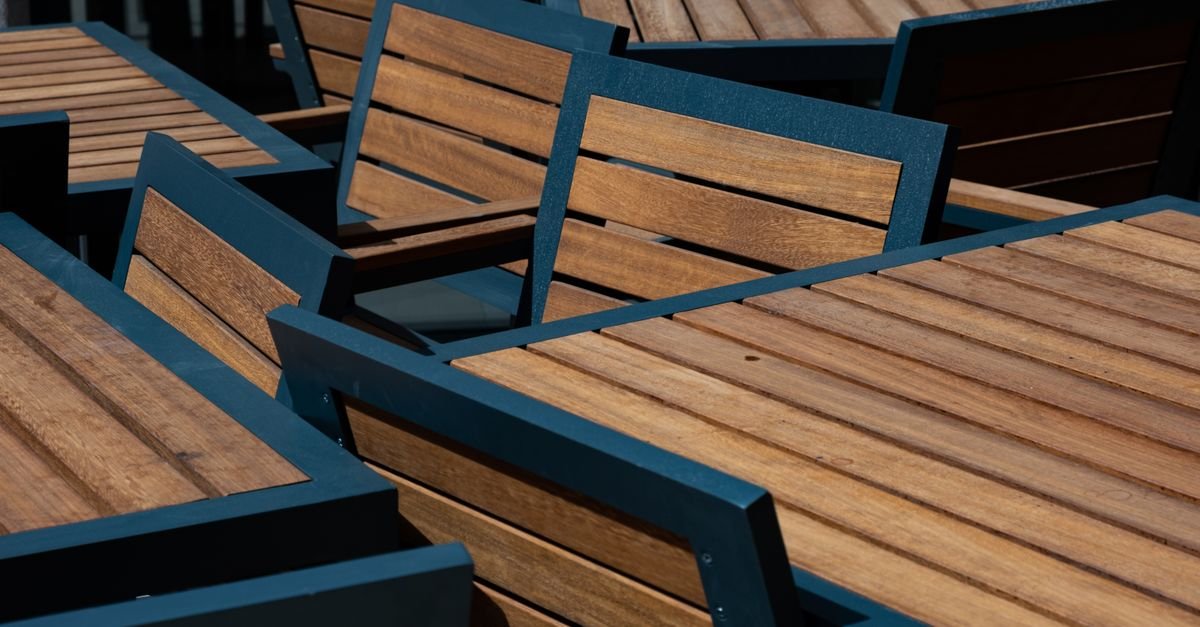
Teak is dense, oily and about as durable as garden timber gets. Its silver-grey weathering is UV breakdown of lignin at the surface — that is not dirt and cleaning will not reverse it, though an oxalic brightener will. Teak’s high extractive content is exactly why surface mildew likes it, so expect to clean it more often than you expect to, not less.
Acacia is the budget hardwood in most flat-pack garden sets, and it is much less stable than teak. It moves a lot with moisture, opens fine surface checks, and those checks hold water and grow mildew from the inside out. Clean acacia quickly, rinse it quickly, and do not leave it soaking in a solution for an hour the way you might a plastic chair.
Cedar is a softwood. It furs at the lowest pressure of anything here, it is also extractive-rich, and it is usually the timber in Adirondack chairs and planter benches. Chemistry only, hand brush, hose rinse. If you are going to break the no-machine rule anywhere, do not break it here.
Eucalyptus, shorea and balau sit between teak and acacia. Treat them as acacia and you will not go wrong.
Painted or varnished frames are a different job. Mildew on a coating usually means mildew is also under it, and the FPL is blunt about the consequence: once growth is beneath a finish coat, it grows through, and “it is usually impossible to stop mildew growth at this point” without stripping back to bare wood. Clean the surface, yes, but if it returns within weeks, the answer is a strip and refinish rather than another wash. Painted wood also has a much lower pressure ceiling — see can you pressure wash painted wood.
| Timber | Typical slat thickness | Ceiling if you must use a machine | First-choice chemistry |
| Teak | 18–25 mm | 800 PSI, 40°, 18 in | Oxygen bleach, then brightener |
| Iroko / balau | 18–22 mm | 800 PSI, 40°, 18 in | Oxygen bleach |
| Acacia | 14–18 mm | 600 PSI, 40°, 24 in | Oxygen bleach, short dwell |
| Eucalyptus | 15–20 mm | 600 PSI, 40°, 24 in | Oxygen bleach |
| Cedar / pine | 18–25 mm | 500 PSI, 40°, 24 in | Hand wash only |
| Painted or varnished | Any | Hand wash only | Diluted bleach, soft cloth |
Why Oiling a Mildewed Bench Makes It Worse
This is the opinion I will defend hardest on this page: the single most common reason a bench cleaned in May is black again in August is that somebody oiled it in June.
Two mechanisms, both from the same source. First, the FPL states that applying a finish over a mildewed surface “provides protection for the existing mildew, preventing its removal and can actually provide a nutrient source to facilitate new mildew growth,” and that mildew “will certainly appear again on the new surface.” Second — and this is the part specific to garden furniture — mildew feeds on extractives and natural oils. A bottle of teak oil is not teak extract. It is usually linseed or tung oil with solvents and driers. You have just applied dinner.
Add the third problem, which is timing. Oil applied to wood that is not fully dry seals moisture underneath it, and moisture is the primary environmental factor in mildew growth. A bench oiled on a Sunday afternoon two days after a wash is a warm, damp, organically enriched surface. It performs exactly as you would predict.
So: if you want the honey colour, clean it, brighten it with oxalic acid, and accept that colour is a maintenance commitment. If you want a low-maintenance bench, let it silver. Teak at forty years old and silver-grey is structurally identical to teak at five years old and golden. It is the same bench. One of them just costs you a weekend every June.
Keeping It Off Through a Wet Autumn
Moisture is the primary environmental component for mildew growth, with temperature a distant second. Everything below is an attack on moisture.
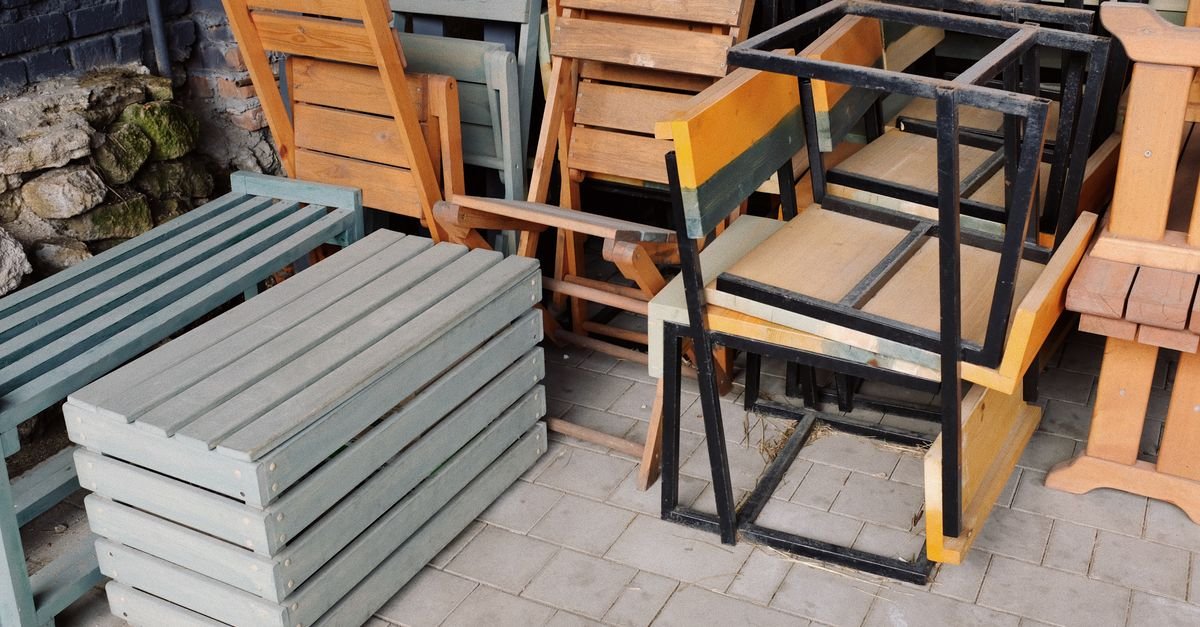
Get the feet off the ground. Legs standing on damp paving or grass wick water straight up the end grain, which is why the bottom four inches of a bench leg go black first. Plastic glides or a couple of bricks solve it for nothing.
Cover it with something breathable, and tent it. A tarp thrown over a table is a condensation chamber with a bow on it. Use a proper breathable cover, leave the bottom open, and prop the middle so air moves underneath.
Rinse the pollen off in spring. Pollen is explicitly on the list of things mildew metabolises, and a two-minute hose down in April removes a season’s food supply.
Cut back what is overhanging it. Shade plus drip plus still air is the condition, not the furniture. Moving a chair four feet into the sun does more than any product.
Stack dry, with gaps. Chairs nested tight and wet in October are a culture experiment by January. And if your set mixes materials, the plastic and resin pieces want a different approach entirely — that is covered in how to clean plastic patio furniture.
FAQ
Does vinegar kill mildew on wood furniture?
Only weakly. Vinegar is about 5% acetic acid, which will knock back a light surface film but will not reliably kill established growth in the grain. It is popular because it is already in the cupboard, not because it works best. Use bleach or oxygen bleach for anything you can actually see as black speckling, and never apply vinegar and bleach to the same piece, because acid plus sodium hypochlorite releases chlorine gas.
Can you pressure wash teak furniture?
You can, and most of the time you should not. Teak seat slats are typically 18 to 25 mm thick and unsupported across their span, so they flex under a jet in a way a deck board on joists does not. If you do use a machine, stay at or below about 800 PSI with a 40-degree tip at 18 inches, move along the grain, and use it only to rinse a solution that has already dwelled. Test on the underside first.
Will bleach damage wood furniture?
Diluted bleach at the strength the Forest Products Laboratory specifies — one part bleach to three parts water — is safe on bare exterior timber for a 10 to 15 minute contact. It will lighten the colour, which matters on teak and not at all on already-grey wood. The real damage risk is to ferrous screws and bolts, which corrode and then stain the wood black around them, so rinse joints thoroughly.
What is the difference between mould and mildew on outdoor furniture?
Practically, none that changes what you do. “Mildew” is a general term for surface growth produced by mould fungi, and around a hundred thousand species can produce it. What matters is that it sits on the surface and feeds on deposits rather than on the wood itself, which is why a biocide and a soft brush deal with it and why it never needs sanding out.
Do I need to sand mildew off wood furniture?
No, and sanding is usually a sign something went wrong earlier. Mildew fungi cannot digest lignin, cellulose or hemicellulose, so the growth is on the surface and in the grain texture, not embedded in the timber. Sanding becomes necessary only when a piece has been furred by too much pressure, which is a damage repair rather than a cleaning step.
How do I stop mildew coming back on my garden bench?
Attack the moisture rather than the organism. Lift the legs off damp paving, use a breathable cover propped for airflow instead of a tarp, cut back overhanging planting so the piece gets sun and wind, and rinse pollen off each spring. Mildew fungi go dormant below freezing but do not die, so a bench that was black last September will be black again unless the conditions change.
Is mildew on outdoor furniture dangerous?
For a healthy adult cleaning a bench outdoors, the main risk is inhaling spores while dry-brushing, which a basic dust mask handles. Wear gloves and eye protection for the bleach step, work upwind, and keep the solution off skin. People with asthma or mould sensitivity should let someone else do the brushing, or wet the surface first so nothing goes airborne.
Can I use the same method on resin or plastic furniture?
The chemistry carries over, the pressure limits do not. Plastic and resin tolerate more PSI than timber but haze permanently above roughly 1,800, and thin moulded sections crack at stress points. Dwell times are similar and oxygen bleach works on both. The full breakdown for the plastic half of a mixed patio set is in how to clean plastic patio furniture.
Let It Soak, Then Let It Dry
If you take two things from this, take the dwell and the dry. Ten to fifteen minutes of bleach sitting on the wood does more than twenty minutes of scrubbing, and two days of sun afterwards does more than any product you can buy to put on top. Everything in between is just a soft brush and some patience.
The pressure washer is not banned here, it is just demoted. Fit the white tip, stand back, rinse along the grain, and let it be the hose it is pretending to be. What it must not be is the thing that does the cleaning, because at the pressure that shifts mildew quickly, it is also shifting wood — and the furred surface you are left with holds water better than the one you started with.
And if the bench is already grey and you have been feeling vaguely guilty about it: don’t. Grey teak is teak. The mildew comes off it just the same, and nobody has ever sat down on a bench and checked the colour first.