Last Updated on September 26, 2026 by Umar Farooq
An undercarriage cleaner attachment is a low trolley carrying three or four fixed jets that you roll under a vehicle to spray upward, and the two documents describing that exact event disagree with each other completely. The attachment makers publish a 1,500 to 4,000 PSI range and recommend 2,500 PSI or higher for best results. Toyota publishes one sentence: “Do not wash the underside of the vehicle using a high pressure car washer.”
Somebody is wrong, and it is worth knowing which, because the underside of a car in a salted climate genuinely is the part that rots and genuinely is the part a cloth cannot reach. This is not a case where the honest answer is “leave it alone.” Something does need to happen up there. The question is whether 4,000 PSI is the thing.
I went looking for the research rather than the reviews, and the most useful sentence I found is in a Washington State Department of Transportation corrosion report. It says most chloride salt on a vehicle comes off with low-pressure washing, and that the salt which does not come off will not come off at 40,000 PSI either. If that is right — and it is the only measured statement on the question I could find anywhere — then the entire pressure band this attachment is built around is the one band nobody has published a use for.
Four Jets Pointed Where You Cannot Look
Start with what the thing actually is, because the marketing name suggests a more sophisticated object than the one in the box.
Westinghouse sells its 16-inch unit as a single product with two names: the Water Broom/Undercarriage washer. Four nozzles, 4,000 PSI maximum, hot water to 194°F, quick connects, wheels, and a long curved wand so you can stand up while you use it. Turn it one way and it sweeps a driveway. Turn it the other way and it is an undercarriage cleaner. Same bar, same tips, same everything.
That matters, because the honest family resemblance is not to a surface cleaner. A pressure wash surface cleaner does three things that make it forgiving: a spinning bar so no single spot takes a continuous jet, casters that fix the nozzle height whether or not your elbow is tired, and a skirt that keeps the spray and the grit inside the housing. An undercarriage cleaner has the casters. It has no skirt, and on most units nothing rotates — the jets are fixed and they point where the bar points.
Remove the skirt and everything the jets dislodge leaves the work area at speed, in a direction set by geometry rather than by you. Aimed at a driveway, that debris goes sideways and down, which is why a water broom is a reasonable tool. Aimed upward, it goes up, hits a chassis rail, and comes back down through the same plane your face is in. Safety glasses are not a nicety on this job. Two decades of dried road film, sand and brake dust are about to be returned to you at somewhere between a trickle and a fire hose, and gravity is on the debris team.
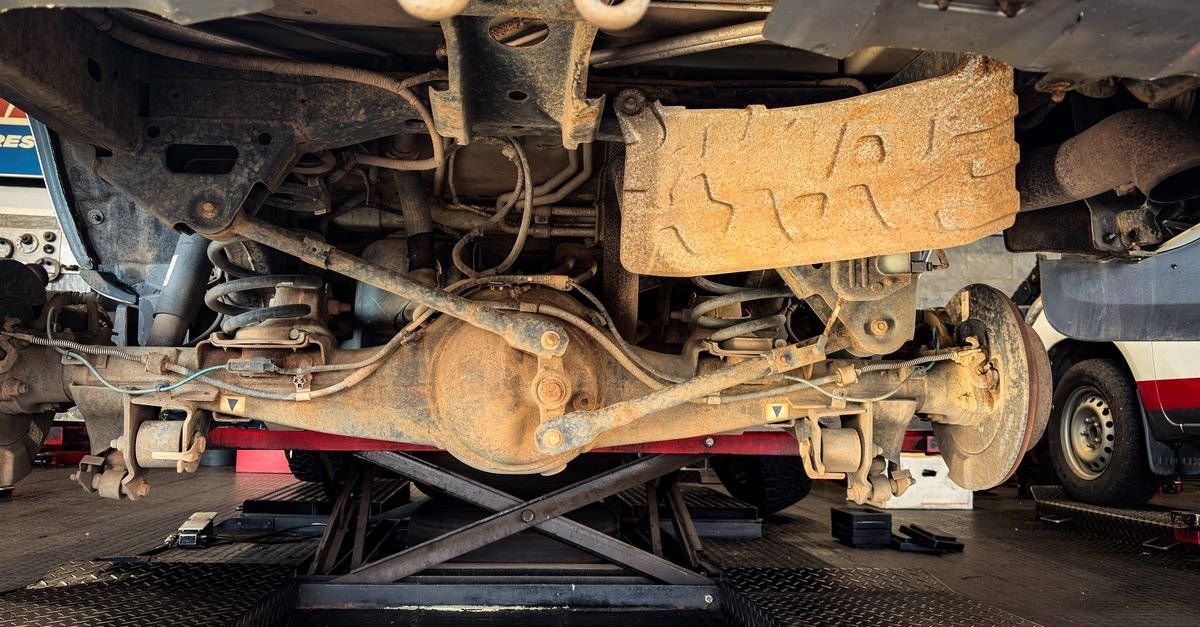
The second consequence of the geometry is the one nobody mentions. When you clean a driveway, you can see the surface, so you can see the bit you should not linger on — the expansion joint, the drain cover, the patch of soft mortar. Under a car, you are looking at the top of a trolley. The jets are on the far side of it, four to eight inches from components you have never seen, and the only feedback you get is noise. Every published caution about this job is a caution about *where you point it*, and this is the one attachment on the market that takes aiming away from you and hands it to a caster.
Brake Lines, Boots and the Parts Toyota Names
So what is up there. Not a flat panel — a dense, unshielded installation of the things a car cannot lose.
Fuel and brake lines run the length of the floor, usually clipped to the underside of the pan or inside the sill, in steel that is typically plastic-coated precisely because of what road salt does to it. Wiring looms run alongside them to the rear lights, the fuel pump and every sensor behind the axle line. The exhaust and catalytic converter sit in the middle with thin stainless heat shields spot-welded around them. At each front wheel there is a driveshaft with a rubber gaiter at either end. And threaded through all of it are rubber bushings, mounts and grommets, none of which are structural in the way steel is and all of which are cheap right up to the point where the labour is quoted.
Two vehicle makers publish lists of what a high-pressure washer must not be brought near, and both of them put the same item first. Toyota’s cleaning section reads: “Do not bring the nozzle tip close to boots (rubber or resin manufactured cover), or connectors or the following parts” — and then names traction-related parts, steering parts, suspension parts and brake parts, adding that “the parts may be damaged if they come into contact with high-pressure water.” Kia’s wording in its EV6 owner’s manual is almost identical: “Do not bring the nozzle tip close to boots (rubber or plastic covers) or connectors as they may be damaged.”
Boots. Not brackets, not panels, not paint. The rubber cover over a joint is what both companies chose to name before anything else, which is a useful thing to know when the search results for this attachment are full of pictures of clean chassis rails. A constant-velocity gaiter is a thin concertina of rubber holding grease in and grit out, and its failure mode is not dramatic. It splits, the grease leaves over a few hundred miles, the grit arrives, and the joint that was fine in March clicks on full lock in July. Nothing about that sequence tells you it began with a wash.
I want to be careful about what the makers do *not* say, because the temptation on this topic is to extend the list. Neither Toyota nor Kia names rubber bushings, and neither publishes a pressure figure for the underbody at all. What Toyota publishes instead is a distance for the bodywork — “keep the cleaning nozzle at least 11.9 in. (30 cm) away from the vehicle body” — plus the instruction not to hold the nozzle continuously in the same place. An undercarriage cleaner on its casters runs its tips somewhere in the region of four to eight inches from whatever is above them, which is well inside the only standoff figure the maker thought worth printing, and it is printed for sheet metal rather than for a gaiter.
The electrical half of this — why a wet connector bites three weeks later rather than the same afternoon, and what the automotive jet-resistance standards actually test — is argued properly on the engine bay page, and the wand-and-tip technique for a salted chassis belongs to pressure washing a truck. I am not going to re-litigate either here. The point specific to this attachment is narrower and worse: the whole published caution is “do not bring the nozzle close to these things,” and a fixed bar on wheels has no mechanism for not doing that.
The Published Answer Is Low Pressure or 40,000 PSI
Here is the research, and it reverses the premise the product category is built on.
Washington State DOT commissioned a study on protecting its own fleet from de-icer corrosion, which is the same problem a homeowner has with a much larger budget behind it. In the report’s literature review, WA-RD 796.1 states: “Most of the chloride-based salts on vehicles and equipment can be washed with low pressure water blasting, but salts that have attached and complexed with the metal substrate often cannot be removed with 40,000 psi Ultra High Pressure Water-jetting.”
Read that as two findings rather than one. Most of the salt leaves at low pressure. The fraction that has chemically attached to the metal does not leave at ten times any consumer machine’s rating. There is no described middle — no band where 2,500 PSI accomplishes something 500 PSI cannot, and no band short of industrial water-jetting that touches the stubborn fraction. The attachment is engineered for the gap between the two answers.

The nearest thing to a measured washing pressure in the whole literature is second-hand, and I will flag it as such: WSDOT’s report cites a three-year field investigation by Hara and colleagues in which “high-pressure (2 – 4 MPa, i.e., 290 – 580 psi) washing with water alone effectively suppressed the deicing salt corrosion of weathering steel bridges.” Note the framing. In corrosion engineering, “high pressure” for chloride removal means 290 to 580 psi. WSDOT’s own laboratory work appeared to disagree with that field result, and the report says so honestly, attributing the difference to weathering steel versus carbon steel and laboratory versus field conditions. It is a bridge figure, not a car figure. But it is the only field-verified washing pressure for chloride removal I could find, and it sits an order of magnitude below the 2,500 PSI floor the attachment makers recommend.
What the WSDOT laboratory work did settle is which variable mattered, and it was not pressure. Steel coupons went through eight wet-dry cycles in 30% magnesium chloride, with a 30-second wash between each one. The coupons washed with a salt remover held their corrosion resistance dramatically longer than the ones washed with water or soapy water; carbon steel took nine days to fall back to the water-washed baseline, stainless steel thirteen. The chemistry moved the needle. The pressure was identical across all three. This is the site’s most repeated opinion arriving from an unexpected direction — a state highway department’s electrochemistry, agreeing that detergent does the work and the machine only carries it away.
Two honest caveats from the same report, because they change what a wash can promise. Aluminium showed no measurable benefit from the salt remover at all, which matters on a modern car with aluminium suspension arms and subframes. And “once active corrosion of metals started, the benefits of simply power-washing in reducing the corrosion rate of metals would diminish.” If there is already scale on your rear subframe, washing is no longer the intervention — the report’s own recommendation at that stage is a sprayed corrosion inhibitor applied immediately after the part is washed and dried.
One number worth keeping for the winter. Modern liquid de-icers are worse than rock salt for a reason that has nothing to do with strength: “Relative to NaCl, MgCl2 and CaCl2 are more hygroscopic and thus their residue on the bare metals in the equipment can lead to higher risk of corrosion, even in seemingly dry environments (e.g., RH of 35%).” Magnesium and calcium chloride pull water out of the air. A deposit of rock salt in a dry garage is dormant. A deposit of brine is still working at 35% humidity, which is drier than most garages ever get.
Drain Holes Are Outlets You Are Using as Inlets
Which brings us to the part of the underbody a jet can reach but a rinse cannot leave.
A car’s floor is not a sheet. It is a series of closed box sections — sills, chassis rails, crossmembers, the pillars — made by welding two pressings together to get stiffness out of thin steel. Those cavities are sealed against splash and they are drained by gravity through small holes at their lowest points. Kia’s manual states the design plainly and then gives the owner a job: “The lower edges of the doors, rocker panels, and frame members have drain holes that should not clog with dirt,” and “make sure the drain holes in the lower edges of the doors and rocker panels are kept clear and clean.”
Those holes are outlets. They are sized and sited for water that has already got in to get back out under its own weight. An undercarriage cleaner pointed straight up at a rocker panel is using them as inlets, at the one pressure the cavity has no defence against, and filling a void whose only exit is a hole a few millimetres across facing the wrong way for the water now in there.
The corrosion engineering in the WSDOT report is unambiguous about what that void is worth. “Structures designed for resistance to atmospheric corrosion should always provide easy drainage from all exposed surfaces,” it says, and “crevice corrosion can be minimized by proper design of welded joints and gaskets that minimize crevices.” Look at the two remedies the trade actually uses for a cavity that will not dry: the report’s best-practice list includes “opening up closed areas (e.g. pillars) and allowing them to flush out easily” and “using welds to close and seal off certain areas that are difficult to drain.” Open it so it flushes, or weld it shut so nothing gets in. Those are the two engineered answers, and neither of them is a jet through the drain hole.
This is the same shape as a filter fabric on a retaining wall or a drip lap on a garage door: a component that faces one direction, doing its job perfectly against the threat it was designed for and offering nothing at all against the same threat arriving from the other side.
On cavity wax I have to leave a gap open rather than fill it. Factory cavity injection is real and the aftermarket for it is large, but I could not find a vehicle manufacturer publishing anything about whether a cavity treatment survives high-pressure water from below, or how long a flooded box section takes to dry. Nobody appears to have measured it. What is documented is that the cavity is supposed to drain and that its drain is supposed to stay clear, which is enough to make the direction of travel a bad idea without needing a figure.
Set It Up to Do the Least Harm
If you already own one, or your climate genuinely requires something, the sourced material points at a specific and rather unglamorous setup.
Drop the pressure to the bottom of everything. The research says most chloride leaves at low pressure and the residue does not leave at any pressure, so there is nothing to buy with the extra 2,000 PSI except risk. Fit the black soap nozzle to the wand if you can plumb it in, or run the attachment off the smallest machine in the garage rather than the largest. The tip-by-tip reasoning for vehicles is worth reading first if you are not sure which end of the set you are holding.
Put a salt remover or a detergent in the water. This is the only variable WSDOT’s electrochemistry found that changed the outcome. A rinse with chemistry in it at low pressure beats clean water at high pressure, measurably, for nine to thirteen days longer.
Keep it moving and keep it out of the wheel arches. Toyota’s instruction not to hold the nozzle continuously in one place is the easiest one to honour and the easiest one to forget, because the trolley makes it feel like a floor-cleaning job with a rhythm. The gaiters, the hub faces and the brake lines are at the corners. Sweep the flat middle of the floor, and do the corners by hand with a wand held at an angle and further back.
Then dry it and reproof it. WSDOT’s own maintenance practice is “regular rinsing and localized cleaning (followed by fast drying)”, with a sprayed corrosion inhibitor where rust has already started. A wet chassis left in a closed garage overnight has undone most of the point of the exercise, which is the same argument the motorcycle page makes about the underside being the only part that needs a machine at all.
And the honest alternative, which costs nothing and is what the vehicle maker actually prescribes: Kia asks owners to “thoroughly flush the vehicle underbody and wheel openings with lukewarm or cold water once a month.” Flush, not jet. A garden hose with an open end, run along the rails and up into the arches for a few minutes, is the published procedure. It is slower than the attachment, it is less satisfying than the attachment, and it is the only method on this page that a manufacturer has put its name to.
FAQ
Is an undercarriage cleaner attachment safe to use on a car?
Not as the makers describe it. Toyota’s owner’s manual says “do not wash the underside of the vehicle using a high pressure car washer,” and both Toyota and Kia tell owners not to bring a high-pressure nozzle close to rubber boots, connectors, or steering, suspension and brake parts. An attachment on fixed casters runs its jets a few inches from all of those with no way to aim around them. Used at the lowest pressure your machine will make, with detergent, kept moving and kept out of the wheel arches, it is a different proposition — but it is still outside what either maker publishes.
What PSI should I use to clean a car undercarriage?
No vehicle manufacturer publishes one, which is the real answer. The nearest measured figure comes from corrosion research rather than the car industry: a three-year field study cited by Washington State DOT found 290 to 580 psi effective at suppressing de-icing salt corrosion on weathering steel. Attachment makers recommend 2,500 PSI or higher. Those two numbers are not close, and only one of them was arrived at by measuring corrosion.
Does pressure washing actually remove road salt from a car?
Most of it, and low pressure is enough for that part. WSDOT’s report states that most chloride salts on vehicles “can be washed with low pressure water blasting,” but that salt which has chemically attached to the metal “often cannot be removed with 40,000 psi Ultra High Pressure Water-jetting.” So the easy fraction is easy and the hard fraction is beyond any machine you can buy. Adding a salt remover to the water did more for corrosion resistance in their tests than any change in pressure.
Will water get trapped inside the chassis if I spray upward?
That is the specific risk of spraying up rather than down. Sills, rocker panels and frame members are closed box sections drained by small holes at their lowest point, and Kia’s manual tells owners to keep those holes clear because they are how water leaves. Pointing a jet at them uses an outlet as an inlet. The engineering remedies for a cavity that will not dry are to open it up so it flushes freely or to weld it shut — not to fill it.
Is an undercarriage cleaner the same thing as a surface cleaner?
Mechanically, no, and the difference is the whole safety margin. A surface cleaner has a rotating bar, so no spot takes a continuous jet, and a skirt that contains the spray. Most undercarriage cleaners have fixed jets and no shroud. Several are sold as dual-purpose water brooms, which is the closer relative — the same bar of fixed tips, turned over.
How often should I wash the underbody in winter?
Kia’s published interval is monthly, with “lukewarm or cold water,” and more often in coastal, heavily salted or industrial areas. The reason to bother more often with modern de-icers is that magnesium and calcium chloride are hygroscopic and keep drawing moisture from the air: WSDOT notes their residue raises corrosion risk “even in seemingly dry environments (e.g., RH of 35%).” Rock salt in a dry garage goes quiet. Brine does not.
The Box Section Keeps Whatever You Rinse Into It
A rocker panel is two pressings welded together with a few drain holes at the bottom, and everything about how it survives twenty winters depends on water only ever arriving from outside and only ever leaving downward. An undercarriage cleaner attachment reverses both halves of that in one pass, and it does it at a pressure the corrosion research says buys nothing, because the salt that was going to come off had already come off at a tenth of it and the salt that was not would have shrugged off forty thousand.
The tool is not useless. It is a good water broom, and on a filthy pickup frame at low pressure with a salt remover in the line it will do a job a cloth cannot. But the two documents I started with are not equally well supported. One of them is a product description. The other is a car company telling you not to, with a list that starts at the rubber over a driveshaft joint.