Last Updated on September 26, 2026 by Umar Farooq
Cleaning window screens is a removal job first and a washing job second: the panel comes off the window, gets supported from behind, and is washed with dish soap, a soft brush and a garden hose — and there is no pressure-washer setting that belongs within arm’s reach of one.
Nobody has ever wrecked a window screen by neglecting it. They get wrecked during the clean.
And the part that gets wrecked is almost never the part people worry about. Ask anyone what they are afraid of doing to a screen and they will say tearing the mesh. The mesh is a woven cloth and it is tougher than it looks. The thing that actually fails is the rectangle of aluminium holding it — a roll-formed strip about half a millimetre thick, deliberately bent slightly out of straight at the factory, and the only thing keeping the cloth taut. Bend that and you do not have a dirty screen any more. You have a screen that no longer fits the hole it came out of.
Depending on where you grew up you call it a window screen, an insect screen, a fly screen or a bug screen, and the manufacturers use all four. The failure sequence is the same in every dialect.
Removal Is the Job, Not the Preparation
Every guide on this subject lists “remove the screen” as step one of seven, in the same tone as “gather your materials”. It is not preparation. It is the entire reason the job works.
A screen fixed in a window can only be washed from one side, and whatever you dislodge from the weave goes one of two places: further into the weave, or onto the glass and the sill below it. You also have no backing. Push a brush at an installed screen and the mesh moves away from you, pulling on the frame, which is held at its edges by a couple of clips. You are loading the fixing rather than the dirt.
Off the window, everything changes at once. You can reach both faces, which matters because the inside face is half the surface and the half you actually look through. You can rest the panel against something solid so the mesh has no room to deflect. And you can rinse in a direction that carries dirt off the panel instead of through it.
Getting them out varies by window and is usually more obvious than it looks. Double-hung half screens generally lift in their channel and tilt inward. Casement and awning screens come off from the inside, releasing clips or plunger bolts at the edges. Sliders push out of a track. Phifer, which weaves the mesh on a large share of American windows, describes it plainly and then adds the instruction most people skip: “If you are washing all your window screens at one time, make sure to note which screens come from which windows” (Phifer, How to Clean Window Screens).
That is not fussiness. Screens are cut to their opening, and two that measure within a quarter inch of each other will both go in and only one will sit right. A strip of masking tape on each frame with the room name on it costs nothing and saves a genuinely irritating twenty minutes at the end.
If a screen genuinely will not come out — some older fixed exterior screens, anything on a second storey you would need a ladder for — you are into damage limitation: vacuum the mesh with a soft brush attachment, then spray-and-wipe with a cloth. Expect to get most of the loose dust and none of the film. That is the honest ceiling on in-place cleaning, and it is why the removable ones are worth the trouble.
A Screen Frame Is 0.020 Inches of Aluminium, Bowed on Purpose
Here is the specification that reframes this whole job. Metro Screenworks, which fabricates screens and sells frame stock by the box, states it flatly: “Our screen frame is made in the USA out of .020 roll formed aluminum material” (Metro Screenworks, Screen Frame Economy Box).
Twenty thousandths of an inch is about half a millimetre — roughly five sheets of printer paper. And note *roll formed*, not extruded: the section is a flat coil of aluminium bent into a hollow shape by rollers, which is a different structural animal from the extruded posts on a pool cage. Half a millimetre of aluminium is not a structural member. It is a suggestion with corners in it.
The corners are the other half of the story. They are pressed spigots, plastic or aluminium, pushed into the open ends of the tube. Nothing is welded. That joint resists being pulled apart reasonably well and resists being twisted hardly at all, which is why a panel picked up by one corner racks out of square rather than bending in the middle.
Now the detail almost nobody knows. The same company notes on its frame listings that “Each screen frame is slightly bowed to maintain screen tension once installed.” The stock is cambered — very slightly curved along its length — so that when the assembled panel is pushed square into the window opening, the members pull straight and the cloth goes taut. Mesh tension is not a property of the mesh. It is a property of the frame’s shape.
Which is why a distorted frame cannot be repaired by straightening it. You can bend a screen frame back. You cannot bend it straight. A kink is a hinge in half a millimetre of soft metal; the camber that was rolled into the stock is gone at that point and no amount of careful thumb pressure returns it. The panel afterwards either sits loose and flutters, or will not enter the channel at all.
So when a fan jet meets a screen, run the forces rather than guessing. A 40-degree tip three feet out is still delivering its entire flow into a band a few inches wide, and the panel has nothing behind it — so all of that momentum is handed to the two frame members either side and then to four unwelded corners. The mesh may well survive. The rectangle is what gives.
Lift the Mesh Out of the Groove and You Are Re-Screening, Not Cleaning
The cloth is not glued, clamped or screwed. Each frame member has a groove along its inner face; the mesh lies over it and a flexible cord — the spline — is rolled in on top, folding the cloth into the slot and trapping it by friction alone. Cleaning a screen enclosure did the sourcing on that mechanism, including the manufacturer’s published groove widths and cord diameters and why the joint is weakest when the cloth is pulled straight out of the slot. It applies identically here, so I will not re-derive it.
Two things are different on a window panel. The spline run is short, so every inch of it is close to a corner where the groove direction changes and grip is lowest. And because you are carrying the thing around, the most common way to pull a spline is not water at all — it is picking the screen up by the middle of the mesh, or resting its weight on one corner while you reach for the hose.
The pre-flight check takes five seconds per panel. Press the mesh gently with a flat palm: it should feel like a drum, not a hammock. Then run a finger along the inside edge. If the cord stands proud anywhere, or there is a wavy line of slack mesh beside it, that panel wants re-splining before it wants washing, and washing it first will finish the job off.
Fibreglass Forgives, Aluminium Creases, and Fine Mesh Does Neither
Identify the cloth before you pick up any tool, because the three families behave nothing like each other.
Fibreglass — glass yarn with a vinyl coating, the default on most domestic windows — is elastic. Push it and it comes back, which is what makes it tolerant of a soft brush. Its failure mode is not tearing but stretching: load it too hard in one spot and it goes baggy, permanently, because the yarn has taken a set and the frame cannot pull any more tension into it.
Aluminium wire is the opposite. It is stiffer, it holds its shape, and it holds the wrong shape just as faithfully. A dent stays a dent, and because the wire is bright it reads as a visible ripple from the street. It also oxidises to a dull grey bloom, and scrubbing that unevenly leaves polished patches — the same problem cleaning aluminum siding runs into on chalked panels, on a much smaller canvas.
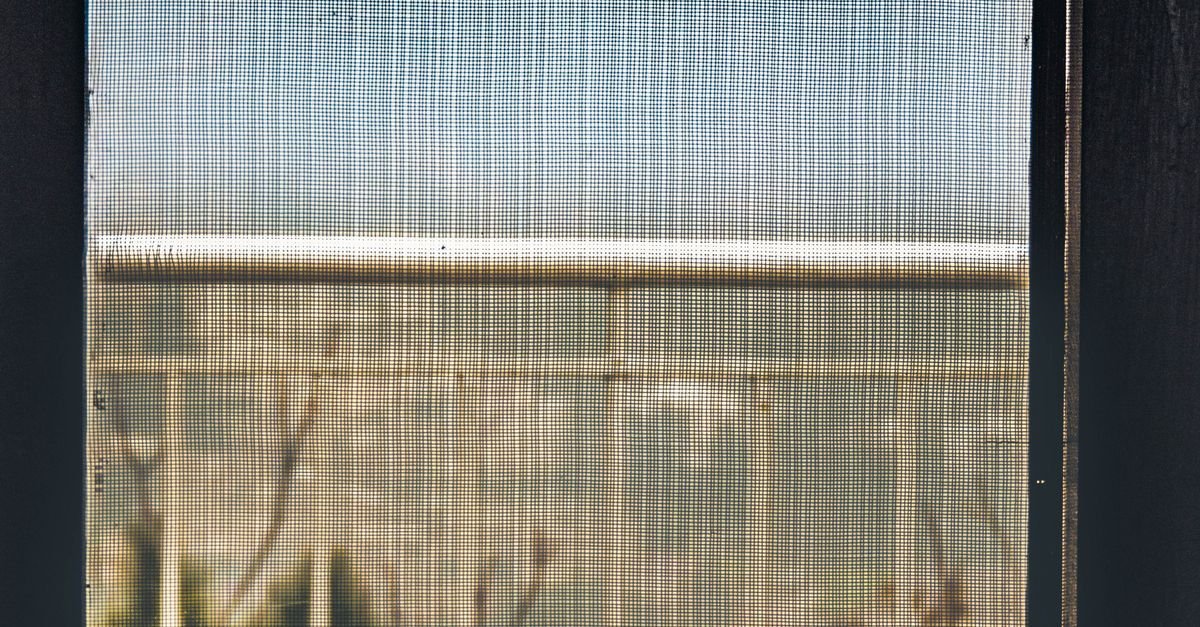
The fine meshes are where this goes wrong, and it is a cruel arrangement: the screens people most want to clean are the ones with the least tolerance for cleaning. No-see-um cloth, pollen and allergen meshes, solar shade fabrics and the micro-fine metal weaves are all sold on optical performance — clarity, or shading, or stopping something very small — so they are the ones that visibly haze first, and they are the ones you are least free to touch.
Andersen’s guidance on its TruScene mesh is the clearest example I found, and I read it twice. The mesh is “micro-fine stainless steel wire mesh that’s one-third the diameter of standard screen wire”, giving “50% more clarity than our standard aluminum screens”. The care instruction is a duster and nothing else: “Do NOT use water or a hose on TruScene insect screens. The micro-fine stainless steel mesh requires dry cleaning only.” The company adds that this is “one of the most common mistakes homeowners make, so it’s worth keeping in mind before you reach for the garden hose” (Renewal by Andersen, Window & Door Screens: Your Insect Screen Guide).
A screen manufacturer telling you not to put water on its screen is not a sentence I expected to find. It is also the single best argument for checking your window maker’s care sheet before you wet anything: if your mesh is visibly finer than the standard grey stuff, the default method may not apply to it at all. Two quick field tests narrow it down. A fridge magnet sticks to steel mesh and ignores both aluminium and fibreglass. And a fingernail push tells you elastic from stiff — fibreglass springs back, metal does not.
Cleaning Window Screens: The Method the Mesh Maker Publishes
I went to Phifer expecting a pressure figure and a maximum. There is no PSI number anywhere in its instructions, because the strongest water in them is a garden hose on the gentle setting. The published tool list is a soft-bristle brush — with the parenthetical “window screens can be damaged using a hard bristle brush” — a hose with a spray nozzle, gentle dish soap, a bucket of lukewarm water and a sponge.
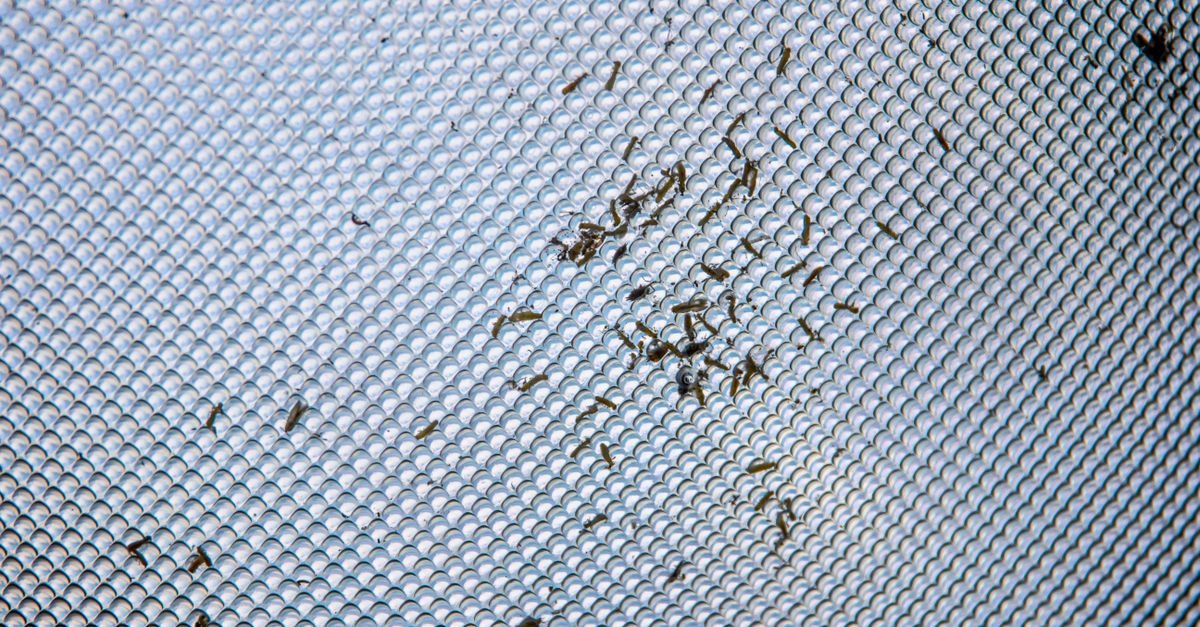
The sequence, with the reasons attached:
1. Take the panel out and label it. Covered above, and it is the step that makes the rest possible.
2. Dry-debris it first if it is bad. Phifer suggests a shop vac on really dirty screens. Wetting a thick layer of pollen and insect parts turns it into a paste that then needs working out of the weave.
3. Support the panel. The instruction is to lean the screens against the house or a fence. Flat on a clean patio or a pair of sawhorses works as well or better, and the principle is the same either way: something behind the mesh so it cannot deflect. Never hold a panel up by one edge and spray it.
4. Wet it at low pressure. Verbatim, because the wording is the whole point: “keep the hose on light pressure and use the option on your nozzle that is more like a spray as opposed to a higher pressure setting.”
5. Soap and a soft brush, both faces. A few drops of mild dish soap in warm water, or a 50/50 white vinegar and water mix if you prefer. Brush along the weave rather than across it, dip often, and change the bucket when the water goes grey. Do the frame channels while you are there — that is where the black line comes from.
6. Rinse off all the soap, top to bottom, still on the gentle setting.
7. Dry properly before it goes back. Shake the panel, lean it in the sun, and flip it halfway through so both faces dry. A damp screen reinstalled against a sash traps water at the bottom rail, which is where staining and, on timber, rot start.
Phifer recommends this once a year, more often for screens taking a lot of wind, rain and dust. Andersen suggests twice, spring and autumn. Somewhere in between is fine; the interval that matters is “before the film sets”, not a date.
Now the opinion, and it has a number behind it. A pressure washer cannot be turned down far enough to be the right tool here, because its own industry standard defines it as a machine that starts above the screen’s ceiling. PWMA PW101-2010, the trade’s testing standard, defines a pressure washer as a device producing a minimum of 500 psi and a minimum flow of 1 gpm — and specifies the inlet water those machines are tested on at 40 to 80 psig. That inlet figure is the water a screen is designed to see. The machine’s *floor* is six to twelve times it. There is no overlap to find, which is why no manufacturer publishes a safe PSI for insect screen: the question does not arise inside the recommended method.
So park the machine, but do not put it away. With the screens out, the wall around the opening is exposed and genuinely wants washing — power washing siding covers what each cladding will take and the order to work in, and the sills and window surrounds are where a house wash visibly pays. Keep the stream level or downward and across the glass rather than into the frame. And while you have the glass to yourself, the white spots that a wash will not touch belong to hard water stains on windows, which are mineral and need an acid rather than force.
FAQ
Can you pressure wash window screens?
No, at any setting. The mesh can be punctured or stretched permanently, the spline can be pulled out of its groove, and the frame — half a millimetre of roll-formed aluminium with pressed-in corners — distorts before either of those. A distorted frame cannot be straightened back, because the slight camber rolled into the stock is what tensions the mesh. Use a garden hose on a gentle spray instead.
What is the best thing to clean window screens with?
A bucket of warm water with a few drops of mild dish soap, a soft-bristle brush, a sponge and a hose with a spray nozzle. A 50/50 white vinegar and water mix is a fine alternative and is what several manufacturers name. Nothing abrasive, no stiff brush, and no solvent — the coating on fibreglass mesh is the part doing the weather protection.
How do you clean window screens without removing them?
Vacuum the mesh with a soft brush attachment to lift dry dust, then spray a mild soap or vinegar solution onto a cloth or sponge and wipe both sides as far as you can reach. Support the mesh with your other hand on the far side so you are not pushing it off its spline. It removes loose debris well and film poorly, so treat it as maintenance between proper washes rather than a substitute.
How often should window screens be cleaned?
Phifer recommends once a year, and more often for screens exposed to a lot of wind, rain or dust. Andersen suggests twice a year, spring and autumn. Screens under trees, behind a sprinkler arc or on a coastal or roadside elevation load up faster and set the interval for the rest of the house.
Can all window screens be washed with water?
Not all. Some premium fine-weave meshes are dry-clean only — Andersen’s TruScene stainless mesh is explicitly dusted rather than washed, and its own guidance says not to use water or a hose on it at all. If your mesh is noticeably finer or clearer than standard grey insect screen, find the window manufacturer’s care sheet before you wet it.
Why do my screens still look hazy after washing them?
Three usual reasons. Soap left in the weave dries to a film, so the rinse matters as much as the wash. The inside face was not done, and it is half the surface you are looking through. Or the coating on the yarn is chalked or the aluminium wire has oxidised, in which case the haze is the mesh itself and washing cannot reach it — that panel is a re-screen when you get round to it.
Do window screens have to be dry before going back in?
Yes, and it is worth the wait. Water sitting between a damp mesh and the sash collects at the bottom rail, which stains painted frames and starts rot in timber ones. Shake each panel, lean it in the sun, flip it halfway, and put the screens back at the end of the day rather than the middle.
Support the Panel, Skip the Machine
Everything about this job follows from one fact: the screen is a removable panel, and once it is off the window it can be washed properly by hand in about the time it takes to argue with yourself about the pressure washer. Off the window, supported from behind, soap and a soft brush on both faces, rinsed gently, dried before it goes back. That is the whole method, and it is the method the people who weave the mesh publish.
The mesh is the part you were worried about. The frame is the part you would actually lose — half a millimetre of aluminium, bowed at the factory so the cloth sits tight, and impossible to un-bend once a jet or a careless grip has found it.
Before any of it, find out what your mesh actually is. Standard grey insect screen washes; a fine-weave stainless mesh like Andersen’s TruScene gets dusted and never wetted, and the care sheet is the only place that distinction is written down. Once you know which one you own, the rest is a bucket, a soft brush, and an afternoon of drying time you have to be willing to give it.