Last Updated on September 26, 2026 by Umar Farooq
The honest answer on cleaning screen enclosure panels is that the frame takes a wash, the mesh takes a rinse, and nothing on the structure takes a pressure washer at the pressure it was sold to you for.
A cage is two materials with almost nothing in common. One is extruded aluminium with a finish on it, which is a building component. The other is a woven cloth held in a slot by friction, which is a textile. Most guides give both of them the same paragraph, and that is where this job goes wrong.
Depending on where you live you call it a lanai, a pool cage, a screen enclosure, a patio enclosure or a screen room. An estate agent may call it a Florida room, which properly means a glazed one, though nobody is going to win that argument in a driveway. The names vary. The failure modes do not.
Power washing a porch gives screens one section, because a porch also has a painted floor and a beadboard ceiling competing for attention. A cage has no other surfaces, so that section needs to be the whole article — what the cloth is, what holds it in, and what a jet does to the joint between them.
Insect Screen Is a Fabric, and Fabric Has a Bursting Strength
There is an industry standard for the cloth on your cage, and its contents page settles the pressure question before you reach any numbers.
ASTM D3656/D3656M-25, *Standard Specification for Insect Screening and Louver Cloth Woven from Vinyl-Coated Glass Yarns*, covers screening “for installation in or on any dwelling, patio, screening enclosure, building, or structure for the purpose of keeping out flies, mosquitoes, and most insects.” To conform, a product must be tested for “appearance, mesh, roll length, mass per unit area, flame resistance, fabric stability, bursting strength, stiffness index, and color stability to accelerated weathering” (ASTM D3656/D3656M-25).
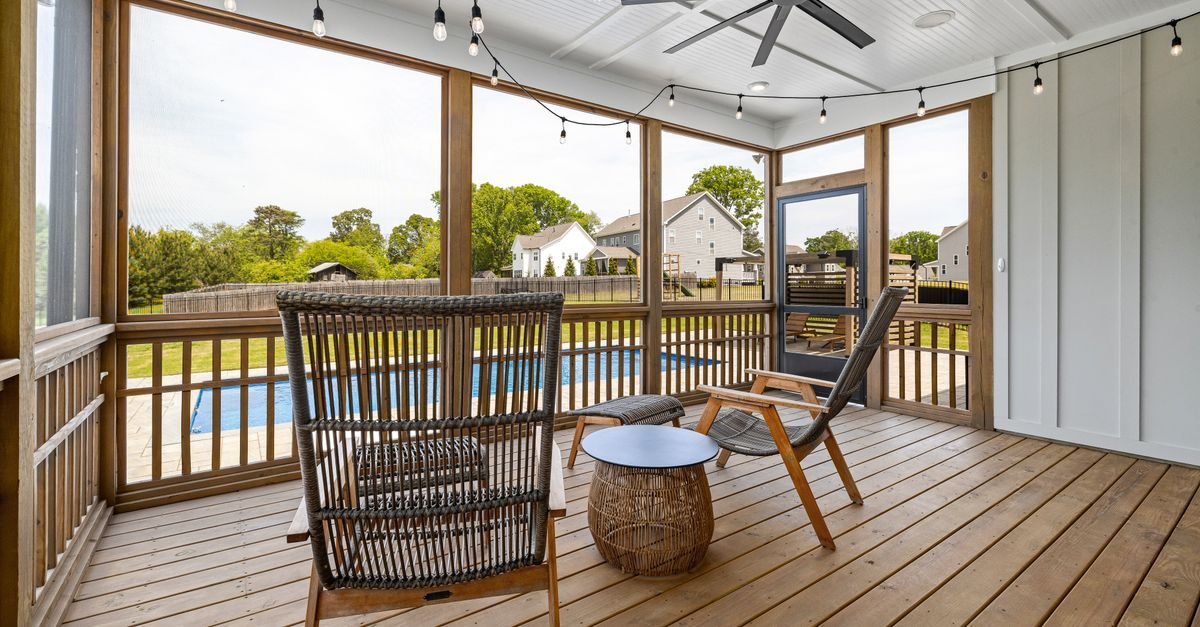
Two of those matter here. Bursting strength is the pressure at which the cloth ruptures — a fabric test, in the same unit your machine’s dial is marked in. Fabric stability is its resistance to permanent distortion, which exists as a test because permanent distortion is a known way for screening to fail. A wand is not testing whether the mesh is dirty. It runs both of those tests at once, without a technician present.
I would like to give you the actual burst figure for pool and patio cloth. It sits behind ASTM’s paywall, I have not read it, and the number circulating on contractor blogs is quoted by everyone and sourced by nobody. The mechanism does not need it. A 40-degree tip on siding lands on a panel backed by sheathing, so the wall absorbs the force and passes it into the house. A screen has nothing behind it: all of that momentum is carried by a handful of strands and handed to the frame through one joint at the edge. Pool and patio screening runs 18 strands per inch one way and 14 the other, so most of what you are aiming at is hole and the part receiving the jet is a grid of yarns you could cut with a fingernail.
Three things then happen, and you learn which only afterwards: the jet punches through and leaves a slit, it stretches the weave so the panel sags permanently, or it lifts the edge out of the frame. All three are a re-screen. A screen is engineered to stop mosquitoes and let wind through, and you are about to arrive with something that strips paint.
The Spline Is a Rubber Cord, and It Is the Only Thing Holding the Panel In
Once you have seen how a panel is fixed, you will not aim a wand at one again.
The mesh is not bonded, clamped or screwed. Each frame member has a groove along its face; the cloth lies over the groove and a length of flexible cord — the spline — is rolled in on top, folding the cloth into the slot and trapping it by interference. Friction is the entire fixing for several hundred square feet of fabric.
The sizes are published and they are small. Phifer’s spline chart lists frame grooves at 5/16 by 3/4 inch, 7/16 by 3/4 and 7/16 by 1 inch, with spline diameters of .125, .140, .160, .175, .190 and .220 inch — so for standard fibreglass and pool and patio 18×14 cloth, a cord between .125 and .235 inch depending on the groove. Its rule is that “the spline size should match the spline groove width for standard insect screen, as a point of reference,” and thicker fabrics such as PetScreen and SunTex “will require a smaller diameter spline because of the fabric thickness,” because the cloth itself takes up room in the slot (Phifer, Selecting the Right Spline for Your Screen Frame).
Somebody specified that fit down to a sixty-fourth of an inch. Your wand has no opinion on sixty-fourths.
Now consider direction. A spline resists being dragged sideways along its groove reasonably well. What it resists poorly is being pulled straight out — and a jet hitting the middle of a panel pulls the cloth away from the frame at right angles to the groove, which is exactly the weak axis. The failure starts as two inches lifting at one corner you were not looking at, and then it walks, because once the cord stands proud the next gust does the rest.
Age is the multiplier: spline is a vinyl or rubber cord that spends its life in ultraviolet light, hardening and taking a set, so a ten-year-old cage has less grip in every groove than it had on day one. A panel that already booms in the wind wants re-splining, not washing.
Wash the Frame, Not the Cage
The aluminium is the part that genuinely gets dirty, genuinely gets cleaned and genuinely has published chemistry. It is also where most of the grime you can see from the deck lives, because the frame members are solid and horizontal while the mesh is mostly air.
Cage extrusions carry one of two finishes: painted, a factory organic coating in the white, bronze or almond on nearly every cage built in the last forty years, or anodised, an oxide layer grown into the metal electrochemically. Neither is bare aluminium, and the finish is what you are protecting.
Linetec, which finishes architectural aluminium for a living, is blunt about the limits: “an anodized finish should be cleaned using mild soap solutions to retain its original beauty,” “aggressive alkaline or acid cleaners must never be used,” and “excessive abrasive rubbing should not be used since it could damage the finish” (Linetec, Anodize Cleaning and Maintenance).
Read that against the standard house-wash mix. Sodium hypochlorite with a surfactant is an oxidiser in an alkaline carrier, and on a painted panel at house-wash dilution, properly rinsed, it is fine. Left to dry on anodised extrusion it is an aggressive alkali sitting on an oxide film, and the dull patch it leaves will not polish out, because the finish is not on the metal — it is in it. So the mix on a cage frame is weaker, wetter and rinsed harder than anything you would bother with on a wall. Old painted frames add a problem with no biology in it: a bronze cage from the 1990s chalks, and scrubbing chalk unevenly leaves bands, exactly as cleaning aluminum siding describes.
| Component | Method | Ceiling |
| Screen mesh | Pump sprayer, dwell, hose rinse, both faces | No pressure at all |
| Painted frame members | Dilute mix, soft brush on a pole, hose | ~500 PSI, 40°, 3 ft, only if you must |
| Anodised frame members | Mild soap, soft brush, rinse hard | Mild soap only |
| Solid kickplate panels | Brush, or low pressure across the panel | ~800 PSI, 40° |
| Screws, base plates, door track | Wipe and rinse, never aim at them | Hose only |
| Header at the house wall | Rinse across the member, never upward | Hose only |
| Concrete or paver deck | Detergent, dwell, surface cleaner | Real flatwork pressure |
Two rows deserve their own sentence. Every frame member is a hollow extrusion screwed together with self-tappers, and water driven into a screw head goes inside the tube. A hollow post does not drain on any schedule you control — it holds the mix in the bottom around a steel fastener, which is a galvanic couple with aluminium as the sacrificial half. The white crust you see around old screw heads is what a few years of help looks like. And the header where the cage meets the house sits under the soffit or on the fascia, so aiming upward there means washing the inside of a roof edge.
Mildew Lives on the Mesh, Where No Brush Can Follow
Here is why a cage is a harder cleaning problem than a wall rather than an easier one.
A lanai sits in permanent partial shade, holds humid air, catches pool splash and chlorine mist, and drips for hours after rain because every strand carries its own droplet. The result is mildew and green algae on the cloth itself, plus dark streaking along the horizontal members where water runs and stops. Growth on any building surface tracks the hours that surface stays wet, and a screen enclosure manages to stay wet in the middle of a breeze.
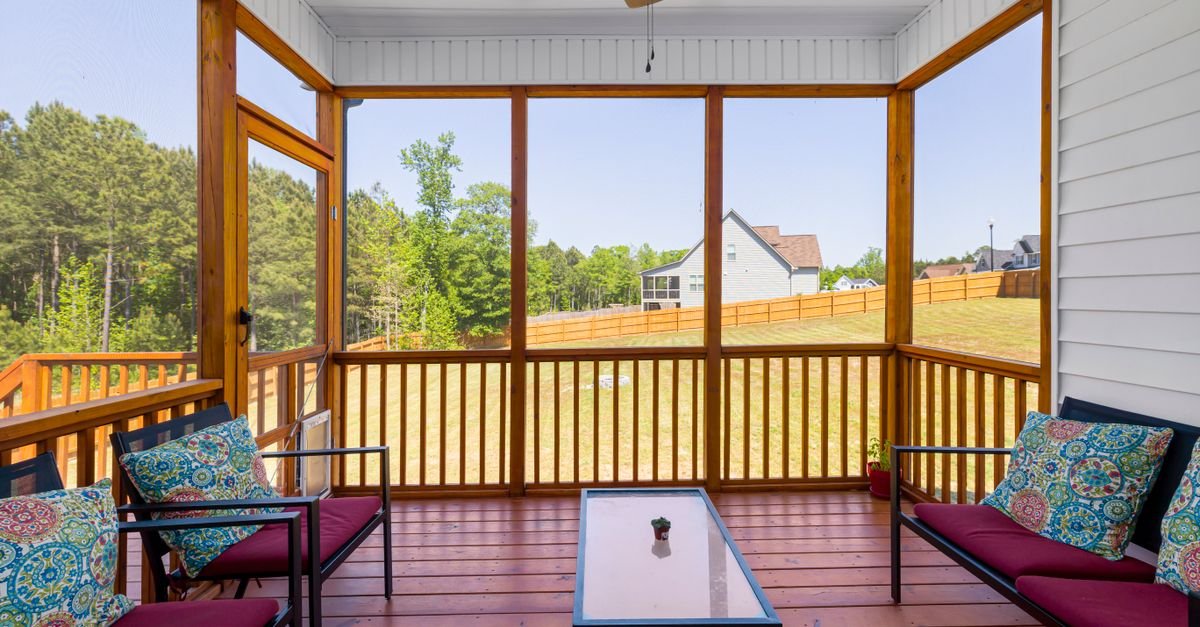
Now take away every tool you would normally reach for. You cannot pressure it, for two sections’ worth of reasons. You cannot scrub it, because a stiff brush loads the yarns sideways and either pulls the weave out of square or abrades the vinyl coating off the glass underneath — and that coating is the weather and ultraviolet protection, which is why the standard tests colour stability at all. And you cannot lift the panels out and lay them flat the way you would a window screen, because they are splined into the structure and removing one is the re-screen you were avoiding.
What is left is chemistry, patience and water at hose pressure — not a lesser version of washing a wall, but a different job with a different tool list.
Helpfully, a screen holds a mild solution unusually well. Every strand is a wick, so a pump sprayer on a coarse fan wets both faces better than you would expect. Work bottom to top, keep it visibly wet for five to ten minutes, re-mist anything drying at the edges, then rinse top to bottom with a garden hose from a few feet back. Do the inside face too — it is half the strand area and the half you look through. And err weak: the coating on the yarn is plasticised PVC, and chlorine left to dry on it chalks it.
Which brings me to the opinion I will defend here. On a screen enclosure the pressure washer is not set wrong — it is the wrong machine. The mesh’s ceiling is zero. The anodised frame’s ceiling is mild soap. Painted frame is a few hundred PSI, and a brush on a pole beats the wand there anyway because it reaches the top face of each member instead of glancing off it. The only surface on the whole structure that wants two and a half thousand PSI is the concrete under your feet.
Where the Pressure Washer Earns Its Keep on a Lanai
So park it, but do not put it away. There is real work for a machine here and all of it is below knee height.
The deck is the job. A concrete or paver pool surround takes detergent, dwell and a surface cleaner at the usual flatwork figures, and a surface cleaner is right for a second reason inside a cage: it holds its own standoff and keeps spray inside a skirt instead of throwing it at mesh eighteen inches away. Cleaning a pool deck covers the flatwork, including the thing that changes all of it — if your surround has an acrylic cool-deck texture coating rather than bare concrete, the coating’s maker publishes care instructions and a wand is not in them.
Four rules cover the rest.
- Do the perimeter strip by hand. A surface cleaner’s sideways discharge is what holes the bottom courses of mesh. Keep the unit two feet off the frame and finish the last band with a brush.
- Cross the members, never enter the joints. Straight into a mitre is how water gets inside the tube.
- Nothing goes upward. Not the header, not the soffit, not the roof panels, not a light or a fan.
- Plan the runoff before you mix. Soak the planting outside the cage with clean water first and again afterwards. The pool will shrug off a splash of dilute hypochlorite — it is already chlorinated — but a house-wash surfactant is not pool chemistry and the loosened debris certainly is not, so cover the surface or skim and run the filter afterwards.
Do the floor last. Everything you rinse off the frame and the mesh lands on it, and gravity has not been repealed for Florida.
FAQ
Can you pressure wash a screen enclosure?
You can pressure wash the deck inside one, and rinse painted frame members at low pressure with a 40-degree tip from about three feet. You cannot pressure wash the mesh at any setting. A jet either punctures the cloth, stretches it permanently or lifts the spline out of its groove, and all three are a re-screen rather than a clean.
What is the best cleaner for screen enclosure mesh?
A dilute cleaner applied with a pump sprayer and given time. Mild dish soap handles seasonal film. For mildew and green growth, weak sodium hypochlorite with a surfactant, kept wet for five to ten minutes and rinsed thoroughly, kills the colony. Mix it weaker than you would for a wall — chlorine left to dry on a vinyl-coated yarn chalks the coating.
How do you clean a pool cage without taking the screens out?
You do not take them out; that is the point. Cage panels are splined into the structure rather than removable like window screens. Work with a pump sprayer and a soft brush on a pole, treating frame and mesh separately: brush the extrusions, wet the cloth and let chemistry work, then rinse with a garden hose. Do both faces, and finish with the floor.
Will bleach damage the aluminium frame on a lanai?
Diluted and rinsed, it is fine on a painted frame. On anodised extrusion it is a real risk, because the finish is an oxide film grown into the metal and aggressive alkaline cleaners attack it, leaving a dull patch that will not polish out. Linetec’s guidance is mild soap solutions, no aggressive alkalis or acids, no heavy abrasion.
How often should a screen enclosure be cleaned?
Once or twice a year suits most cages, and the interval is set by drying hours rather than the calendar. Deep shade, overhanging trees, a screened section under a solid roof or a coastal site all push it towards twice. A hose-down of the shaded elevations every couple of months removes the organic film mildew feeds on, which does more than a stronger mix will.
Why did my screen go loose after I washed it?
Because the spline lifted. The cord holding the cloth is an interference fit between about an eighth and a quarter of an inch across, and it resists being pulled straight out of its slot far less well than anything else you could do to it — which is the exact direction a jet pulls. A loose panel needs re-splining; stretched mesh needs replacing.
A Cage Is a Frame With a Fabric Stretched Across It
The frame is a painted or anodised building component with published chemistry and a few hundred PSI of tolerance. The fabric is a textile with a bursting strength, held in place by a cord you could cut with scissors. Treat them as one surface and you will clean the tolerant half while testing the other one to destruction.
So the list is a pump sprayer, a soft brush on a pole, a garden hose and an afternoon. The machine comes out for the concrete, with a surface cleaner on it and two feet of clearance from anything woven.
Should there already be a neat slit in one panel, which is how a lot of people arrive at this page: it is one panel, screen shops price by the panel, and nobody standing on your deck in August will be looking at it. Start the rest with the sprayer.