Last Updated on September 26, 2026 by Umar Farooq
Cleaning wrought iron fence panels is really cleaning the coating on them — mild detergent, a soft brush, a rinse at 1,200 to 1,500 PSI with a 40-degree tip from 18 inches, and every wet crevice dry before dark. The metal underneath is not what you are washing. It is what you are protecting, and only three faults actually matter on an iron fence: rust breaking out through the finish, water sitting inside hollow sections, and a coating that has started to fail and now looks like dirt.
One more thing belongs this early, because it decides everything that follows. Your fence is almost certainly not wrought iron. Real wrought iron went out of commercial production generations ago. What stands at the front of most houses is welded tubular mild steel, galvanised and powder coated, or cast aluminium that cannot rust at all — and those want different afternoons.
This Rust Is the Fence, Not a Stain on It
Orange on a white vinyl fence and orange on an iron fence are not the same problem, and treating them the same way is how somebody ends up with a clean fence that is quietly eating itself.
On vinyl, the iron arrived from somewhere else. A sprinkler drawing well water, a rusting hinge screw, a bracket weeping down a panel — the plastic itself is inert and the stain is a deposit sitting on top of it. That is rust bleed, it comes off with an acid, and it is worked through properly in the notes on cleaning a vinyl fence.
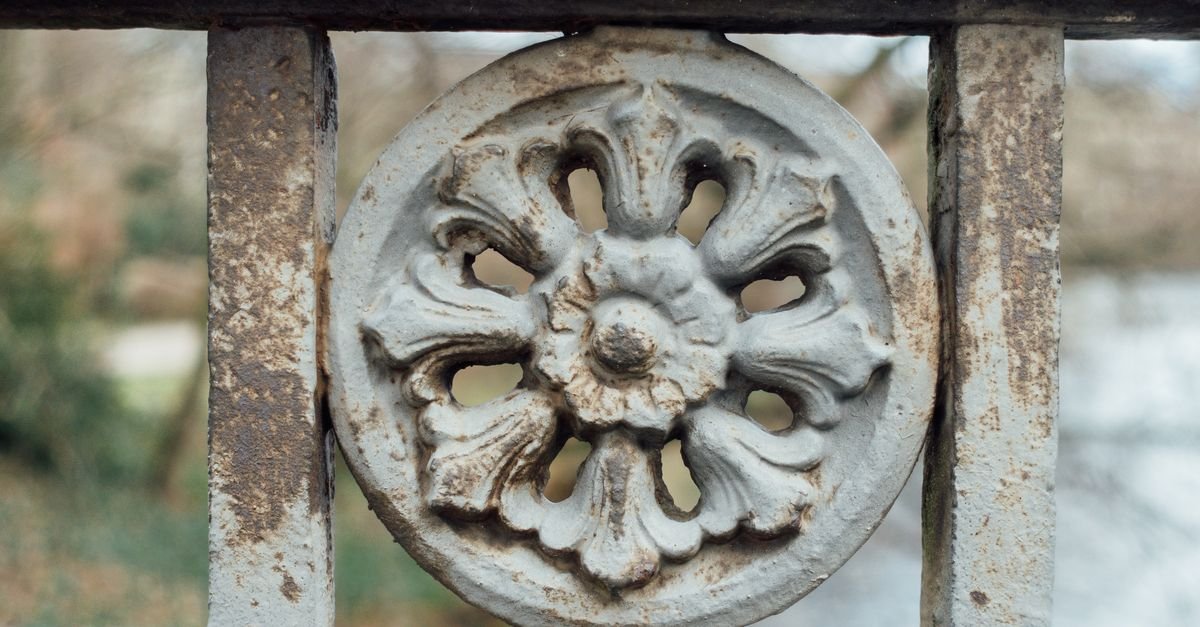
On an iron fence, nothing arrived. The stain *is* the fence, converting itself into iron oxide one flake at a time. Dissolving it with an acid does not fix that, because the acid removes the evidence and leaves the hole. The chemistry of why oxalic acid lifts iron oxide and bleach does nothing to it is already worked out in cleaning rust stains off concrete.
What matters on metal is the direction of travel. A stain on an inert surface stops growing the moment you cut off its supply. Rust on steel has an unlimited supply — the steel — and it spreads sideways *under* the coating, where nobody can see it, long before the next blister appears. So the useful question on an iron fence is never “how do I get the orange off.” It is “how much sound coating is left.”
What You Actually Own: Four Metals, One Look
Take a fridge magnet to the fence before you take anything else to it. Thirty seconds of testing tells you more than any amount of squinting at a style that four different metals have all been made in.
| What you have | The tell | Rusts? | How to treat it |
| True wrought iron | Pre-1900s, hand-forged, hammer marks, riveted or collared joints, no welds | Slowly, and it is historic | Conservation job, hand tools only |
| Cast iron | Heavy, brittle, moulded detail with a seam line, bolted sections | Yes, and it cracks rather than bends | Hand tools, no impact, no blasting |
| Tubular mild steel | Hollow when tapped, welded joints, machine-identical pickets | Yes, readily | Wash, dry, touch up bare spots |
| Cast or extruded aluminium | Magnet falls off, very light, screwed brackets not welds | Never | Wash with mild detergent, relax |
The magnet answers the last row instantly, and it is the row most people are in. If it drops, you own aluminium, you have no rust problem on the pickets, and the only ferrous things on the whole fence are the screws and the hinges. The other three all hold a magnet, so separate them by construction: neat repeated welds mean steel, a mould seam and real weight mean cast iron, and hammer marks with no seam and no weld mean you may genuinely have wrought iron — in which case stop reading pressure washing advice and find a conservator.
Here is the part I did not expect when I went looking. Mild steel — the metal modern “wrought iron” fencing is actually made of — is *worse* at resisting corrosion than the material it imitates. The National Park Service says so plainly in its brief on architectural cast iron: “Mild steel is not as resistant to corrosion as either wrought iron or cast iron” (NPS Preservation Brief 27). The reason your fence has survived at all is not the steel. It is the zinc and the powder coat wrapped around it, which is exactly why the wash is about protecting a finish rather than scrubbing a metal.
Cleaning Wrought Iron Fence Panels Without Stripping the Coating
Chemistry first, and on this surface the chemistry is almost embarrassingly boring. Mild detergent in warm water, applied bottom to top, five minutes of dwell, then rinsed top to bottom. That is the whole job on nine fences out of ten, and a soft brush does the rest.
For the rinse, sound factory powder coat handles the 1,200 to 1,500 PSI range with a 40-degree white tip at 18 inches that the wider fence pressure guide sets out. Three adjustments are specific to ironwork:
- Never square on to a weld or a finial joint. Coating is thinnest where the metal changes direction, because powder does not wrap a sharp edge as thickly as it covers a flat face. Work at a shallow angle so the jet skims rather than lands.
- Never point upward into an open picket end or a rail cavity. More on that shortly, and it is the one mistake whose damage takes two years to surface.
- Drop to garden-hose pressure the moment chalk comes off on your hand or rust is bleeding through. At that point you are no longer cleaning metal, you are stripping a failing coating, and the machine will win that contest.
There is no 0-degree nozzle case here and there never was. A red tip on a hollow picket concentrates the machine’s entire output into a stripe about the width of a pencil, which is plenty to cut the coating open and nowhere near enough to remove rust. Rust comes off with a brush. Coating comes off with a jet. Green film on the shaded run is organic and a longer dwell handles it.
Water Gets Into the Tube and Never Leaves
Tap a picket. If it rings hollow, your fence is a set of sealed tubes that are not quite sealed, and the inside face has no coating on it worth speaking of.
Water gets in three ways: down an open picket top where the cap has fallen off, in through the drainage slots punched in the bottom rail, and up from the base of a post set into concrete. Once inside it has nowhere to go. The fence rusts from the inside out, and the first visible sign is usually a blister or a split along a bottom rail years after the process started.
The NPS brief describes the mechanism in a sentence worth pinning up. Rusting “is accelerated in situations where architectural details provide pockets or crevices to trap and hold liquid corrosive agents,” and once a rust film has formed, “its porous surface acts as a reservoir for liquids, which in turn causes further corrosion.” A hollow steel tube with a hole in the top is a purpose-built pocket. A rust film inside it is a sponge.
So, three rules. Aim level or slightly downward, because a jet fired up into an open tube fills it in seconds and that water is not coming back out. Replace missing picket caps before you wash rather than after. And keep the bottom rail slots clear of soil, mulch and leaf mush, because a blocked drain slot turns the rail into a gutter. Aluminium owners get a pass on the rust, though not on the mosquitoes.
65 Percent Humidity Is All Rust Needs
Drying is not the tidy-up at the end. On bare or thinly coated steel it is part of the cleaning, and there is a number that makes the case better than any warning could.
The same NPS brief puts the minimum relative humidity needed to promote rusting at 65%, and notes it falls lower still in the presence of salt air, acid precipitation, soil contact or atmospheric sulfur compounds. Sixty-five percent is not weather. It is an ordinary overcast afternoon in most of the country. Any bare spot left damp is already oxidising before the hose is wound up.
The same document holds a detail that surprised me more. Wet sandblasting is not recommended on iron, and the reason given is not the dust — it is that “the water will cause instantaneous surface rusting and will penetrate deep into open joints.” Instantaneous. That is a conservation body saying water on freshly exposed iron starts working within minutes, which is the honest explanation for a fence that looked fine on Saturday evening and had orange speckles by Sunday.
So wash in the morning, not late afternoon. Towel the horizontal surfaces and the insides of the scrollwork, where water pools and sits for hours; a leaf blower clears the crevices a towel cannot reach at about two minutes a panel. And do not wash a fence you intend to prime with rain forecast, because you will seal moisture in under the new paint.
Every Bare Spot You Expose Is a Warranty Clause
This is the strong opinion, and it is not really about pressure washing at all: washing an iron fence is a paint job that happens to start with soap. If you are not willing to prime and touch up the same day, do not take a wire brush to the rust in the first place. You will have opened the coating, handed water a route in, and gone indoors.
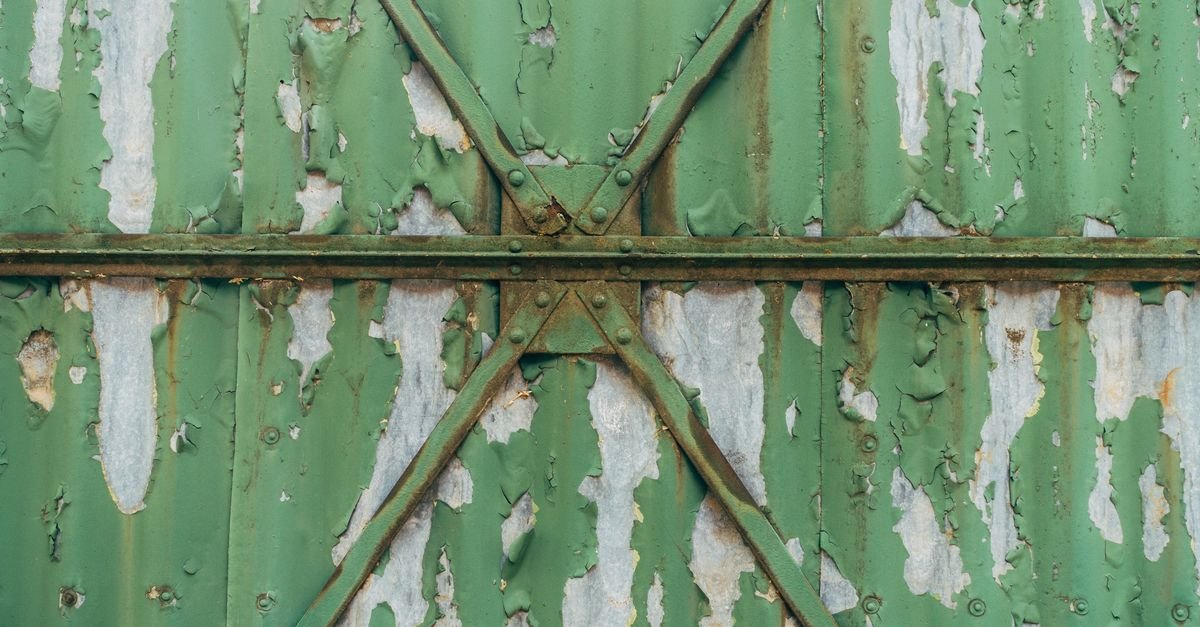
The manufacturers say as much themselves, in the one place they are obliged to be precise. Ameristar’s residential Montage warranty describes the product as galvanised steel framework given “a multi-stage pretreatment/wash, followed by a duplex cathodic electro-coat corrosion protection, and an acrylic liquid topcoat.” Then it sets out what happens when that stack is broken. Cut or drill a component and you must remove all shavings, apply zinc-rich primer to “thoroughly cover cut edge and drilled hole,” and paint over it; “failure to seal exposed surfaces per steps 1-3 above will negate warranty” (Ameristar Montage limited warranty).
A wire brush taken to a rust spot creates the same condition as a drill hole: bare steel with no zinc and no topcoat over it. The maker’s own remedy is your remedy — brush back to sound metal, wipe it clean and dry, zinc-rich primer, two coats of finish. Two of its exclusions are cleaning decisions too: damage from “chemicals that may cause damage” and from “water sprinklers with high mineral content and/or greywater/reclaimed water.” If a sprinkler head is hitting your fence, moving it is a warranty matter and not just housekeeping.
If the Railing Was Painted Before 1978, Do Not Wash It
Old ornamental ironwork is where this article stops being about cleaning. If the railing, gate or fence was painted before 1978, assume lead in the paint until a test says otherwise, and understand that a pressure washer is one of the specific tools the guidance names.
HUD’s guidelines on controlling lead-based paint hazards are unusually direct. They “recommend strongly against the use of uncontained hydroblasting,” because “removal of paint using this method can spread paint chips, dust, and debris beyond the work area.” The next sentence is the one to read twice: “Pressure washing is also discouraged.” What is allowed is contained pressure washing at less than 5,000 PSI inside a protective enclosure built to stop chips and dust escaping (HUD, Guidelines for the Evaluation and Control of Lead-Based Paint Hazards in Housing, Chapter 12). Nobody is building a containment tent around a front railing before lunch.
Table 12.1 of the same chapter lists prohibited methods outright, and two of them are things people reach for on a rusty railing without a second thought: machine sanding or grinding without a HEPA local vacuum exhaust tool, and abrasive blasting or sandblasting without one.
So the answer for a pre-1978 railing is a lead test first, from a hardware-store swab kit or a certified inspector. If it comes back positive, the job is hand washing with detergent and no scraping, or a certified contractor with containment. Not a machine. And if the paint is already flaking into the soil beside a path where children walk, that is a hazard you have just found rather than one you created — a better position than not knowing.
FAQ
Can you pressure wash a wrought iron fence?
You can pressure wash modern powder-coated steel or aluminium fencing at 1,200 to 1,500 PSI with a 40-degree tip from 18 inches, angled so the jet skims welds rather than striking them square. You should not pressure wash genuine antique wrought or cast iron, anything whose coating is already peeling, or anything painted before 1978 until it has been lead-tested.
What is the best cleaner for a wrought iron fence?
Warm water and a mild dish or car-wash detergent, five minutes of dwell, and a soft-bristle brush. Nothing stronger is needed for dirt, pollen, cobwebs or light green film, and stronger chemistry mostly attacks the coating you are trying to preserve. Keep bleach for heavy organic growth, dilute it, and rinse it off the fixings properly afterwards.
Can you use vinegar on a wrought iron fence?
Only on bare rust you are about to prime, and even then oxalic acid does the job better. Acetic acid is weak at dissolving iron oxide and it will happily dull a nearby coating while it works. The bigger problem is what comes next: acid leaves clean, bare, activated steel that starts rusting again within hours unless you dry it and prime it immediately.
How do I stop my iron fence rusting again after cleaning?
Seal every spot the brush exposed. Brush back to sound metal, wipe dry, apply a zinc-rich primer over the bare steel, then two coats of exterior finish. Then remove the cause: move the sprinkler head soaking one run, clear soil away from the bottom rail, replace missing picket caps, and lift the base of the fence out of standing mulch.
Should I use a wire brush or sandpaper on rust?
A fine stainless-steel wire brush by hand is the standard first choice, and the reason to keep it gentle is that coarse tools score the surface and flatten fine ornamental detail. Sandpaper is fine on flat sections. What you should not reach for is a grinder or a blasting nozzle: the NPS brief notes that even in professional grit blasting, pressure above 100 PSI is unnecessary and should be avoided.
How often should an iron fence be cleaned and repainted?
Wash it twice a year, which is mostly an excuse to inspect it. Walk the run afterwards looking for blisters, chalk on your palm, rust at welds and at ground level, and soft spots in the bottom rail. Touch up bare patches as you find them. A full repaint is a five-to-ten year job in a mild climate and sooner within a mile of the coast.
Soap First, Then Seal What the Brush Uncovers
The short version of cleaning a wrought iron fence: find out which metal you actually have, wash it with the mildest thing that works, and treat every bare patch you create as an open wound rather than a job well done.
Magnet on a picket first. Aluminium means no rust and an easy afternoon. Tubular steel means a wash, a dry, and touch-up paint bought before you start rather than after. Cast or genuine wrought iron means hand tools and, if it is old and painted, a lead test before anything else happens. Detergent bottom to top, five minutes, rinse top to bottom at 1,200 to 1,500 PSI with a 40-degree tip, level or downward, never up into a hollow picket.
Then dry it, because 65% humidity is all the rust needs and a damp scrollwork crevice is where it starts. A fence that has been washed and left bare is not a clean fence. It is a fence with a head start on next year’s rust, and it will show you exactly where you stopped caring.