Last Updated on September 26, 2026 by Umar Farooq
Cleaning vinyl fence panels is a bucket, a soft brush and ten minutes of dwell time — and on most residential fences it does not need a pressure washer at all. Work one section at a time, do both sides the same day, and keep every jet of water pointed square at the panel or slightly downward. The four things people most often try to scrub off a vinyl fence — chalk, yellowing, green film and orange bleed — are four different problems, and only one of them is dirt.
That is the part the guides skip. A vinyl fence looks like one uniform white surface, so it gets treated as one uniform cleaning job, and then the homeowner spends an afternoon discovering that half of what they were trying to remove is the fence itself.
A Vinyl Fence Is a Hollow Extrusion, Not a Clad Wall
Almost everything written about cleaning vinyl assumes you are standing in front of a house. That assumption carries one very large worry with it: vinyl siding is a rain screen hung over sheathing, housewrap and insulation, and the reason everyone shouts about never spraying upward is that water driven under the laps ends up inside a wall you cannot see or dry.
A fence has none of that. There is no sheathing behind it, no housewrap, no cavity insulation and nobody’s drywall. Both faces are weather faces. The entire “water gets behind it” anxiety that dominates siding advice simply does not apply here, and you can put it down.
What replaces it is a different problem, and a more literal one. A vinyl fence is not a sheet of anything. It is a kit of hollow extruded PVC tubes: square posts, rectangular rails, and either pickets or tongue-and-groove infill boards slotted between them. The rails pass through routed pockets cut in the sides of the posts. The posts are closed at the top by a cap that is pushed on, and closed at the bottom by concrete, a footing or a steel post stiffener. Every one of those joints is an opening into a sealed tube.
So water that goes into a vinyl fence does not go behind anything. It goes *inside* something, settles in the bottom of a rail or the base of a post, and then has nowhere to be. It comes back out over the following week as a slow weep from the underside of the rail, dragging a chalky grey line down the panel you just finished cleaning. The mechanism is undramatic and nobody photographs it, which is probably why it never became the headline warning it deserves to be.
The other structural difference is arithmetic. A wall has one side. A fence has two, plus the top edge of every rail, plus the post caps, plus the routed shoulders where rails meet posts. Roughly twice the area of a wall of the same length, and considerably more edge per square foot — which matters, because edges and horizontal top surfaces are where dirt and algae settle first. If you want the wood equivalent of this comparison, our guide to pressure washing a fence sets the materials side by side. The short version of the difference: wood fails by tearing, and vinyl fails by filling.
The White Powder and the Yellow Tinge Are Not Dirt
Run a dark cloth down an older white vinyl fence and look at the cloth. If it comes away with a fine chalky film on it, that powder is not pollen, not dust and not hard-water residue. It is the fence.
Pigmented plastics and paints hold their colour with a binder, and ultraviolet light breaks that binder down from the surface inward, releasing loose pigment as a powder. That is chalking, and we have a full explainer on what chalked actually means rather than repeating the chemistry here. The consequence for cleaning is what matters: washing removes the powder that has already formed, not the process that is forming it. A chalking fence comes back chalky, and how fast depends on how much sun that face gets.
Chalking also sets a trap that is worse on a fence than on a house. Washing lifts the dull layer and the panel underneath reads noticeably brighter. On a wall you might never see the treated and untreated sections at the same time. On a fence you certainly will, because you walk the whole run at a glance and both sides are visible from somewhere. Clean half a fence and you own a fence in two shades until you finish the other half.
Now the cloth test’s other outcome. If the cloth comes away clean and the panel still looks cream rather than white, that is not chalk and it is not a stain. Rigid PVC is white because of the titanium dioxide loaded into it, and the polymer itself shifts colour as UV drives chlorine off the chain and leaves behind structures that absorb blue light. That is a chemical change inside the material, not a film sitting on top of it.
No cleaner reverses it. Not oxalic acid, not bleach, not the product with the sunburst on the label. I went looking for a vinyl fence maker publishing a numerical colour-change limit I could actually open and quote, and came up empty — several warranties gesture at weathering, none I could read put a figure on it. So the honest answer is the mechanical one: chalk wipes off, yellow does not, and the cloth tells you which you have in about four seconds.
Where the Green Grows and Why It Is Always the Same Run
Green film is the commonest complaint about vinyl fencing, and it is almost never evenly spread. There is usually one run — north-facing, usually behind something — that greens up while the rest of the fence stays clean for years.
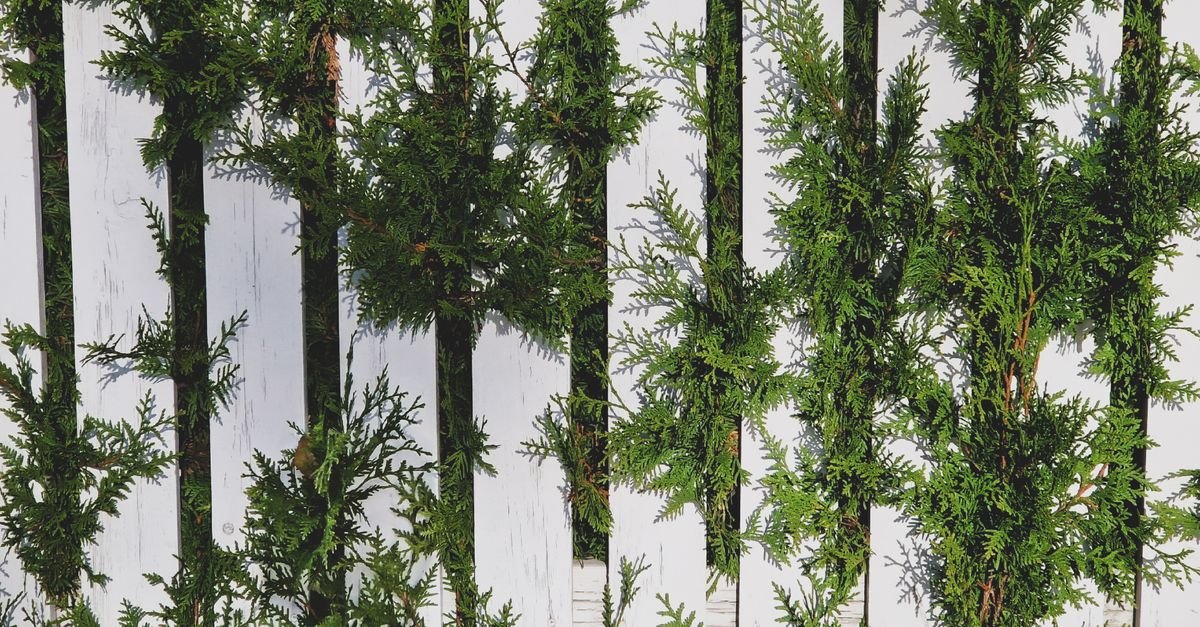
Algae is a plant. It gets enough light even in shade, so the limiting factor is how long the surface stays damp. On a house wall, the eaves and a foot of open air on both sides let a surface dry within an hour of rain. On a fence there is very often a laurel hedge, a row of arborvitae or a shrub border pressed flat against one face, holding moisture against the panel most of the day and blocking the air that would otherwise carry it off.
The bottom rail has its own reason for going first, and on a fence it is less about splash-back than about lawn maintenance. A mower throws wet grass clippings horizontally. A fence is the thing standing horizontally in their way. Clippings that stick to a damp bottom rail stay there and rot, which is a food supply pinned to the wettest part of the structure. Weatherables, who manufacture vinyl fencing, recommend rinsing clippings off promptly for exactly this reason, alongside their published cleaning method for light and heavy soiling — a third of a cup of powdered detergent plus two thirds of a cup of a non-bleach cleaner in a gallon of water, worked on an overcast day between 55 and 75 degrees so the solution cannot dry on the panel.
Which leads to the part no cleaning method fixes. Cut the vegetation back a foot from the fence line, move the sprinkler head that soaks the panel every morning, rinse after mowing, and the green run stops being a green run. Skip that, and you have signed up to clean the same twenty feet every spring for the life of the fence. Cleaning treats the symptom. The hedge is the disease.
Most Vinyl Fences Do Not Need a Pressure Washer at All
Here is the opinion, and it is a slightly awkward one to hold on a pressure washing site: for a standard residential vinyl fence you can walk both sides of, the pressure washer is the wrong tool, and reaching for it makes the job worse rather than faster.
A pressure washer solves two problems. It reaches surfaces you cannot touch — second-storey siding, a roof edge, the middle of a wall — and it covers large uninterrupted areas quickly. A driveway is six hundred square feet of flat, continuous, chemically indifferent concrete, and a wand is obviously correct there. A vinyl fence is neither of those things. It sits at arm height, you can lay a hand on every square inch of it, and it is not continuous at all: it is a few hundred feet of edges, joints, routed pockets and cap seams.
What actually removes algae and grime from PVC is surfactant, plus dwell time, plus mechanical contact. A wand gives you impact, which is the least useful of the three on a non-porous surface, and it takes away the one thing you cannot get any other way. A soft brush drags dirt out of a routed shoulder in a single pass. A 40-degree fan at eighteen inches pushes it further into the shoulder, and then, if the fan tips upward at the wrong moment, into the post.
So the honest sequence for most fences is a garden hose pre-rinse, a bucket of detergent solution applied with a soft-bristled car brush on a pole, five to ten minutes of dwell without letting it dry, a light scrub, and a hose rinse from the top down. That is not the compromise version of the job. On a fence it is the better one.
The machine earns its place in three cases: long runs where scrubbing by hand really is hours of work, a fence you can only reach from one side, and as an applicator and rinse tool rather than a scraper. Fit the black soap nozzle to lay detergent down, then the 40-degree white tip to rinse. If you want the settings, a fence is the same polymer as your siding, so take the figures from our safe PSI for vinyl siding page rather than a number someone invented for fences.
Cleaning Vinyl Fence Rails Without Filling the Posts
If you are using a machine anyway, the angle matters more than the pressure does, and this is the one rule that is genuinely specific to fences rather than inherited from siding advice.
Spray square at the panel or slightly downward. Never let the fan tip upward into the seam where a rail enters a post, never aim up under a post cap, and never park the jet along a joint line while you turn your head to look at something. A rail-to-post pocket is a slot leading directly into the hollow interior of both parts, and unlike a siding lap there is no drainage plane behind it and no airflow inside it to dry it out.
Before you start, walk the fence and push down on every post cap. Caps are friction-fitted and they lift over the years as the post expands and contracts through the seasons. A lifted cap is a funnel with a four-inch mouth pointed at the sky, and it is the easiest way in the world to put a litre of soapy water inside a post. Push them home. If one will not stay seated, glue it after the fence has dried out rather than before, because sealing water in is worse than leaving the cap loose.
Gate hardware is the other reliable entry point. Hinge and latch screws pass straight through the hollow rail, and water runs down a screw shank into the cavity without any help from a pressure washer at all. Give those fixings gentler treatment than the rest of the panel.
Then work in six to eight foot sections, because that is about as far as you can get before the detergent starts to dry:
1. Pre-rinse the section with a plain hose or the 40-degree tip.
2. Apply detergent bottom to top, so run-off cannot streak dry, dirty panel below it.
3. Let it dwell five to ten minutes. Re-wet if the surface goes matte.
4. Agitate the edges, rail tops and routed shoulders with a soft brush.
5. Rinse top to bottom, square on, keeping the wand moving.
6. Move one section along and repeat. Do both sides the same day.
If a rail has already taken on water — and you will know, because it weeps and streaks for days afterwards — some installers drill a small weep hole in the underside of the rail at the low end. Check your warranty before you do that. Drilling a structural rail is a modification, and a fence maker is entitled to have opinions about it.
What Bleach Actually Damages, and It Is Not the PVC
Nearly every top-ranking page on this topic states that bleach dries out or degrades vinyl. I went looking for the mechanism behind that claim and could not find one anywhere, which is usually the sign of a sentence that has been copied rather than checked.
Rigid PVC is, after all, the polymer the water treatment industry plumbs sodium hypochlorite through. Piping material selection guides rate PVC as an excellent match for hypochlorite service up to 15% concentration at ambient temperature, and list ultraviolet exposure rather than the chemical as the thing that degrades the pipe. Household bleach is 5 to 8%. A dilute solution sitting on a fence for ten minutes and then being rinsed off is not a chemical attack on PVC by any reading of that data.

None of which makes bleach the right default, because the things it does damage are all sitting within three feet of a fence. The plants come first, and a fence is the one structure in a garden that has a border planted against it on purpose. Steel hinges, latches, gate hardware and any non-stainless fixing come second. Third is everything downhill: a stained deck, a painted gate post, a car parked against the far side, and your neighbour’s hostas, which are entirely blameless in the matter.
Two practical rules follow. Soak the soil and the foliage with plain water before you mix anything, because wet ground dilutes whatever lands on it, then rinse the plants again at the end. And never put an acid rust remover on the same panel as bleach on the same day. Hypochlorite meeting acid releases chlorine gas, and a fence line is a low, still place to discover that.
Rust Bleed: Sprinklers, Screws and Orange Streaks
Orange staining on white vinyl is the fault that survives the most confident cleaning, because it is not organic and detergent has nothing to grip. There are two sources, and they want different answers.
The first is the water. Irrigation drawn from a well, or municipal water running through old iron mains, carries dissolved iron that oxidises on contact with air and leaves an orange deposit wherever the spray lands. The EPA’s secondary standard for iron is 0.3 mg/L, set for cosmetic rather than health reasons, with “rusty color; sediment; metallic taste; reddish or orange staining” listed as the noticeable effects (US EPA, Secondary Drinking Water Standards). That is a concentration far below anything a person would taste in a glass, and it is enough to paint a fan-shaped stain across a white fence in one irrigation season.

The second source is the fence’s own hardware. Gate hinges, latches, brackets and the screws holding them are the only ferrous parts in an otherwise plastic structure, and they weep rust downward in a narrow tail from each fixing. Stainless is not a guarantee either — common 18-8 fasteners will tea-stain in a wet, chlorinated or coastal spot.
For removal, bleach is the wrong chemistry twice over: it will not lift iron oxide, and it can drive the stain darker. Rust wants an acid, and the usual one is oxalic acid, sold as deck brightener or as a dedicated rust remover. Apply it, give it a few minutes, rinse thoroughly, and keep it well away from any bleach step.
Then deal with the cause, because rust bleed is the one fault on this list with a guaranteed return date. Rotate or shield the sprinkler head that is hitting the fence. Swap a rusting hinge screw for a better grade. Otherwise you have not cleaned a fence, you have booked an appointment for next August.
FAQ
What is the best thing to clean a vinyl fence with?
Warm water with a mild detergent, applied with a soft-bristled brush and given five to ten minutes of dwell time, handles the great majority of vinyl fence dirt. For algae and mildew, an oxygen bleach solution is the plant-safe option and chlorine bleach is the fast one. Skip anything abrasive. Scouring pads and melamine sponges dull the gloss on PVC permanently, and a dulled panel holds dirt better than a glossy one does.
Can you pressure wash a vinyl fence?
Yes, but on a fence you can reach from both sides it is usually unnecessary and slightly risky. Use a 40-degree white tip, spray square or slightly downward, and never angle up into a rail-to-post joint or under a post cap. The hollow interior of a vinyl fence has no way to drain and no airflow to dry it, so water driven inside weeps back out for days afterwards and streaks the panel.
Will bleach damage a vinyl fence?
The PVC itself tolerates dilute sodium hypochlorite well, since it is the same polymer used for hypochlorite pipework. What bleach does damage is everything nearby: the plants growing against the fence, steel gate hardware, and any painted or stained surface the run-off reaches. Soak the soil and foliage with plain water first, rinse them again afterwards, and never mix bleach with an acid rust remover.
Why is my white vinyl fence turning yellow?
Because the polymer is changing colour, not because it is dirty. Ultraviolet light drives chlorine off the PVC chain and leaves behind structures that absorb blue light, which the eye reads as a cream or yellow cast. It happens within the material rather than on its surface, so no cleaner reverses it. Wipe a panel with a dark cloth: powder on the cloth is chalking, which washes off, while a clean cloth and a still-yellow panel is permanent.
How do I get green algae off a vinyl fence?
Wet the panel, apply an oxygen bleach or dilute chlorine solution, let it dwell without drying, agitate with a soft brush and rinse top to bottom. Then fix the reason it grew. Algae on a fence is nearly always a hedge, a shrub or a sprinkler holding moisture against one particular run, and cutting that vegetation back a foot does more for next year than any cleaner does this year.
Does a magic eraser work on a vinyl fence?
It works, and that is the problem. Melamine foam is a very fine abrasive, so it removes the stain by removing a thin layer of the surface with it. On a small, out-of-sight scuff that is a reasonable trade. Used across a whole panel it leaves a matte patch that will never match the gloss around it and will collect dirt faster than the rest of the fence.
How often should a vinyl fence be cleaned?
Once a year suits most fences, ideally in spring before algae gets established. A shaded run behind planting may want twice. The higher-value habit is not the annual wash though — it is rinsing clippings off the bottom rail after mowing, which takes about ninety seconds and removes the food supply the spring clean is otherwise dealing with.
Will vinegar clean a vinyl fence?
It is mediocre at the job most people want it for. Household vinegar is a weak acid with no surfactant, so it does little against the oily film that holds dirt on a PVC panel, and it is a poor algaecide next to either bleach. Where it earns a place is light hard-water spotting from sprinkler overspray, which is mineral rather than organic and does respond to an acid.
If You Can Touch Both Sides, Put the Wand Down
A vinyl fence is the rare outdoor surface where the cheapest method is also the best one. You can reach all of it, both sides, from standing height. That means you can give it the one thing a pressure washer cannot — a brush in contact with the surface — along with the detergent and the dwell time that were doing the actual cleaning all along.
So work out what you are looking at before you mix anything. Powder on a dark cloth is chalk, and it will be back. A cream tint with no powder is the polymer, and it is not coming off. Green is moisture management rather than a cleaning problem. Orange is iron, and it needs an acid and a quiet word with your sprinkler.
Then do the boring version properly: both sides the same day, section by section, bottom to top with the soap and top to bottom with the rinse, every jet pointed square or down. Keep the water on the outside of the fence, where it is free to leave again, and the fence will still be white on the side you are not looking at.