Last Updated on September 26, 2026 by Umar Farooq
Cleaning flagstone patio surfaces comes down to two questions you answer before picking up the wand: what the stone actually is, and what is holding it down. Flagstone gets sold as sandstone, limestone, slate, bluestone and quartzite, and those five rocks do not share a chemistry. Underneath, the slabs may be sitting on sand, on a full mortar bed, or on a concrete base with mortared joints — and that decides whether an enthusiastic rinse costs you an hour with a broom or a weekend with a pointing trowel.
Search flagstone cleaning and the first page gives you the same three instructions everywhere: sweep it, use a wide tip, keep the pressure low. All true, and all silent on the decisions that matter. Two other pieces of advice recur on that same page — undiluted vinegar for the mildew, diluted muriatic acid for the stubborn stains — and both permanently damage some of the stones people call flagstone. Identification is not the preamble to this job. It is the job.
Joint sand, the paver pressure table and the re-sanding sequence live in our guide to power washing pavers; the cleaner itself lives in patio cleaning solution. This page covers what natural stone adds on top: the construction, the rock, and the way bedded stone comes apart.
What Is Under Your Flagstone Decides the Whole Job
Nobody labels a patio. But flagstone is laid in three broadly different ways, and each one fails differently under a jet of water.
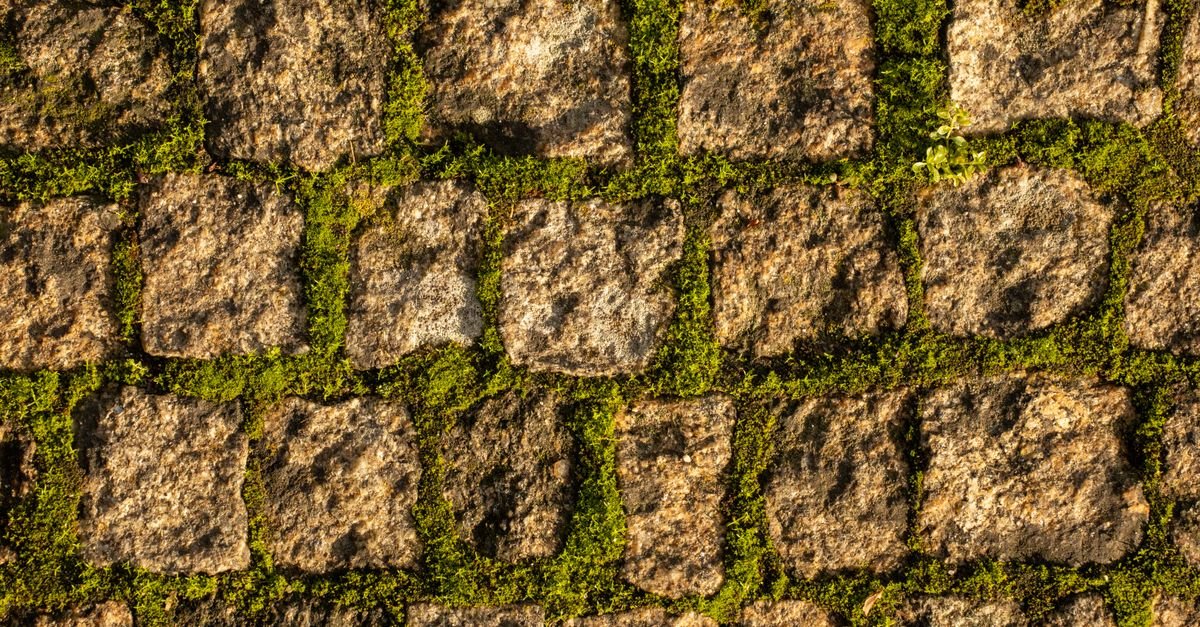
Dry-laid on sand or stone dust. The stones sit on a compacted granular bed, and the gaps are filled with sand, grit or screenings — wide, irregular, slightly soft underfoot. Wash the filler out and you have a re-sanding job: tedious, cheap, recoverable.
Wet-laid on a mortar bed over a concrete slab, with mortared joints. The stones do not move at all and the joints are a continuous cementitious line, grey or buff. Wash that out and you have a repointing job, which is a worse afternoon, because you cannot sweep new mortar in.
Wet-laid over a compacted base with mortared joints and no slab. The awkward middle: the joints crack seasonally as the base moves, so some are already open before you arrive with a machine.
Two tests sort this out in under a minute. Push a stiff wire into a joint: if it sinks, the joint is granular; if it stops dead, it is mortar. Then scrape that mortar with a coin. A hard sand-and-cement joint gives you almost nothing. A lime-rich or weathered joint gives up grey dust and loose grains at once — and that joint is now the softest material on the patio by a wide margin. Softer than sandstone. Far softer than quartzite.
That is the asymmetry that catches people out. On a concrete paver patio the joint sand is the structure. On mortared flagstone the mortar is not the structure — the bed is — but it is the weak point, and a pressure washer does not distinguish between mortar and dirt. It removes whatever is softest, in order, and here the running order puts your joints ahead of the moss. Our guide to pressure washing brick covers the mortar scratch test in more detail, and the logic transfers unchanged.
A joint scoured half an inch deep also becomes a channel directing water into the bed. On a dry-laid patio it drains away; on a slab build it reaches the concrete, has nowhere to go, and spends the winter freezing under one corner of one stone. That is how a clean patio becomes a rocking patio by March.
| Construction | Joint test | What a jet costs you | Repair |
| Dry-laid on sand / grit | Wire sinks in | Joint filler, 1–3 in deep | Sweep in new sand |
| Wet-laid, hard cement joints | Wire stops; coin skids | Little, unless already cracked | Spot repointing |
| Wet-laid, lime or weathered joints | Coin raises grey dust | Whole joints, several feet at a time | Full repointing |
“Flagstone” Names a Shape, Not a Rock
Flagstone is a format, not a material — a flat slab split thin enough to walk on. Any rock that cleaves into sheets gets sold as it, which is why the stone industry has no specification for flagstone at all. It has one per rock family: the Natural Stone Institute lists ASTM C616 for quartz-based stone, C568 for limestone and C629 for slate, with separate specifications again for marble, granite and travertine. Six standards, because there are six materials, and the delivery note describes none of them.
Telling them apart is harder than it should be, and the people with the most to lose say so. The National Park Service, writing for buildings that cannot be replaced, notes that “certain sandstones can be easily confused with limestones” (NPS Preservation Brief 1). If a federal conservation programme hedges on identification, you are allowed to spend five minutes on it.
Look at a broken corner or a cut edge, in daylight, dry:
| What you see | Probably | Quick confirmation |
| Visible sand grains, buff, tan or rust-red, slightly gritty to the palm | Sandstone | A fingernail can sometimes dislodge a grain |
| Dense, fine, blue-grey, splits into flat sheets with sharp edges | Bluestone (usually a feather-edge sandstone) | Very flat faces, no visible grain |
| Thin, very flat cleavage, dark grey, black or purple, rings when tapped | Slate | Layers visible at the edge |
| Pale cream or grey, smooth, sometimes shell or fossil fragments | Limestone | Fizzes on the acid test |
| Glassy or glittery, hard, shrugs off a knife blade | Quartzite | Will not scratch |
The one-drop vinegar test that separates calcareous stone from siliceous stone is covered in our patio cleaning solution guide, and it costs nothing. Do it before you buy anything.
Acid is the trap here, and three pages on this site already argue that case in full, so this is only the verdict. Limestone, travertine, marble and calcareous sandstone sit on the National Park Service’s acid-sensitive list, next to the flat statement that acidic cleaners “can be extremely damaging to acid-sensitive stones, such as marble and limestone, resulting in etching and dissolution of these stones.” Slate, quartzite and most sandstones sit on the non-acid-sensitive list, and “most” carries real weight: the same brief warns that “while an acid-based cleaner may be safely used on some sandstones, others are acid-sensitive and can be severely etched or dissolved by an acid cleaner.”
Which makes the internet’s favourite flagstone remedy worth naming. Diluted muriatic acid appears in guide after guide as the fix for stains on stone. The same brief says muriatic “should not be used on historic masonry, because it can dissolve lime-based mortar, damage brick and some stones.” On a mortar-jointed patio made of a stone you have not identified, that is two failures for the price of one bottle. The dilutions and the mechanism are in concrete cleaning acid; the short version is that acid does not belong on a patio you cannot name.
Bedded Stone Lifts in Flakes, and Flakes Do Not Go Back
Sandstone and slate exist as paving for one reason: the rock already wants to come apart in flat sheets. Sediment settled in layers, and the quarry splits it along them. You are standing on a material with a structural preference for delaminating, and a pressure washer is very good at finding preferences.
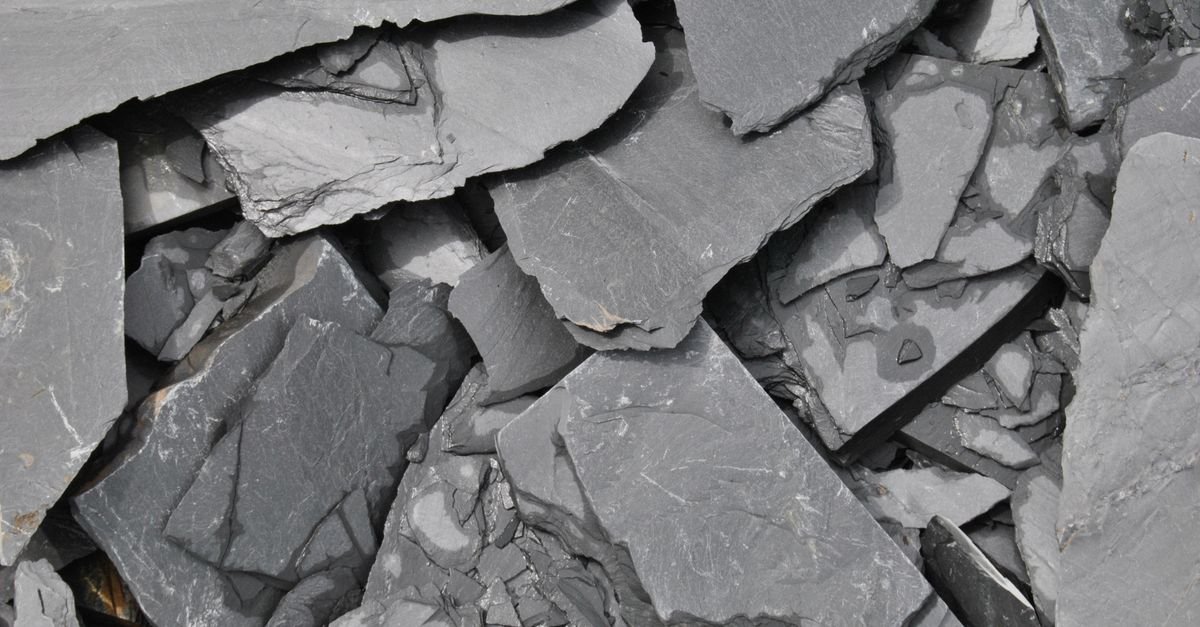
In conservation work the failure has a name and a documented trajectory. Writing in the Building Conservation Directory, Jamie Coath notes that “some sandstones may be more fissile along the natural bed due to layers of micaceous particles,” that stone with its bed parallel to the exposed face “has a tendency to delaminate in scales,” and — the line worth reading twice — “once delamination starts there is little that can be done to stop it, as moisture penetration leads to freeze thaw action and/or salt crystallisation.”
On paving the exposed edges do the work. A weathered flag usually has a lamination already parted a fraction of a millimetre at one arris, invisible from standing height. Drive a jet across that edge and the water goes in, cannot exit sideways, and lifts the flake. You hear it before you see it: a small dry tick, then a corner that is suddenly a different colour.
The National Park Service adds a line that should be on the box of every pressure washer sold to a homeowner with a stone patio: “some sandstones contain water-soluble minerals and can be eroded by water cleaning.” Water. No chemistry involved at all.
There is a ten-second check for this. Run a dry palm firmly across a dry flag. If grit or a fine powder comes away on your hand, the surface has already started shedding, and pressure will finish what the weather started.
The pressure figure, and why it is awkward. I went looking for a published cleaning-pressure ceiling for natural stone paving and found trade numbers scattered between 500 and 1,800 PSI with nobody showing their working. The one figure anyone has written down and defended is a conservation number: Preservation Brief 1 recommends starting at “a very low pressure (100 psi or below), even using a garden hose,” and going “generally no higher than 300-400 psi.” That is for irreplaceable masonry, and your back garden is not a cathedral. It is also the only defensible number in the conversation, and it sits at roughly a quarter of the contractor figures. Treat it as the direction to be wrong in.
Practically, on flagstone: a 40-degree white tip and nothing narrower, no turbo head, 12 to 18 inches of standoff and more on anything that failed the palm test, sweep diagonally across the joints rather than along them, and never let the wand stop moving. Test on the stone that lives under the barbecue.
Cleaning Flagstone Patio Stains: Dwell Beats Pressure
Here is the honest limit of the machine on this surface. On a flagstone patio the pressure washer’s job is the rinse. It is not the cleaning step, and treating it as one is how patios get thinner.
Every stain that actually lands on stone — green algae film, black organic speckling on shaded slabs, tannin outlines from wet leaves, barbecue grease, a wheelbarrow tyre mark — is lifted by the right chemistry, enough dwell time and a stiff nylon brush. Never a wire one: the brief above is blunt about metal bristles, which “abrade the surface and leave metal particles that can stain the masonry.”
The brush beats the jet because of where the growth lives. Organic colonies are not sitting on the face of a porous stone, they are rooted in the pore structure. A jet shears the top off and leaves the roots, which is why a pressure-only clean looks excellent for six weeks and then goes green again in the same pattern. A brush delivers shear at the surface without driving water into the stone or the joint. The jet does both, and only one of them was the point.
So the sequence runs: sweep dry, treat the growth, let it dwell without ever letting it dry, agitate with nylon, then rinse at the lowest pressure that clears what the chemistry has already killed. If the rinse is doing work, the dwell was too short.
Four problems here do not respond to pressure at all, and all four get worse with more of it: etched limestone, iron bloom in a sandstone, delaminated scales, and mortar you have already washed out. Recognising those as finished rather than stubborn is most of the skill.
FAQ
What PSI is safe for cleaning a flagstone patio?
There is no single answer, because flagstone is five different rocks. Start absurdly low — garden hose pressure — on a hidden stone and work up only while nothing changes on the surface. The only published ceiling for natural masonry is the National Park Service’s 300 to 400 PSI, written for historic buildings. Trade advice for stone paving sits at 800 to 1,500 PSI with a 40-degree tip at 12 inches or more, which is defensible on hard quartzite and optimistic on weathered sandstone.
Can you use vinegar to clean a flagstone patio?
Not if the stone is limestone, travertine or a calcareous sandstone. Vinegar is an acid, those stones are calcium carbonate, and the reaction etches and dulls the surface permanently. One drop of vinegar on a hidden corner is a useful identification test precisely because a fizz means you must never do it again at scale. On slate and quartzite it is merely ineffective.
Will a pressure washer ruin flagstone?
In two specific ways. It scours out joint filler, which is recoverable on a sand-laid patio and expensive on a mortared one. And on layered sandstone or slate it drives water into a bedding plane at an exposed edge and lifts a flake, which is not recoverable at all. Wide tip, long standoff, constant movement and a test patch avoid both.
How do I tell whether my flagstone joints are sand or mortar?
Push a long screwdriver or a stiff wire into a joint. Granular joints let it sink; mortar stops it. If it is mortar, scrape it with a coin — grey dust and loose grains mean a soft or weathered mortar that will wash out, while a hard cement joint gives you almost nothing. Do this in three or four places, because one patio often has both sound and failed joints.
Why is my flagstone flaking after I washed it?
Because the stone is bedded and the wash found a lamination. Sandstone and slate split along layers by nature, and a weathered flag often has a plane already slightly open at an edge. Water forced in cannot escape sideways and lifts the layer as a scale. Conservation literature is clear that once scaling begins it is very hard to arrest, so stop washing that stone and reduce pressure everywhere else.
Chemistry, a Brush, and the Washer Last
Cleaning a flagstone patio is two identifications and one restraint. Find out how the stones are held down — wire in the joint, coin on the mortar — because that tells you what a jet will cost. Find out what the rock is, from a broken edge and a drop of vinegar, because that tells you which bottle is allowed near it. Then let the chemistry and a nylon brush do the removing, and use the machine for the rinse it is good at.
If the joints in your patio have already gone and you are standing there with a hose in one hand wondering whether to keep going: stop, let it dry, and find out whether you are refilling sand or mixing mortar. One of those is a Saturday morning. The other is worth knowing about before lunch.