Last Updated on September 24, 2026 by Umar Farooq
The right patio cleaning solution is decided by what the slabs are made of, not by what the stain looks like — roughly 2% sodium hypochlorite with a surfactant for algae on concrete and block paving, oxygen bleach where the colour is precious, a pH-neutral stone soap on limestone, sandstone and porcelain, an alkaline degreaser for oil, and acid on nothing you would be upset to lose.
Almost every patio cleaning article on the internet skips the first half of that sentence. They list mixes — vinegar, bleach, washing-up liquid, baking soda — and leave you to guess which of them your particular slabs can survive. That guess is where the damage happens, because the two most commonly recommended homemade patio cleaners are the two that do permanent, unfixable harm to the most expensive patio materials.
So this is a chemistry page, not a technique page. What to mix, what it does at the molecular level, and which surfaces it will quietly destroy. If you want the wand angle, the PSI ceiling and the re-sanding sequence, that lives in our guide to power washing pavers and is a separate job.
Start With What the Slabs Are Made Of
Go outside and look at a broken corner, a cut edge, or the underside of a spare slab in the shed. Four families cover almost every domestic patio, and each one has a different chemical weakness.
| Patio material | What it is | Attacked by | Safe default |
| Cast concrete slabs | Cement, sand, aggregate, often pigmented | Acid (dissolves the cement paste); strong hypochlorite fades pigment | Sodium hypochlorite ~2% + surfactant |
| Concrete block paving | Same, plus structural sand joints | Acid; anything that floods the joints | Hypochlorite ~2%, applied low and slow |
| Clay pavers | Fired clay, colour through the body | Acid on the mortar and bedding, not the brick | Hypochlorite ~2% or oxygen bleach |
| Limestone, travertine, marble | Calcium carbonate | Any acid at all, including vinegar | pH-neutral stone soap |
| Sandstone, granite, slate, quartzite | Silicates, often with iron | Acid mobilises iron into orange bloom | pH-neutral soap; hypochlorite with care |
| Porcelain | Vitrified clay, almost zero porosity | Hydrofluoric acid, bleach residue, wax | Neutral or mildly alkaline detergent |
The split that matters most is calcareous versus siliceous stone. The Natural Stone Institute defines calcareous stone as “composed mainly of calcium carbonate” and notes it “is sensitive to acidic solutions so mild, non-acidic cleaners are recommended” — and says plainly that “products containing lemon, vinegar or other acids may dull or etch calcareous stones” (Natural Stone Institute, care and cleaning).
Here is the test that costs nothing. Put one drop of ordinary white vinegar on an offcut or a hidden corner and watch it for thirty seconds. If it fizzes, foams or leaves a dull ring, your patio is calcareous and every acidic product in the shed is now off the list permanently. If nothing happens, you have a siliceous stone or a well-cured concrete, which is more tolerant but not immune.
The Patio Cleaning Solution That Suits Concrete Slabs
Cast concrete is the most forgiving patio surface there is, which is exactly why people ruin it with a cleaner chosen for a stronger material. Concrete is alkaline by nature — its own chemistry sits around pH 12 when fresh — so alkaline cleaners and oxidisers sit comfortably on it and acids do not.
For the green film, the black speckling and the slippery grey bloom that turns up on the shaded half of every patio in the country, the working mix is sodium hypochlorite:
| You have | Mix | Result | For |
| 12.5% pool-strength SH | 1 part SH to 5 parts water | ~2% | General algae and mildew on concrete |
| 12.5% pool-strength SH | 1 part SH to 3 parts water | ~3% | Thick moss, deep shade, lichen |
| 6% supermarket bleach | 1 part bleach to 2 parts water | ~2% | Same job, more jugs |
| Sodium percarbonate | Per label, warm water | Oxygen bleach | Pigmented or coloured slabs |
Add a surfactant. This is the part everyone skips and it is the part that decides whether the mix works. Bare hypochlorite runs off a slab in about forty seconds and does nothing on the way past; a thickening surfactant holds it on the surface for the five to ten minutes it actually needs to oxidise the cell walls. Our guide to sodium hypochlorite for pressure washing covers strength, shelf life and what it does to pump seals if you run it through the machine.
One honest correction to how this is usually described. Hypochlorite does not clean a green patio. It kills it. The slab then looks clean, which is a different and slightly grimmer achievement, and it is also why the green does not come back for a year instead of six weeks. Pressure alone knocks the top off the colony and leaves the roots in the pores.
On pigmented or coloured concrete slabs, drop to oxygen bleach. Sodium percarbonate breaks down into soda ash and hydrogen peroxide in warm water, oxidises organic staining, and leaves no chloride behind to lighten the pigment. It is slower — twenty to thirty minutes of dwell rather than ten — and it is much kinder to the lawn it runs into.
Block Paving Joints Change Which Cleaner You Can Use
Block paving is concrete chemistry with a structural complication: the sand in the joints is the only thing holding the patio together, and every litre of solution you pour on the surface goes somewhere.
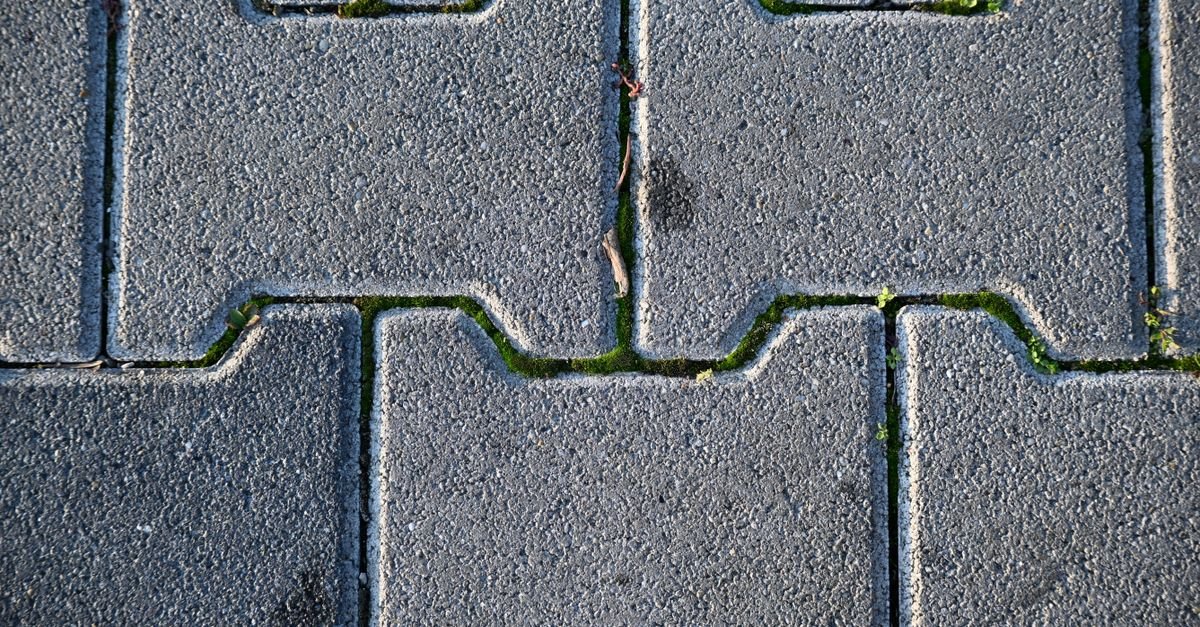
Three rules follow from that, and none of them are about pressure.
Apply less, more often. A flooded joint carries cleaner down into the bedding layer, where it does nothing useful and where hypochlorite will keep killing soil bacteria for weeks. Mist the surface until it is wet and glossy, not until it is running. If your solution is pooling in the joints, you have applied roughly twice what the slab needed.
Keep acid off polymeric sand. Acidic cleaners attack the cement content in the bedding and can soften the polymer binder in jointing compounds. If your joints were done with polymeric sand, acid is not a “be careful” — it is a no.
Planted joints get water and a knife, nothing else. If you have thyme, sedum or chamomile growing deliberately between the blocks, there is no patio cleaning solution on this page you can use near them. Hot water into the joint, a hand weeder for the invaders, and accept that the blocks will be less white than the neighbours’.
Weeds and moss in joints want treating three to seven days before the wash, not during it. Moss has no roots at all — it anchors with rhizoids sitting on the surface — which is why it lifts easily and returns fast if the shade and the damp are still there.
Why Acid and Natural Stone Should Never Meet
This is the section that justifies the rest of the page. Acid-based patio cleaners — brick acid, patio acid, muriatic, sulfamic — are sold in every builders’ merchant, sit next to the stone cleaners, and will permanently wreck two of the four materials on this page.
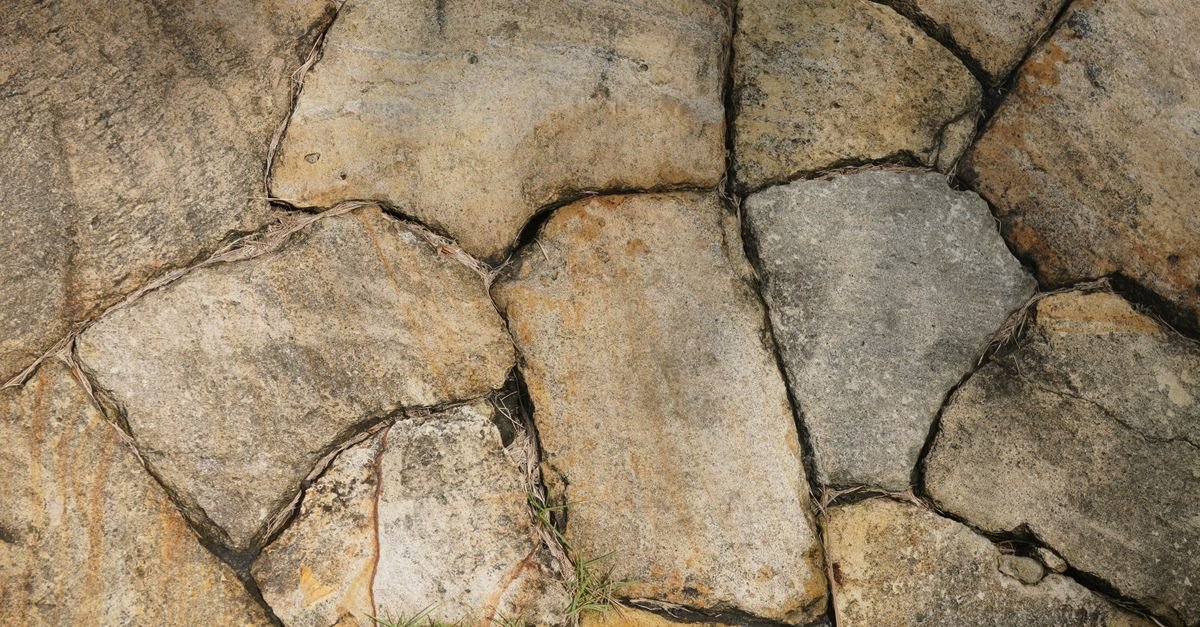
The mechanism is simple enough to say in one line. Limestone, travertine and marble are calcium carbonate. Acid plus calcium carbonate gives you a calcium salt, water and carbon dioxide — meaning the acid does not clean the stone, it dissolves a thin layer of the stone and takes the dirt with it. That is why an acid wash looks brilliant for a week and then looks worse than before: you have opened the pores, roughened the surface and given the next crop of algae a better grip.
Sandstone and granite fail differently. They are silicate stones and do not dissolve, but they carry iron minerals through the body. Acid mobilises that iron, it migrates to the surface, and it oxidises into orange staining that no cleaner will lift, because it is no longer a stain sitting on the stone — it is part of the stone now.
| Stone | Acid does this | Reversible? |
| Limestone, travertine, marble | Etches, dulls, pits the surface | No — needs resurfacing |
| Sandstone | Mobilises iron into orange bloom | No |
| Granite, quartzite | Resists dissolution; can still bloom iron | Rarely |
| Slate | Can delaminate along bedding planes | No |
| Concrete slabs | Dissolves cement paste, exposes aggregate | No |
So what is left for natural stone? A pH-neutral stone soap or a mild dishwashing detergent in warm water, applied generously, brushed with a stiff nylon brush — never a wire one, which sheds steel filaments that rust into orange freckles a fortnight later — and rinsed off. For the organic growth, hypochlorite at the weaker end, around 1%, tested on a hidden corner first, because it can lighten some sandstones.
The black spot honest answer: those hard, flat, ink-black discs on sandstone are lichen, not dirt, and they are chemically bonded into the top of the stone. I went looking for a domestic product with published evidence that it removes them in one pass and found a great deal of confident marketing and no data. What the trade actually does is repeat applications of hypochlorite over several weeks. Anyone selling you a single-treatment black spot cure is selling you optimism.
Porcelain Resists Almost Everything, Including Your Cleaner
Porcelain paving is vitrified — fired until the clay body effectively glasses over — with a water absorption figure typically under 0.5%. Nothing soaks in. That makes it the easiest patio material on this page to clean and the easiest one to leave looking streaky, because everything you put on it stays on top and dries there.
Kronos, which manufactures porcelain pavers, puts the routine mix at “warm water and a neutral or acid-free detergent,” escalating to a “mild alkaline detergent” for tougher work, and lists what to keep away: “ammonia, bleach, wax, oil-based cleaners, steel wool pads” and “abrasive products such as scouring pads” (Kronos USA, cleaning advice).
That list is worth reading twice, because bleach is on it. The slab itself does not care about hypochlorite — a vitrified body is close to chemically inert — but the jointing compound between the slabs very much does, and a bleach residue left to dry on a textured porcelain surface leaves a dulled film that is harder to remove than the algae was. If you do use a dilute hypochlorite on porcelain to kill green growth, rinse it as though you are being marked on it.
Two porcelain-specific problems that no general patio cleaner solves:
- Grout haze and cement film from installation. That is a dedicated grout haze remover, mildly acidic, used on porcelain only, and never allowed to run onto adjoining stone.
- Barbecue grease. Porcelain will not absorb it, so it sits as a film. An alkaline degreaser lifts it in one pass. Acid does nothing to fat, which is the single most common wrong-bottle mistake on a patio.
Porcelain is the only patio material here that is genuinely easier to look after than your kitchen worktop. The industry has responded by pricing the cleaner accordingly.
Dilution, Order and the Two Bottles That Must Never Meet
Four families of patio cleaning solution cover every stain you will meet outdoors. The full breakdown of how each family works is in power washing chemicals; here is the patio-relevant version.
| Family | Use it on | Typical dwell | Do not use on |
| Sodium hypochlorite + surfactant | Algae, mildew, lichen, black mould | 5–10 min, never dry | Planted joints, coloured slabs at strength |
| Sodium percarbonate (oxygen bleach) | Tannin, leaf stain, coloured concrete | 20–30 min | Nothing much — it is the safe one |
| Alkaline degreaser | Oil, grease, barbecue fat, tyre marks | 5–10 min | Acid-sensitive sealers |
| pH-neutral stone soap | Routine cleaning, all natural stone, porcelain | 5 min | Nothing |
| Acid (efflorescence, grout haze) | Cured concrete and porcelain only, rarely | Per label, short | All calcareous stone, sandstone, polymeric joints |
Mixing order matters more than people expect. Water into the sprayer first, then the concentrate, then the surfactant last and stirred gently — pouring hypochlorite into an empty container and topping up foams the surfactant into a head that clogs a spray tip in about a minute.
And then the rule that has no exceptions. Never let a hypochlorite product and an acidic product meet, in the sprayer, in the bucket, or on the slab. ATSDR states it plainly: sodium hypochlorite “releases chlorine gas when it comes in contact with acids” (ATSDR, Medical Management Guidelines for Chlorine). On a patio this is not a theoretical laboratory concern — it is someone treating efflorescence with brick acid on Saturday, deciding the algae needs doing too, and wetting the same slabs with bleach on Sunday morning while kneeling over them. If you have used an acid on a surface, rinse it thoroughly and give it a full day before anything chlorinated goes near it.
Ammonia is on the same list. A lot of glass cleaners and some general-purpose outdoor sprays are ammoniated, and hypochlorite plus ammonia produces chloramine vapour. Read the back of the bottle rather than the front.
Vinegar and Baking Soda Cancel Each Other Out
Here is the strong opinion, and it is aimed at the three top-ranking homemade patio cleaner recipes rather than at anyone who has used one.
Vinegar is dilute acetic acid, around pH 2.5. Baking soda is sodium bicarbonate, a base at about pH 8.3. Put them in the same bucket and they neutralise each other, immediately and completely, and what you have left is a fizzy glass of sodium acetate in water — salty, pH-neutral, and less effective at cleaning a patio than the washing-up liquid you were going to add anyway. It is an excellent volcano. It is not a cleaner.
Which leaves the two ingredients separately, and both have a problem:
- Vinegar on its own is an acid. Every failure mode in the natural stone section above applies to it. It etches limestone and travertine, it can bloom iron in sandstone, and on concrete it dissolves the cement paste at the surface and leaves a slab that holds dirt better than it did before. The 50:50 vinegar mixes that half the internet recommends for patios are fine on exactly one material — well-cured, unsealed, unpigmented concrete — and even there they are a worse algaecide than a 2% hypochlorite at a fifth of the volume.
- Baking soda on its own is a mild abrasive and a weak alkali. It will take a scuff off a plastic chair. It will not touch an algal colony rooted in the pores of a slab, because it does not oxidise anything.
If the appeal of the homemade route is avoiding harsh chemistry near planting, the honest substitute is not vinegar. It is sodium percarbonate — oxygen bleach — which does genuinely oxidise organic growth, breaks down into soda ash, water and oxygen, and is the one homemade-adjacent option on this page that works on chemistry rather than on optimism.
What the Runoff Does to Your Borders
Every litre you spray on a patio leaves that patio, usually into the bed running along the edge of it. Plan for that before you mix, not after you notice the hosta has gone translucent.
Soak the borders with clean water before you start. Wet soil and wet foliage dilute what lands on them, and a plant already full of water takes up much less of what arrives next. Do it again after you rinse. This is the single most effective thing you can do and it costs five minutes with a hose.
Beyond that:
- Cover what you cannot soak. A dust sheet over a low hedge for twenty minutes is cheaper than the hedge.
- Work away from the beds. Start at the border edge and pull the solution towards the middle, so the run-off has slab to travel over rather than soil.
- Hypochlorite is worse for plants than for people. Diluted, it is a mild skin irritant. On foliage it is an oxidiser that strips the waxy cuticle, and the sodium left behind after it breaks down is what lingers in the soil.
- Skip the de-icing salt trick for weeds. It appears in several homemade patio recipes and it does kill weeds. It also stays in the bedding sand, draws moisture, and encourages the salt bloom you will later be tempted to treat with acid. That is a circle with no exit.
- Pets and the storm drain. Keep animals off until the patio is rinsed and dry, and remember that in most places your patio drains to a watercourse rather than to treatment.
Goggles and gloves, incidentally, are not optional with anything at 2% or above. Hypochlorite reaches the eye as a splash off a hard, flat, reflective surface, which is precisely what a patio is.
FAQ
What is the best homemade patio cleaning solution?
For algae and mildew, dilute household bleach at one part bleach to two parts water, with a squeeze of dish soap as a crude surfactant, on concrete or block paving only. For coloured slabs or natural stone, use oxygen bleach (sodium percarbonate) in warm water instead. Avoid the vinegar-and-baking-soda recipes entirely — the two ingredients neutralise each other, and the vinegar on its own etches stone.
Can I use bleach on patio slabs?
On concrete slabs, concrete block paving and clay pavers, yes, diluted to roughly 2% and rinsed thoroughly. On coloured or pigmented slabs it can lighten the pigment, so test a hidden corner. On porcelain the slab itself is unaffected but residue dulls the surface and attacks jointing compound, so rinse hard. Never use it where you have used an acidic cleaner, and never near planted joints.
Will vinegar clean a patio?
Barely, and at a cost. Vinegar is a weak acid that will fade surface algae on plain concrete, but it etches limestone, travertine and marble on contact, can draw orange iron staining out of sandstone, and dissolves the cement paste on concrete so the surface holds dirt faster afterwards. A 2% hypochlorite solution does the job better, in less volume, without any of that.
What removes black spot from a sandstone patio?
Nothing in one pass. Black spot is lichen bonded into the top layer of the stone, and the realistic treatment is repeated applications of a dilute hypochlorite solution over several weeks, letting each one dwell without drying. Acid-based black spot removers exist and will take the lichen off along with a thin layer of the sandstone, frequently leaving iron staining behind.
Is patio cleaner safe for plants?
No patio cleaner on this page is safe for plants at working strength. Sodium percarbonate is the mildest and breaks down into harmless components; sodium hypochlorite is the harshest and leaves sodium in the soil; acidic cleaners will alter soil pH directly. Soak the borders with clean water before and after, cover what you can, and work away from the beds rather than towards them.
Do I have to rinse patio cleaning solution off?
Yes, every time, and thoroughly. Any cleaner left to dry on a slab leaves a residue that is often more visible than the original dirt — chalky with alkaline products, dulling with hypochlorite, and permanently etched with acid. Rinsing is also what stops the next rainfall carrying a concentrated dose straight into your borders.
Can I use the same cleaner on porcelain and natural stone?
A pH-neutral stone soap is the one product that is genuinely safe on both, which is why it is the sensible default for a mixed patio. Everything else diverges: the mildly acidic grout haze removers used on porcelain will etch limestone, and stronger hypochlorite tolerated by concrete can lighten sandstone and dull porcelain if it dries on.
How long should a patio cleaning solution dwell?
Five to ten minutes for hypochlorite and degreasers, twenty to thirty for oxygen bleach. The rule that matters more than the number is that it must never dry on the surface. If a slab in full sun starts going matte at the edges, mist it again. A cleaner that dries has stopped working and started staining.
Match the Mix to the Slab, Not to the Stain
Work it in this order and you will not get it wrong. Identify the material first — one drop of vinegar on a hidden corner tells you whether you are dealing with calcareous stone. Pick the family second: hypochlorite for anything alive, oxygen bleach where the colour matters, alkaline degreaser for anything greasy, pH-neutral soap for stone and porcelain, and acid for essentially nothing a homeowner needs to do. Only then worry about dilution, and keep it weaker than you think, because a weak mix left to dwell beats a strong one rinsed off early on every surface here.
Then soak the borders, rinse properly, and let the chemistry finish before you reach for the machine. The patio you can ruin in an afternoon took someone a week to lay, and the bottle that does it is usually the one that was cheapest and loudest on the shelf.