Last Updated on October 4, 2026 by Umar Farooq
What PSI should you use to pressure wash composite decking? There is no single safe number — each manufacturer publishes its own limit, and they range from 1,500 PSI up to 3,100 PSI. Trex permits up to 3,100 PSI with a fan tip no closer than 8 inches. TimberTech caps you at 1,500 PSI and rinsing only. Exceeding your brand’s published figure can void the warranty, so the correct answer is always your board maker’s number, not a generic one.
Working out what PSI to pressure wash composite decking with is the one deck-care question where copying a number off a random blog can genuinely cost you money. Composite is not wood. It has a manufactured surface — often a bonded polymer cap — and every brand engineers that surface differently. That is why the published limits differ by a factor of two, and why the warranty language is explicit about pressure.
This guide assembles the brand-by-brand numbers, explains why they diverge so much, and covers the technique that matters more than the PSI dial.
What PSI to Pressure Wash Composite Decking: The Published Brand Limits
Here are the figures taken directly from manufacturer care documentation. Where a brand does not publish a specific number we say so rather than guess — an invented figure is worse than no figure when a warranty is on the line.
| Brand | Published max PSI | Nozzle | Minimum distance | Notes |
| Trex (Transcend, Enhance, Select) | 3,100 PSI | Fan attachment/adjustment | 8 in (203 mm) | Soap dispenser permitted; exceeding 3,100 “could damage the boards and void the warranty” |
| TimberTech (AZEK, Pro, Edge, Reliaboard, Docksider) | 1,500 PSI | Fan tip | Keep washer off the deck surface | Explicitly “for rinsing only” — not for cleaning |
| Fiberon | Under 3,000 PSI | Wide fan tip | 12 in above deck | Framed as guidance for skilled professionals; improper use can void warranty |
| Deckorators | Not published in accessible care docs | Fan tip | Consult owner’s manual | Treat as 1,500 PSI until you confirm |
| Other / unknown brand | Assume 1,500 PSI | 40° fan | 12 in | The safe default across the whole category |
Read that table again. Trex and TimberTech differ by more than 1,600 PSI. A setting that Trex explicitly permits is more than double what TimberTech allows on its own boards. There is no universal “composite decking PSI” and anyone quoting one is guessing.
Trex’s own care guidance states that a pressure washer of “no greater than 3100 psi” with a fan attachment and soap dispenser may be used, that the fan tip should be used no closer than 8 inches from the decking surface, and that going above that figure risks both damage and warranty coverage.
TimberTech goes the other way, describing power washing as something that “can be used for rinsing only (with a maximum PSI of 1,500 and a fan tip nozzle)” — meaning the pressure washer is a rinse tool at the end of the job, not the cleaning method itself.
Fiberon sits in between, permitting a pressure washer at under 3,000 psi held 12 inches above the deck with wide fan tips, while stressing that this is guidance aimed at skilled professionals and that misuse can void warranty coverage.
Why the Brand Number Is the Only Number That Matters
Composite decking is sold on a long warranty — commonly 25 to 50 years on fade and stain for capped products. That warranty is the product. And every one of those warranties excludes damage caused by improper maintenance.
What does “voids the warranty” actually mean in practice? It rarely means the whole warranty disappears. It means that when you file a fade or stain claim, the manufacturer inspects the boards. If the surface shows the signature marks of over-pressurisation — fuzzing, wand striping, an eroded cap layer, localised colour lightening — the claim is denied because the damage is attributed to maintenance, not to a manufacturing defect. You do not get told “you used 3,200 PSI.” You get told the boards show evidence of improper cleaning.
That is why the practical advice is simple:
1. Find your brand and product line. Check the installation paperwork, the receipt, or the stamp on the underside of an offcut if you still have one.
2. Read the current care page for that specific line, not a general composite article. Limits differ between product lines from the same manufacturer.
3. Work well below the ceiling, not at it. If your brand permits 3,100 PSI, clean at 1,500 to 2,000. The published limit is where damage becomes likely, not where good results start.
4. Photograph the deck before you clean it. If you ever do file a claim, evidence that a mark predated your wash is genuinely useful.
Capped vs Uncapped Composite: The Physical Reason the Limits Differ
The two-fold spread in published PSI limits is not marketing inconsistency. It reflects genuinely different board construction.
| Uncapped composite (first generation) | Capped composite | Capped polymer / PVC | |
| Construction | Wood flour + plastic, homogeneous | Composite core + bonded polymer shell | Solid PVC, no wood content |
| Surface layer | None — the core *is* the surface | Cap 0.5–1 mm thick on 3 or 4 sides | Cap over a PVC core |
| Moisture absorption | Absorbs; supports mould growth | Sealed on capped faces | Essentially zero |
| Typical failure under pressure | Fuzzing, wood fibre exposure | Cap erosion or peeling — permanent | Scuffing, gloss change |
| Fade and stain warranty | Short or none | 25–50 years | 30–50 years |
| Realistic safe PSI | 1,200–1,500 | Follow brand figure | Follow brand figure |
| Repairable? | Light sanding sometimes helps | No — the cap cannot be replaced | No |
Uncapped composite is exposed wood flour bound in plastic. Blast it and the plastic erodes faster than the wood fibre, leaving a fuzzy, fibrous surface that then holds dirt and grows mould. Most decks built before roughly 2010 are uncapped.
Capped composite carries a thin polymer shell fused to the core during extrusion. That cap is what delivers the fade and stain resistance — and it is typically well under a millimetre thick. Remove it in a patch and you have exposed raw core that will weather to a different colour permanently. There is no touch-up product for it.
This is the crux of the whole topic: on wood, over-pressurising costs you a rough surface you can sand back. On capped composite, it costs you the layer the entire warranty is written about.
What PSI to Pressure Wash Composite Decking When You Don’t Know the Brand
Plenty of people inherit a deck with no paperwork. Use this decision path:
- Default to 1,500 PSI, a 40-degree fan tip, and 12 inches of distance. That combination is at or below every published limit we could verify, so it cannot breach any brand’s ceiling.
- Test a hidden board first — under a bench, behind a planter, or on the stair riser closest to the house. Wash a one-foot square, let it dry fully, and inspect in daylight for fuzzing or colour change.
- If a magnet-free scratch test on an offcut shows a different colour under the surface, it is capped. Stay conservative.
- If the boards feel slightly fibrous or chalky already, it is old uncapped composite. Drop to 1,200 PSI or skip the pressure washer altogether.
If you are unsure whether your machine can even dial down that far, our guide to what PSI pressure washer you need covers how to reduce effective pressure with nozzle choice and distance when the pump has no regulator.
Nozzle, Distance and Angle: The Settings That Do the Real Work
Every brand that permits pressure washing specifies a fan tip. None of them permits a narrow or rotary tip. That is because the nozzle, not the pump, decides how much force lands on a square inch of cap.

| Nozzle | Distance | Effect on capped composite |
| 40° white | 12 in | Correct default; safe rinse and clean |
| 40° white | 8 in | Still safe on most brands; faster |
| 25° green | 12 in | Acceptable on brands permitting 2,500+ PSI; watch for marks |
| 25° green | 6 in | Risk of visible wand lines |
| 15° yellow | Any | Cap damage likely; not permitted by any brand |
| 0° red | Any | Instant permanent gouging |
| Turbo / rotary | Any | Strips the cap; never use on composite |
| Soap/black tip | 6–12 in | Correct for applying detergent at low pressure |
Three technique rules matter as much as the numbers:
Keep constant height. Do not swing the wand in an arc from a fixed elbow. The tip drops closer to the boards mid-sweep and cleans harder there, leaving a scalloped pattern that becomes visible once the deck dries.
Never stop moving with the trigger down. Two seconds stationary at 2,000 PSI is enough to leave a lighter oval on a capped board.
Angle the spray slightly, around 45 degrees, and work with gravity. A perpendicular jet drives water into the board seams and under the cap edges. An angled jet lifts dirt and pushes it along the board.
The full colour-and-angle breakdown for every tip is in our pressure washer nozzle chart.
Spray With the Grain — Why the Embossing Direction Matters
Composite boards are given a wood-look texture by an embossing roller during extrusion. That texture is a pattern of tiny ridges and valleys pressed into the cap, running lengthwise along the board.
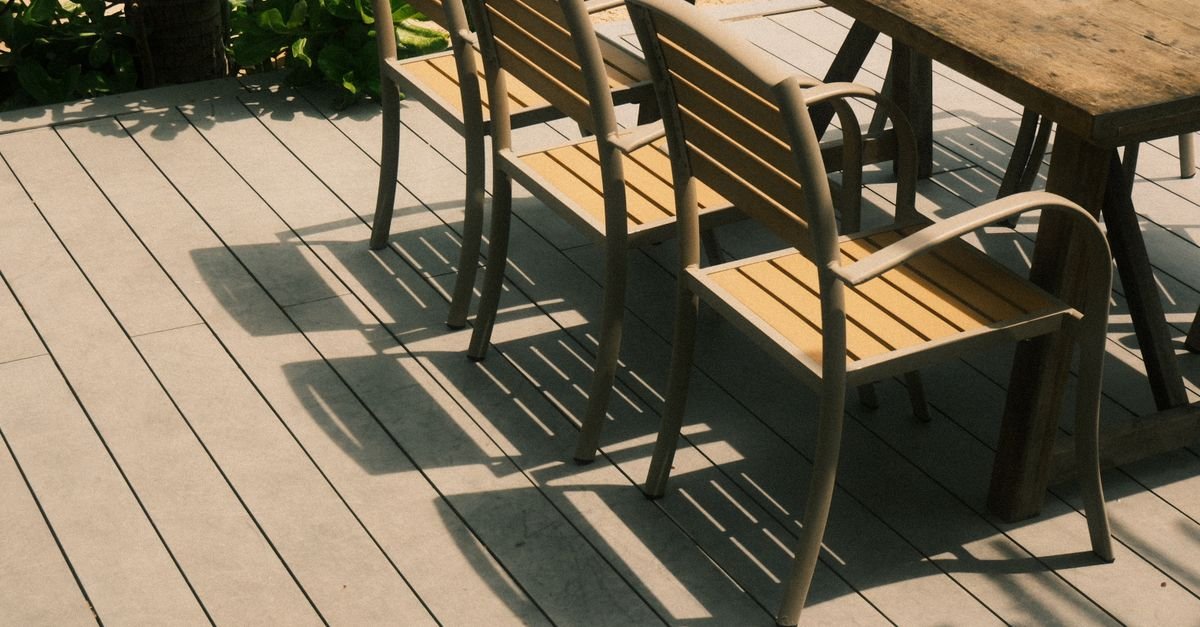
Fiberon’s guidance is to wash in the direction of the grain pattern to avoid damaging the boards, and the reason is mechanical. Spraying across the ridges means the jet hits each ridge edge-on at full force, which erodes the peaks and gradually flattens the texture — leaving a shiny, smoother band that catches the light differently from the rest of the deck. Spraying along the grain lets the water run down the valleys and lift dirt out of them, which is also where the dirt actually is.
Practically:
- Start at the house end and work toward the stairs, one board or two at a time, always along the length.
- Overlap each pass by about a third of the fan width.
- At the ends of boards, ease off rather than stopping abruptly.
- Do the perimeter, fascia and stair risers last with the same fan tip, spraying downward.
What if boards run in different directions on a multi-level deck? Change your direction to match each section. It is slower, and it is the difference between an even deck and one with a visibly different-looking landing.
Detergent and a Soft Brush Beat Pressure Every Time
This is the point every manufacturer makes and most homeowners ignore. Trex’s own instruction is to spray the deck with soap and then follow by gently scrubbing each board with a soft bristle brush. TimberTech is blunter still: power washing is rinsing, and the actual cleaning happens with a cleaner and a brush.
The reason is that dirt on composite sits *in* the embossed texture, not bonded to a porous surface. It is mechanically trapped, not chemically attached. A soft brush reaches into the valleys and lifts it out. A jet skates over the top and only removes what is proud of the surface — which is why people crank the pressure up, chasing a result that pressure cannot deliver.
What Cleaner to Use
- Warm water and dish soap handles most seasonal dirt and is safe on every brand.
- A composite-specific deck cleaner for embedded grime, tannin or mildew. These are formulated to be safe on capped surfaces.
- Oxygen bleach (sodium percarbonate) for organic staining, leaf tannin and mildew. Mix with warm water, apply, dwell 15 to 20 minutes, brush, rinse. It is far gentler on cap and on nearby plants than chlorine.
- A dedicated composite degreaser for barbecue grease and cooking oil.
Apply cleaner in shade or on a cool, overcast day and never let it dry on the boards. Work one section at a time. If your machine’s detergent siphon is not pulling, our troubleshooting guide on a pressure washer soap dispenser not working covers the usual causes.
What to Never Use
- Chlorine bleach on brands that prohibit it — it can lighten cap pigment permanently and several warranties call it out by name.
- Acid-based cleaners, including deck brighteners containing oxalic or phosphoric acid, unless the manufacturer names the product.
- Wire brushes and stiff nylon scrubbing pads — both scratch the cap.
- Solvent cleaners, acetone, mineral spirits — they can soften and cloud a polymer cap.
- Deck stains and sealers — composite does not accept them; they sit on top, peel, and are near-impossible to remove.
Mould and Mildew Between the Boards
The black speckling that appears on composite is almost never growing on the board. It is growing in the layer of pollen, tree debris and organic film that has settled on the surface — and mostly in the shaded gaps between boards where that debris collects and stays damp.
Capped composite is sealed on the top and sides, which is why the mould has nowhere to root and comes off comparatively easily. Uncapped composite has exposed wood flour, so mould can genuinely take hold and needs more work.
The fix has two parts, and only one of them involves cleaning:
1. Clear the gaps. Run a putty knife, a paint stirrer or a stiff wire down every board gap to remove packed leaf litter and pollen. Vacuum or blow the debris out. This is the step that matters most, because that packed organic layer is both the food source and the sponge holding water against the boards.
2. Treat with oxygen bleach, dwell 15 to 20 minutes, brush along the grain, rinse at your brand’s PSI limit with a fan tip.
Then remove the cause. Mould returns wherever the deck stays wet:
- Trim back overhanging branches and shrubs to increase sun and airflow.
- Lift planters, mats and furniture feet onto risers so water can escape underneath.
- Confirm the deck actually drains — blocked gaps and a flat pitch trap standing water.
- Move barbecues off the deck or use a splash mat; grease film feeds mildew.
- Clear leaves in autumn rather than letting them sit over winter.
What Permanent Damage Looks Like
Knowing the warning signs lets you stop before the mark becomes permanent. All three of these are irreversible on capped composite.
Fuzzing
The surface develops a soft, fibrous, slightly hairy texture. This is exposed wood fibre from the core, and it appears when pressure has eroded either the cap or the plastic binder around it. Fuzzed areas then absorb water, hold dirt and grow mould, so the damage compounds. Light sanding sometimes improves uncapped boards; on capped boards it makes it worse by removing more cap.
Cap Layer Removal
A patch, stripe or spiral that looks slightly duller, lighter or rougher than the boards around it. Run a fingertip over it — a change in texture confirms it. Once the cap is breached, the exposed core weathers at a different rate and the mark becomes more obvious every season rather than blending in. There is no repair; replacing the board is the only fix.
Colour Change and Flash Marks
Localised lightening where the wand paused, or a series of parallel lighter bands where the tip was too close. Composite pigment is concentrated in the cap, so removing even a fraction of it changes the colour. This is the damage most often cited when a fade claim is denied.
| Symptom | Cause | Reversible? |
| Fuzzy, fibrous texture | Pressure eroded binder or cap | No on capped; sometimes on uncapped |
| Parallel lighter stripes | Narrow tip or too-close wand | No |
| Lighter oval patches | Trigger held stationary | No |
| Spiral swirl marks | Turbo/rotary nozzle used | No |
| Flattened, shiny texture | Sprayed across the grain | No |
| Cloudy or tacky film | Solvent or wrong cleaner | Sometimes with correct cleaner |
| Water spotting after wash | Hard water dried on surface | Yes — rinse and dry |
Stain-by-Stain Guide for Composite Decking
| Stain | Treatment | Pressure after treatment |
| General dirt and pollen | Soap and water, soft brush | Rinse at brand limit |
| Mould and mildew | Oxygen bleach, 15–20 min dwell, brush | Rinse at brand limit |
| Leaf and tannin stains | Oxygen bleach or composite cleaner | Rinse at brand limit |
| Barbecue grease | Composite degreaser, dwell, brush | Rinse at brand limit |
| Ice-melt / salt residue | Warm water flush, soft brush | Low-pressure rinse only |
| Rust from furniture feet | Composite-safe rust remover; test first | Low-pressure rinse only |
| Berry and wine spills | Act within days; oxygen bleach soak | Rinse at brand limit |
| Chalk-like mineral deposits | Composite-safe mineral deposit remover | Low-pressure rinse only |
| Sunscreen and insect repellent | Degreaser quickly — DEET can etch caps | Rinse at brand limit |
| Paint splatter | Scrape gently when dry; no solvents | Rinse at brand limit |
The pattern is consistent: chemistry removes the stain, and the pressure washer only rinses. That is the opposite of how most people use the machine on a deck.
Step-by-Step: Cleaning a Composite Deck Safely
1. Confirm your brand and its published PSI limit. Everything else follows from this.
2. Clear the deck completely — furniture, planters, grill, rugs. Rugs left down are a common cause of trapped-moisture staining.
3. Sweep, then clear the board gaps with a putty knife or blower.
4. Wet the surrounding plants and lawn before you start.
5. Test one hidden square at your chosen setting. Let it dry fully and inspect before committing.
6. Apply cleaner at low pressure through the soap tip, or with a pump sprayer, working in shaded sections.
7. Dwell 10 to 20 minutes, keeping the surface damp.
8. Scrub along the grain with a soft bristle brush. This is where the cleaning actually happens.
9. Rinse with a fan tip at your brand’s limit or below, spraying along the grain, moving constantly, at the specified distance.
10. Rinse surrounding plants again and let the deck dry fully before replacing furniture.
Old Decks and First-Generation Composite: A Special Warning
Trex specifically advises against using a pressure washer on older deck surfaces, and the caution generalises. A deck that is fifteen or twenty years old is likely uncapped, has weathered surface plastic, and may have loosened fasteners and softened board edges.
On any deck of that age:
- Skip the pressure washer entirely if you can. A cleaner, a soft brush and a garden hose will do the job.
- If you must use one, cap yourself at 1,200 PSI with a 40-degree tip at 18 inches.
- Check the frame first. A pressure washer will find soft joists and loose ledger fasteners the hard way.
- Expect a matte, slightly faded result. Old composite does not return to its original colour and no amount of pressure makes it.
The same restraint applies to adjacent surfaces — railings, painted trim and fence panels often sit within splash range of a deck wash. Our guides to pressure washing painted wood and pressure washing a fence cover the settings for those.
Seasonal Care Calendar
| Task | Frequency | Method |
| Sweep debris | Every 2 weeks in season | Broom or blower |
| Clear board gaps | Twice a year | Putty knife, then blower |
| Full clean | Twice a year (spring and autumn) | Cleaner + soft brush + fan-tip rinse |
| Spot-treat spills | Within 24–48 hours | Soap or degreaser |
| Move planters and furniture | Every 2–3 months | Prevents shadow staining |
| Inspect for fuzzing or cap damage | Annually | Fingertip and daylight check |
| Clear snow | As needed | Plastic shovel, never metal or rock salt |
Composite decks that get swept fortnightly and cleaned twice a year almost never need aggressive washing, which removes the risk entirely. The decks that end up damaged are the ones cleaned once every five years, when the owner reaches for maximum pressure out of frustration.
FAQ
Can you pressure wash composite decking at 3,000 PSI?
Only if your brand permits it. Trex allows up to 3,100 PSI with a fan tip at 8 inches minimum, and Fiberon permits under 3,000 PSI at 12 inches. TimberTech caps at 1,500 PSI. Using 3,000 PSI on a TimberTech deck exceeds the manufacturer’s own published maximum by double and puts warranty claims at risk.
What PSI to pressure wash composite decking if the brand is unknown?
Default to 1,500 PSI with a 40-degree fan tip held 12 inches from the boards. That combination sits at or below every published manufacturer limit we could verify, so it cannot breach any brand’s ceiling. Test a hidden section first and let it dry fully before you commit to the rest of the deck.
Does pressure washing void a composite deck warranty?
Pressure washing itself does not, provided you stay within the published limit and use a fan tip. Exceeding the limit can. Trex states directly that using a pressure washer greater than 3,100 PSI could damage the boards and void the warranty. In practice, claims are denied when the boards show physical evidence of over-pressurisation.
Why does my composite deck look fuzzy after washing?
The pressure eroded either the polymer cap or the plastic binder, exposing wood fibre from the core. It is most common on uncapped first-generation composite and on any deck washed with a narrow or turbo nozzle. Fuzzed areas absorb water and grow mould, so the damage worsens over time. On capped boards it cannot be repaired.
Is a turbo nozzle ever safe on composite decking?
No. Every manufacturer that permits pressure washing specifies a fan tip. A turbo or rotary nozzle concentrates a pencil jet and spins it, which is exactly the profile that strips a cap layer. The spiral marks it leaves are permanent and are among the clearest indicators an inspector looks for on a denied claim.
Should I use bleach on my composite deck?
Use oxygen bleach (sodium percarbonate), not chlorine bleach. Oxygen bleach lifts mould and tannin without attacking cap pigment and is far gentler on surrounding plants. Several composite warranties specifically exclude damage from chlorine bleach, so check your brand’s care sheet before using it at all.
How often should composite decking be cleaned?
Twice a year suits most decks — once in spring and once in autumn — plus fortnightly sweeping and immediate spot treatment of spills. Shaded, tree-covered or coastal decks may need three cleans a year. Regular light cleaning is what keeps you from ever needing high pressure.
Can I use a surface cleaner attachment on a composite deck?
Generally no. Surface cleaners are designed for concrete and their nozzles usually run at a pressure and fixed height suited to masonry. They also cannot follow the grain direction, and their skirts can scuff cap layers. Stick to a wand with a fan tip and a soft brush.
What is the difference between capped and uncapped composite for cleaning?
Capped composite has a bonded polymer shell that seals the surface, so dirt sits on top and mould cannot root. Uncapped composite has exposed wood flour that absorbs water and supports genuine mould growth. Uncapped boards need gentler pressure — around 1,200 to 1,500 PSI — and more frequent cleaning.
Can I clean composite decking without a pressure washer at all?
Yes, and most manufacturers effectively recommend it. A composite deck cleaner or warm soapy water, a soft bristle brush and a garden hose will clean any composite deck properly. It takes longer but carries zero risk of cap damage, fuzzing or a denied warranty claim, which makes it the right choice for older or unidentified decks.
Find Your Board’s Own Number
There is no universal answer to what PSI to pressure wash composite decking with, and any page that gives you one number is guessing on your behalf. The verified published limits span 1,500 PSI for TimberTech up to 3,100 PSI for Trex, with Fiberon permitting under 3,000 PSI at 12 inches. Find your brand, read its current care page, and treat that figure as a ceiling rather than a target.
Then let technique do the work. Use a fan tip and only a fan tip. Keep the specified distance, spray along the embossed grain, and never pause with the trigger down. Above all, follow the manufacturers’ actual method: cleaner plus a soft bristle brush does the cleaning, and the pressure washer only rinses. A composite deck cleaned that way — twice a year, gaps cleared, spills handled quickly — will still look right in twenty years, with the warranty intact and not a single stripe, fuzz patch or flash mark to show for it.