Last Updated on September 26, 2026 by Umar Farooq
**Removing lichen is a different job from removing moss or algae, because lichen is neither of those things: it is a fungus and an alga living as one organism, and the fungal half grows *into* the surface instead of sitting on top of it.** That single anatomical fact decides the rest of this page — why the wash that cleared your moss over a weekend left the grey discs exactly where they were, why levering one off takes a flake of surface with it, and why the honest timescale for lichen is seasons rather than afternoons.
This site has been as guilty of the blurring as anyone. Moss, algae and lichen keep turning up in the same table row, the same “and lichen” clause, treated as three grades of one green problem. They are not three grades of anything. Two of them sit on your surface. The third is partly your surface now.
Two Organisms, One Crust, and Neither of Them Is Moss
A lichen is not a species. It is an arrangement. The review literature on biodeterioration of historic buildings describes the body of a lichen — the thallus — as “a symbiotic union of a fungal element, the mycobiont (Ascomycetes or seldom Basidiomycetes), and a photosynthetic organism (cyanobacteria or green algae), the photobiont” (The Role of Lichens, Mosses, and Vascular Plants in the Biodeterioration of Historic Buildings, PMC9781475).
In plainer terms: the fungus does the building and the alga does the catering. The fungus supplies the structure, the grip and the water management; the alga, sealed inside it, photosynthesises and feeds them both. It is the most durable house-share in nature and it has run for a very long time without an argument about the bins. It is also why lichen behaves like nothing else on your property:
| Algae | Moss | Lichen | |
| What it is | Single-celled photosynthesiser or cyanobacteria | Non-vascular plant | Fungus and alga as one organism |
| How it holds on | Biofilm glued to the surface | Rhizoids threaded into surface texture | Fungal hyphae grown into the material |
| Survives drying out | Green algae, poorly | Poorly | Extremely well |
| Dies in one chlorine dwell | Yes | Yes | The alga does; the fungus often does not |
| Comes off when killed | Rinses away | Weathers off in 1–3 months | Stays put, sometimes for years |
| What force removes | The film | The clump | The clump plus some surface |
Read the bottom two rows together, because everything difficult about lichen lives there. Algae is a film that lets go on its own once you oxidise it. Moss is a clump with a grip you can outwait. Lichen is neither — it is a crust with roots in your masonry, and the removal problem is not chemical stubbornness. It is carpentry.
Millimetres In, Not Sitting on Top
Here is where the science stops being decorative, because somebody has actually sectioned lichen-colonised masonry and measured how far the fungus goes.
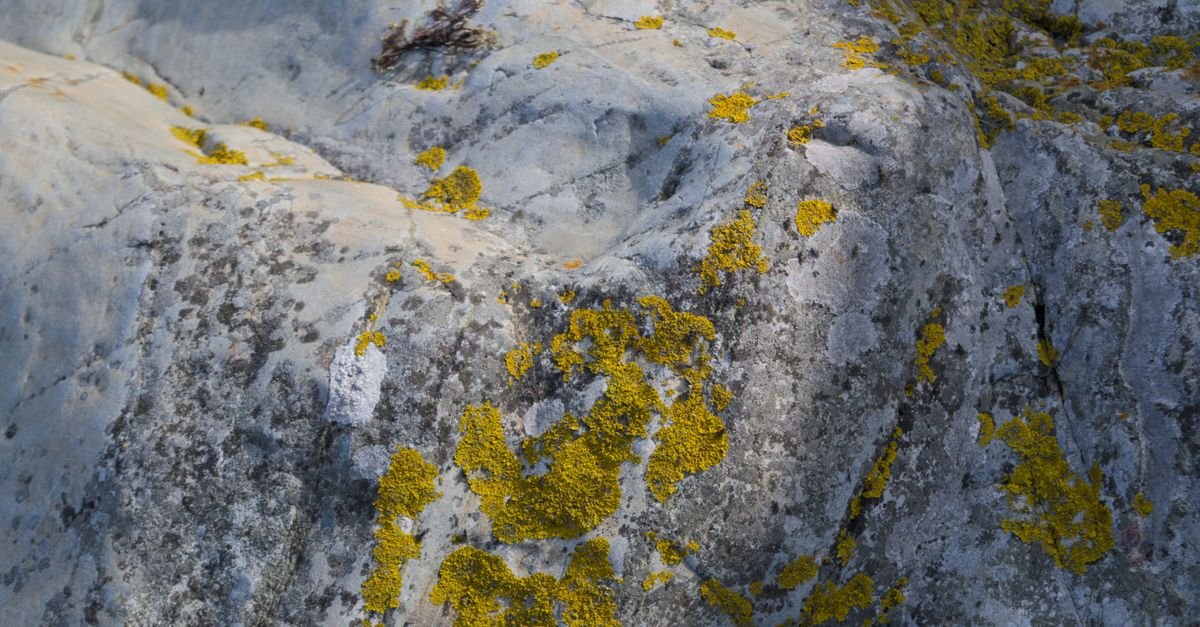
I spent a morning on a study of the brickwork of the Gonbad-e Qābus tower in northern Iran, a UNESCO World Heritage Site, because it was the only place I could find where somebody had cut the material open and put numbers on it. Microscopy found mycobiont hyphae of *Verrucaria nigrescens* “down to depths of 1.0–2.5 mm,” and *Circinaria decipiens* deeper still — “4.0–5.0 mm” on the wet sides of the tower against “2.0–3.0 mm” on the dry sides. At the lichen-brick interface, X-ray diffraction found whewellite: calcium oxalate monohydrate (Lichen colonization and associated biodeterioration processes on ancient bricks of the Gonbad-e Qābus tower, PMC12559727).
Two mechanisms are at work. Physically, the hyphae fill the pore space and the thallus swells when wet and shrinks when dry — the review above names the consequence as “the penetration of the hyphae into the substrate, causing loss of cohesion due to the contraction and expansion of the thallus during fluctuations in the water supply.” Chemically, the same review lists the acids lichens produce: “citric, oxalic, lactic, and gluconic acids which favor the chemical processes by which the lichens are able to decompose lithic constituents.” Those strip calcium out of stone, mortar and cement paste, and the oxalate crystals at the interface are the receipt.
The British Lichen Society, whose members spend a great deal of time on gravestones and cathedral walls, puts one species’ rate in writing: calcium oxalate encrustation “up to depths of almost 2 mm in under 12 years” (British Lichen Society, Monuments and Urban Habitats). Twelve years for two millimetres. That is the pace of this organism, and it is also the pace of undoing it. (There is an entire branch of conservation science devoted to getting lichen off cathedrals without also getting some of the cathedral off. Your garden wall is the same problem with a shorter ladder.)
Why Your Moss Treatment Left the Lichen Behind
Three reasons, and they compound.
Lichen does not mind being dry. The same review describes lichens as “highly resistant to drying and high temperatures,” in contrast to mosses, which “generally prefer wetter climates.” Moss dies when the damp goes; lichen suspends itself and waits. That is why you find it on a south-facing sill in full sun, where moss would not last a fortnight — and why “improve the drying hours,” the correct advice for almost everything else growing on your house, barely touches it.
A dry crust does not wet out. Fifteen minutes of dwell is a figure written for an organism that absorbs solution. A dried thallus sheds it. Without pre-wetting and without a surfactant, most of what you spray runs off a waterproof scab.
You are only killing half of it. The photobiont sits near the outside and dies readily. The mycobiont is 1 to 5 millimetres down in the pores, further than a surface oxidiser reliably reaches. So the disc goes pale, you conclude the job is done, and eighteen months later it has recoloured from the inside out.
Which brings me to the opinion I will defend hardest here, and it is not the one about pressure. With lichen, “clean” is the wrong goal. The goal is “dead”, and dead looks bad for about a year. The mechanism is the whole argument: the fungus is interlocked with your surface and cemented to it with its own oxalate, so nothing detaches that crust without detaching material. Anyone selling a single-pass lichen cure is selling you either a solvent that will take the top off your sandstone, or optimism.
So: pre-wet the surface, use a sodium hypochlorite solution with a hypochlorite-stable surfactant so it clings instead of beading off, give it a long dwell without letting it dry, then do it again in a few weeks and again after that. Each pass gets further in. The review names quaternary ammonium compounds by low-pressure spray as the conservation-side choice for lichen, concentration matched to the porosity of the substrate — the same logic as the no-rinse products in a green jug, and the same requirement to be patient.
Removing Lichen From a Roof Is a Biology Problem
This site’s position on asphalt shingles is settled and I am not reopening it: shingles get soft washed at garden-hose pressure, never pressure washed, not on a low setting and not carefully. The full method, dilution and dwell are in how to remove moss off a roof. What I am adding is why lichen is the growth that makes a sensible person fetch the machine, and the growth that punishes it hardest.
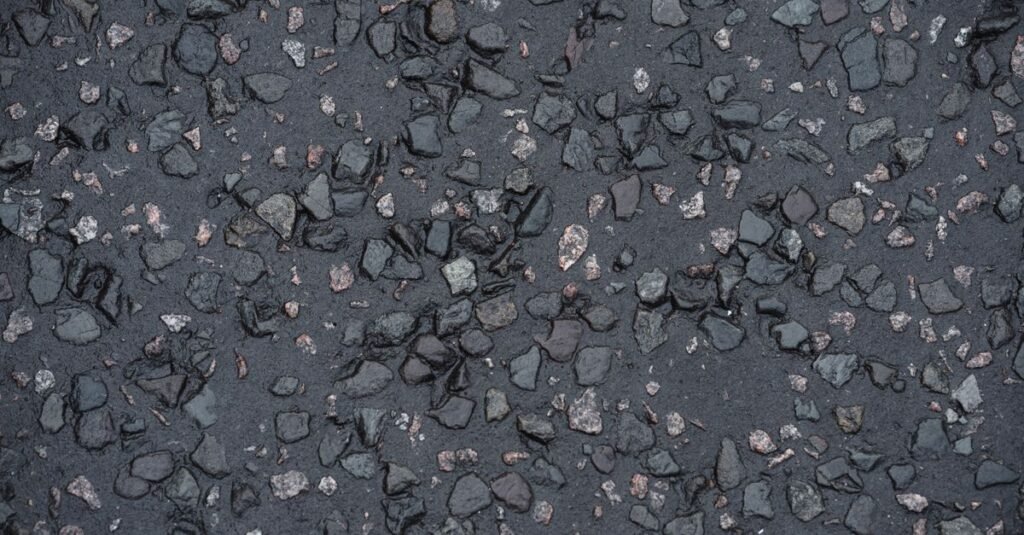
A shingle’s wear surface is ceramic-coated mineral granules pressed into hot asphalt. The gaps between those granules are pore space, and pore space is exactly what a crustose lichen grows into. So the hyphae are not on the granules — they are between and around them, tangled into the only part of the roof standing between the asphalt and ultraviolet light. Lift the disc and the granules come with it. There is no procedure for putting granules back.
Two consequences, both honest rather than encouraging. Expect repeat applications, because one chlorine dwell will bleach a lichen disc and frequently not kill it through. And expect a ghost — a faint pale mark where the disc sat, sometimes permanently. A pale outline is what you get to keep instead of a bald patch, and nobody standing in your driveway will ever notice the difference.
If the roof is tile rather than asphalt, the pressure rules are different and published, but the biology is identical. Tile is harder than the lichen. It is not harder than the part of the tile the lichen has already got into.
On Stone, the Lichen Already Owns Some of the Stone
Stone, concrete, mortar and sandstone paving are where lichen does measurable harm rather than cosmetic harm, because these are the materials whose binder those organic acids dissolve. The flat, ink-black discs on a sandstone patio are lichen, not dirt, and the working treatment is repeated dilute hypochlorite over several weeks — set out in patio cleaning solution, along with why acid-based black spot removers take a layer of sandstone with the crust.
On a driveway the useful contrast is the moss beside it. Scraping moss off concrete is fine, because rhizoids sit in the surface texture rather than in the material; that sequence is in removing moss from a concrete driveway. Take a scraper to a lichen disc and you are removing cement paste — and the conservation literature warns that mechanical work “causes the dispersion of spores and increased stone loss,” so you have roughened the surface and seeded it in the same afternoon.
The pressure washer has one narrow role: a rinse, after the chemistry, at whatever pressure the slab tolerates. It lifts dead crust that has already let go. It will not shift a live one, and if it appears to be shifting a live one, look at the colour of the water running off. Grey is the slab.
The conservation specialists are more cautious than the cleaning trade, and it is worth knowing why. The Gonbad-e Qābus researchers concluded that “removing lichens after they have already affected their substrate may indeed cause more exposure to damage.” On soft old brick, a limestone sill or a headstone, the case for leaving it alone is stronger than the case for cleaning it.
Timber Is the One Surface Where Lichen Is a Symptom
Lichen on wood is the easiest of the three to remove and the most informative to find.
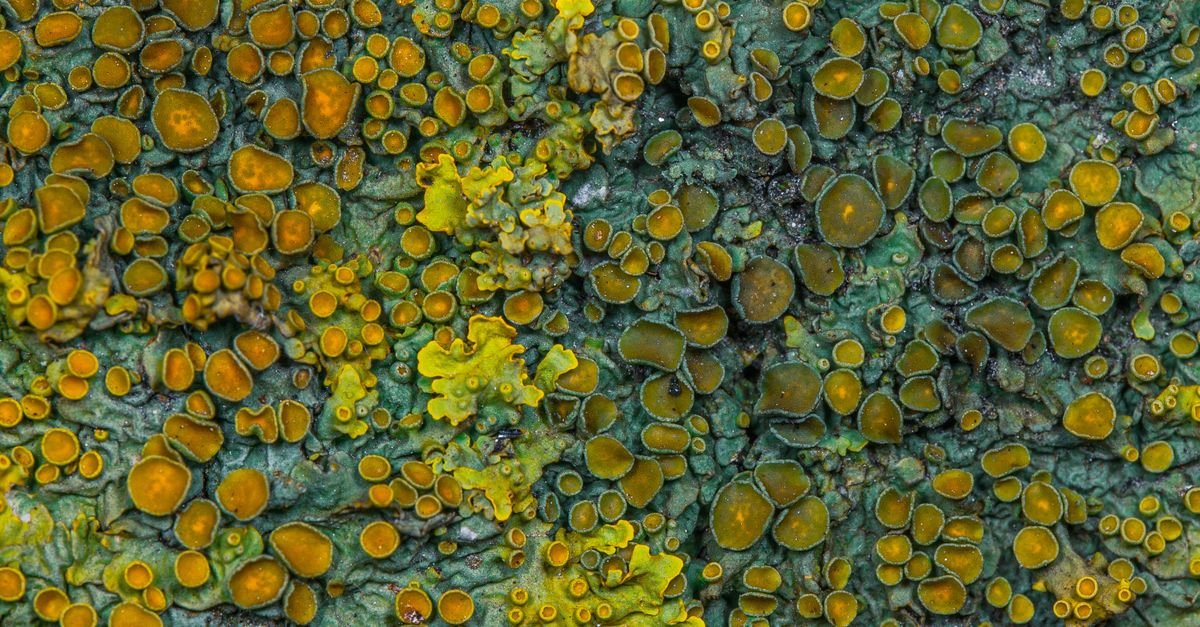
Wood has no mineral binder for the acids to attack and no granule layer to lose, so a thallus on a deck board, a fence rail or a cedar shake is gripping fibre rather than dissolving anything. A hypochlorite wash with a proper dwell and a gentle rinse deals with it, and the method — dilution ceiling, what chlorine does to fibre and fixings, and why it changes how your next coat behaves — is in cleaning decks with bleach.
The diagnosis is the part worth stopping on. Lichen needs years of undisturbed surface, wet often enough to photosynthesise. If it is on your timber, that timber has been damp, unprotected and untouched for a long time. On a deck it means the finish failed several seasons ago. On cedar shakes it means the slope has not been drying — which is the mechanism that actually shortens a wood roof, rather than anything the lichen is doing chemically.
So clean it off, then treat the reading it gave you: cut the branch shading that elevation, clear the debris out of the keyways or the board gaps, and get a coat back on. Removing lichen from wood without fixing the drying is resetting a clock you are not winding.
Dead Lichen Still Has to Weather Off
This is the expectation nobody sets, and it is why people believe lichen treatments fail. A dead lichen is still mechanically attached: the hyphae are still in the pores and the oxalate is still at the interface, and neither dissolves because the organism inside has stopped. What changes is colour — green-grey goes pale, black discs go chalky, orange goes bone. Then you wait, while frost, rain and thermal movement do the separating you were told not to do with a scraper.
| Surface | Time to visible kill | Time for the crust to shed | Realistic end state |
| Asphalt shingle | Days, after repeat passes | Months to years | Faint ghost may be permanent |
| Concrete, paving | Days, over 2–3 applications | Several months | Usually clears, may leave a shadow |
| Sandstone, soft brick | Weeks, over repeat applications | Months | Often a lightened outline |
| Timber, painted or bare | Days | Weeks, or lifts in the rinse | Clean, sometimes a stain |
So for about a year, your patio has a pattern of pale grey coins on it that used to be dark grey coins. That is a result. It does not look like one, and it is the exact point at which people go and buy the wire brush they were carefully talked out of six paragraphs earlier. Judge it by colour, not by absence: push a fingernail at a treated disc after a month or two, and a dead one crumbles at the edge while a live one stays leathery.
FAQ
Is lichen the same as moss?
No, and not even closely. Moss is a plant that anchors with rhizoids in the surface texture and absorbs water through its leaves. Lichen is a fungus and an alga functioning as one organism, and the fungal partner grows into the material itself — measured at 1 to 5 millimetres deep in masonry. That is why moss can be scraped and lichen cannot.
Does lichen damage the surface it grows on?
On stone, brick, mortar and concrete, yes: lichens produce oxalic, citric, lactic and gluconic acids that decompose mineral constituents, and the hyphae wedge the surface apart as the thallus swells and shrinks. On timber the harm is indirect — the growth holds water against the wood. On an asphalt roof, the damage almost always happens during removal rather than during growth.
What kills lichen best?
A sodium hypochlorite solution with a surfactant, on a pre-wetted surface, given a long dwell without drying, and repeated over several weeks. No-rinse quaternary ammonium products work too, and the conservation literature names them specifically for lichen. Either way it takes multiple passes, because the target is a fungus inside the surface.
Can I pressure wash lichen off?
You can, and you will take surface with it, which is the whole problem. On asphalt shingles that means granule loss, and it is never acceptable. On stone and concrete it means cement paste and roughening, which holds more water and lets the next colony establish faster. The machine’s one legitimate role is rinsing off crust the chemistry has already killed.
Will vinegar remove lichen?
Barely, and it is the wrong tool twice over. Vinegar fades a surface tint without reaching the mycobiont in the pores, and on limestone, sandstone and mortar it etches the material you are trying to keep. Lichen already makes stronger organic acids than your vinegar does. It is not impressed.
How long does lichen take to come back?
Not soon. Lichen is a slow coloniser — one measured species took under twelve years to build a two-millimetre encrustation — so a properly killed patch does not return next season the way algae does. If something green is back within months, that is algae or moss moving into the surface you opened up.
Slow Is the Method, Not the Failure
Everything awkward about lichen comes out of one sentence: it is a fungus with an alga inside it, and the fungus is millimetres into your roof, your slab or your boards. It is not a stain, it is not a plant sitting on top, and no amount of pressure turns it into either.
So treat it as the slowest job on the property. Wet the surface, use a solution that clings, give it a long dwell, then come back and do it again in a few weeks. Take the surface method from the article that owns the surface — the roof, the paving or the timber — and let weather do the detaching, because weather takes a year and does not cost you granules or cement paste.
The only real decision here is whether you can look at grey discs for another season, because every method that clears them today takes surface away with them. Kill it, leave it, and let frost and rain detach the dead thallus on their own schedule. That is not patience offered as a virtue. It is the one technique that costs you nothing — no granules, no cement paste, no wood fibre — and the lichen took a decade to get there.