Last Updated on September 24, 2026 by Umar Farooq
DIY roof cleaning is the right decision when you can wet and rinse the entire roof without standing on it, and the wrong one the moment any part of the job needs you on the slope. Nothing else about the job is difficult. The deciding factor is geometry, not competence.
That is not the answer most homeowners are expecting, because most roof cleaning advice is written as either a tutorial that assumes you are already up there or a sales page that assumes you should never try. Both skip the actual question. You are standing on the drive looking at a streaked roof, and what you need to know is whether this is a Saturday or an invoice.
DIY Roof Cleaning Is a Reach Problem, Not a Skill Problem
Here is the position, stated plainly: there is nothing technically hard about cleaning a roof, and anyone telling you otherwise has a van with their name on it.
The method the industry actually endorses is a dilute sodium hypochlorite solution applied at garden-hose pressure, left to sit, and left alone. The Asphalt Roofing Manufacturers Association rules out pressure washers, brushes and brooms for asphalt entirely in its guidance on algae and moss prevention and cleaning. That is the whole trade secret. Mix, wet, wait, leave. The hardest instruction in the entire method is “do not scrub it”, and the correct technique for that is to go inside.
What a contractor sells you is not knowledge. It is reach — the ability to put an even film of solution across two thousand square feet of sloped surface, and rinse it, without anyone’s body weight ever arriving on the shingles. That is a hardware and access problem. Which means the honest way to make the DIY-versus-hire call is to stop asking “am I capable of this” and start asking “can I get solution onto every part of that roof, and water back off it, from somewhere I am not going to fall from.”
If the answer is yes, do not pay anyone. If the answer is no, the money is not buying skill you lack. It is buying a ladder you do not own and a knee you would like to keep.
Four Capabilities the Job Quietly Assumes
Every roof cleaning tutorial has an implied list of things you already have. It is worth writing the list down, because three of the four are the reason homeowner attempts go wrong.
| Capability | What it actually means | Homeowners usually have it? |
| Reach | Solution onto every square foot, and rinse water back off, without standing on the slope | Sometimes — single storey, shallow pitch, yes |
| Footing and fall protection | An anchor point, a rated harness, and a ladder set and tied at the right angle | Rarely |
| Chemical handling | Mixing dilute hypochlorite correctly, eye and skin protection, controlling where runoff goes | Underestimated |
| A second person | Someone at the foot of the ladder who is not holding a phone | Almost never |
Reach is the one you can measure before you commit. Stand at each elevation with the ladder you own and work out, honestly, how much roof you can wet from the eave with a pole or a hose-end applicator. Not “could probably get”. Wet.
Footing is where people confuse equipment with protection. A harness in a bag is not fall protection. A harness is fall protection when it is attached to an anchor rated to hold a falling adult, and the overwhelming majority of houses do not have one fitted. Buying the harness without the anchor gets you a very expensive high-visibility waistcoat.
Chemical handling is the capability people are most confident about and least justified in being confident about. A review of published sodium hypochlorite case reports found that among households mixing their own disinfectant solution, 74.2% used the wrong proportion and roughly 42% reported at least one side effect. That survey was about pandemic-era home disinfectant, not roofs, and I am not going to pretend otherwise — but it measures exactly the skill this job requires, which is a person with a jug and a bucket getting a ratio right. The same review lists what a splash does to an eye: lacrimation, photophobia, corneal abrasions, impaired vision. Goggles, not safety glasses. Our guide to sodium hypochlorite for pressure washing covers the handling side properly.
A second person gets its own section, because it is the requirement everyone waives.
Nobody Should Be Up There Alone
The reason to have someone else in the garden is not that they will catch you. Nobody catches anybody. It is that a roof job has three moments where being alone changes the outcome.
The first is the ladder itself. A ladder that is footed by a person does not walk sideways when you shift your weight, and a ladder that moves is the event, not the fall. The second is the solution. If you take a face full of hypochlorite thirty feet up, your eyes close involuntarily and you are now descending a ladder blind. Somebody at the bottom talking you down is worth more than any piece of kit you can buy. The third is the boring one: if it does go wrong, the difference between being found in ten minutes and being found in two hours is the difference between two outcomes.
So the rule is simple. If the only other adult in the house is out, the roof waits. It has been streaked for three years. It can be streaked until Tuesday.
Five Conditions That Take the Decision Out of Your Hands
These are not preferences. Each one removes DIY from the table regardless of how confident you are feeling, because in each case the failure mode is not recoverable by being careful.
1. Anything above a single storey. The disqualifier is not the roof, it is the ladder. A ladder long enough to reach a second-storey eave has to be set further out, flexes more under load, and is genuinely difficult for one person to raise without it getting away from them at the top of the arc.
2. An overhead service drop anywhere near the elevation. The cable from the pole to your house is usually the lowest thing on the property and the one nobody looks at. An aluminium extension ladder rotating past it is a fatality, not an injury. If the drop crosses the elevation you need to work, that elevation is not yours. This is the condition that almost no roof cleaning guide mentions, and it is the only one on this list that can kill you before you have climbed anything.
3. No anchor point, on a pitch you cannot stand on dry. Test it at the eave before you commit to the slope. If you would not walk it in the dry with no solution on it and nothing in your hands, it does not become walkable once you are holding a wand and the surface is wet with surfactant.
4. A surface that goes slick rather than gritty when wet. Asphalt shingles at least give you grit and a bit of warning. Glazed tile, painted metal and a slope already carpeted in algae do not — they go from grip to no grip with nothing in between.
5. You are over 55 and doing this alone. This one sounds like a slight and is not. In the ladder-fall data below, the patient profile is startlingly consistent, and the point is not that older homeowners are careless. It is that the same fall produces a much longer recovery.
Solar panels deserve a mention here too. They are an anchor point that is not an anchor point, they are slick, and standing on one is a five-figure mistake dressed up as a handhold.
The Whole Job From Ground Level
Here is the part the sales pages leave out: on a single-storey house with a shallow pitch, most of a roof clean is a ground-level job already, and the bits that are not can usually be done from a ladder set at the eave without a foot ever touching the slope.
Assessment is the first one. A pair of binoculars from the driveway tells you more about what is growing up there than standing on it does, because from the slope you are looking along the surface instead of at it. Debris clearing comes next — a leaf blower from the ladder at the eave, working down-slope, moves the loose material without anyone walking the roof.
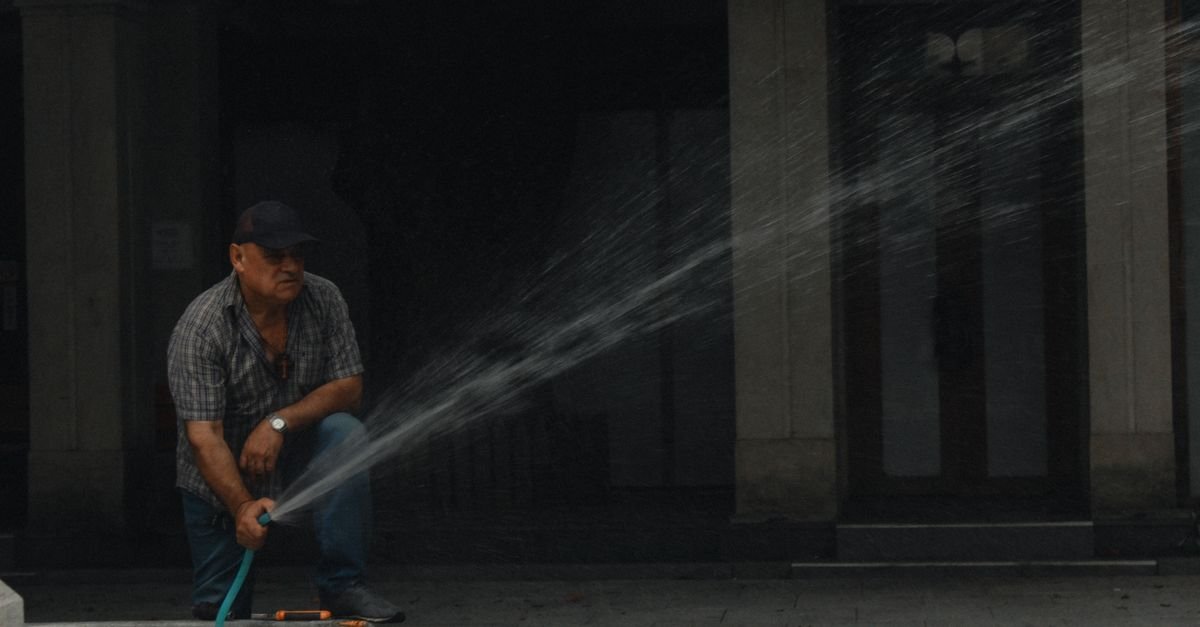
Then the actual work. Pre-soaking the landscaping is entirely a ground job and is the single most effective thing you will do all day. Applying solution is a ground job too, given a pole applicator or a low-pressure pump feeding a hose, and so is the rinse, if you choose to rinse at all. Afterwards: flushing the gutters, rinsing the siding and the drive before runoff dries, and cutting back the overhanging branch that is the reason the north slope stays damp. All of it from the floor.
Stack that up and the only genuinely elevated part of a single-storey roof clean is the ladder work at the eave. Our walkthrough of how to clean roof shingles without pressure washing covers the mixing, dwell and rinse order in full, and it is written to be done exactly this way.
Where a Homeowner Attempt Usually Comes Apart
When a DIY roof clean disappoints, it is almost never because the chemistry failed. It is because the application was uneven, and uneven shows up in daylight for the next three years.
| Failure mode | What causes it | What it looks like afterwards |
| Running out of solution mid-slope | Mixing one batch and guessing at coverage | A horizontal line across the roof where batch one stopped |
| The top third drying out | Mixing batch two while batch one sits in the sun | Streaky residue and a strip that never cleaned |
| An untreated far slope | You can only see what the ladder faces | One clean elevation and one that still streaks |
| Scorched planting at the downspout | Pre-soak done, runoff concentration ignored | A dead shrub the exact shape of the drip line |
| A second, harsher attempt | Judging the result the same afternoon | Damage caused by impatience rather than by method |
| Gutter interiors left unrinsed | The job felt finished when the roof looked wet | Staining down the fascia in the next heavy rain |
Two of those deserve expanding. Mix in one container, all of it, before you start — a roof cleaned in two batches at two slightly different concentrations is a roof with a visible seam, and there is no fixing that except doing the whole thing again. And the same-afternoon judgement is the one that pushes people into genuine damage: a treated roof carries on improving for weeks as rain weathers the dead growth off. The homeowner who goes back up on day two with a stiffer plan is solving a problem that was already solving itself.
Sixteen Per Cent Had Not Fully Recovered at Six Months
I went looking for what a domestic ladder fall actually costs a person, because “be careful up there” is advice, not information. The best data I found followed 134 ladder-fall patients through two emergency departments for six months.
The patient profile is the part worth sitting with. Eighty-one per cent were male. Seventy-three per cent were over 55. That is not a construction demographic. That is a Saturday-morning-jobs demographic, which is to say it is most of the people reading this. And at the six-month mark, 16% had either not returned to work or had not fully recovered (ladder-related injury outcomes, PMC7310734).
Sixteen per cent is the number I would put against a contractor’s quote. Not the fear, not the drama — just the fact that roughly one in six of the people who came off a domestic ladder were still not right half a year later. Weigh a quote against that rather than against a Saturday.
Renting Reach Instead of Buying Labour
The decision is usually framed as ladder or contractor, and there is a whole middle that nobody writes about. If reach is the only thing you are missing, buy the reach and keep the labour.
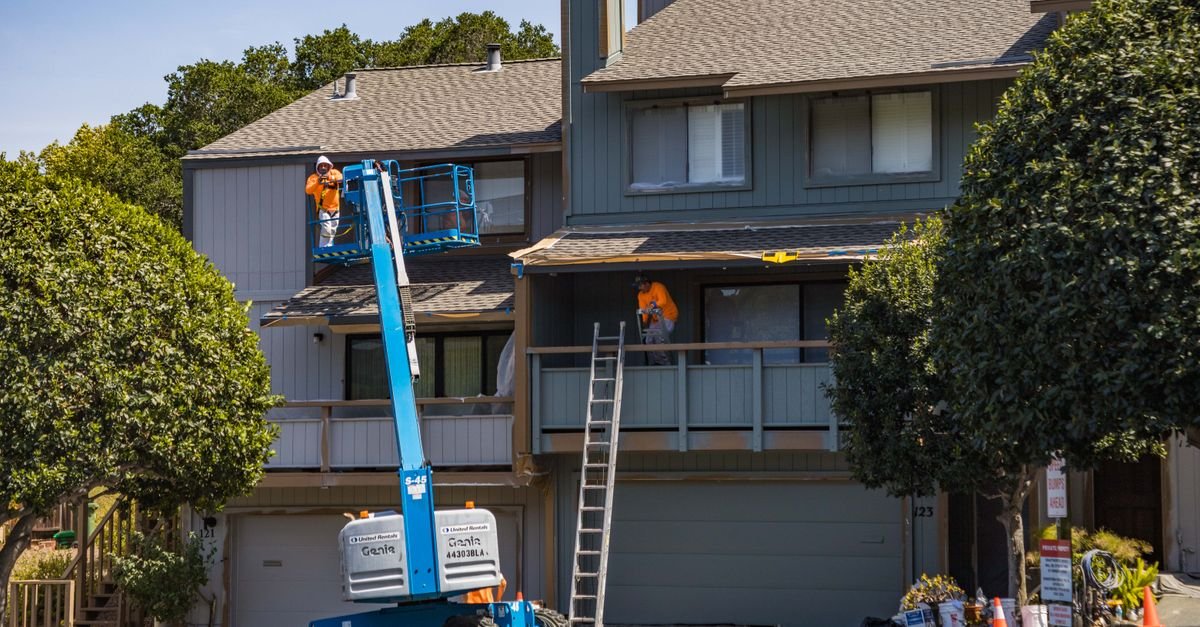
A telescoping pole applicator adds reach for the price of a takeaway and turns a chunk of a shallow roof into a standing job. A low-pressure pump with a long hose run puts solution up there at the pressure the roof wants without you carrying it. A rented towable lift for a day is a real option on a two-storey house and is cheaper than most people assume, because they never price it. And if you are getting quotes anyway, ask each contractor what a ground-only treatment costs versus one where their crew walks the slope — you will learn a lot about the company from whether they can answer.
The same logic applies to everything else on the outside of the house, which is why the tools that extend your reach tend to earn their keep across several jobs rather than one. Our guide to power washing your house covers the wall side of that, where the reach problem is much more forgiving.
FAQ
Is DIY roof cleaning worth it?
On a single-storey house with a shallow pitch and no overhead service drop, yes — comfortably. The materials cost tens rather than hundreds, and the method is genuinely simple. On a two-storey house, or anywhere you would have to walk the slope, the economics reverse quickly, because the equipment and the risk both scale faster than the price of a quote.
Can I clean my roof without getting on it?
Frequently, yes. Assessment, debris clearing, pre-soaking plants, applying solution, rinsing, flushing gutters and trimming branches can all be done from the ground or from a ladder set at the eave. The limiting factor is the size of the roof and the reach of your applicator, not the method.
Is it safe to walk on a roof to clean it?
A dry, shallow roof is walkable for a fit person. The problem is that the roof will not be dry — it is about to be wet with a solution containing a surfactant, which is the closest thing to deliberately lubricating a slope. Plan the job so that you never need to.
Do I need a harness for DIY roof cleaning?
If you are going onto the slope, yes, and it has to be attached to a rated anchor. That is the part people skip. A harness clipped to nothing, or to a vent or a chimney of unknown condition, is not fall protection. Most houses have no anchor fitted, which is itself a strong argument for staying off.
How much roof can you reach from a ladder at the eave?
More than most people expect with a pole applicator, and less than most people expect with a hose. Measure it before you plan the day: set the ladder, reach up with whatever you are going to use, and mark how far up the slope you can actually wet. That distance, times the number of ladder positions you can safely set, is your DIY roof.
Should I clean my roof alone?
No. Not because the second person catches you, but because they foot the ladder, talk you down if you take a splash to the eyes, and are the difference between a ten-minute response and a two-hour one. If you cannot get someone into the garden, postpone it.
Why did my DIY roof clean come out patchy?
Almost always because it was applied in two batches, or because the first section dried before the second was mixed. Mix everything in one container before you start and work in overlapping bands so no area sits waiting. Patchiness is an application problem, not a product problem.
Is it cheaper to clean the roof myself?
In materials, dramatically. In total, only if you already own the access equipment and the roof is reachable. Buying a longer ladder, a harness and an anchor for one job costs more than most quotes, and leaves you owning a ladder you will be tempted to use on the elevation you already decided against.
If You Can Reach It From the Ladder, Do Not Pay Someone
The honest DIY roof cleaning answer cuts both ways, and I am not going to round it in either direction. Single storey, shallow pitch, no service drop overhead, a second adult in the garden, and every square foot reachable with a pole from the eave — that is your job, it is not difficult, and paying somebody several hundred dollars for it would be a waste of money you could spend on the branch surgery that stops it coming back.
Two storeys, a slope you cannot stand on dry, a cable crossing the elevation, or nobody home to hold the ladder — that is somebody else’s job, and what you are buying is reach, not expertise. Get three quotes, ask each one whether their people walk the roof, and spend the afternoon you saved doing the ground-level half yourself anyway. The roof will not know the difference. Your knees will.