Last Updated on September 26, 2026 by Umar Farooq
Removing BBQ grease patio stains is a race against a chemical reaction, not against absorption. While the splash is still a fat, warm water and an alkaline cleaner lift it the same evening. Once it has taken up oxygen and cross-linked, it is a solid film that is insoluble in water and in most solvents, has no melting point for heat to exploit, and gives up only to long alkaline dwell and repetition.
That is the whole difference between the stain you can fix tonight and the one you will still be looking at next June. And it is why barbecue fat behaves nothing like the oil drip under the car, even though every stain-family table I have read — including the one on this site — files them together under petroleum.
A hydrocarbon does not cure. It sits, it migrates, it oxidises slowly into something darker, but it never becomes a different class of material. A cooking fat does. Given oxygen, heat and a thin film, a triglyceride does what linseed oil does in a tin of paint: it sets. Nobody on the patio intended to varnish it.
Fat Leaves the Grill Already Halfway to a Solid
The splash on your slabs did not arrive as oil. It arrived as oil that had already spent time in the exact conditions the food-science literature uses to make polymers on purpose.
Start with temperature. A study of frying-oil degradation in *Food Chemistry: X* opens by noting that the high-temperature frying process, “typically between 150 °C and 190 °C, induces chemical changes such as oxidation, polymerization, isomerization, and hydrolysis, resulting in the deterioration of frying oil” (Chen et al., 2025). Fat rendering out of a joint sitting over lit charcoal is not in a fryer, but it is not below that band either, and the fat that catches and flares on its way down has plainly passed through a flame. I went looking for a published temperature for the fat as it leaves a domestic grill and did not find one, so treat the band as where the chemistry starts rather than as a measurement of your barbecue.
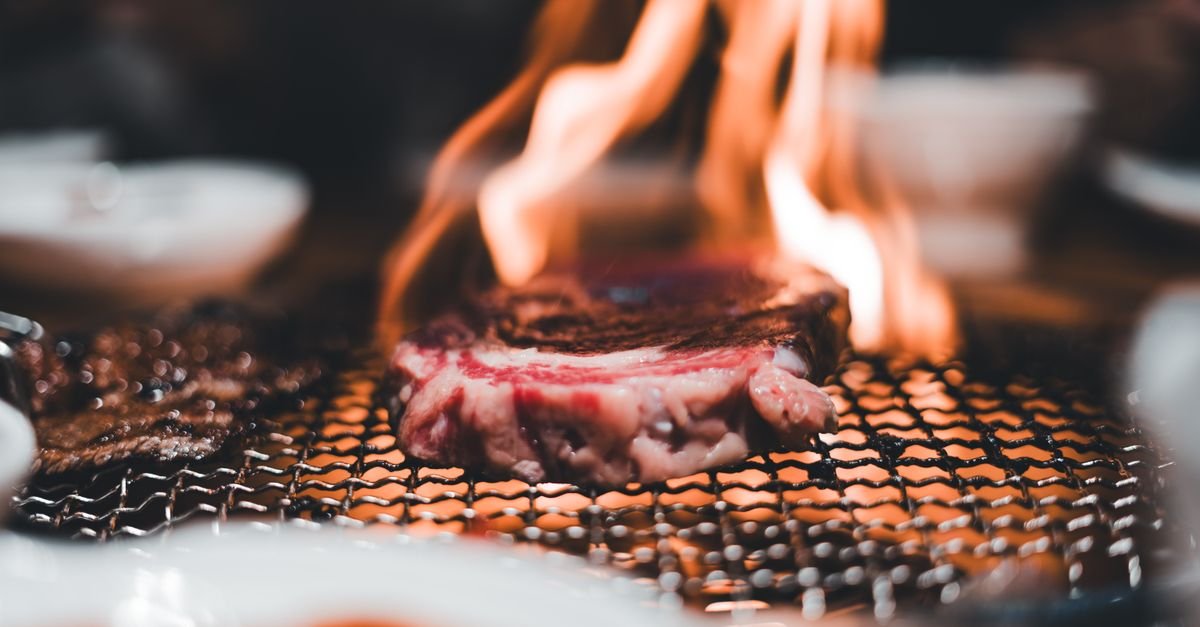
Then the part I did not expect, and it is the reason a barbecue splash is worse than the same volume of cooking oil knocked off a shelf. The same paper explains that “when exposed to high-temperature frying, denatured meat proteins accelerate the release of ferrous iron, which enhances lipid oxidation and results in increased accumulation of oxidized and polymeric TAGs in frying oils.” Iron is a catalyst for lipid oxidation, and the meat supplies it. The fat dripping off a steak is pre-dosed with the thing that speeds up its own setting.
Three more conditions line up, and none of them is under your control.
It lands as a thin film over an area. Fat leaves a grate as droplets, not as a stream, so the deposit is a spray field rather than a puddle. A thin film has an enormous surface-to-volume ratio, which means oxygen reaches nearly all of it at once. That is my reasoning rather than the paper’s — the frying work measured bulk oil in a fryer — but it is the same variable, and it runs the wrong way for you.
It gets reheated and re-cooled all summer. This one is measured. The same study compared continuous frying against discontinuous frying, where the oil is heated, used, allowed to cool and heated again, and found that “discontinuous frying consistently resulted in higher TGDs and OxTGs than continuous frying at each time interval.” The explanation is “increased oxygen solubility as oil cools.” A patio splash is the most discontinuous heating regime imaginable: Sunday afternoon sun, Sunday night cool, repeat until September.
Nothing is protecting it. Cooking oil in a closed bottle in the cupboard stays liquid for a year because the headspace runs out of oxygen. Your slab has an atmosphere over it.
So by the time somebody notices the marks, four separate accelerants have been at work. Which is the honest answer to why an old barbecue stain behaves unlike a fresh one: it is not the same substance any more.
One caveat worth having, because it changes what you will actually see. Cross-linking runs on unsaturation, and animal fat carries far fewer of the reactive sites than a seed-oil marinade or a basting brush full of sunflower oil does. So a plain lamb chop and a marinated chicken thigh do not leave the same mark on the same slab, and the marinade is the faster of the two. I could not find anyone who has measured that comparison on paving, so take the direction and not a rate.
Cured Fat Stops Being Something You Can Dissolve
Here is where the trail leaves food science entirely and picks up in a field with a much more precise vocabulary for the problem: the people who clean oil paintings.
An artist’s oil paint is a drying oil, which is to say a triglyceride chosen for how readily it sets. Writing in *Scientific Reports*, Modugno and colleagues summarise what happens to it: unsaturated fatty acids, “representing more than 80% of the total fatty acid composition of a drying oil, undergo oxidation and cross-linking reactions when exposed to light and oxygen, leading to the formation of a solid film, insoluble in water and in many organic solvents” (Modugno et al., 2019).
Read that sentence as a description of your patio rather than of a canvas. Same class of molecule, same two reagents, same product. The film on a slab in September is not grease that has gone hard. It is a solid, and it is insoluble, and conservators — whose entire job is removing exactly this material from something irreplaceable — describe it that way in their own literature. That is a considerably stronger statement than anything on a bottle in a builders’ merchant.
Which changes what your degreaser is doing, and this is the part worth understanding before you buy a second bottle of it.
On a fresh splash an alkaline cleaner works on a liquid. It hydrolyses the ester bonds in the fat into soap and glycerol, and its surfactants surround whatever is left so water carries it off. That chemistry is not mine to explain here — cleaning concrete with TSP takes the saponification mechanism apart properly, including why the same bottle does so much less to a hydrocarbon.
On a cured film the ester bonds have not gone anywhere. Modugno’s group note that during ageing, “the most important” of the further reactions is “the hydrolysis of the ester bonds of the triacylglycerols.” So the alkaline route still exists. What has changed is that those bonds now sit inside a solid network instead of in a liquid, so the reaction has to eat inward from a surface rather than surround a droplet. Same bottle, same chemistry, an entirely different rate — and contact time replaces product strength as the variable that decides the outcome. That last step is my reasoning from the two sources rather than a published figure, and saying so seems better than handing over a dwell time somebody invented.
The practical shape of that is simple and slightly depressing. A fresh splash is one treatment. A cured one is several long ones, each doing less than the last, and the endpoint is a pale shadow rather than clean slab. Everything about pore depth, poultices and the point at which surface chemistry stops improving is already worked out on whether pressure washing removes oil stains from concrete, and it applies here unchanged once the film has set.
Is There a Temperature That Releases a Cured Splash?
No, and the reason is structural rather than a matter of your machine being too small.
Heat genuinely is the right lever on greasy soils, and the hot water article owns that argument, including the neat test it ends on: if you can melt it in a pan, heat will help. That test is correct, and a barbecue splash is one of the few stains on this site where it gives the wrong answer — not because the test is wrong, but because the material stopped qualifying.
Cross-linking is what takes a melting point away. A liquid fat and a soft solid fat both flow when warmed, because the molecules can slide past each other. Tie those molecules together with covalent bonds and they cannot slide, so there is nothing to soften into. That is the defining property of the whole class: a cured film degrades before it flows. Note the difference from the other thing on a patio that ignores heat — grit has a melting point and it is simply out of reach, whereas this has none to reach.
I went looking for a published softening or drop point for an oxidised fat film, half expecting a temperature band the way there is for a wax, and there is not one. The frying literature publishes the temperatures at which the polymer *forms* and says nothing about a temperature that undoes it. The paint-conservation literature reports a solubility problem and never a thermal one. And the one body of writing that discusses polymerised cooking oil in everyday terms — the enormous corpus on seasoning cast iron — is blogs citing each other, with no measurement behind any of it. An absence that consistent across three separate fields is the answer, not a gap in my searching.
So the honest version for someone holding a cold electric machine, which is most people: heat was never going to rescue the cured stain, you have not missed an upgrade, and the inlet temperature limit on a domestic machine is low enough that the question is usually academic anyway. Where heat does real work on this topic is the fresh splash, in the washing-up bowl, on the same evening — thinning a fat that has not set and speeding up the alkaline reaction on it. Which is a fairly ordinary use for hot water, and it is the one that works.
Removing BBQ Grease From Patio Paving While It Is Still a Fat
The good news is that this stain hands you an advantage no oil stain does, and almost nobody uses it.
A cooled barbecue splash is a solid. Motor oil never gives you that — it is liquid on arrival, liquid in the pores, and there is nothing to get an edge under. Fat is solid at patio temperature within an hour of the grill going out, which means the first move is mechanical and dry: a plastic scraper or the spatula you have already privately decided is never going near food again, held shallow, lifting the raised part off the surface texture and into a bag. On sawn or honed paving you will take off most of the deposit this way. Do not use a metal blade on stone, and do not chase the last of it — you are removing bulk so the chemistry has less to do, not cleaning.
Then the wet stage, the same evening if you possibly can. Pre-wet the slab, apply an alkaline degreaser well past the visible edge, keep it wet, agitate with a stiff synthetic brush, rinse, and judge it dry. That sequence is not barbecue-specific and I am not going to re-derive it: cleaning stains from concrete sets it out step by step, along with the tablespoon-of-water test for whether your slabs are sealed. Which cleaner your particular paving can survive is a separate question with a real answer, and the patio cleaning solution guide settles it by material — that matters here, because the single drop of vinegar it tells you to try is also the test that rules out every acid on the shelf.
Three things are genuinely specific to this stain, and they are the ones to get right.
Do not jet it first. Hitting an untreated splash with a wand achieves two bad things at once: it drives fat into the surface texture, and on a warm slab it spreads a thin film outward, which is precisely the geometry that cures fastest. You will convert a hand-sized mark into a faint metre-wide one.
Take the warm emulsion downhill, and know where downhill goes. This site’s rinse rule is really one question — work out where the water has to end up, then choose the direction that takes it there. On a wall that resolves to top-to-bottom; on a soffit, outboard. A patio is a near-horizontal plane with a fall built into it, so the answer is the fall itself, and the mistake is pushing warm emulsified fat across the dry, cooler, clean slabs you have not treated. Fat that has been thinned and then allowed to cool sets again wherever it stops. Work toward the gully, the drain or the open edge, in the direction water already runs, and never back across the seating area because that is where you can see it.
Jointed paving gets one attempt. Degreaser flooding a sand joint does nothing useful down there, and fat that has soaked into loose jointing sand is not something you can wash out of it — that sand gets raked out and replaced. So apply enough to wet the surface and no more. This is reasoning rather than a published finding, but the direction is not in doubt.
And the prevention argument, which is the only part of this page the ranking articles get roughly right, with one geometric error. The standard advice is a drip tray, and a tray under the firebox catches what falls vertically. What stains the slabs is the part that does not: droplets thrown sideways by a flare-up, landing beyond the footprint of the grill. So the useful thing is area, not a tray — a mat that extends a decent margin past the barbecue on the side you stand on, which is also the side the lid is open towards. Trimming the fat cap before it goes on, as the barbecue trade suggests, works for the same reason: it is the only intervention that reduces the volume rather than trying to catch it.
FAQ
How do you remove BBQ grease from a patio?
Scrape the cooled solid off dry with a plastic blade first, then pre-wet the slab, apply an alkaline degreaser generously past the edge of the mark, hold it wet for a genuine ten to fifteen minutes, brush it with a stiff synthetic brush and rinse. Do that the same evening and one pass usually does it. Check what your paving material tolerates before you pick the product.
Will a pressure washer remove barbecue grease from paving slabs?
Not on its own, and going first with it makes the mark bigger. A washer is the rinse step: it clears emulsified fat off the surface far better than a hose once a degreaser has done the chemical work. Used on an untreated splash it spreads a thin film outward across warm slabs, which is the condition in which cooking fat cures fastest.
Does hot water remove BBQ grease from a patio?
On a fresh splash, yes — heat thins the fat and speeds up the alkaline reaction, which is why the washing-up bowl works. On a splash that has been there for weeks, no. Oxidised fat cross-links into a solid that has no melting point to soften, so there is no temperature at which it lets go, and a domestic machine’s inlet limit makes the question academic anyway.
Why does an old barbecue stain look different from an oil stain?
Because it is no longer the same kind of material. Motor oil stays a hydrocarbon however long it sits. Cooking fat takes up oxygen and cross-links into a solid film — the same reaction that turns linseed oil into paint — so an old barbecue mark reads as a dull, slightly raised varnish rather than a dark patch with a soft halo.
How long do I have before a BBQ grease stain becomes hard to remove?
Nobody has published a curing time for a fat splash on paving, and I would not trust one if they had, because it depends on the oil’s unsaturation, the sun on that slab and how many more barbecues happen on top of it. The useful version is directional: the same evening is one treatment, the following weekend is two or three, and a whole summer of reheating is a permanent shadow.
Will dish soap remove barbecue grease from paving?
On a fresh splash it does a reasonable amount, because a surfactant is most of what a fresh fat needs. It is weaker than a dedicated alkaline degreaser on anything that has sat, and it has no useful effect on a cured film. Use it if it is what you have in the first hour; do not buy more of it in week three.
Does baking soda remove BBQ grease from a patio?
It is a mild alkali and a mild abrasive, and both of those do something to a fresh splash, mostly by absorbing and by giving your brush some grit. It is not in the same league as a proper alkaline degreaser on pH, and it does nothing at all to a cross-linked film. It is also the ingredient half the internet tells you to mix with vinegar, which neutralises both.
Can I use bleach on barbecue grease?
No, and this one has a certain irony to it. Hypochlorite destroys coloured organic molecules, and a fat has no colour to destroy — it is the trapped dirt you can see, not the fat. Worse, oxidation is the reaction that set the stain in the first place, so the bottle you have picked up runs the same process that caused the problem. The green film that later colonises a greasy patch is a separate job with a separate bottle.
Cold, Alkaline, and on the Night
A barbecue splash is the one stain on a patio where the clock is running on a reaction rather than on absorption, and that reaction only needs air. Fat that is still fat scrapes off with a spatula and washes away with warm water and something alkaline. The same fat after a summer of sun and reheating has cross-linked into a film that conservators describe as insoluble in water and in most solvents, with no melting point for a burner to find and no product on a merchant’s shelf that undoes the bonds in an afternoon.
So the whole page collapses into a habit rather than a method. When the coals go out and the plates go in, take the scraper and the washing-up bowl out with them. Ten minutes at the end of the evening is the difference between a slab that looks like it was never cooked over and a pale patch you will be explaining to people for years.