Last Updated on September 26, 2026 by Umar Farooq
A wet sandblasting attachment adds water to an abrasive process for one reason, and it is not cleaning: the water is there to hold the dust down, and it does almost nothing to the cutting action of the grit travelling inside it.
That sentence is not mine. It belongs to the National Park Service, which has been watching people take the faces off historic buildings with this technique since long before it arrived in a blister pack for eighty dollars.
So there is no “best kit” section here. There are four things worth knowing before the parcel arrives: what the attachment physically is, what it demands of your machine, what somebody measured when they sampled the air around wet blasting, and what the grit does to the surface underneath — which is the part buyers underestimate, because the tool is sold as a cleaner and it is a material-removal tool with a hose on it.
A Venturi in the Lance and a Probe in a Bucket
The whole attachment is a nozzle assembly with a side port, a length of clear tubing and a weighted probe. Alkota, which builds industrial pressure washers, describes the mechanism in one sentence: “The Sandblast kits use a venturi to draw sand through a suction hose where it is injected into the high-pressure stream at the Nozzle Head” (Alkota, Product Highlight: Sandblasting).
Nothing more sophisticated is happening. Water leaving a small orifice at high velocity drops the static pressure beside it, so the side port sits below atmospheric and the atmosphere pushes dry grit up the tube to fill the gap. STIHL puts the user-facing half just as plainly for its own kit: “Insert the other end of the wet sand-blasting attachment into a bucket containing the appropriate blasting granulate. The optimum quantity of granulate is automatically conveyed via the hose” (STIHL, Wet sandblasting with pressure washers).
The most reassuring fact about the design is Alkota’s: “The sand does not enter the pump.” The media joins the water after the pump, after the hose, after the trigger gun, at the very last fitting on the machine. Everything with a tolerance measured in thousandths is upstream of the grit, which is why this attachment can exist at all while there is no such thing as a sand hopper for your detergent tank.
What that means is that all the wear lands on the last four inches of the tool. Alkota’s kit ships with a tungsten carbide nozzle, because a stream of angular mineral leaving an orifice at velocity treats that orifice as a target. Your quick-connect tips were designed to pass water.
The failure people actually hit is duller and it is in the feed line. Alkota is emphatic twice — “Make sure your blast media is dry” and “Keep your supplied feed hose interior walls dry (Moisture internally will cause media clumping)” — and gives the fix as geometry: “Place the sand probe to the top of the blast head so the sand drops into the sand chamber with the help of gravity.” Mount the port at the bottom and water works backwards up the tube, meets dry sand, and you have manufactured a small quantity of grout inside your new attachment.
What a Wet Sandblasting Attachment Demands of Your Machine
Alkota publishes three requirements and the third one is the interesting one. The kit “Requires 3,000 to 5,000 PSI Pressure Washer”, its flow range “Requires 4 to 8 GPM Pressure Washer”, and the tip “Must be 0° Threaded ¼” nozzle Sized to specs of your machine (Not Included w/Sandblaster Kit)”.
Zero degrees. On a site whose standing position is that the red tip is a paint stripper that should stay in the bag, a tool whose specification *requires* one is worth stopping over. And it is not an oversight. The venturi needs the highest exit velocity the machine can manage through the smallest orifice it can manage it through, because that velocity is the only thing generating the vacuum that lifts the media; a 25-degree fan spreads the jet and kills the suction. So the nozzle is not a bad choice somebody made — it is the specification telling you what the tool is. There is no gentle version of this. An attachment that cleans politely does not pick up sand.
The flow figure rules most readers out. Four to eight gallons a minute is a professional skid; a domestic electric machine delivers about 1.2 to 1.6 GPM and a mid-range petrol unit two to two and a half. Meanwhile STIHL sells a wet sandblasting device for its RE-series domestic washers and Kärcher lists one as compatible with everything from a K 2 Classic upward. Those are real products that work, so “wet sandblasting attachment” names two tools with a threefold gap in flow between them, and the small one is slower rather than broken.
Jamie Fairchild, a former quarry-industry materials engineer writing on abrasive masonry cleaning in *The Building Conservation Directory*, gives professional abrasive jetting as typically 20 litres a minute at 200 bar for coarse masonry work — about 5.3 GPM at 2,900 PSI, landing almost exactly inside Alkota’s bracket from a completely different trade. When your machine supplies a quarter of that flow, the two things within reach are to move closer and to hold still for longer. Both of those are the substrate-removal mechanism two sections down.
One last demand, and it is a clock rather than a number. Alkota’s end-of-job instruction is to “apply a rust stop/metal prep chemical on the surface you are preparing to help prevent flash rusting”. Bare steel that has just been abraded and soaked starts oxidising while you are coiling the hose. That is not a defect in the kit, it is what wet means on ferrous metal — and on ornamental ironwork one conservation authority treats it as a reason not to wet blast iron at all.
Wet Cut the Silica by a Factor of Four, Not to Zero
Here is why the water is in the design. Dry abrasive blasting of concrete, masonry or painted surfaces puts respirable crystalline silica into the air, and that is the particle that causes silicosis. The obvious question is how much good the water does, and somebody measured it.
In September 2006 a University of Iowa team, funded by CPWR, spent five days sampling the breathing zone of workers wet blasting precast concrete panels at a plant in Redmond, Washington. The equipment was a water induction nozzle — in the report’s own words, “a venturi nozzle in which water is added to the abrasive-air mixture to suppress dust during abrasive blasting”, which is your attachment’s idea with air doing the propelling instead of water. Ten personal samples, minimum 200 minutes each.
The good half first. Geometric mean respirable dust came out at 0.53 mg/m³ and geometric mean respirable crystalline silica at 0.062 mg/m³, figures “lower by a factor of 7 (for respirable dust) and 4 (for respirable crystalline silica) than exposure data recently reported for construction workers performing dry abrasive blasting” (CPWR, *Field Tests of a Water Induction Nozzle as a Dust Control for Abrasive Blasting*, January 2007). Reviewing the earlier literature, the same report puts the benefit across wet methods at “a factor of 3 to 20, depending on the conditions”. Water works. It is not marketing.
Now the half that decides what goes on your face. The average personal exposure was 0.077 mg/m³, with a maximum reading of 0.13 and a 95% upper confidence limit of 0.141, and the report states flatly that these “exceed both the NIOSH REL of 0.05 mg/m3 and the ACGIH TLV (0.065 mg/m3)”. Best-case wet blasting, at a plant doing it all day with proper equipment, came in over both recommended limits. Its conclusion is not that respirators are unnecessary but that a cheaper one will do: “the use of respirators with an assigned protection factor of 10 would appear to provide adequate exposure reduction”, a factor “well below the level typically required to protect workers during abrasive blasting work”. An APF of 10 is a properly fitted half-mask. Wet changes which respirator, not whether.
Worth noticing what the consumer paperwork says beside that. STIHL’s published protective equipment for its wet sandblasting device is “safety glasses, non-slip footwear and gloves”. Eyes, feet, hands. No respirator on the list.
Then the finding I did not expect, and it is the one that should change how you choose media. The sand in that study “contained 59% crystalline silica, and the crystalline silica measured in the respirable dust samples was less than 20%.” The dust was less silica-rich than the abrasive being fired at the wall, and the author names where that points as the hypothesis worth testing: “When the fines content of the abrasive is nil, the surface being treated is the source of the respirable crystalline silica exposures.” The same report notes earlier that high silica exposures “can result when workers perform abrasive blasting on materials such as concrete surfaces or surfaces coated with silica-containing paint, even when using non-silica abrasives.”
Read that twice, because every product page has it backwards. The wall is made of the thing you are trying not to breathe. Switching to a medium softer than the aggregate takes the silica out of your bucket, not out of your concrete. And one more from the same report, free and actionable: “The highest respirable dust concentrations were measured at the stations with the lowest water application rate.” More water, less dust, measured. Nobody publishes a recommended rate — the report asks for laboratory work to establish one — so the practical version is the wettest setting that still cuts, and never in a space with poor natural ventilation, where the earlier surveys found exposures going up rather than down.
None of which means an afternoon on a trailer chassis gives you silicosis. These are eight-hour averages built around a working lifetime. It means a half-mask, outdoors, and it means the “dust-free” wording on the box is a comparison rather than a claim.
Somebody Measured How Much Concrete This Removes
The same field study carries a number that has nothing to do with dust and everything to do with what this tool is. That plant was not cleaning panels. It was wet blasting them to expose the aggregate for a finish, and the researchers measured product thickness reduction with a gauge, because the removal was the deliverable.
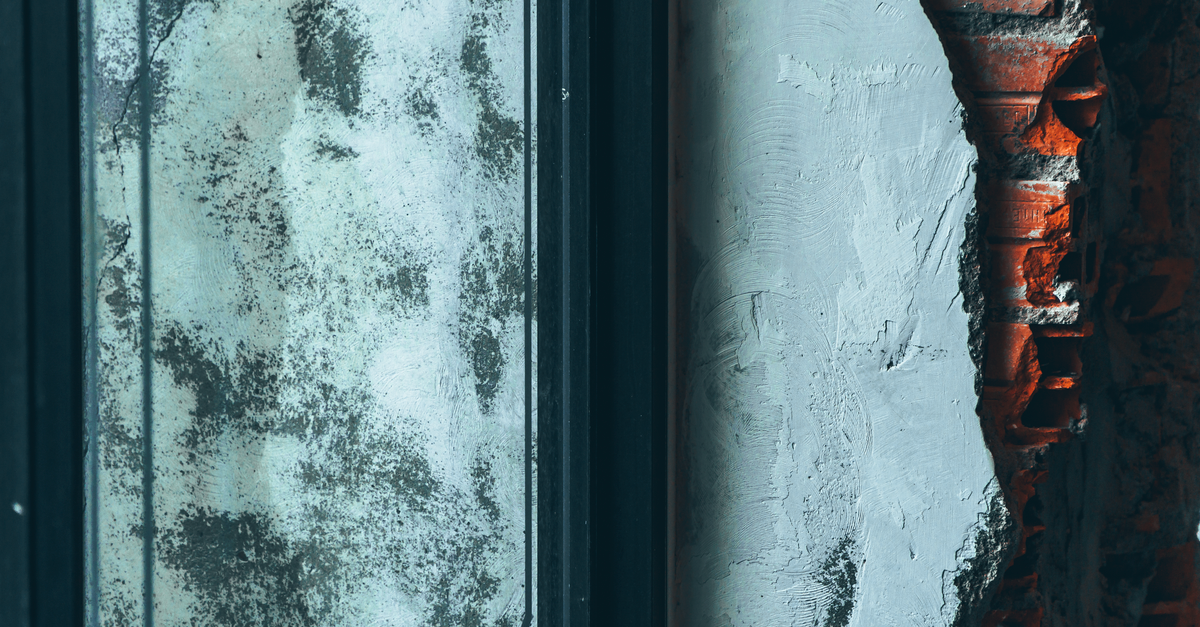
Light blasting on two walls, “to even color, aggregate not exposed”, took off what “appeared to be under 0.02 inches”. Stair units where “aggregate is barely exposed” lost 0.03 inches. Wall components “blasted to expose aggregate” lost 0.04 inches. So under two hundredths of an inch is enough to change the colour of a concrete surface, and three to four hundredths takes you past the paste and into the stone. That is this tool’s working range, and it is a machining tolerance rather than a cleaning one.
Which brings in a distinction the Park Service drew in 1979 and the internet has never repeated. There are, it says, “basically two different methods which can be referred to as ‘wet grit,’ and it is important to differentiate between the two. One technique involves the addition of a stream of water to a regular sandblasting nozzle. This is done primarily to cut down dust, and has very little, if any, effect on reducing the aggressiveness, or cutting action of the grit particles. With the second technique, a very small amount of grit is added to a pressurized water stream” (NPS Preservation Brief 6, *Dangers of Abrasive Cleaning to Historic Buildings*). Your attachment is the second kind, and the first half of that quote answers the question everybody arrives with. Wet is a dust control. The grit is unchanged. The brief also notes, unprompted, that “even water under pressure can be an abrasive substance” — this site’s founding argument, in a federal document older than I am.
Brief 6 is unusually specific about what comes off which material. On brick, “the hard, outer layer (closest to the heat of the kiln) is eroded, leaving the soft, inner core exposed and susceptible to accelerated weathering” — and then a second mechanism most people miss, that “the impact of the grit particles tends to erode the bond between the mortar and the brick, leaving cracks or enlarging existing cracks where water can enter.” Not the joint, the *bond*. Whether your joints can take any pressure at all is a separate test with its own published ceiling, and that belongs to can you pressure wash brick.
On render and plaster the brief is almost funny: these materials “if treated abrasively… will simply disintegrate. Indeed, when plaster or stucco is treated abrasively it is usually with the intention of removing the plaster or stucco from whatever base material or substrate it is covering.” The trade’s ordinary use of abrasive blasting on that surface is demolition.
On timber the mechanism is differential hardness inside a single board: “because the summer wood between the lines of the grain is softer than the grain itself, it will be worn away by abrasive blasting or power tools, leaving an uneven surface with the grain raised and often frayed or ‘fuzzy’.” Grit also lodges in checks and is then “loosened by vibrations and gradually sifts out” for years afterwards. Kärcher’s datasheet describes its own abrasive as suiting gentle cleaning of bricks, tiles, steel, hardwood and concrete, so hardwood is on a manufacturer’s list; the Park Service calls wood “particularly susceptible”. Both statements exist, and on a surface I meant to keep I would follow the conservation document.
Stone gets the brief’s one permission, and it is narrow: wet grit may occasionally suit “small areas of rough-cut granite, limestone or sandstone having a heavy dirt encrustation”, under careful supervision — while “polished or honed marble or granite should never be treated abrasively, as the abrasion would remove the finish in much the way glass would be etched or ‘frosted’.”
I am going to refuse the obvious comparison. Brief 6 puts conscientious abrasive cleaning of a historic structure at 20 to 100 psi from three to twelve inches with a very fine grit, and the guides ranking for this attachment recommend 2,500 to 3,500 PSI. That looks like a thirtyfold gap and it is not one number divided by another: the first is air pressure at a blast nozzle feeding grit, the second water pressure at an orifice. What you can fairly say is that conservation practice treats its figure as a ceiling to stay under while consumer guidance publishes its figure as a target to reach — and that on porous masonry the mark an abrasive leaves is not a stain but missing material, in the shape of whatever was shielding it.
One more from the same document, which explains a patchy wall better than technique does. Because of line drop between the pressure source and the nozzle, “the amount of force reaching the first story will be greater than that hitting the second story” even when the operator climbs to meet it. The tool cuts harder low down than high up, whether or not anybody notices.
Grain Size, Shape, and Why Never Quartz Sand
The medium is the only control this attachment has. There is no hardness dial, no depth stop and no feedback of any kind, so whatever you tip into the bucket is the decision.
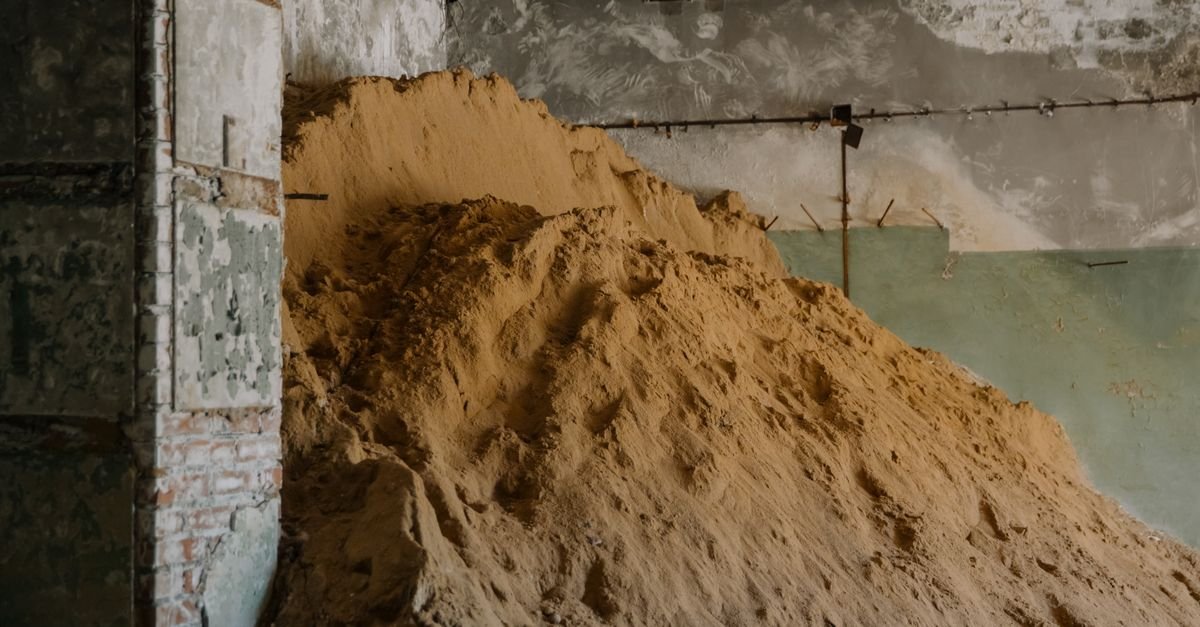
Start with what the manufacturer of one of these kits says about the substance the tool is named after. STIHL: “Avoid sandblasting with quartz sand in particular. Sandblasting with quartz sand is prohibited in many countries as even with breathing protection measures in place, its fine crystals can enter the lungs when used with pressure washers, and so it poses a health risk.”
Even with breathing protection in place. That is the company selling you the wand telling you a respirator is not a licence to use builders’ sand, and it is the most useful sentence I found on this topic anywhere. What STIHL supplies instead is SB 90, which it describes as “made of iron-containing aluminosilicate glass” — an amorphous glass rather than crystalline quartz, and crystalline is the form the exposure limits are written about.
Size is published and consistent across makers. STIHL: “A grain size of 0.2 to 1.0 millimetres is suitable for wet blasting.” Kärcher’s bagged abrasive is listed on its own datasheet at a granulation of 0.2 to 0.8 mm. A narrow window, and play sand, beach sand or anything that has sat in a shed through a wet winter is outside it in two directions at once — wrong grading, and damp enough to bridge the feed tube.
Hardness is where the published guidance thins to almost nothing, and I want to be straight about that. No maker of a pressure-washer blasting kit that I could find publishes a hardness figure for its own granulate, never mind a rule for matching it to a wall. The nearest thing to a rule comes from the conservation trade, where Fairchild writes that abrasives in common use for careful masonry cleaning “fall generally into the 2.5-6.5 Mohs range of hardness”, and that “for polished surfaces and un-weathered concrete, the abrasive hardness should be less than the softest constituent of the substrate.” The *softest* constituent, not the average — the mortar on a brick wall, the paste on a concrete slab, never the aggregate. He also notes that abrasives for dry use must be under 1 per cent free silica, a standard the bag in your garage almost certainly fails.
Shape matters as much as hardness, and Brief 6 has the cleanest illustration. Conservators clean bronze sculpture with 75 to 125 micron glass beads at 60 to 80 psi specifically “because these glass beads are completely spherical, there are no sharp edges to cut the surface of the metal” — a sphere peens where an angular grain of the same mineral cuts. At the other end, restoration architects found crushed walnut shells mixed with copper slag at around 200 psi was the only thing that would lift corrosion off a mid-nineteenth-century terne-coated iron roof. Three variables, then: how hard, how big, how sharp. Your attachment exposes none of them.
Last, quantity, because it is what usually ends the project. The plant in that field study got through 9.8 pounds of sand per square foot treated. That is air-driven blasting of precast concrete rather than your kit, so take it as an order of magnitude, but the arithmetic is mine and it is sobering: one 4-by-8 panel is 32 square feet, or roughly 310 pounds of media. This is not a bucket-and-an-afternoon tool. All of it lands on the ground at your feet, mixed with whatever you just took off the wall, which on anything painted before 1978 makes it a disposal question rather than a rinsing one.
FAQ
Will a wet sandblasting attachment damage brick?
Yes, and the damage has two parts. Abrasive blasting erodes the hard outer layer of a fired brick and exposes the softer core, which then weathers faster, and the impact also erodes the bond between mortar and brick and opens paths for water. Neither is reversible and neither is visible on the day. Whether your particular wall can take any pressurised water at all is a separate question with a published ceiling and a simple field test behind it.
What PSI do I need for a wet sandblasting attachment?
Industrial kits specify 3,000 to 5,000 PSI and 4 to 8 GPM, with a 0-degree threaded nozzle sized to the machine. Domestic kits from STIHL and Kärcher are sold for machines producing a third of that flow and they do work, more slowly. The pressure requirement is about generating vacuum at the venturi rather than about cleaning power, which is why there is no low-pressure version of this attachment.
Do I still need a respirator if the blasting is wet?
Yes. The best field measurements available for wet abrasive blasting recorded average respirable crystalline silica above both the NIOSH recommended limit and the ACGIH threshold limit value, and concluded that a respirator with an assigned protection factor of 10 — a properly fitted half-mask — would be appropriate. What water buys you is a lower grade of respiratory protection than dry blasting requires, not the absence of it.
Can I use play sand or beach sand in a pressure washer sandblaster?
No, on two counts. Manufacturers specify a grain size of roughly 0.2 to 1.0 mm and a dry, graded granulate; bagged play sand is outside that and damp sand clumps in the feed hose. More importantly, quartz sand is the crystalline silica hazard itself, and STIHL states that its fine crystals can reach the lungs even with breathing protection in place when used with a pressure washer.
Will sand get into my pressure washer pump?
No, by design. The media is drawn in by a venturi at the nozzle head, downstream of the pump, the hose and the gun, so nothing abrasive passes through anything with a precision tolerance. What does wear is the nozzle, which is why blast tips are tungsten carbide rather than the brass or stainless in your tip kit. The recurring fault is media clumping inside the feed hose, prevented by keeping the hose dry and mounting the probe port at the top of the head.
Can a wet sandblasting attachment remove paint from concrete?
It will, and that is the problem: it removes paint by removing a layer of what the paint is stuck to. On a slab whose texture you want to keep, the mechanical ladder starts several rungs lower than this. Match the force to the size of the mess before reaching for anything that eats hundredths of an inch.
Point It at Metal You Are Going to Repaint
There is one job this attachment is honestly good at, and it is a rusty steel object you have already decided to paint: a trailer frame, a gate, a mower deck, a run of pipe. On those, taking off three or four hundredths of an inch is the point rather than the cost, the profile left behind is what primer wants, and flash rusting is a reason to have the tin open rather than a reason to stop. Even there, conservation guidance on ornamental ironwork would rather you did not, and that argument is worth reading before you start on anything old.
Everywhere else, you are asking a tool with a 0-degree jet, a bucket it cannot meter and no adjustment for hardness anywhere on it to stop just short of the surface it is designed to cut. It will not, because that is not a setting. The only control the thing has is what you tip the probe into, so buy the graded granulate the maker sells, run it wet enough to be genuinely messy, wear the half-mask the field data says you need, and keep the whole business well away from anything whose face you plan on looking at afterwards.