Last Updated on September 25, 2026 by Umar Farooq
How to remove mildew odor, in one line: kill the colony, physically wash off the residue it was living in, and then dry the item all the way through — because the smell is a gas the mildew produced, not the stain it left behind, and only the drying step keeps it gone.
Those three things are usually treated as one job. They are not. You can kill every spore on a cushion and still have a cushion that smells, because killing something does not remove it, and removing something does not remove what it already emitted. That gap is why people clean an item twice, watch it come out looking perfect, and then open the shed in July to the exact same smell.
This article is about outdoor things: seat cushions, furniture covers, sling chairs, an awning, a rolled parasol, a canvas gazebo, a shed that has smelled like that since March. The visible black speckling is a different job and it is already covered properly — how to remove mildew from furniture handles the fabrics, wicker and foam, and how to remove mildew from wood furniture handles timber. They own the stain. This one owns the smell.
The Smell Is Not the Mildew, It Is What the Mildew Exhaled
Mildew does not have a smell in the way a cut onion has a smell. What you are detecting is a set of gases the colony is releasing while it eats — microbial volatile organic compounds, mVOCs, the exhaust from a living metabolism.
The main one has a name and a job description. A review of fungal volatiles describes 1-octen-3-ol, sometimes sold in food chemistry as mushroom alcohol, as a “nearly ubiquitous fungal VOC” that is “largely responsible for the musty odor commonly associated with mold-contaminated damp indoor spaces” (Are Some Fungal Volatile Organic Compounds Mycotoxins?, PMC4591661). The earthy half of the smell — the one that reads as wet soil rather than old flannel — is mostly geosmin, and the same paper gives its odour threshold as 0.0009 ppm. That is a number worth sitting with. Your nose is a better mildew detector than your eyes, by a distance, and it is the only instrument on the patio that works around corners.
Two consequences follow, and both of them explain something that otherwise feels like bad luck.
You can smell a colony you cannot see. Gases diffuse. The growth might be inside a cushion, in the fold of a rolled awning, or on the underside of a cover, and the smell will be evenly distributed across the whole shed regardless. Looking for a black patch and finding none does not mean there is nothing there. It means you have not opened the right thing yet.
You can also smell one that has stopped growing. Those compounds are absorbed by anything porous they sit next to — foam, canvas, softwood, a coir doormat — and released again slowly over weeks. The colony can be thoroughly dead and the item still smells, because the smell is stored in the material, not in the organism.
The same review puts the fungal volatile catalogue at “approximately 300 VOCs” characterised, against over 1,700 from plants. That is not a lot of research for something this many people can identify blindfolded.
Why Does It Still Smell After You Killed It?
This is the question that brings most people to an article like this, usually a week after a thorough wash, and the answer is normally one of three things.

You killed it but left it there. Diluted bleach kills the organism and bleaches the pigment, which is why a patch can vanish without anything being removed. The dead biomass and the pollen, sap and skin oil it was eating are all still in the weave. Dead mildew still smells, and the food layer is a standing invitation to the next colony. Killing is chemistry; removing is agitation and rinsing, and it is the step people skip because the visible problem has already gone.
The material is holding the smell. Sorbed mVOCs come back out of foam and canvas gradually, and they come out faster when it is warm and humid — which is precisely when you are next using the furniture. A cushion that smells fine in the cold garage and musty on the first hot afternoon is not being reinfected on the hot afternoon. It is being desorbed.
It is still producing. This is the common one, and it is the reason for the opinion I will defend for the rest of this page: a mildew smell is a moisture reading. Ongoing mVOC production requires active metabolism, and active metabolism requires available water. If an item is genuinely dry to the core and it is still producing that smell today, the growth is somewhere you have not looked — inside the foam, in the frame tubes, under the slab, in the fold you did not unroll. Deodorising products are sold as the final step of the job. On mildew they are the step you can skip entirely once the thing is dry, and the step that cannot possibly work while it isn’t.
That is a more useful test than anything you can buy. Smell, then go looking, rather than smell, then spray.
Sniff Test Your Patio, Object by Object
Twenty minutes with your nose beats an afternoon with a bottle. Work through the objects in the order below, because on a typical patio the smell almost always traces to one of about eight places, and six of them are not the surface you were about to clean.

| Object | Where the smell is actually coming from | The test |
| Seat cushion | The foam core, not the cover | Press the heel of your hand into the centre, hold five seconds, smell your palm |
| Furniture cover or tarp | The inside face, where condensation collects | Turn it inside out and smell the underside |
| Rolled parasol | The innermost fold, rolled away damp | Open it fully and smell the centre, not the outside |
| Retractable awning | The roll, and the fabric where it meets the wall | Run it fully out and check the last metre to come off |
| Sling chair | The rail pocket where the spline sits | Run a finger down the channel, then smell it |
| Tubular metal frame | Rainwater trapped inside the legs | Tip the chair over and watch what comes out of the feet |
| Shed or store | The floor, and anything stacked on it | Open the door and smell at ankle height first |
| Cushion storage box | The sealed bottom corner | Empty it and smell the base, not the lid |
The rolled parasol is the one that catches nearly everybody, because a parasol gets closed in a hurry in bad weather, which is the one occasion it is guaranteed to be wet. Rolled canvas is a dark, still, damp cylinder with pollen in it. It is not a storage method, it is a culture medium with a crank handle.
The cushion test is the highest-value thirty seconds in this article. Covers get washed constantly and cores almost never, and a standard open-cell foam block holds water like the sponge it structurally is. If your hand comes back musty, nothing you do to the cover will change the outcome.
How to Remove Mildew Odor From Cushions, Covers and Canvas
Six steps, in this order. The order is the point — three of them are the ones people reverse, and every reversal costs a repeat.
1. Go dry first. Vacuum or blow out the pollen, cobwebs, leaf litter and insect casings before any water touches it. Add water to that layer and you turn a removable dust into a grey paste that bonds to the weave. This also tells you what you are dealing with, because mildew under a clean surface looks very different from mildew under a season of debris.
2. Kill it, with contact time. A biocide only works while it is wet on the surface. The ratio and the fifteen-minute dwell that both Sunbrella and Phifer publish for outdoor fabric are set out in full in the furniture article, along with which materials can take bleach and which want oxygen bleach instead. Re-mist rather than letting it dry — dried solution has stopped working and started staining.
3. Remove what you killed. Agitate with a soft brush in two directions, then rinse until the run-off comes off clear rather than grey. This is the deodorising step, whatever the label on the bottle says. You are taking away both the dead colony and the organic film it was eating, and that film is what the next colony was counting on.
4. Deal with the core separately. Covers come off and get washed. Foam does not get washed, it gets assessed. If water runs freely out of a squeezed corner, it is reticulated quick-dry foam and will dry in an afternoon. If it stays heavy and weeps, it is standard foam, it will take days, and if the smell is coming from the middle of the block then a replacement insert is the answer. No cleaner reaches the centre of a solid foam cushion. It never has.
5. Dry it, on edge, with air moving. Flat on the patio means the underside sits in its own puddle. On edge on a slatted bench, in sun, with a breeze or a fan, for two full days is the standard. Sunlight helps twice here: it dries, and ultraviolet is genuinely unkind to the surface growth it reaches.
6. Judge it a day after it is dry, not while it is damp. Damp material smells musty on its own, and a sorbed-mVOC smell fades over days rather than minutes. Give it twenty-four dry hours before deciding whether the job worked. Deciding at hour two is how people end up washing a cushion three times that only ever needed drying once.
A word on the two bottles from the kitchen, since they come up in every discussion of this. White vinegar is a weak acid, it is a mild biocide, and its own smell dissipates within a day or so, which makes it a reasonable choice on anything you do not want lightened. Bicarbonate of soda is a weak alkali — PubChem, citing the Merck Index, puts a 1% solution between pH 8.0 and 8.6 — and a very soft abrasive at 2.5 on the Mohs scale. It is genuinely adsorbent and it genuinely does something in a closed box with a smelly cushion. What I could not find anywhere, and I went looking, is a single measured figure for how much odour a given quantity of it actually removes. Every number circulating for that traces back to somebody selling a tub. Use it; just do not expect it to do the drying for you.
A Damp Shed Smells Because It Cannot Breathe
A shed does not smell of mildew because of one mildewed object. It smells because the whole building is a humidity trap and eight different things in it are quietly contributing.
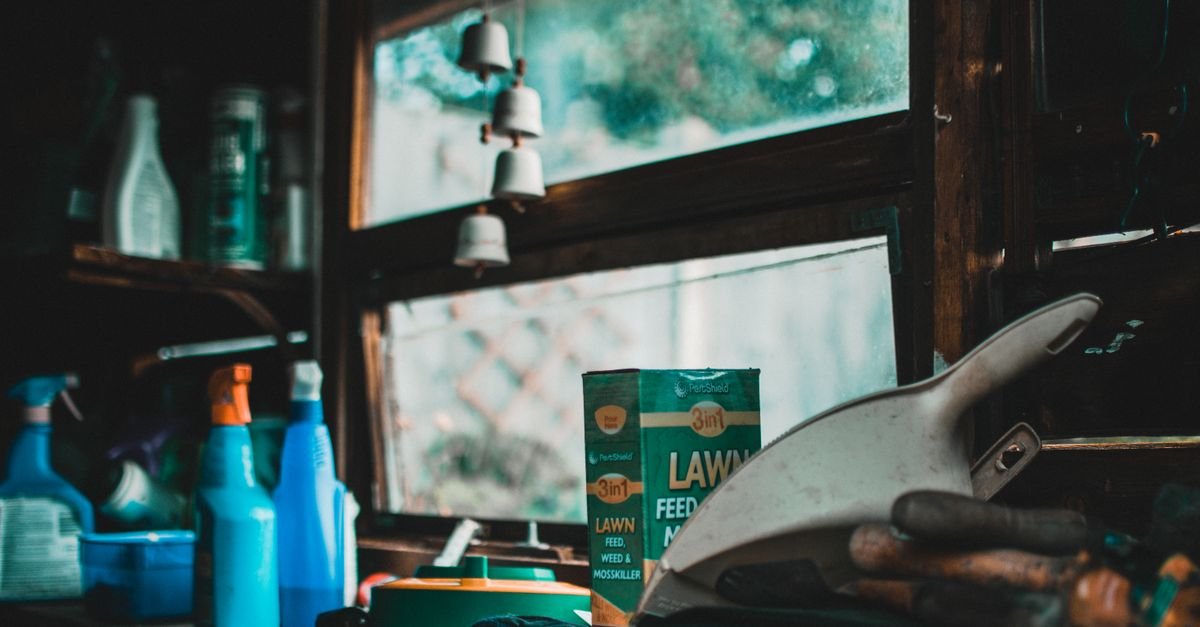
Four mechanisms, and they compound.
The floor is feeding it. A shed on a concrete slab without a damp-proof membrane wicks ground moisture upward continuously, and anything sitting directly on that slab — a bag of compost, a folded cover, a cardboard box — takes it on. That is also why the shed smells strongest at ankle height. If the slab itself has gone dark and speckled, that is its own job: how to remove mildew from cement covers it.
There is no air change. Most garden sheds have one door and no vent at all. Warm damp air produced in the day has nowhere to go at night, so it condenses on the coldest surface it can find, which is usually the underside of the roof sheet, and drips back onto the contents. A pair of vents — one low, one high, on opposite walls — creates a convection path and is the cheapest fix available. Air moving through a shed is doing more work than any product you can leave in it.
Everything is stored in contact with everything else. Stacked chairs, folded covers and rolled matting hold a film of water between every pair of touching surfaces, in full shade, for the entire winter. Spacers between stacked items sound fussy until you compare a spaced stack with a nested one in March.
The timber has absorbed it. Shed cladding is softwood, which is porous and holds mVOCs the same way canvas does. Once the moisture is under control the timber will release them over several weeks — assuming you have actually fixed the moisture, and not simply had a dry fortnight.
One thing worth saying because the internet keeps suggesting it: do not seal a damp shed up tighter to keep the weather out. A sealed damp shed is a jar. Ventilation looks like the opposite of weatherproofing and is, in this specific case, the weatherproofing.
Dry Enough Is a Number, Not a Feeling
“Bone dry” and “dry to the touch” are surface impressions, and the surface is the part of a cushion that dries first and matters least. There are published numbers, and they are more demanding than most people assume.
The building-science threshold is the useful one. ASHRAE Standard 160’s original criterion for avoiding mould growth requires that “the 30-day running average relative humidity at the material surface be less than 80 % when the 30-day running average surface temperature is between 5°C (41°F) and 40°C (104°F)” (Glass et al., 2017, USDA Forest Service). Read that carefully, because two words in it do the work. Thirty-day running average. Not “dry today.” A surface that sits above 80% relative humidity most of the time is a growing surface, and one sunny Saturday does not change a monthly average.
For timber, the Forest Products Laboratory’s number is moisture content rather than humidity: keeping wood “at or below ~20% moisture content in service” is, in its words, “the single most important step in ensuring good performance from wood products.” Wood kept outdoors under cover in most of the United States settles at around 12% to 14%. A cheap pin moisture meter costs less than a bottle of fabric refresher and tells you something true, which puts it ahead on both counts.
Three practical translations of all that:
- Air movement beats heat. A fan across a cushion does more in a day than a warm garage does in three, because evaporation needs the saturated layer at the surface carried away, not just warmed up.
- Shade is the variable, not rain. A north-facing patio that never sees direct sun stays above that threshold for months at a time in a wet autumn. Cutting back the overhanging branch changes more than any wash.
- Storage is where the month is won. Items go into storage in October and come out in April. Whatever their moisture content is on the day the door closes, they have six months to act on it.
What Helps, What Masks and What Is Just Expensive
Everything in this table works on something. The column that matters is which part of the problem it touches, because only two rows here address the cause.
| Approach | What it actually does | Worth it? |
| Sun and moving air | Removes the water, so production stops | The answer, and it is free |
| Biocide with 15 min dwell | Kills the organism producing the gas | Yes, but it is step two of three |
| Washing and rinsing | Removes the dead biomass and the food film | Yes, and it is the step most often skipped |
| White vinegar | Mild acid biocide; own smell clears in a day | Useful where bleach would lighten |
| Bicarbonate of soda | Weak alkali, adsorbent, soft abrasive | Real but modest, and unquantified |
| Activated carbon | Adsorbs VOCs from air in an enclosed volume | Works in a sealed box, useless in open air |
| Dehumidifier in a shed | Attacks the cause, if the shed is closed enough | Yes, where there is power |
| Fragrance sprays | Adds a second smell over the first | Masking only |
| Ozone generator | See below | No |
Ozone deserves the extra sentence, because it is marketed hard at exactly this problem. The EPA’s assessment is blunt on both halves of it. On odour: “at concentrations that do not exceed public health standards, ozone is not effective at removing many odor-causing chemicals,” and body odour “may be masked by the smell of ozone but is not removed by ozone.” On the organism: “if used at concentrations that do not exceed public health standards, ozone applied to indoor air does not effectively remove viruses, bacteria, mold, or other biological pollutants,” and it “may have no effect on biological contaminants embedded in porous material” (US EPA, ozone generators sold as air cleaners). A mildew smell in a cushion is, definitionally, a biological contaminant embedded in a porous material. That is the one case the agency names.
And a note on the machine, since this is a pressure washer site and somebody is standing next to one: pressure is the rinse step in this job and nothing more. It moves the dead colony and the food layer off a sling or a resin weave efficiently, which genuinely helps. It also puts several litres of water into an item whose entire problem is water. If you use it, use it early in a dry week, use the 40-degree white tip, and budget the two days of drying that have to follow. Pressure washing a cushion at four in the afternoon in November is how a faint smell becomes a strong one.
FAQ
What causes a mildew smell?
Microbial volatile organic compounds — gases released by mould and mildew colonies as they metabolise. The two best known are 1-octen-3-ol, which produces the musty note, and geosmin, which produces the earthy one. They are by-products of growth, which is why the smell tracks moisture rather than dirt.
Why does the mildew odour come back in humid weather?
Two reasons at once. Compounds absorbed into foam, canvas or timber are released faster as temperature and humidity rise, so an old smell reappears without any new growth. And surviving colonies that went dormant through a dry spell resume producing as soon as water is available again. Mildew fungi do not die when they dry out; they wait.
Do air fresheners get rid of mildew odour or just mask it?
Mask it. A fragrance spray adds a second smell on top of the first and does nothing to the organism, the moisture or the residue. It has a legitimate short-term use — the afternoon guests arrive — but if you are spraying the same cushion every week, the cushion is still wet inside.
Does vinegar remove mildew odour from outdoor cushions?
It helps, in a specific way. White vinegar is a mild acid and a weak biocide, so it kills some of what is producing the smell, and its own sharpness clears within about a day. It will not reach the middle of a foam core and it does not substitute for drying. Use it on covers and on anything you do not want bleach to lighten.
Does baking soda actually remove mildew smell?
It adsorbs some odour, and sealed in a box with a cushion for a few days it makes a noticeable difference. It is a weak alkali, roughly pH 8 in solution, and a soft abrasive. What nobody publishes is how much it removes, in any measurable sense — every figure quoted for that comes from somebody selling it. Treat it as a useful last touch, not as the method.
Why do my cushions still smell after I washed the covers?
Because the smell is almost never in the cover. Standard polyurethane foam holds water through its whole thickness and can take three or four days to dry to the core outdoors. Compress the centre of the cushion hard for a few seconds and smell what comes back out of it. If that is musty, the core is the problem and the cover was never relevant.
How long does it take for a mildew smell to go away?
If you have killed it, washed it out and dried it fully, expect the residual smell to fade over several days to a couple of weeks as absorbed compounds leave the material. If it has not noticeably improved after a fortnight of genuinely dry conditions, something is still wet or still growing, and it is time to look inside the foam, inside the frame or under the item rather than to buy anything.
Can you pressure wash a mildew smell out of furniture?
Not out of it, no. A pressure washer is a rinse tool, and rinsing removes the dead colony and the organic film after a biocide has done the killing — which is a real contribution. But on its own it relocates spores and adds water to the one variable that controls the smell. On cushions and foam it makes things worse rather than better, every time.
Is a mildew smell outdoors harmful?
The smell itself is a set of gases at very low concentration, and outdoors it disperses. It is best treated as an indicator rather than a hazard: something nearby is persistently damp. The sensible responses are ventilation, drying and gloves plus eye protection while you clean, rather than alarm about the odour on the patio.
Sunlight and a Draught Are the Only Deodorisers That Last
Every product in this article can be defended and none of them is the answer. The biocide kills, the brush and the hose remove, and then a fortnight of dry air does the part that actually holds. Skip that last part and you will be back here next season with the same cushion and a different bottle.
So before you buy anything: open the shed and let it stand open on the next dry day. Unroll the parasol all the way. Tip the chairs over. Stand the cushions on edge, in the sun, and leave them there longer than feels necessary.
And if you are reading this next to a cushion you have already washed twice — you were never fighting a cleaning problem. You were fighting the weather, and it has been winning at night.