Last Updated on September 24, 2026 by Umar Farooq
To remove mildew from cement, sweep the slab bone dry, damp it down, apply a diluted sodium hypochlorite solution, let it sit ten to fifteen minutes without drying out, agitate with a stiff synthetic brush, then rinse. Five steps, and the first one does more long-term work than the other four combined.
That is not the order most people use. Most people wet the slab, hit it with the pressure washer, watch the dark patch fade, and call it finished. It will be back on the same square metre before the next season is out, because the thing you removed was the colour and the thing you needed to remove was the food.
This page is about mildew on concrete specifically — what it is, why your slab grows it and your neighbour’s newer one does not, and the difference between killing it and simply making it pale.
Mildew, Mould, Algae or Lichen: Four Calls on One Grey Slab
On a painted wall these four look different. On a grey slab in October they all look like “the dark bit”, and people buy the wrong bottle accordingly.
| What it is | Looks like | Feels like | Where it sits | Alive? |
| Mildew | Flat dark grey or black speckling that merges into a haze from standing height | Powdery dry, nothing to grip | Anywhere the slab stays damp; often over an older green patch | Fungus |
| Mould | Raised, fuzzier, a defined patch rather than a haze; black, green, brown or dirty white | Slightly furred | Joints, edges, under planters, anywhere organic debris collects | Fungus |
| Green algae | Even green film or a streak following a water path | Slick wet, dusty dry | Where water runs or stands, in light | Photosynthetic, plant-like |
| Lichen | Crusty grey-green or yellow discs with a defined edge | Cemented on, will not smear | Old, unsealed, undisturbed concrete | Fungus and alga together |
| Efflorescence | White or pale grey powder or bloom | Chalky, comes away on a finger | Anywhere water moves through the slab | Not alive at all |
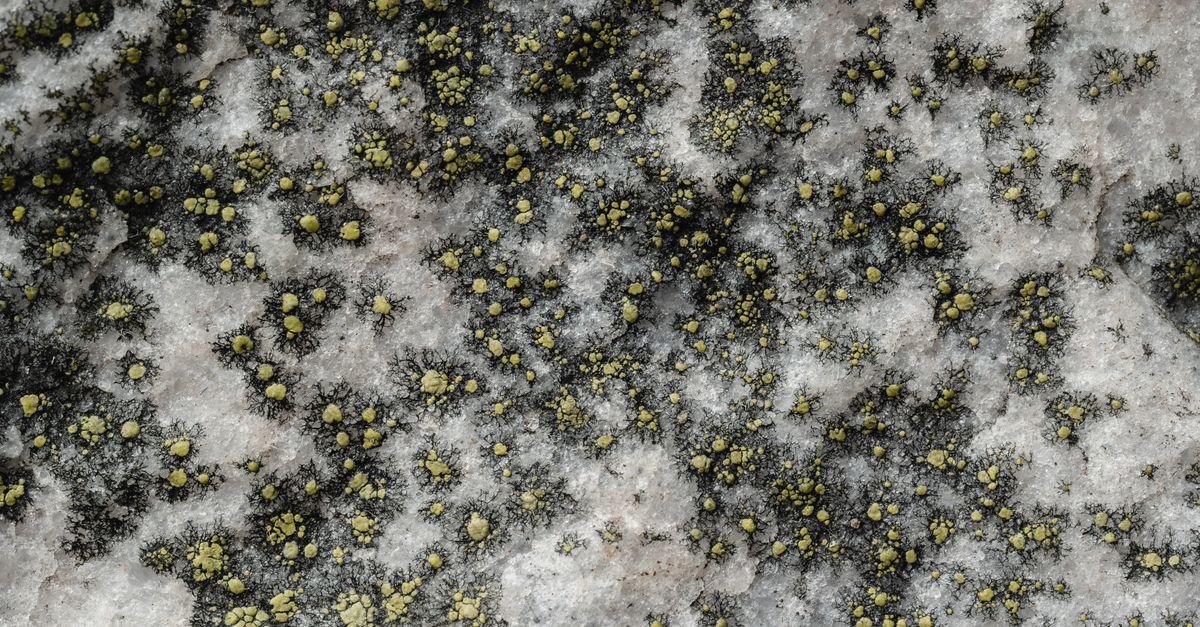
Two tests settle it in about a minute. Run a dry finger or a stiff brush across the patch: algae smears, mildew comes away as a fine dark dust, lichen and mould do not move at all. Then dab a rag with household bleach on a corner and wait sixty seconds. Anything biological lightens. Efflorescence, tyre rubber and tar do not care in the slightest.
Here is the fair question: if the same oxidising wash kills all four, why bother making the call? Because the call changes three things. Lichen needs a much longer dwell and physical agitation afterwards, because killing the crust does not detach it. Mould in a joint needs the joint cleared first. Efflorescence is a salt coming up from inside the slab and will laugh at every biocide you own — that one is a moisture problem wearing a disguise.
And mildew, the flat dark haze, is the one that tells you something useful about your slab. So it gets the rest of this page.
Fresh Concrete Is Too Alkaline to Grow Anything
A new slab is chemically hostile. Portland cement hydrates into a strongly alkaline matrix, and for the first few years that surface is not a habitat — it is a place where spores land and quietly fail to do anything.
Then the atmosphere goes to work on it. Carbon dioxide reacts with the cement at the surface in a process called carbonation, rain leaches the soluble alkalis out, and the surface pH drifts down year on year. The Concrete Society puts the consequence in one sentence: “As the concrete ages, the surface alkalinity is reduced by carbonation and the action of rainfall, thus providing a more suitable environment for biological growth” (The Concrete Society, Biological growth).
This explains something that otherwise looks like bad luck. The patio that was spotless for eight years and has been speckling ever since did not get shadier in year nine. It finished its grace period. The same weathering also opens the surface up — the cement paste between the sand grains erodes, the texture gets rougher, the pores get deeper, and the slab goes from a hard surface with nowhere to hide to a landscape full of places to hide.
The practical consequence is blunt. You cannot put the alkalinity back, and you cannot un-carbonate a driveway. Of the four things any growth needs — oxygen, warmth, water and something to eat — you control exactly two, and only one of those is cheap.
What the Mildew on Your Cement Is Actually Eating
Mildew is a fungus, and fungi do not photosynthesise. They have no way of making their own food, which means every dark speckle on your slab is sitting on top of something it is digesting. Cement is not that something. There is no carbon chain in a bag of Portland cement for a fungus to break down.
So it is eating the film. Pollen in spring, tree sap, leaf tannin, the fine green dust off a hedge, lawn clippings that blew over, exhaust soot, dead insects, and the grey organic grit that settles on every horizontal surface in the world. Thin, invisible, and completely sufficient.
There is a second act to this that makes the whole thing make sense. Algae gets there first. Algae is photosynthetic, so it can colonise bare, clean, freshly weathered concrete on nothing but light and water — no food required. Then it dies back, and it becomes food. A study of biological growth on cement surfaces describes the handover directly: “Algae, as the pioneer colonizers, enhance the microbial succession of heterotrophic components — bacteria and fungi” (Thomas et al., PMC12155056).
That is why the black haze so often turns up exactly where the green film was two summers ago. The algae was not a separate problem that went away. It was the first course.
How to Remove Mildew From Cement in the Right Order
The sequence below is short on purpose. Nothing here is difficult; the only thing people get wrong is the order, and step one is the one that gets skipped.
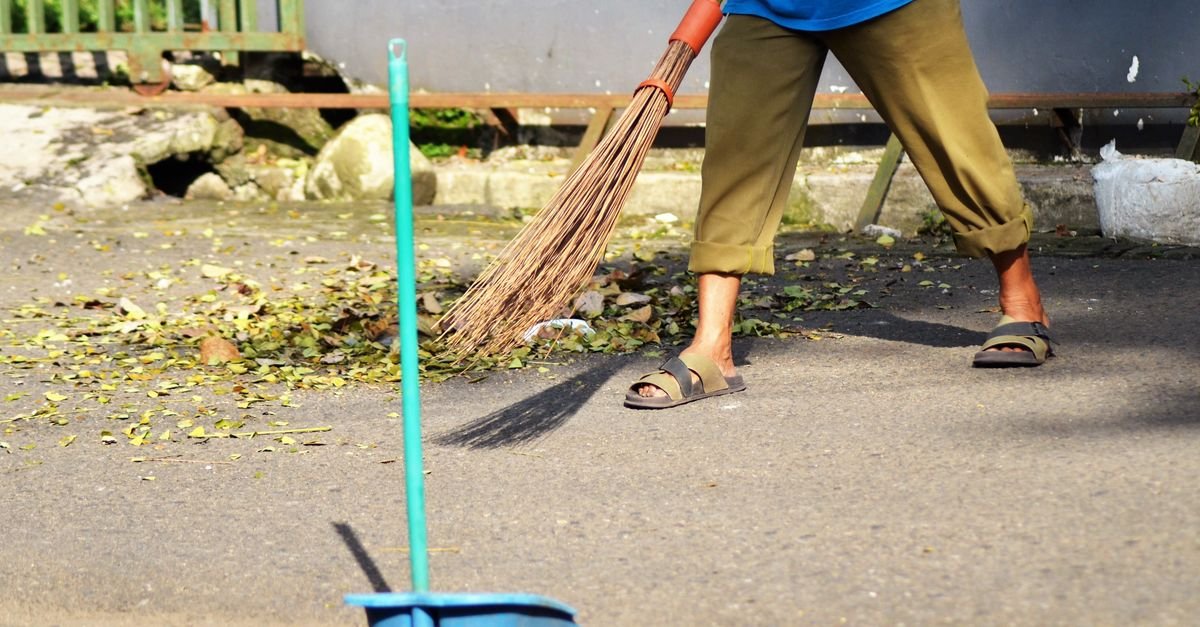
1. Sweep it dry, properly. Not a tidy-up. A stiff push broom over every square foot, into the joints, under the planters, out from the wall line. Every leaf fragment you leave behind does two jobs against you: it soaks up chlorine that was meant for the fungus, and it is next year’s dinner. Bag the debris rather than sweeping it onto the border.
2. Damp the slab down. Unsealed concrete drinks. Spray a dry slab and a good share of your solution disappears into the pore network without touching anything living. Damp, not puddled — standing water dilutes the mix a second time.
3. Apply a diluted sodium hypochlorite solution with a drop of dish soap in it. The soap is for surface tension, not cleaning; it stops the mix running off a graded slab before it has done anything. Strengths by jug, handling and how to run it through a machine are covered properly in sodium hypochlorite for pressure washing, and there is no sense repeating a mixing table here.
4. Let it dwell ten to fifteen minutes, and do not let it dry. Re-mist the edges if they go pale and matte. A dried film has stopped working and started staining.
5. Agitate, then rinse. A stiff synthetic-bristled brush, then water — 2,500 to 3,000 PSI with a 25-degree tip on sound flatwork, or a surface cleaner if you have one. Never a red 0-degree tip, which cuts a permanent line into a slab faster than you can react to it.
Two things that are not steps but will decide how the afternoon goes. Soak every plant and lawn edge within a couple of metres before you mix anything, and soak them again afterwards. And do not use a wire brush — the bristles snap off constantly, the fragments lodge in the surface pores, and within a month you have swapped a dark haze for a field of orange pinpricks that is genuinely harder to remove.
Then walk away and let it dry completely before you judge it. Wet concrete looks clean. Everybody’s concrete looks clean while it is wet.
Bleached Pale Is Not Dead
Sodium hypochlorite does two separate jobs at once, and you can only see one of them happening.
The first is oxidation of pigment. It breaks the coloured molecules in the fungal cell walls apart, and the dark goes — quickly, often within a minute or two, and permanently, because the colour has been dismantled rather than lifted. The second is killing living cells, which is slower, depends entirely on contact time, and looks like absolutely nothing at all.
On a wall those two finish close enough together that nobody notices the gap. On concrete they do not, and the reason is the pore network. The top of the colony is bleached within seconds while the living tissue further down is still shielded behind a layer of its own dead, decolourised self. You look at a grey slab, conclude you have won, and rinse off a chemical that had another eight minutes of travelling to do. Five weeks later the speckles are back, and the bottle gets the blame.
The fix is not a stronger mix. It is dwell time and a brush, because both of those are ways of getting the chemical further down.
Worth knowing what is only cosmetic:
- Water at any pressure. Pressure does not kill fungus, it exfoliates it. You take the pigmented surface off and leave the base in the texture with its food supply untouched. Worse, aggressive rinsing erodes the cement paste, which makes the surface rougher and more absorbent — better habitat than it was before you started.
- Vinegar. On concrete it has a problem it does not have on tile: the slab is alkaline and eats acid. A good share of your 5% acetic acid is neutralised by the cement paste rather than by the mildew, and the bit that does react etches the paste. The wider case on acids and concrete is in power washing chemicals.
- Scrubbing alone. Fine on a doorstep. On a whole patio it is a lot of Saturday for a result you could have had chemically, and it still leaves the pores populated.
What actually kills: chlorine with a real dwell; oxygen bleach (sodium percarbonate), slower but far kinder to the bed you are standing in; or a labelled mildewcide, which is the polite way of saying “chlorine with a marketing department”. Pick by what is downhill of the slab.
Why Does It Come Back on the Same Square Metre?
Because a wall drains and a slab does not.
Vertical cladding sheds rain in seconds and then dries from two sides with air moving across it, which is why mould on siding is usually a symptom of shade and still air. Your slab has none of those advantages. It drains only where it was graded to drain — and after twenty years of settlement, often no longer there — it dries from one face only, and it holds water in the surface texture and the pores long after the last drop landed. The same shower that leaves a wall damp for an hour leaves a low spot on a patio damp until Wednesday.
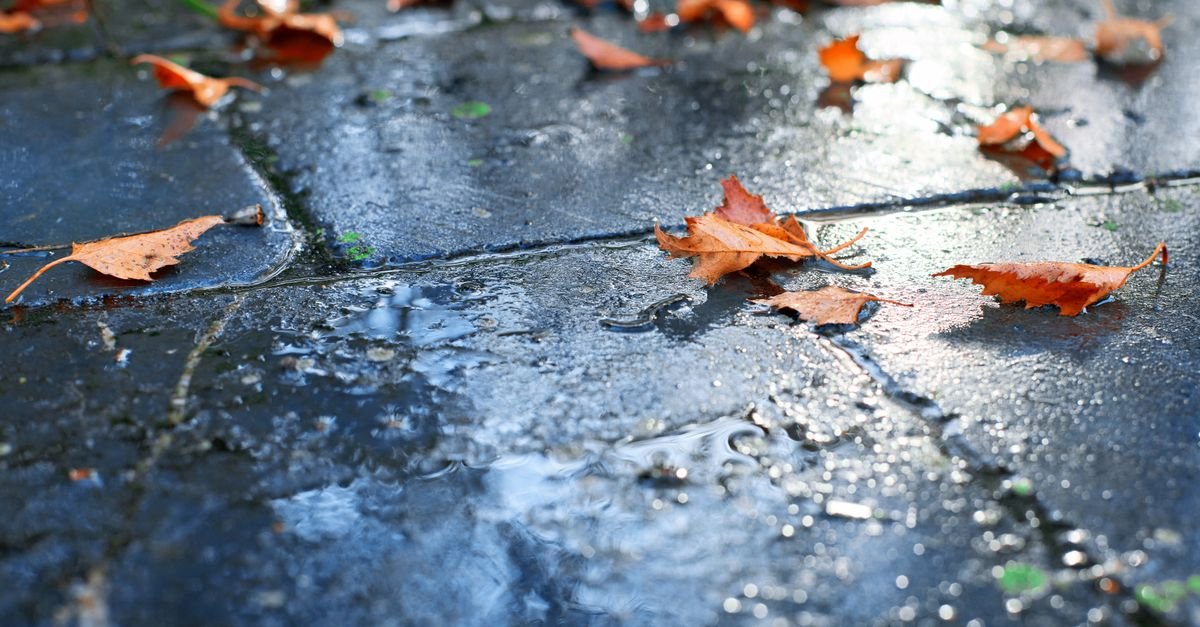
That is why the patch returns to the same square metre rather than wandering. The growth is not choosing that spot; that spot is the only part of the slab that stays wet long enough. So read the shape before you reach for anything:
- A band along one edge, parallel to the house. Roof drip line. Missing gutter, blocked gutter, or a downspout discharging onto the slab.
- A rough circle in the open. A settled low spot. Put a hose on it for two minutes and come back in twenty — wherever the water still is, that is your answer.
- A haze under a canopy. Leaf litter and shade, working together.
- Darkness on one side of a step or planter only. Drying time. That face gets an hour less sun and an hour less air.
- A stripe down one edge of the drive. Almost always a sprinkler head clipping the concrete every morning.
Here is my one strong opinion on the subject, and it will not sell anybody anything: the most effective tool for mildew on a slab is a broom, used in autumn. Mildew is eating an organic film, and wet leaf litter is the densest source of that film there is — while also holding water against the concrete for weeks. Sweeping the slab clear in October removes the food and the water in a single pass, which is more than any bottle on the shelf does. It costs twenty minutes and nothing else.
The deeper fixes are the same ones that end a moss problem, and they are set out in full in the guide to removing moss from a concrete driveway. If the same growth is on your walls as well as your ground, the wall version behaves differently enough to be worth reading separately in how to remove mold from vinyl siding.
FAQ
Is the black speckling on my concrete mildew or dirt?
Dab it with household bleach on a rag and wait a minute. Mildew, mould, algae and lichen all lighten; plain dirt, tyre rubber and tar do not change at all. A dry brush test backs it up — mildew comes away as a fine dark dust, ingrained dirt stays put and needs a detergent rather than a biocide.
Does bleach kill mildew on cement or just lighten it?
Both, but not at the same speed. The colour is oxidised within a minute or two; the cells further down in the pores need real contact time to die. Rinsing as soon as the slab looks grey is the single most common reason mildew reappears within weeks. Give it ten to fifteen minutes and agitate before rinsing.
Why is the mildew worse on my old path than my new patio?
New concrete is strongly alkaline at the surface and is a poor habitat for anything. Carbonation and rainfall lower that alkalinity over years, and the same weathering opens up the surface texture. An old path is both chemically friendlier and physically rougher, so it holds moisture and debris in a way a newer slab does not.
Can mildew damage a concrete slab?
Mildew itself is not eating the concrete — it is eating the film on top of it. The damage is indirect: growth holds moisture against the surface, and in a freeze-thaw climate that trapped water expands and accelerates surface scaling. Lichen is the more aggressive neighbour, since it grips the paste directly and takes some of it with it when removed.
Is hydrogen peroxide any good on mildew on cement?
Household 3% peroxide will kill surface growth on a small patch and is worth having for a doorstep or a step tread. On a full slab it is slow, expensive per square metre, and breaks down quickly in daylight, so most of what you spray is gone before it reaches anything. Sodium percarbonate — oxygen bleach — is the same chemistry in a form that actually scales.
What kills mildew on cement without harming plants?
Oxygen bleach. Sodium percarbonate dissolves into hydrogen peroxide and washing soda, kills by oxidation, and breaks down into things a border can live with. It works more slowly than chlorine and may want a second pass on heavy growth, so dissolve it in warm water and allow twenty to thirty minutes rather than ten.
Is the mildew on my patio a health risk?
Outdoors, in moving air, it is far more of a slip hazard than a respiratory one — wet biological film on concrete is genuinely slippery, particularly on a slope or near steps. The health caution that matters is on the cleaning side: wear eye protection and gloves, and never let sodium hypochlorite meet an acid cleaner on the same slab on the same afternoon.
Will sealing the slab stop mildew for good?
It will not stop spores landing, but it closes the pores they settle into and makes the surface shed water rather than hold it, which removes most of what growth needs. Seal only a fully clean, fully dry slab — around 48 hours after the final rinse — and use a penetrating silane or siloxane rather than a film-forming topcoat, which can turn slippery when wet.
Take the Food Away and the Grey Stays Grey
Mildew on a slab is not a stain and it is not really a cleaning problem. It is a colony living on a thin film of organic debris, in the one part of your concrete that never gets a chance to dry, on a surface that stopped being chemically hostile some years ago and is not going back.
So the cleaning is the easy half. Sweep, damp, apply, dwell, agitate, rinse — and give the chemical the ten minutes it needs rather than the ninety seconds it takes to look convincing. Bleached pale is not the same as dead, and the slab will tell you which one you achieved somewhere around week five.
The half that lasts is the boring one. Find out where the water stands, move the downspout, aim the sprinkler at the lawn instead of the edge of the drive, and get the leaves off before they turn into a compost blanket. Do the cleaning and you get a good-looking slab this weekend. Do the sweeping and you get a slab with nothing left to eat.