Last Updated on September 24, 2026 by Umar Farooq
Cleaning concrete with bleach works beautifully on anything that was once alive — algae, mould, mildew, lichen, moss and the grey-green film that makes a shaded path lethal in January — and does essentially nothing to oil, rust or efflorescence. On a slab, the working mix is household bleach cut roughly one part to two parts water, kept visibly wet for five to ten minutes, agitated with a stiff broom, then rinsed. That is the article. The rest of it is why the slab needs a stronger mix than your siding does, and the two mistakes that turn a simple job into a chlorine gas problem.
Concrete is the one surface where people routinely under-mix and over-scrub. The bottle under the sink says a third of a cup per gallon, which is a disinfecting dose written for a countertop, and a driveway is not a countertop. It is a four-hundred-square-foot sponge with a texture deliberately designed to hold things.
Green, Black and Slimy: The Only Stains Bleach Owns
Sodium hypochlorite is an oxidiser. It works by breaking the double bonds in coloured organic molecules — the chlorophyll in algae, the melanin in the black spotting on a north-facing path, the pigment in a season of leaf tannin. Break the bond and the colour is gone, permanently, because you have not lifted the pigment off the slab. You have dismantled it.
That single mechanism decides everything bleach can and cannot do on concrete:
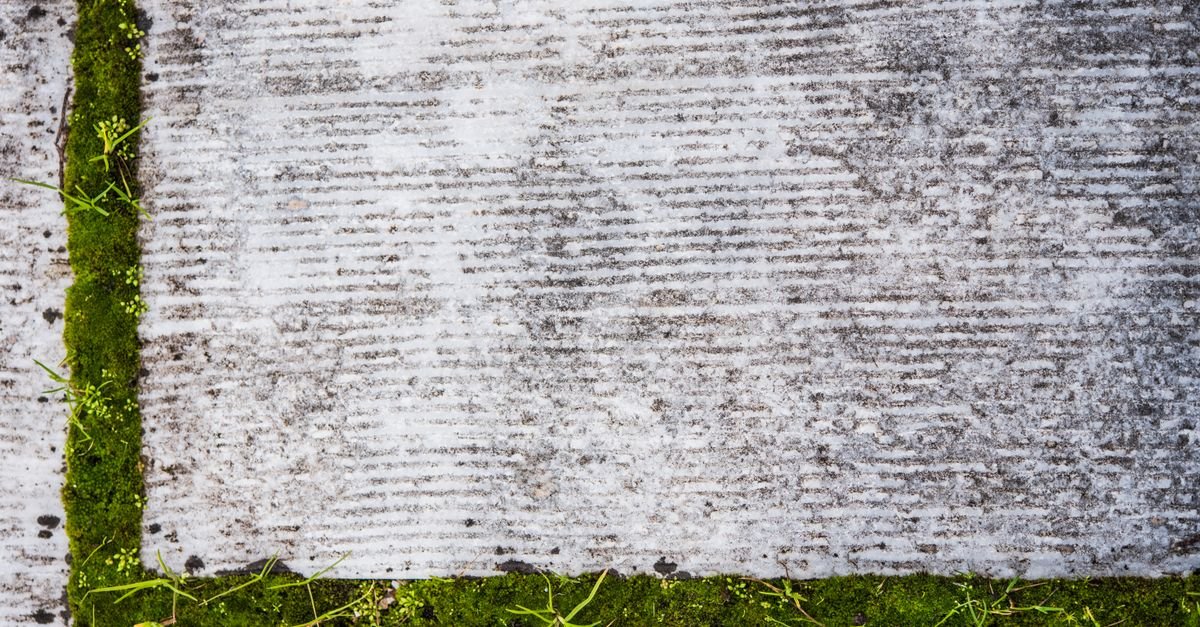
- Green algae film — the slick layer on a shaded walk. Gone in one pass, usually inside five minutes.
- Black spotting and mildew — the dark freckling on patios and pool decks. Two passes, sometimes three, because the growth sits down in the pores.
- Lichen — the crusty grey-green discs. Slow. Bleach kills it but the dead crust still has to be brushed off.
- Moss — killed reliably, removed poorly. The holdfast is mechanical, not chemical, so you scrape the bulk off dry first and use bleach on what is left. The full sequence is in the guide to removing moss from a concrete driveway.
- Leaf and berry tannin — the brown shadows under a tree in November. Responds well, often better than people expect.
- General grey grime — mostly soil, tyre dust and atmospheric soot. Bleach does not care about any of that. A detergent and a surface cleaner do.
That last one is worth sitting with, because it is the reason a lot of driveways come out disappointing. If the slab is just *dirty* rather than *growing*, bleach is the wrong bottle and you have spent an afternoon killing things that were not there.
Why Does Concrete Need a Stronger Mix Than Siding?
Three reasons, and they compound.
The surface is rough on purpose. A broom finish exists to stop you falling over, which means it is a landscape of grooves the width of a bristle. Growth lives down in them where a sprayer’s droplets arrive weakly and a rinse arrives late. A study comparing disinfectants across surface types found that on smooth plastic, “all disinfectants were highly effective in clearing the smooth surfaces (plastic) from the heavy bioload of *Salmonella*, even in the presence of high organic matter” — while on rougher, more complex surfaces the same chemicals struggled, because the pores and cracks physically shelter the organisms (Alenazy et al., PMC6532963). That study did not test concrete. It tested wood, rubber and nylon, and a broom-finished slab is rougher than all three.
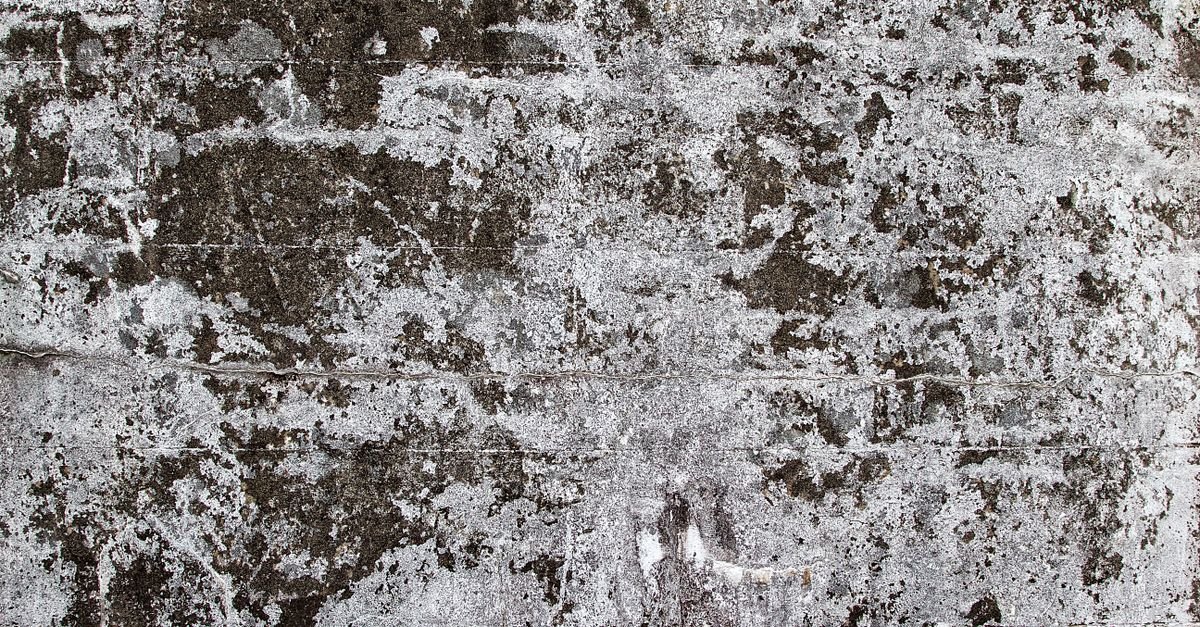
The slab is absorbent. Unsealed concrete drinks. Spray a dry slab and a meaningful fraction of your mix goes straight down past the stain into the pore network, where it is doing nothing except making the concrete damp. That is why pre-wetting is not optional here, and the masonry literature explains the second half of the benefit too: the Concrete Masonry and Hardscapes Association notes in its technical guidance on removal of stains from concrete masonry that “soaking with water causes dirt deposits to swell, loosening their grip on the underlying masonry.” Damp, not puddled. A slab with standing water on it will dilute your mix a second time and you will be back to countertop strength without noticing.
Organic load eats chlorine before the algae does. Every chlorine molecule that meets a leaf fragment, a smear of soil or a film of pollen is spent. A driveway carries far more of that than a vinyl wall. This is called chlorine demand, and on a slab it is the invisible tax on every mix you make. Sweeping properly before you spray is not housekeeping. It is chemistry.
Cleaning Concrete With Bleach: Mixing by Jug Strength
The number that matters is the concentration landing on the concrete, not what is written on the jug. For flatwork — concrete, brick, pavers — that target is roughly 2 to 3% sodium hypochlorite on the surface. Here is how to get there from whatever you can actually buy.
| What you have | Label strength | Mix for a slab | Lands at about |
| Household bleach, standard | 6% | 1 part bleach : 1–2 parts water | 2.0–3.0% |
| Household bleach, “concentrated” | 8.25% | 1 part bleach : 2–3 parts water | 2.1–2.8% |
| Pool or trade SH | 12.5% | 1 part SH : 4–5 parts water | 2.1–2.5% |
Read “1 : 2” as one part bleach to two parts water, three parts in total. Check your jug — US household bleach has drifted between 5.25%, 6%, 7.5% and 8.25% over the years, and the number is on the label in small type near the ingredients. Guessing costs you either a wasted afternoon or a bleached shadow on the brick edging.
Two things that are not in the table and change the outcome more than the ratio does.
A drop of dish soap per gallon. Not for cleaning power — for surface tension. Neat solution beads and runs off a slope. Thickened solution stays where you sprayed it, which buys you dwell time you would otherwise be chasing with a re-mist. The full case for surfactants lives in the article on sodium hypochlorite for pressure washing, which is also where to go if you are running it through a machine rather than a pump sprayer.
Test a square foot first on anything decorative. Integral-coloured, stamped and acid-stained concrete can lighten unevenly at the top of that range, and the edge of a test patch will tell you inside ten minutes. Bare grey flatwork does not need the ceremony. A stamped patio that cost more than the pressure washer did, absolutely does.
Do not mix a slab-strength batch and leave it in an unlabelled sprayer in the garage, incidentally. Not because it will go off, but because someone will eventually pick it up thinking it is the window spray.
The Ten Minutes Where Everything Actually Happens
Five to ten minutes of dwell, and one rule that outranks the number: never let it dry on the concrete.
Dried hypochlorite has stopped cleaning and started depositing. Everything it just lifted settles back into the pores along with a salt residue, and on coloured or stamped concrete that can leave a pale ghost of the exact area you sprayed. On a hot slab in direct sun you do not have ten minutes. You have three or four, which is why the whole job should follow the shade around the house rather than starting at the garage because that is where the tap is.
The sequence that works on flatwork:
1. Sweep hard and dry. Leaves, grit, moss clumps, the lot. Every gram of debris you leave is chlorine demand you are paying for.
2. Pre-wet with plain water until the slab is uniformly dark but not ponding. Wet the surrounding planting and grass at the same time, and keep them wet.
3. Apply low and slow, bottom of the slope first, working upwards. Solution running down dry concrete leaves clean stripes that set. Running down already-wet concrete, it does not.
4. Watch the edges. When the gloss starts going matte, re-mist that section. A pump sprayer in your other hand is the whole trick.
5. Brush it. Two minutes per square metre with a stiff deck brush. A broom finish has grooves that spraying genuinely never reaches, and this step changes the result more than any upgrade to the mix.
6. Rinse at the low end. The chemistry has already done the work, so you are rinsing, not cutting. A 25-degree tip or a surface cleaner beats anything narrower. The red 0-degree tip will draw a legible line in cement paste in about two seconds, and you will be looking at that line long after the algae is forgotten.
7. Judge it dry. Wet concrete is uniformly dark and hides everything, including your own missed patches. Give it a couple of hours.
Here is the opinion I would defend hardest on this page: when a pass underdelivers on concrete, the answer is almost never a stronger mix. It is more contact time, more brushing, and a second weak pass. Strength is the variable everyone reaches for because it feels like effort, and it is the one that does the least — a surface that shelters growth in its grooves is a *time* problem, not a *concentration* problem. Doubling the bleach doubles your plant risk, your residue and your smell. Doubling the dwell costs you ten minutes and a hose.
What Bleach Will Never Touch: Oil, Rust and Salt
Every stain family on a slab responds to exactly one kind of chemistry, and bleach is the answer to precisely one of them. The full diagnostic is in cleaning stains from concrete. Here is where bleach specifically runs out of road.
Oil and grease. Hydrocarbons have no organic colour body for an oxidiser to destroy, and oil migrates millimetres below the surface where nothing water-based reaches. You want an alkaline degreaser and surfactants, and sometimes a poultice. The honest limits are in whether pressure washing removes oil stains from concrete.
Rust. This one deserves a straight answer, because the internet gives two and they contradict each other. Bleach does not remove rust, and that much is not in dispute: iron oxide is iron that has already given up its electrons, so an oxidiser has nothing left to take, and hypochlorite has no chelating ability, meaning it cannot pull the ferric ion into solution the way oxalic acid does. What you will also read, on a great many sites, is that bleach makes a rust stain *permanent*. I went looking for a primary source for that claim and could not find one. It is asserted by trade blogs quoting each other, and I would rather flag it than quietly leave it standing. What the evidence supports is narrower and still reason enough to put the jug down: bleach does nothing useful to rust, it lightens the cement paste around the stain so the contrast often looks worse once the slab dries, and it leaves chloride on a surface that may well have steel underneath it. Use an acid chelator instead — and read the next section before you do.
Efflorescence and hard water scale. These are mineral salts arriving from inside the slab, not dirt sitting on it. Bleach is chemically irrelevant to them. If a white bloom vanishes when wet and returns as the concrete dries, you have a moisture path to fix rather than a surface to clean.
Tyre marks and paint. Plasticiser migration and coating films are not stains at all. One wants a solvent-based cleaner, the other wants a stripper.
There is a version of this article on other sites that says bleach cleans concrete. It does not. It kills things on concrete, which is a much smaller and much more useful claim.
Never Let It Meet an Acid on the Same Slab
This is the paragraph that matters more than any dilution ratio on this page.
Sodium hypochlorite “releases chlorine gas when it comes in contact with acids” — that is the plain wording used by the Agency for Toxic Substances and Disease Registry in its medical management guidelines for chlorine. Not a fume. Not an irritant smell. Chlorine gas, which is heavier than air and therefore collects at roughly the height of someone kneeling on a driveway.
On concrete specifically, there are three ways into this that nobody plans:
- The two-stage clean. Bleach the algae on Saturday, attack the rust with an acid remover on Sunday. Residual hypochlorite is still sitting in the pores. The acid finds it.
- The muriatic etch. Someone reaches for hydrochloric acid as a general-purpose concrete cleaner — which it is not, it is a dissolver of cement paste — on a slab that was bleached last month.
- The garage floor. Bleach plus ammonia gives chloramine, and the ammonia source on a garage or kennel slab is usually pet urine, which nobody files under “chemicals.”
If you have used bleach and now need an acid, rinse thoroughly and give the slab days to dry rather than hours. Treat the two as products that must never share an afternoon, a bucket or a sprayer. It is also worth noting where the masonry literature lands on acid generally: CMHA states that “strong acids or chemicals with a strong acid reaction definitely should be avoided” on masonry, and that “even weak acids should be used only as a last resort.” Bleach’s real advantage on a slab is not that it is stronger. It is that it does not eat the slab.
Gloves, sealed eye protection and old clothes, every time. Work with the breeze at your back rather than in your face, which sounds obvious right up until you are crouched in a walled courtyard on a still day.
Follow the Water Before You Mix Anything
A slab is a funnel. That is its job — it is poured with a fall so that water leaves it — which means everything you put down is going somewhere specific, and you can work out where in about thirty seconds. Stand at the top and look downhill.
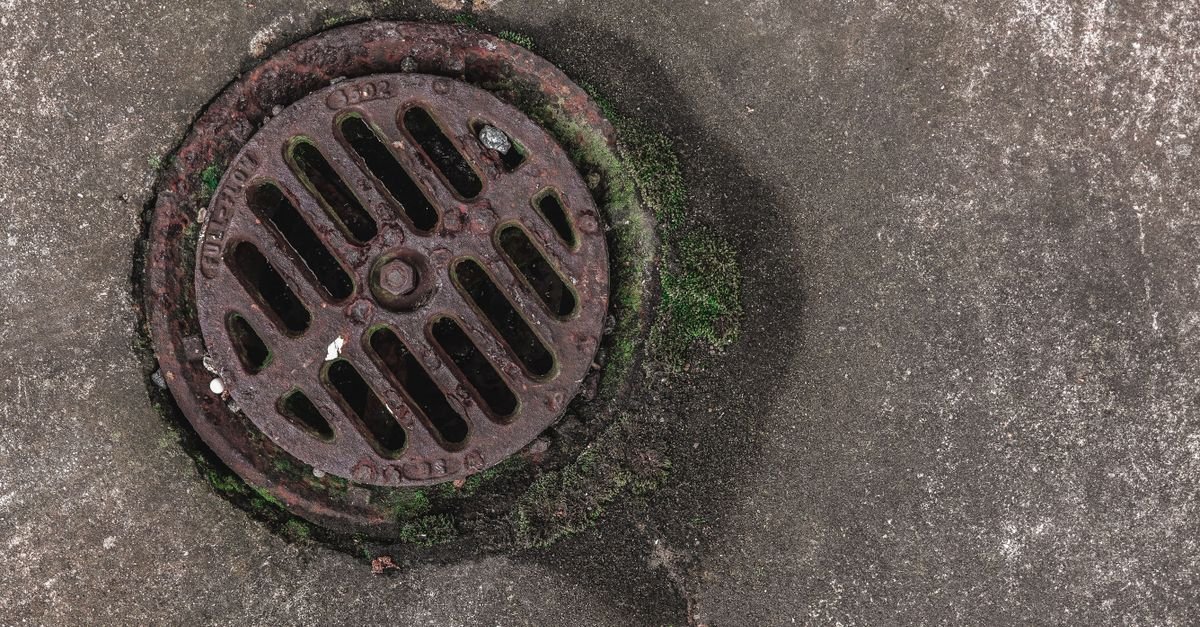
Most driveways end at the street, and most streets end at a storm drain, which in the majority of municipal systems discharges to a creek or a river without treatment. That is the one destination worth actively avoiding, and the fix is not complicated: wash toward a lawn or a gravel bed where runoff can soak in and dilute, dam the low edge with a rolled towel or a length of foam pipe insulation, and pick a dry day rather than the morning before a storm, when everything you apply gets flushed straight down. The EPA’s stormwater programme exists precisely because municipal storm sewers discharge without treatment, and a residential driveway is exactly the sort of surface it has in mind.
The plants along the edge need the standard routine — soak them before you start, keep them wet while you work, rinse everything afterwards — and that routine is covered properly in the sodium hypochlorite guide linked above. The slab-specific part is geometry. A patio that drains into a bed of hostas is a different problem from a driveway that drains into the gutter, and you plan the direction of work around whichever one you have.
Keep pets off until the slab has been rinsed and has dried. Cats cross treated concrete and then wash their feet, and the sequence rather writes itself.
FAQ
How long should bleach sit on concrete before rinsing?
Five to ten minutes, and it must stay visibly wet the entire time. On a hot slab in full sun that window shrinks to three or four minutes, so work small sections and re-mist the edges as they go matte. Letting it dry does not extend the dwell — it ends it, and re-deposits everything the bleach just lifted.
What is the correct bleach to water ratio for a driveway?
From standard 6% household bleach, one part bleach to one or two parts water. From 8.25% concentrate, one to two or three. From 12.5% trade sodium hypochlorite, one to four or five. All three land on the slab at roughly 2 to 3%, which is the working strength for flatwork. The dose printed on the bottle is a disinfecting dose for indoor surfaces and is very much weaker than this.
Will bleach damage concrete?
Bare, unsealed, uncoloured concrete tolerates dilute bleach well. It is an alkaline material and bleach is alkaline, so there is no etching mechanism of the kind acid brings. What bleach does damage is everything else nearby: sealers and acrylic coatings can haze or soften, coloured and stamped concrete can lighten unevenly, adjacent metal fixings corrode, and plants die. Rinse thoroughly and the slab itself will be fine.
Does bleach kill moss on concrete?
It kills it reliably and removes it badly. Moss holds on mechanically, so the dead mat still has to be scraped and swept off. Scrape the bulk away dry first, then treat what is left and the spores sitting in the pores — which is the part that decides whether it returns in three months or three years.
Can I pressure wash after applying bleach to concrete?
Yes, and that is the right order: chemistry first, pressure as the rinse. Do not run undiluted bleach through the pump unless the machine is rated for it and you flush it afterwards. A pump sprayer for application and the washer for rinsing is the simpler arrangement, and it keeps the strong stuff away from your seals entirely.
Why does my concrete look lighter where I cleaned it?
Usually because it genuinely is cleaner than the concrete beside it, which is a spot-cleaning problem rather than a bleach problem — clean out to the nearest expansion joint and the patch disappears. If the pale area has hard edges matching exactly where you sprayed, the solution dried on the surface. If the whole slab has gone patchy and washed out, you were stronger than 3% on coloured or stamped concrete.
Is oxygen bleach better than chlorine bleach on concrete?
Sodium percarbonate is gentler on plants, does not gas off, and will not lighten adjacent surfaces, which makes it the sensible pick for a courtyard surrounded by planting. It is also slower and weaker on established black spotting, and it wants a longer dwell — thirty minutes or more, kept wet. On a large exposed driveway, chlorine bleach does more per hour. On a small patio full of pots, percarbonate is worth the extra time.
Two Weak Passes Beat One Strong One
Cleaning concrete with bleach is a narrow tool used well: it destroys organic colour, and it does nothing else. Get the jug strength right, cut it to land at 2 to 3% on the slab, pre-wet, keep it wet for ten minutes, brush the grooves, rinse low, judge it dry. If a pass underdelivers, run a second weak one rather than mixing a stronger batch — the slab is sheltering the growth in its texture, and texture is beaten by time, not concentration.
And if there is an acid anywhere in this job — a rust remover, an etch, a masonry cleaner you bought for something else — it does not come out on the same day, in the same sprayer, on the same slab, until everything has been rinsed and dried. That is the one rule on this page with a gas attached to it.
The driveway will still be there next weekend. Give it the ten minutes.