Last Updated on September 24, 2026 by Umar Farooq
Gutter cleaning winter advice reduces to one rule: clear the troughs before the first hard freeze, because once the ice is in there you cannot scoop it, the ladder has become genuinely dangerous, and the gutter was not the thing causing your ice dam anyway.
That last clause is the part nobody says out loud, so this article is mostly about it. A blocked gutter causes overflow, rot and a soaked foundation, and those are real. An ice dam is a different failure with a different cause, sitting in the same place, and the internet has spent twenty years conflating the two because the ice is visibly in the gutter and the attic is not visibly anywhere.
A trough full of wet leaves in November is a chore. The same trough in January is a masonry project.
The Gutter Cleaning Winter Deadline Is the First Hard Freeze
The useful date is not on a calendar. It is on a forecast — the first run of nights that stay below freezing, which is the moment a trough full of wet debris stops being debris and becomes one object.
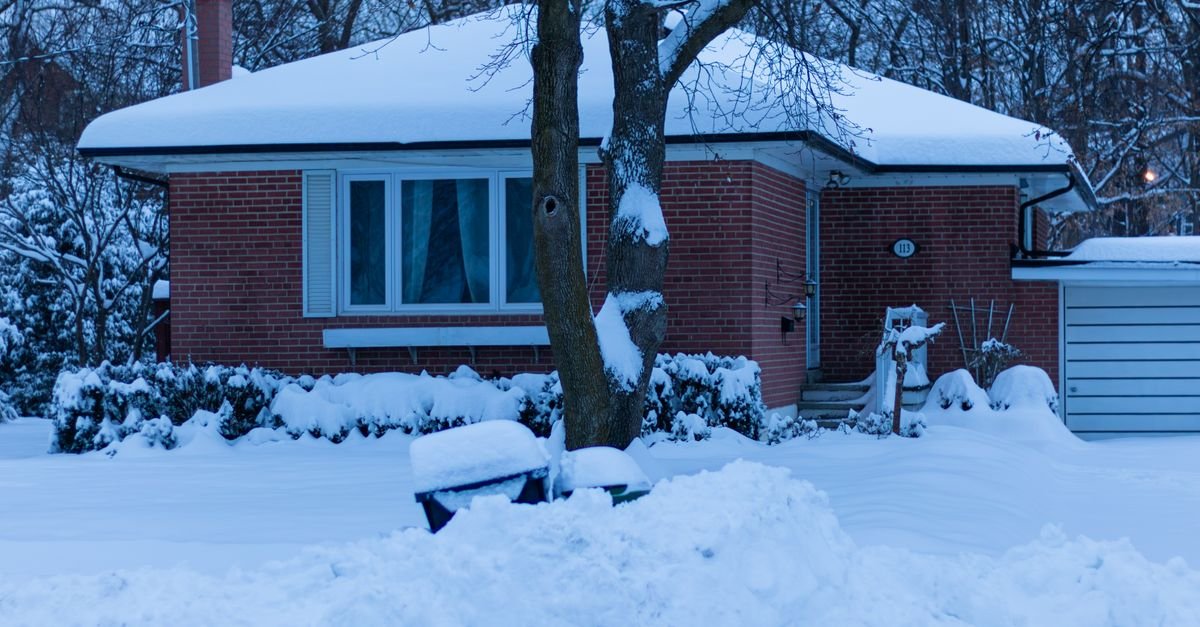
Here is why that transition matters more than the mess itself. Wet leaf pack in a gutter holds an extraordinary amount of water, and when that freezes it becomes a slab keyed into the trough, around the hangers and into the outlet. It does not melt out cleanly at the first thaw either, because it is shaded by its own bulk and sitting against metal that spends every night radiating heat to a clear sky. What you get is a block that survives half a dozen thaw-freeze cycles, and every one of those cycles is a small expansion event working against end caps, sealant beads and the fasteners holding the whole thing to the fascia.
So the sequence for the year is: last leaves down, gutters cleared, downspouts proven to run, and all of it finished before the first sustained freeze. Watch the ten-day forecast in late autumn rather than picking a weekend in advance. If you are in a climate where the leaves are still coming down when the first freeze arrives, you clear twice — once mid-drop and once after — and you accept that this is the cost of living somewhere with both trees and winter.
There is one structural detail worth checking while you are up there, and it is specific to snow country. The Asphalt Roofing Manufacturers Association recommends positioning gutters so the outer edge sits lower than the roof’s slope line, to let snow and ice slide clear rather than catching on the lip. A gutter hung proud of that line acts as a shelf. Sliding snow stops on it, sits there, and then does exactly what a few hundred pounds of wet snow does to thin aluminium hung on screws. Sight along the roof plane from the end of the run. If the front lip is above the line, that is a hanging problem to fix in spring, not a cleaning problem.
For the trough-to-outlet method itself — the scooping, the strainer, the flush — that job does not change because it is October, and it is not worth repeating here.
An Ice Dam Starts at Your Ceiling, Not in Your Gutter
This is the section the rest of the article exists for, and the mechanism is not complicated once someone states it plainly. Building Science Corporation puts it in one sentence: “Ice dams happen when the outside temperature is below freezing, the roof deck temperature is above freezing, and there is snow on the roof.”
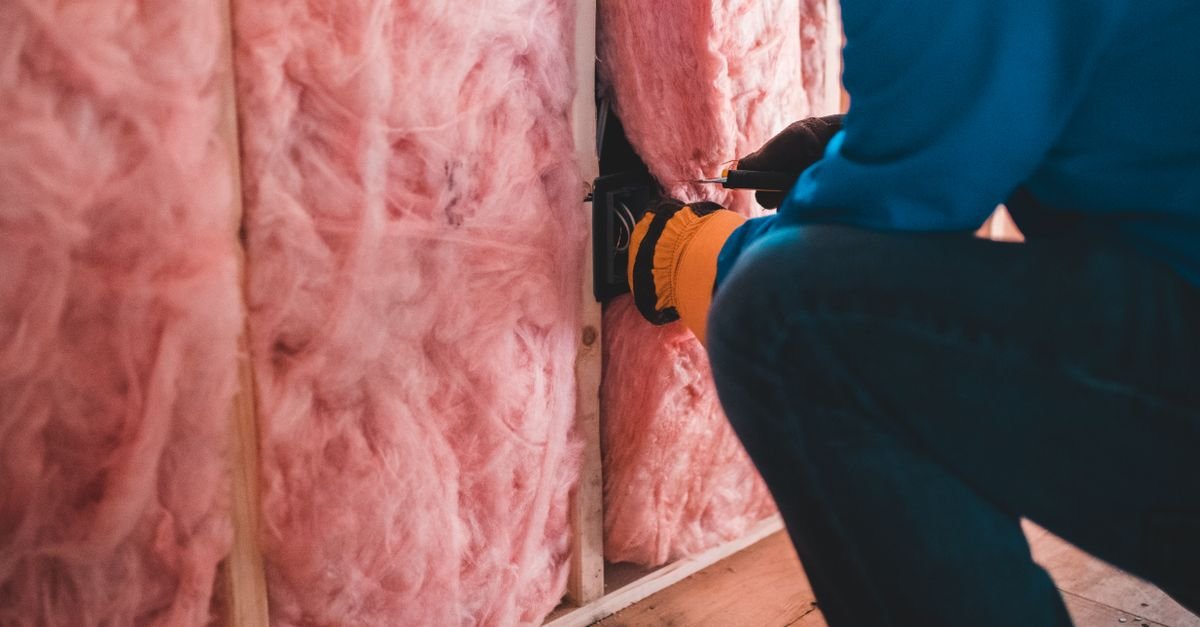
Read that again and notice what is not in it. The gutter is not in it. The leaves are not in it. What is in it is a roof deck that is warmer than the air outside, which can only happen if heat is arriving from underneath — from your house, through the ceiling, into the attic, into the sheathing.
The full sequence goes like this. Warm air leaks up through the ceiling plane, mostly through penetrations rather than through the insulation itself. It warms the attic, which warms the underside of the roof deck, which melts the bottom layer of snow lying on top. That meltwater runs down the slope. Somewhere near the eave it crosses over from roof that has heated space beneath it to roof that overhangs open air — the soffit — and that section is at outdoor temperature. The water refreezes there. Do it for a week and you have a ridge of ice with liquid water ponded behind it, and ponded water on a shingle roof goes where water goes, which is sideways and under the laps.
Snow makes it worse in a way that feels backwards. Snow is an insulator — roughly R-1 per inch — so a deep snow cover keeps the deck warmer, not colder. The heaviest snowfall of the year is also the best blanket your leaky attic has ever had.
The fix, then, is upstairs and inside. Building Science is direct that “airtightness is more important than insulation levels. But both are important.” That means the attic hatch, the recessed light housings, the bathroom fan duct where it passes through, the plumbing stacks, the top plates of interior walls — the holes, not the fibreglass. Insulation depth is the second half of the job and it matters, but a deep pile of fibreglass with a light fitting punched through it is a deep pile of fibreglass with a chimney in it.
So here is my one strong opinion on this page, and it is going to annoy a certain kind of gutter company: cleaning your gutters is not ice dam prevention, and selling it as ice dam prevention is selling the wrong product. A spotless gutter under a leaky attic still gets an ice dam, because a 34°F roof deck does not care how tidy the trough is. What a clean gutter does — and this is genuinely worth something — is remove the head start. ARMA describes ice dams as forming from repeated thaw-freeze of meltwater *or* from the backing up of frozen slush in gutters, and a trough already packed with frozen leaf pack gives the ice somewhere to anchor and a lip to build off. Clean gutters make a dam smaller and slower. They do not make it not happen.
If your neighbour with the same house has icicles and you do not, the difference is almost never the leaves.
Why the Downspout Freezes Before the Trough Does
Ask anyone who has dealt with this and they will tell you the same thing: the trough is usually still moving water when the downspout has been solid for a week. There are three reasons, and they are all geometry.
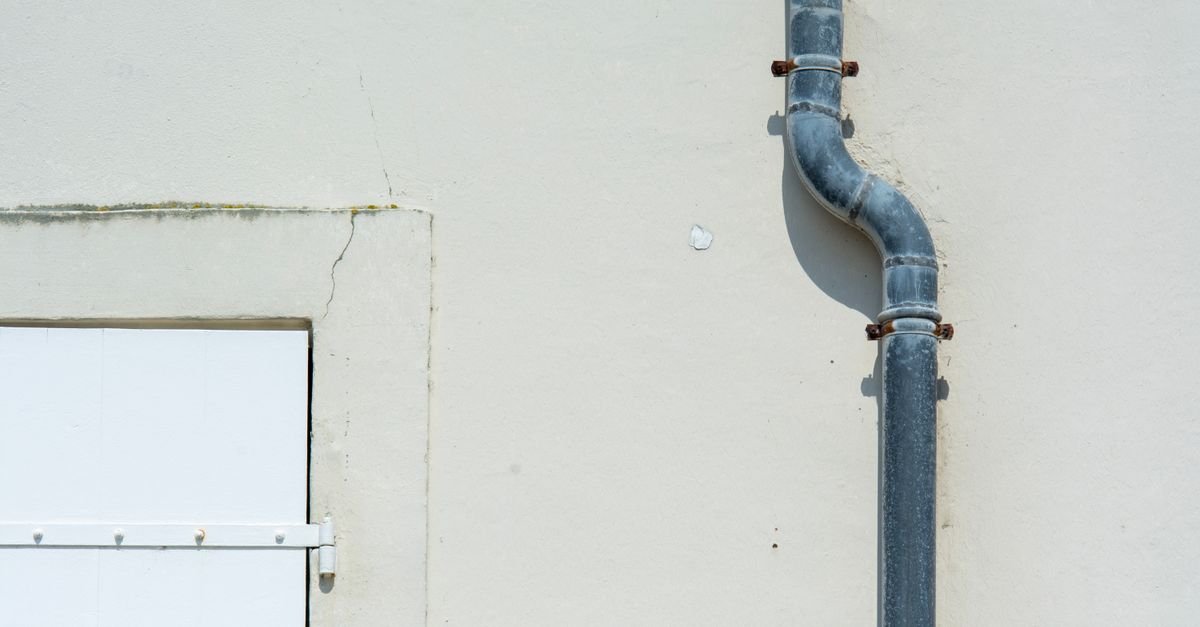
It holds a column, not a film. Water in a trough is a thin sheet with a lot of surface area and somewhere to go. Water in a vertical pipe is a standing column sitting on whatever is below it. A sheet drains. A column waits.
The elbows are traps. The top elbow where the outlet turns into the pipe, and the shoe at the bottom where the pipe kicks out over the splash block, are both offsets. Flow slows at an offset, fine grit settles at an offset, and the residual water after a rain does not drain out of an offset — it sits in the bend. That is your first plug, and once you have one plug, everything above it backs up and freezes onto it.
The bottom freezes from the ground up. This is the version most people actually get. The downspout discharges onto a splash block or a short extension, the water spreads out on cold ground, and it freezes where it lands. The next discharge freezes on top of that. Within a few days the ice sheet has grown back up into the mouth of the pipe and stoppered it from below, at which point you have a perfectly clean downspout that does not work.
The prevention is unglamorous: get the water further from the house before you let go of it, with an extension long enough that the ice sheet forms out on ground you do not care about, and make sure the pipe runs empty after every rain rather than holding a few inches in the shoe. If you are going to clear a downspout, do it in autumn, from the bottom end, while the water is still liquid.
What not to do once it is frozen, in rough order of how often I see it suggested:
- Boiling water. It opens a short channel, refreezes overnight, and puts a sharp temperature differential across a butyl-sealed joint, which is how seams let go. It also has to go somewhere, and where it goes is the ice sheet you are standing on.
- A hammer, or any percussive optimism. Residential downspout is thin coated metal. It deforms permanently long before the ice inside gives.
- Rock salt. Sodium chloride is corrosive to the steel screws holding your aluminium system to the fascia, it is unkind to whatever is planted underneath, and it does very little to a solid column of ice in a pipe that is nowhere near its surface.
- The pressure washer. Covered in its own section below, because the answer deserves more than a bullet.
If a particular downspout freezes solid every single winter, that is a design problem and heat cable is the honest answer — self-regulating cable run down the trough and into the pipe, on a thermostat. It treats the symptom and it draws power all winter, and I would rather tell you that plainly than pretend there is a clever free fix.
Frozen Ground Is Not the Stable Surface a Ladder Needs
Frozen ground feels like the best ladder footing of the year. It is hard, it is flat, the feet do not sink into the lawn, and there is no soft border to worry about. That impression is a trap and it is worth understanding why.

Ladder feet grip by deformation. The rubber pad flexes into the microtexture of the surface and the friction comes from that mechanical interlock. Frozen soil with a glaze of frost on it has no microtexture available — the rubber has nothing to key into, and the coefficient of friction drops toward what you would get on a sheet of glass. Hard is not the same as grippy, and the ladder that would not move an inch on damp October grass will skate on the same spot in January.
Then there is the thing that catches people out even on a clear, dry, cold day: the ground is frozen at 8am and it is not at 2pm. Sun on the south side of the house softens the top inch, one foot settles, the other does not, and a ladder that was plumb is now slightly racked with your weight thirteen feet up.
And the most underrated hazard is one you bring with you. Boots pick up snow from the ground, the snow melts against the rung, and by the third trip up you have laid a thin film of ice on the rungs yourself. Nothing about the ladder failed. You resurfaced it.
I went and looked up what the outcome actually looks like, because “be careful” is not information. In a prospective study following 134 ladder-fall patients for six months, most of the injuries were not workplace events at all, and of the falls that happened at home, 78% were outdoors rather than indoors. Eighty-six per cent were from more than a single metre, and at six months, 49% reported a clinically significant deterioration in quality of life. That is the half of a year you are weighing against a downspout.
So the winter rule is simple and slightly unsatisfying. If there is snow or frost on the ground where the feet go, do not go up. If there is ice on the roof edge you are reaching toward, do not go up. If it genuinely cannot wait, it is worth what a contractor charges.
Should a Pressure Washer Come Out Below Freezing?
No. Not for gutters, not for anything, and there are three separate reasons — one about the property, one about the machine, and one about you.
Everything you rinse becomes an ice rink. This is the one people underestimate, and it is the one that hurts them. At 2 to 4 gallons per minute you are laying down a great deal of water, and below freezing it does not drain, it sets. The path, the steps, the driveway and the patch of ground your ladder is standing on all glaze over while you work, and they glaze over behind you where you cannot see them. You are manufacturing the hazard you then have to walk across.
Water freezes inside the machine between trigger pulls. A hose lying on frozen ground loses heat fast, and a gun and wand full of static water in still, sub-freezing air can plug in minutes. A plugged wand with the pump running is not a neutral state — the unloader goes into bypass, the water in the pump head recirculates and heats, and you now have a machine building heat at one end and ice at the other. And whatever is left in the pump when you finish is the failure this site covers in full elsewhere: water expands about 9% when it freezes and the pump housing does not stretch. The complete procedure is in how to winterize a pressure washer and there is no reason to restate it here.
The chemistry has stopped working anyway. Reaction rates fall as temperature falls, so a detergent that wants five to ten minutes of dwell at 70°F wants considerably longer near freezing — and near freezing it will not stay liquid on a vertical surface long enough to get it. You would be applying a cleaner to a surface that freezes it in place. That is not cleaning, that is decorating.
There is also the obvious point that a wand produces real reaction force the instant you pull the trigger, and a ladder in winter is the worst possible place to be surprised by it — the physics of that are in power washing siding, and the cold does not improve them.
What you *can* do in the cold is dry work. Look at the fascia, look at the drip edge, look at where the ice is forming and work backwards to what is warming that section of deck. Rinsing waits for a day above about 40°F with a night that stays there, which in most climates means spring.
The Ice Is Already There. Now What?
Assume for a moment that you are reading this in February with a ridge of ice along the eaves and a brown stain appearing at the top of the living room wall. Here is the honest triage.
Do not chip it. Not with a hammer, not with a hatchet, not with the flat end of a pry bar. The ice is bonded to the shingles and to the gutter, and the thing that gives first is not the ice. You will hole the trough, tear granules off the shingles, or punch through the self-adhering membrane that is the only thing currently keeping the water out of your ceiling.
Do not aim heat at it. Torches and heat guns near a soffit, in a cavity full of dry timber and possibly a bird’s nest, is how a winter afternoon becomes an insurance claim.
Do not aim the pressure washer at it. Cold water at high velocity on a roof edge does two things: it adds several gallons of water that will be ice within the hour, and it drives that water up under the shingle laps, which is the exact path the dam was already exploiting. The trade uses low-pressure steam for this, which is a completely different tool doing a completely different job — it melts a channel at near-zero pressure. A pressure washer is not a slow steamer.
Do pull the snow off, from the ground. A roof rake — a wide blade on a long pole — used to strip the lower three or four feet of snow off the roof removes the material that feeds the dam. No snow above the eave, no meltwater, no growth. It is the single most effective thing available to a homeowner in February, and it is done standing on the ground. (Stand to the side of what you are pulling down, not under it. Snow that has been sitting on a warm roof deck comes off in slabs.)
Do melt a channel if you need pressure relief now. A fabric tube filled with calcium chloride, laid perpendicular across the dam so one end hangs over the edge, will open a drain path through the ice over a day or two and let the ponded water out. It is a stopgap, not a repair, and it needs to be placed rather than thrown, which for most roofs means a ladder you should not be on. Weigh that honestly.
Do check inside. Water past a dam shows up as staining at the top of exterior walls, damp at the ceiling-wall junction, or wet insulation in the attic. If you find it, the ceiling is already taking water and the roof rake stops being optional.
The permanent fix is a re-roofing decision, not a January one. ARMA’s guidance for regions with a history of ice dams is a self-adhering polymer-modified bitumen underlayment running at least 24 inches inside the interior wall line, which puts a waterproof layer under the exact zone where the ponding happens. Note the phrasing: it does not stop the dam, it makes the dam survivable. Whatever is on the roof edge, the thing that stops the dam forming is still the air sealing in your attic — and if the shingles themselves need attention when spring comes, that is a soft wash job with its own method in how to clean roof shingles without pressure washing.
FAQ
Can you clean gutters in winter?
You can, and in mild, dry, above-freezing spells with bare ground it is a perfectly reasonable job. What you cannot do is clean a frozen gutter — ice does not scoop, and everything that works on frozen material works by hitting it or heating it, both of which damage thin aluminium. If the trough is frozen, the honest answer is that you missed the window and the job is now waiting for a thaw.
Do clogged gutters cause ice dams?
Not by themselves. An ice dam requires snow on the roof, a roof deck above freezing and outside air below freezing, and the warm deck comes from heat leaking out of the house. A clogged gutter gives the ice an anchor point and makes an existing dam bigger and quicker, so clearing it helps — but a spotless gutter under an under-sealed attic will still grow one. If you only have budget for one intervention, spend it on air sealing the ceiling plane rather than on a fourth gutter visit.
Will pouring hot water down a frozen downspout clear it?
Briefly, and at a cost. Hot water opens a short channel that refreezes overnight, it puts a sharp temperature differential across a joint sealed with butyl, and all of it ends up as a sheet of ice on the ground below — usually exactly where you would want to stand a ladder. If a downspout freezes every winter, self-regulating heat cable fixes it properly. If it is a one-off, wait for the thaw.
Is it safe to pressure wash gutters in cold weather?
No, for reasons that have nothing to do with the gutter. The rinse water freezes on every surface it lands on, including the ground under your ladder; water trapped in the wand, hose and pump can freeze between trigger pulls and crack components; and detergents need dwell time that cold weather will not give them. Wait for a day above roughly 40°F, and winterize the machine properly in the meantime.
Should you remove snow from the roof?
From the lower three or four feet, yes, and with a roof rake from the ground rather than by going up. Clearing that strip removes the meltwater supply that feeds an ice dam. Clearing the whole roof is generally unnecessary for dam prevention and introduces a much larger set of risks, and on a structurally healthy house the snow load itself is rarely the issue.
Can you use rock salt on an ice dam?
It is the wrong salt in the wrong place. Sodium chloride attacks the fasteners and metal of the gutter system, damages planting below, and stains masonry. Calcium chloride in a fabric tube is the version that is actually recommended for opening a drainage channel through a dam, and even that is a temporary relief measure rather than a fix.
Win This One in November
Everything in this article is easier in autumn than it is in February, and the reason is not motivation, it is physics. Liquid water can be moved. Ice has to be waited out.
So the plan is small: clear the troughs and prove the downspouts after the last leaves drop, get an extension on the bottom of the pipe so the discharge ice forms somewhere harmless, and then spend the money you were going to spend on a January emergency call on a weekend with a caulk gun and a bag of insulation in your attic instead. That is where your ice dam lives. The gutter is just where it shows up.
And if you are reading this while standing at a window watching a genuinely impressive row of icicles — they are lovely, and they are a receipt for a heating bill you already paid.