Last Updated on September 24, 2026 by Umar Farooq
A house siding cleaning brush is the only tool in the whole job that removes anything mechanically — the solution kills the growth, the rinse carries it off, and the bristles are the only part that actually touches what is stuck. Everything else you point at the wall is chemistry arriving at speed.
That is not an argument for scrubbing a whole house by hand. It is an argument for knowing what the brush is doing, because the difference between the right brush and the wrong one on the same wall is a clean panel versus a permanent matte patch where you worked hardest.
What a Brush Does That a Nozzle Cannot
Water arriving at a wall pushes. Bristles arriving at a wall drag. Those are two different loads, and the film on your siding fails under one of them far more readily than the other.
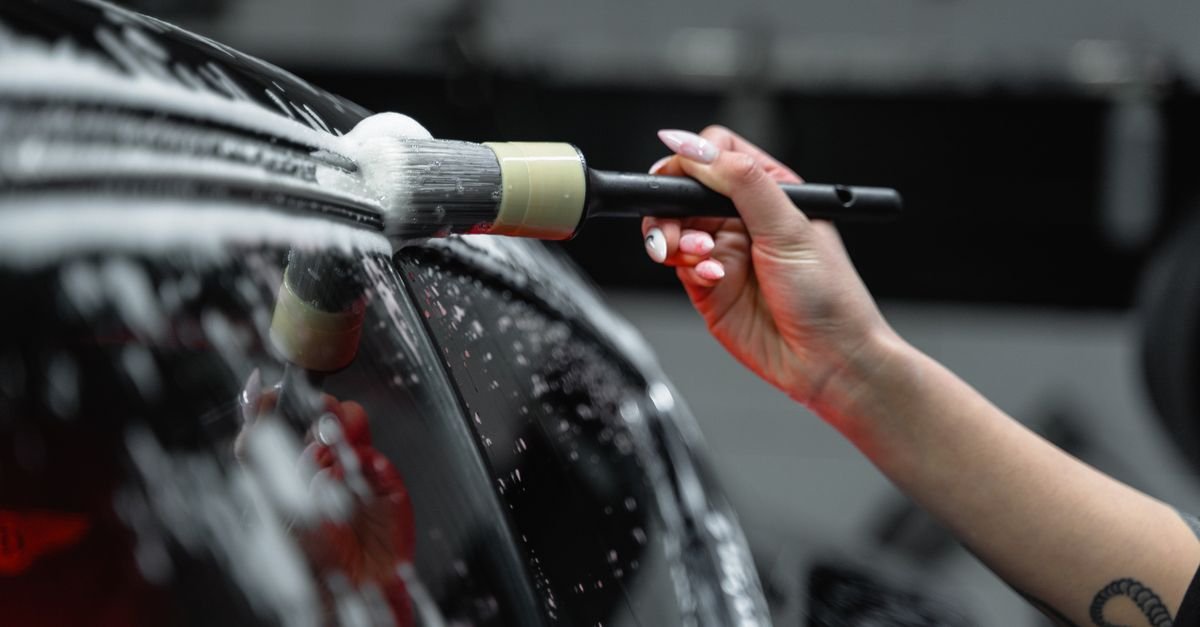
What is on a dirty wall is mostly not loose dirt. It is a biological film — algae, mould, the grey haze that is both — grown attached to the surface, plus, on older painted metal, a layer of degraded binder and pigment. Films like that are strong in compression and weak in shear. You can push on one all day. Slide something sideways across it and it lets go.
There is a second thing a jet cannot do, and it is geometric. A fan of water hits the face of the panel and then has to turn ninety degrees to get anywhere else, so it skims over the drip edge, the underside of the lap and the moulded grain on a textured panel — the three places the growth actually lives, because they are the three places that stay wet. A bristle does not have to turn a corner. It is already in the groove. The siding trade body says it in one flat line: for textured surfaces, a soft bristle brush helps clean the grooves effectively (Polymeric Exterior Products Association, siding cleaning and maintenance).
Here is the opinion, and it is the whole point of this page: on a chalked or heavily colonised wall, agitation does more for you than any pressure increase you are willing to risk. Vinyl is generally handled at 1,300–1,600 PSI and painted wood at 500–800, so the headroom above “gentle” is about one nozzle change wide. The headroom on agitation is a human arm. Turning the machine up moves you toward the failure mode. Adding a brush does not.
Soft Bristles, and What Soft Is Measured Against
“Soft” on a brush package is a claim with no unit behind it. Four things actually decide how a brush behaves, and only one of them appears on the label.
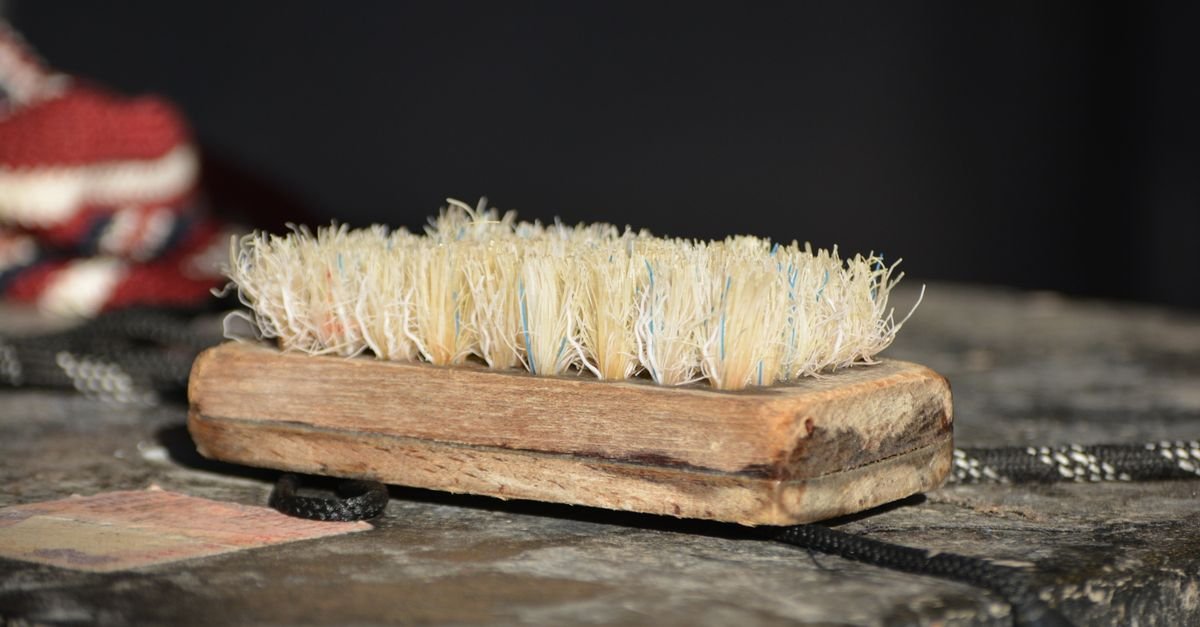
The polymer. Nylon is the general-purpose fill, offered from about 0.0025 to 0.060 inches in diameter, and it is used because of its abrasion resistance and bend recovery — it springs back rather than staying bent. Polypropylene is cheaper, has excellent stiffness when wet, but “does not have the bend recovery that nylon has or abrasion resistance” and “will take a set much quicker.” Polyester sits between them, with excellent bend recovery and better abrasion resistance than polypropylene, and it holds its stiffness wet because it absorbs very little water (Jenkins Brush, brush filament materials). A brush that has taken a set is not a softer brush. It is a brush whose tips now all point one way and dig in on the return stroke.
The diameter and the trim length. These matter most and are almost never printed. A bristle is a little cantilever: its stiffness rises with the fourth power of its thickness and falls with the cube of its free length. Double the filament diameter and you have made it roughly sixteen times stiffer — same plastic, same colour, same word on the packet. Lengthen the trim and it goes dramatically softer. That is the quiet reason a long-bristled wash brush and a short-cropped scrub brush feel like different tools when both are nylon.
Flagging. Flagging splits the tip of each filament into finer branches. Mr. LongArm’s soft flow-thru wash brush uses 100% polystyrene filaments that are “flagged, a process that splits the ends of the fibers making them even softer” (Mr. LongArm, soft flow-thru brush). Splitting the tip multiplies the contact points, which divides the force per point — the same trick a make-up brush uses, applied to a house.
Take the palm test to the shop with you. Press the brush into your open hand and lean on it. If the bank of bristles folds over as a group, it is a wall brush. If individual tips dig in, it is a concrete brush, and it will leave scuffs on vinyl that show in raking afternoon light for the rest of the summer.
How a Flow-Through Brush Feeds Water Down the Handle
A flow-through brush is a head with a hose fitting and a water passage that exits at or just behind the bristle bed, screwed onto a hollow pole with a garden hose running up it. Water leaves where the bristles are, which changes three things at once.
The first is that the surface never dries, and solution drying before you rinse it is the commonest cause of streaks. The second is that the head rinses itself: a dry brush loads up with everything it just removed and carries that across the next panel, which is how a soft brush produces hard scratches. The third is that there is no bucket, which matters once you are working above shoulder height, because a bucket and a raised arm are a combination that ends with the bucket on your shoes.
The hardware is standardised and duller than you would hope. That Mr. LongArm head is ten inches wide and “fits any pole or broom handle with 3/4″ standard threads” — the same thread a paint roller uses, which is why the extension pole in the garage usually just works.
There is one thing a flow-through brush is bad at, and people find it out the annoying way. It is a rinse-and-agitate tool, not an apply-and-dwell tool — run water through the head while you scrub a solution you just applied and you are diluting your own chemistry in real time. Apply the mix bottom-up with a sprayer, let it dwell its five to ten minutes without drying, then bring the brush in to agitate and rinse. Reverse that order and you will decide the brush does not work, when what happened is you washed the cleaner off before it finished its shift.
Every Extra Foot of Pole Costs You Scrubbing Force
Telescopic poles are sold on reach, which is the only number on the box and the least useful one. The honest version is that reach and agitation pull against each other, and past a certain extension you are no longer scrubbing at all.

Two things happen as the sections come out. The first is that you are holding a long lever near one end, so the further the head goes, the more of your effort goes into resisting the pole’s own weight rather than pressing bristles into a wall. The second is deflection: every telescopic joint is a place the pole can flex, and flex it will. Push harder at eighteen feet and the pole bows in the middle instead of the bristles compressing at the top. There is a length past which extra effort produces only pole movement, and you are now polishing the wall with a wet noodle.
That is why serious high-reach work is water-fed and chemistry-led rather than scrubbed. Above the first storey a brush is really a wiper: it wets, it spreads, it knocks the loose material off, and the solution does the rest. Scrub what you can genuinely lean into, and let the mix do the work higher up, as covered in power washing siding.
What you should not do is solve the reach problem with a ladder. Scrubbing is a sideways load, and a sideways load applied by someone standing on a ladder is the classic way people come off one. A pole that flexes is an inconvenience. A ladder that steps sideways is not.
Match the House Siding Cleaning Brush to the Cladding, Not the Stain
The stain tells you what solution to mix. The cladding tells you what brush goes on the pole. People reverse that constantly, pick a brush by how stubborn the mark looks, and take a stiff bank of bristles to the one material that cannot have it.
| Cladding | Brush call | The reason |
| Vinyl | Soft only, long handle | PEPA’s guidance is a soft cloth or a long-handled soft-bristle brush. Stiff bristles alter the gloss, and altered gloss reads as blotchy from the street |
| Painted aluminium | Soft, rinsed constantly | The brush is right, but it loads with chalk in about four strokes and then you are burnishing chalk into the next panel |
| Painted wood | Soft to medium, along the board | A brush finds failing paint before your eye does. Bristles lifting flakes is information, not damage |
| Fibre cement | Soft to medium, along the board | The board does not care; the coating does, and the moulded grain needs a bristle to get into it |
| Cedar and bare wood | Soft only, with the grain | Wet softwood raises fibre under a stiff brush, and raised fibre means sanding |
| Steel | Soft only | Nothing here is about the steel. It is all about not opening the coating |
| Stucco and render | Soft, and accept it will be slow | The texture chews bristles and the binder is a mineral that acid-producing growth is already attacking |
| Brick, sound mortar | Medium or stiff is fine | Fired clay does not care about nylon. Crumbling joints do, and that is a repointing job |
The through-line: on every cladding above, the limit is the coating or the surface layer, never the substrate. Nobody has ever scrubbed through a vinyl panel. Plenty have scrubbed the shine off one.
Where a Brush Is the Thing Doing the Damage
There is one surface where the brush is explicitly banned by the industry that makes it, and almost everyone reads the sentence wrong.
The Asphalt Roofing Manufacturers Association writes: “DO NOT use a power washer or any type of brush or broom to clean algae from the roof surface.” Notice that the brush and the broom sit in the same sentence as the power washer, carrying the same prohibition, for the same reason. Shingles are protected by a granule layer that is glued on, the granules are what stops ultraviolet light eating the asphalt, and anything dragged across them takes some with it. A broom is not gentler in the way that matters — it is a slower version of the same abrasion. Cleaning roof shingles without a pressure washer covers what ARMA wants instead.
The same logic travels to any surface whose protective layer is thinner than the muck sitting on it. Heavily chalked painted metal is the honest case: brushing removes the chalk, and on a coating most of the way through its life it removes a little of what is left. That can be the right trade — but make it deliberately rather than discovering it.
Then there is the mechanism nobody accounts for: a brush carries grit. The bristle is soft. The grain of sand wedged between two bristles is quartz, which is harder than paint, harder than vinyl, and harder than your resolve. That is what actually puts fine swirl marks on a panel, and it is why the flow-through head earns its keep — it rinses the abrasive out continuously. Working dry, dunk and shake the head far more often than feels necessary.
Do You Actually Need to Buy One?
Probably not, and this is the part the tool listings will not tell you.
Most extension poles use the same 3/4-inch thread, so the pole you already own for painting the hallway ceiling is very likely the pole this job needs. That reduces the purchase to a head, and a soft car-wash brush — the flow-through kind sold for the roof of a van — is the same object as a siding brush with different marketing. Check the garage broom too. Press it into your palm. If the bank folds rather than the tips digging in, you own a house siding cleaning brush and have done for years.
If you do spend, spend on the pole rather than the head. A head is a few dollars of plastic and filament; a rigid, properly locking pole is what decides whether you can still apply force at fourteen feet. The flow-through feature is the one real upgrade, and only if you have a second storey or a wall where the solution keeps drying on you.
Not worth buying under any circumstances: a stiff deck brush for a wall, a wire brush for anything attached to a house, and a rotating brush attachment for a pressure washer wand. That last one is fine on a car and wrong on cladding, because it spins a stiff ring of bristles at a fixed pressure against a surface whose only defence is a coating thinner than a sheet of paper.
FAQ
What kind of brush is best for cleaning house siding?
A long-handled brush with soft, flagged nylon or polystyrene bristles, ten inches or wider, on a pole you can still control with both hands. The siding trade body’s guidance for vinyl is a soft cloth or a long-handled soft-bristle brush, and a soft bristle is specifically what gets into the grooves of a textured panel.
Can you use a stiff bristle brush on vinyl siding?
No. A stiff brush will not perforate vinyl, but it changes the surface gloss, and altered gloss reads as a stain from the street that cannot be cleaned off, because it is not dirt. If a mark needs more than a soft brush, it needs a different solution or a longer dwell, not more bristle.
What is a flow-through brush and do I need one?
A head with a hose fitting that feeds water out at the bristles. You need one above head height, or on a wall where the solution keeps drying before you can rinse. On a single-storey wall you can reach comfortably, a bucket and a plain brush do the same job.
How long a handle do I need for a two-storey house?
Longer than you think and shorter than the box promises. Poles are sold by maximum extension, but useful scrubbing length is shorter, because pole flex and your own wrists eat the force you can apply. For most people the practical limit is around the top of the first storey; above that, plan on the solution doing the work.
Can I use a house siding cleaning brush on my roof?
Not on asphalt shingles. ARMA rules out a power washer, a brush and a broom alike, all three for the same reason: they remove the granule layer that protects the asphalt. A brush is not the gentle alternative up there — it is the slow version of the same damage.
Should I scrub upwards or downwards?
Along the boards, not up and down them. That keeps bristles out from under the laps and stops you driving water upward behind the courses.
Will scrubbing scratch my siding?
The bristles will not, if they are soft. The grit they pick up will. That is the whole scratch mechanism on cladding, and the fix is to rinse the head constantly rather than to scrub more gently.
Can I attach a brush to my pressure washer wand?
You can, and on cars and wheels it is genuinely useful. On cladding it is the wrong tool: a wand brush holds a fixed bristle pattern against the wall at whatever pressure the machine is making, and you lose the one advantage a hand brush has — feeling how hard you are pushing. For where the machine itself should sit, see what PSI pressure washer for vinyl siding.
Agitation Beats Pressure on a Colonised Wall
All of it collapses to one decision. When the wall is not coming clean, you can turn the pressure up, which moves you toward the failure mode of the material, or you can add agitation, which does not. The brush is the only tool on the job that increases cleaning without increasing risk, and it is the cheapest thing in the bucket.
So the answer to “what brush” is nearly always: softer than you were about to choose, longer in the bristle than looks right, on a pole you already own, rinsed far more often than feels reasonable. Go and press the garage broom into your palm. If the bristles fold, you have finished shopping.