Last Updated on September 26, 2026 by Umar Farooq
Cleaning garage door panels is a mitt-and-bucket job rather than a wand job: the door is a thin painted skin bonded to a block of foam, its seals are shaped to shed falling rain rather than to resist a jet, and the opener’s safety sensors sit in the bottom six inches of the opening, which is exactly where the spray ends up.
That is a firm position to open with, so here is the evidence first. Raynor’s cleaning page says “do not use a pressure washer. This, too, can damage the surface.” Garaga says “NEVER use a high-pressure spray washing machine,” capitals theirs. Clopay’s cleaning guide runs to about a thousand words and never mentions a pressure washer once — it gives you a dilution, a sponge and a tin of wax. And Simple Green, the only one of the four that actually publishes pressure-washer directions for a garage door, still stops halfway through to warn that “even a 40-degree nozzle can potentially damage your door’s finish, as well as the rubber seal or weather stripping.”
Three door manufacturers and the detergent company that wrote the instructions, and not one published PSI between them. None of that makes a garage door delicate — it is the largest moving object on most houses and it shrugs off thirty years of weather. It is bad at one narrow thing: water arriving with momentum, from below, at a joint.
A Door Panel Is Two Thin Skins Glued to a Slab of Foam
Cut a modern insulated section in half and you get a sandwich: outer skin, foam, inner skin. DASMA — the Door and Access Systems Manufacturers Association, the trade body for this product — lists the cores in its Technical Data Sheet 157: expanded polystyrene, extruded polystyrene, polyurethane, and polyurethane/isocyanurate. The same sheet says the foam “may be purchased in sheets or blocks and attached as a non-structural material, or it may be bonded to facings to form insulated, structural ‘sandwich’ panels,” or it may be “foamed-in-place and used as an adhesive between the facings.”
The word carrying the weight there is *adhesive*. On a foamed-in-place door the insulation is not a passenger — it is the glue holding two pieces of sheet metal into something stiff enough to span a sixteen-foot opening and stay flat. That bond line is a structural connection, and it is the one part of the door you cannot see, inspect or dry out. The insulation you are paying for is also the joint holding the thing together, which is efficient of the manufacturer and inconvenient for everyone else.
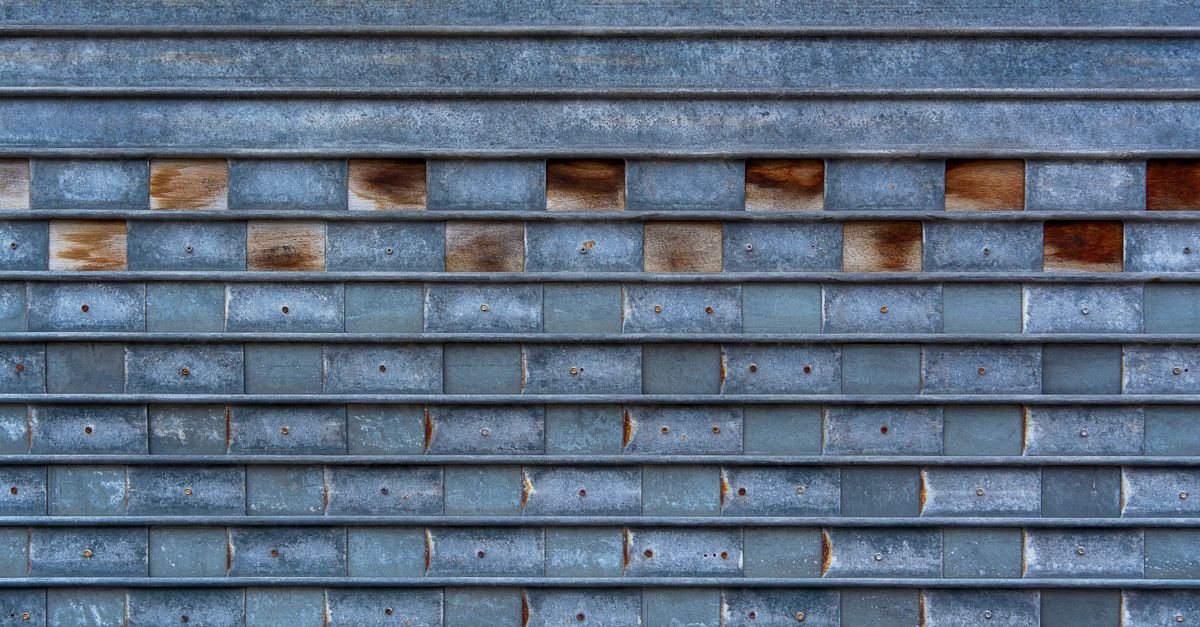
How thin is the skin? The US model codes quoted in TDS-157 require foam plastic in a door to be covered by a minimum of 0.010 inch of steel, 0.032 inch of aluminium or 0.125 inch of wood — and the sheet notes that doors on one- and two-family dwellings are exempt from even that. Real doors use more than the code floor, but ten thousandths of an inch is the figure the industry was willing to write down.
The risk is not that a jet punches through the skin. It will not. The risk is that the panel has nowhere to put water. A wall cavity weeps and a vinyl lap sheds downward; a garage door section is closed on all six sides, so anything that gets in past a hinge screw, a split seam or a perished glazing strip stays in there against the bond line with no drain and no airflow.
DASMA’s home-inspector checklist, TDS-167, asks three questions about the sections: are they free of signs of fatigue, free of signs of cracking, and “free of any signs of separation of materials.” That last one is the trade’s phrase for the sandwich coming apart, and it is a line item on a fifteen-minute inspection because it happens. A structural panel that also has to be a door is already a lot to ask of two thin sheets and a block of foam.
The Seals Are Shaped to Shed Rain, Not to Stop a Jet
DASMA publishes a 24-page terminology standard, TDS-160, and reading the seal definitions one after another is the quickest education available on why a garage door loses this fight.
Astragal: “a compressible or deformable seal provided on the bottom edge of a door.” It works by being squashed, and what squashes it is the weight of the door resting on the slab.
Drip lap: “an angled weather seal provided between sections on steel doors in lieu of a rabbeted joint to prevent entrance of the elements.” An angle. A shingle, in effect, at every horizontal joint, keeping the elements out the way a roof tile does — by sitting above the thing below it with gravity on its side.
End stile sealing strip: “foamed plastic strip to seal sections at end stiles of steel and fiberglass doors.”
Glazing strip: “extruded plastic or rubber strips that fit against glazing and window frame to resist water infiltration.” Resist. Not exclude.
Not one of those is rated against pressure, because not one of them was ever asked to be. They are geometry and squash, and both assume the water is falling.
The clearest proof sits in a different sheet. TDS-197 is DASMA’s document on rainwater getting under the bottom of a sectional door, and its proposed fix is not a better seal — it is the concrete. Slope the slab three to five degrees under the door, or cut a rectangular notch at least half an inch deep, sized for a two-inch track and a two-inch-thick section, so the door closes down into a rebate. (DASMA TDS-197, Water Infiltration Under the Bottom of a Sectional Door) They fix it with the floor because the door cannot fix it.
Then there is the Scope paragraph, which ends the argument. TDS-197 states that it “does not include driven or pressurized water directed at or between the section interfaces.” The one document the industry publishes about water getting past a garage door explicitly declines to cover pressurised water aimed at the joints. That is not an oversight in a two-page sheet. That is a scope note written by people who know exactly what happens and would rather not be asked about it.
Everything That Makes the Door Move Lives in the Spray Zone
Every residential opener listed to ANSI/CAN/UL 325 has to carry entrapment protection, and on almost every domestic installation that means a photoelectric sensor — a through-beam pair with an emitter one side and a receiver the other, or a retro-reflective unit firing at a reflector. DASMA publishes where they go, and two of the numbers matter here: the beam must be emitted no higher than six inches above the garage floor, and the sensors must sit within six inches of the path of the door, measured perpendicular to the door. (DASMA TDS-364, Installation Location of Photoelectric Sensors on Residential Garage Doors)
Read that as a map of where not to spray. The bottom six inches of the opening, six inches either side of the door line, is the only part of the whole assembly with a lens on it — and it is also the strip holding the leaf mulch, the salt and the tyre grime you got the machine out for.
A photo eye does not have to break to stop working properly. It only needs a film on the lens, a bead of water in the wrong place, or a degree of misalignment from a knock. The obvious failure is the door refusing to close while the opener blinks at you, which is merely irritating; the one worth worrying about is the alignment that still looks fine and never gets tested. So test it. TDS-364 gives the procedure: start the door moving down, put a controlled obstruction in the path of the beam, and confirm the door reverses and returns to fully open. DASMA asks for that monthly. Do it after a wash as well, because you have just spent twenty minutes throwing water at the one place it lives.
Rollers, hinges and bearings are the quieter casualty. Garaga’s schedule is metal lubricant on rollers, hinges and springs every three months, worked mainly into the bend of the track, with an explicit warning never to put petroleum-based lubricant near the weatherstripping because petroleum attacks the rubber. Detergent and pressure together are a degreasing operation. Run that down a track and nothing visible happens; you have just moved the next lubrication forward and will find out about it in February.
Then the springs. TDS-167 carries a heading reading “Serious Injury or Death May Occur,” under which it says springs and spring hardware are under high tension, that a broken spring means you stop operating the door, and that you should “not try to remove, repair or adjust springs or any door parts or mounting surfaces.” Extension springs have to run a containment cable through the middle so the pieces stay in the garage if one lets go.
A pressure washer will not make a torsion spring fail, and I am not going to pretend otherwise. The hazard is the sequence: you are up a stepladder with a wand, the door is open above you, the counterbalance fully loaded, and the dusty assembly at head height looks like it could do with a rinse as well. The spring is the one component where the correct answer to “while I’m here” is a phone number. Wash the door closed, from outside, and leave the inside of the assembly to somebody with winding bars.
Nobody Publishes a PSI for a Garage Door, Only a Do Not
The coating argument is settled elsewhere on this site. On a factory-finished metal product the coating is the product and the metal is just what it is stuck to — that case is made properly, with the published numbers, on cleaning a metal roof. A garage door is the same family: pre-painted steel finished in a factory, over a primer, in conditions you cannot reproduce with a brush on a Saturday.
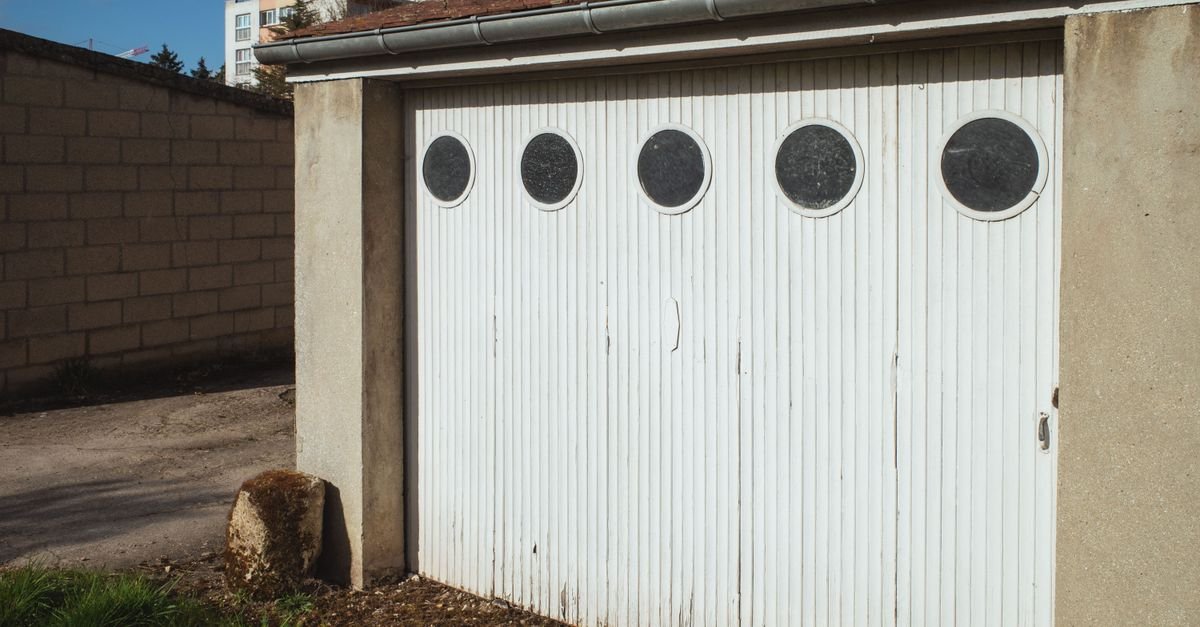
What is specific to this surface is what happened when I went looking for the ceiling. On most exterior products somebody eventually commits to a maximum — Eagle Roofing publishes 1,200 PSI for concrete tile, decking and siding makers publish their own. For a residential garage door finish I could not find a single published PSI ceiling from any door manufacturer. Not a generous one, not a cautious one. What they publish instead is a prohibition and a bucket.
That gap is the one strong opinion on this page. A published maximum implies the manufacturer thinks there is a safe operating window worth describing to you. A flat “do not” implies they do not think there is one. On a product where a single pass of the wand hits the finish, the drip laps, the astragal, the bonded core and an optical safety sensor inside the same six seconds, that judgement looks right to me.
What they will tell you is how to wash it. Clopay asks for a clean at least twice a year, quarterly if you live somewhere coastal or somewhere the roads get salted, using about one cup of a non-toxic biodegradable cleaner containing less than 0.5% phosphate in two gallons of warm water, or plain household dishwashing detergent, applied with a very wet cloth, a sponge or a soft-bristle brush. It also says, in its own capitals, DO NOT use scouring powders or solvents. Chalky residue on your palm afterwards is a separate diagnosis with its own tests — that is what chalking is — and no amount of extra pressure fixes it.
Windows get a stricter rule. Polycarbonate glazing takes no abrasive or highly alkaline cleaner, and no benzene, gasoline, acetone or carbon tetrachloride, and it never gets a squeegee or a razor blade. Polycarbonate scratches if you look at it with intent.
A wooden or composite door is a different argument, resting on the state of the paint rather than a factory coating, and it is made in full on painted wood.
Cleaning Garage Door Panels Without a Wand
Take the four pages together and they describe the same job in the same order.
1. Close the door completely, including the pass door if there is one.
2. Rinse the loose dust off with a garden hose, working top to bottom.
3. Mix a cup of mild detergent into two gallons of warm water. Car wash soap beats dish soap for the same reason it does on a vehicle: it lifts road film without stripping the wax underneath.
4. Wash bottom to top, in sections you can comfortably reach, with a mitt or soft-bristle brush. Bottom to top is not fussiness — a clean rivulet running down dirty paint dries into a streak you can read from the pavement.
5. Let it dwell three to five minutes, and do not let it dry on the surface.
6. Rinse top to bottom with the hose, keeping the water travelling down and across. Never up into the drip laps.
7. Do the weatherstrip and the frame separately with the same solution, then rinse.
8. Dry it off, and wax if that finish takes wax.
Detergent and dwell time do the work, and on this surface they almost always finish it. Road film, pollen and a little mildew are what a garage door actually carries, and none of them needs pressure — they need five minutes of contact time and something to carry them away.
If you are going to use the machine anyway, because it is already sitting on the driveway, the only defensible use is as a rinse. Widest tip you own, lowest setting, standing well back, held level or angled slightly downward. Never from below a section aiming up into a joint, never within a couple of feet of the astragal, never at a window, never at the sensors, never into the track. Simple Green’s own pressure-washer directions ask for a minimum of two feet and a nozzle held perpendicular to the surface, and they still attach the 40-degree warning to it.
And if a panel seam has already opened, a glazing strip has perished or the bottom section is visibly damaged, do not point a machine at that door at all. You would be filling the panel through the exact fault you were hoping to wash out of it.
What to Check Once the Door Has Dried
- Test the photo eyes. Start the door down, obstruct the beam, confirm it reverses and returns fully open. Two minutes, and it is the check that matters most after a wash.
- Run one full cycle and listen. A roller that has lost its lubricant announces itself before it fails.
- Re-lubricate rollers, hinges and the bend of the track, keeping petroleum-based products away from the rubber.
- Walk the astragal. Check it contacts the floor along its whole length, treat it with a vinyl protectant, and replace it if it is cracked or has taken a set.
- Look along the bottom rail a day later. If water dribbles out of a section twenty-four hours after you washed it, it went in somewhere, and that door is a cloth-only door until somebody finds the hole.
- Wax it if the finish accepts wax. Garaga says annually, Raynor says every six months with a quality car wax — and Raynor excludes its AccuFinish and ArmorFinish products and anodised aluminium from waxing entirely. (Raynor, How To Clean Your Garage Door)
The slab inside is a separate job with a separate problem, mostly about where several gallons of water are going to end up: cleaning garage floor concrete covers that one.
FAQ
Can you pressure wash a garage door?
The manufacturers say no. Raynor’s cleaning page states “do not use a pressure washer,” Garaga says “NEVER use a high-pressure spray washing machine,” and Clopay’s cleaning guide does not acknowledge the tool at all. If you use one regardless, use it only as a low-pressure rinse with the widest tip, at least two feet back, angled level or downward, and never aimed up into a panel joint or at the bottom seal.
What is the best thing to clean a garage door with?
A bucket of mild detergent and a soft wash mitt. Clopay’s published mix is about one cup of a non-toxic biodegradable cleaner with under 0.5% phosphate in two gallons of warm water, or ordinary dishwashing liquid. Car wash soap does the same job. Avoid scouring powders, solvents and anything abrasive.
How often should you clean a garage door?
Clopay asks for at least twice a year, and quarterly in coastal areas or anywhere the roads are salted in winter. Salt and coastal aerosol are the reason for the shorter interval, not dirt.
Why won’t my garage door close after I washed it?
Almost certainly the photoelectric sensors. They sit no higher than six inches above the floor and within six inches of the door’s path, so they are directly in the splash zone, and a wet or dirty lens or a knock out of alignment will stop the door closing. Dry both lenses, check they are aimed at each other, and run DASMA’s obstruction test.
Can you use bleach on a garage door?
Only as a spot treatment, heavily diluted, on something like an oil mark or heavy mildew, rinsed off immediately. Raynor allows dilute bleach for stubborn stains and warns never to mix it with other cleaners. It is not a wash solution for the whole door and it does not belong near the hardware.
How do you clean the rubber weather strip at the bottom of a garage door?
Wash it with the same mild detergent you used on the panels, rinse properly, let it dry, then treat it with a vinyl protectant. Keep petroleum-based products off it entirely — Garaga’s wording is that petroleum attacks the rubber — and replace the astragal if it is split or no longer touches the floor along its full width.
Can you pressure wash a wooden garage door?
The answer is the same as for any other painted wood: it depends on the condition of the paint rather than on the door. Sound paint, a wide tip and low pressure survive. Failing paint does not, and lead is a real consideration on anything painted before 1978.
Wash It Like a Car, Not Like a Driveway
The two jobs sit ten feet apart and have almost nothing in common. The slab wants volume, a wide fan and somewhere for the runoff to go. The door wants a mitt, five minutes of dwell time and a garden hose, because behind that painted skin there is a foam core with no drain, a stack of seals that only work downhill, and a safety sensor with a lens on it at ankle height.
If the machine is already out for the concrete, finish the concrete. Then coil the hose, go and get the bucket, and give the door its twenty minutes. The sensors will still be talking to each other next week, which is more than the wand was offering.