Last Updated on September 23, 2026 by Umar Farooq
A pressure washing hose is chosen by bore first and length second: 1/4 inch handles anything up to about 3 GPM, 3/8 inch takes over above that, and the hose length you are worrying about is costing you far less pressure than the internet has told you.
That second half is the part nobody believes. Every forum thread about a machine that feels weak eventually arrives at “how long is your hose,” said in the tone of someone who has found the culprit. Then the hose gets shortened, nothing changes, and the thread moves on without anyone updating the theory.
So this starts with the spec that decides things — inner diameter — then gives you real friction numbers from a manufacturer’s chart. After that: materials, non-marking covers, what a burst rating is really measuring, and why hoses kink where they kink. Threads and couplers are a separate subject. This is the hose itself.
Bore First: 1/4″, 5/16″ and 3/8″ Pressure Washing Hose Compared
The number that matters is the inner diameter, written ID. Not the outside dimension, which varies with how much reinforcement is wrapped around the bore, and not the fitting size, which is a separate thing entirely.
| Bore (ID) | Flow it suits | Typical pressure rating | Usually found on |
| 1/4″ | 0–3.0 GPM | up to ~3,200 PSI | Electric and homeowner gas machines |
| 5/16″ | ~2.5–4.0 GPM | ~2,700–3,600 PSI | Prosumer gas, factory-fitted on some 3,000+ PSI units |
| 3/8″ | 3.0–8.0 GPM | 4,000 PSI and up | Contractor gear, hot-water skids, long runs |
| 1/2″ | 8.0–15 GPM | varies widely | Industrial and jetting work |
Those GPM bands are the industry’s standard sizing rule, and they are about flow, not pressure. A hose does not care how hard the pump pushes. It cares how many gallons a minute you force through a given hole, because that sets water velocity, and velocity creates friction.
Match the hose to what comes out of your machine, not to what is printed on the box in the largest font. If you are unsure what your unit actually flows, settle the GPM you need before buying any hose.
One trap in that table: bore and pressure rating are independent specs, and people routinely mash them together. The ratings overlap messily — a 1/4″ hose can be rated higher than a 5/16″ one depending on construction. A hose can be far too narrow for your flow and still be rated well above your pressure. It will simply eat PSI on the way to the nozzle.
What a 1/4-Inch Hose Actually Supports
This is the size that ships with almost everything sold to homeowners, and it is correctly specified more often than the upgrade advice suggests.
Run the numbers. Electric homeowner units sit around 1,300–2,000 PSI at 1.2–1.6 GPM. Homeowner gas machines run 2,000–3,200 PSI at 2.0–2.8 GPM. Both land inside the 0–3.0 GPM band 1/4 inch is built for, the gas machines nearer the ceiling.
So: on an electric machine, 1/4 inch is correct and there is no upgrade waiting for you. On a 2.5 GPM gas machine it works, and 5/16 inch will feel slightly better on a long run. On a 4 GPM machine it is genuinely holding you back.
Where 1/4 inch stops being enough:
- Above 3 GPM. The friction curve gets steep fast. This is the actual threshold.
- Above its pressure rating. A 3,200 PSI hose on a 4,000 PSI prosumer machine lives permanently near its limit.
- On a surface cleaner. Those generally want around 3 GPM, which puts you at the edge of the band with nothing spare.
- Hot water. Temperature rating is a separate spec, and most homeowner hose is cold-water only.
The trade runs the other way too. On a 1.5 GPM electric machine, 1/4 inch out-handles 3/8 inch without giving up a single usable PSI. Buying more bore than your flow needs is one of the few upgrades that is unambiguously worse.
Where Your PSI Goes Between the Pump and the Nozzle
Water rubbing along the inside of a hose loses energy, and that loss shows up as lower pressure at the nozzle. It scales with flow rate and with length — not with the pressure your pump is producing. A 4,000 PSI machine and a 2,000 PSI machine flowing the same gallons through the same hose lose the same number of PSI.
Hydro Tek, which builds pressure washers, publishes an approximate loss chart for 3/8 inch hose:
| Hose length | 2 GPM | 3 GPM | 4 GPM | 5 GPM | 6 GPM | 7 GPM |
| 100 ft | 25 PSI | 50 | 90 | 130 | 220 | 300 |
| 200 ft | 50 PSI | 100 | 180 | 260 | 440 | 600 |
| 300 ft | 75 PSI | 150 | 270 | 390 | 660 | 900 |
Read the top-left cell again. A hundred feet of 3/8 inch at 2 GPM costs 25 PSI — one percent of a 2,500 PSI machine, less than the variation from holding the wand an inch further back. Now the bottom-right: 300 feet at 7 GPM costs 900 PSI, which is a different conversation entirely.
Length is not the variable. Flow is the variable, and length multiplies it. Doubling the length doubles the loss. Doubling the flow roughly triples or quadruples it. The useful question is never “is my hose too long” but “is my hose too narrow for what my pump is moving.”
The honest caveat, because I went looking for a second chart to check the first. Ultimate Washer publishes one and it disagrees: 120 PSI per 100 feet of 3/8 inch at 3 GPM where Hydro Tek says 50, and for 1/4 inch, 180 PSI at 2 GPM rising to 380 at 3 GPM. Two published industry charts, one roughly double the other, neither stating its assumptions about wall roughness or fitting count. I am not going to pretend that is settled. What both agree on is the shape: 1/4 inch at 3 GPM loses hundreds of PSI per hundred feet, and 3/8 inch at 2 GPM loses almost nothing. The bore does the work, not the tape measure.
One loss no hose guide mentions: height. Lifting water costs pressure regardless of bore or flow — roughly 22 PSI per 50 feet of vertical rise, 43 PSI per 100 feet. Wash a second-storey gutter from the ground and that is spent before friction gets a turn.
How Long Should a Pressure Washing Hose Be?
Fifty feet, for almost everyone. Twenty-five is the factory default on cheap machines and short enough that you spend the day moving the machine instead of cleaning. A hundred feet is where handling costs outweigh the convenience.
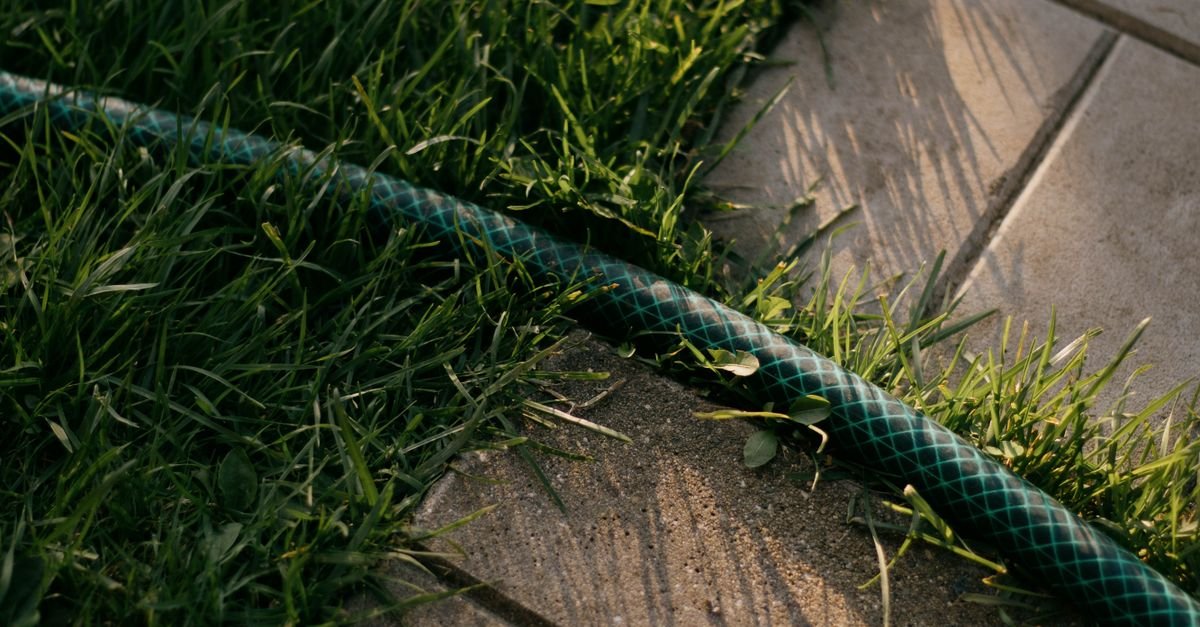
At homeowner flows PSI is not the deciding factor, so decide on what actually changes your afternoon:
- Weight and drag. You pull this behind you all day. Every extra foot is friction on the ground, around corners and over steps.
- The water inside it. The arithmetic: 100 feet of 3/8 inch bore holds about 0.57 gallons, 100 feet of 1/4 inch about 0.26. Small numbers, but it is dead weight spread along the whole length, and it is what you feel lifting a loop over a shrub.
- Where it lives afterwards. A hose that does not fit your storage lives in a heap, and a heap is where kinks are born.
- Marking risk. More hose on the ground is more hose dragging over what you just cleaned.
Adding a second 50-foot length to reach further is legitimate — losses simply add, and at homeowner flow you have margin to spare. Each joint is one more place to leak, and joining two different bores means the narrow one sets the limit for the whole run.
Rubber, PVC and Polyurethane Are Not Interchangeable
Three cover materials dominate, and they fail in three different ways.
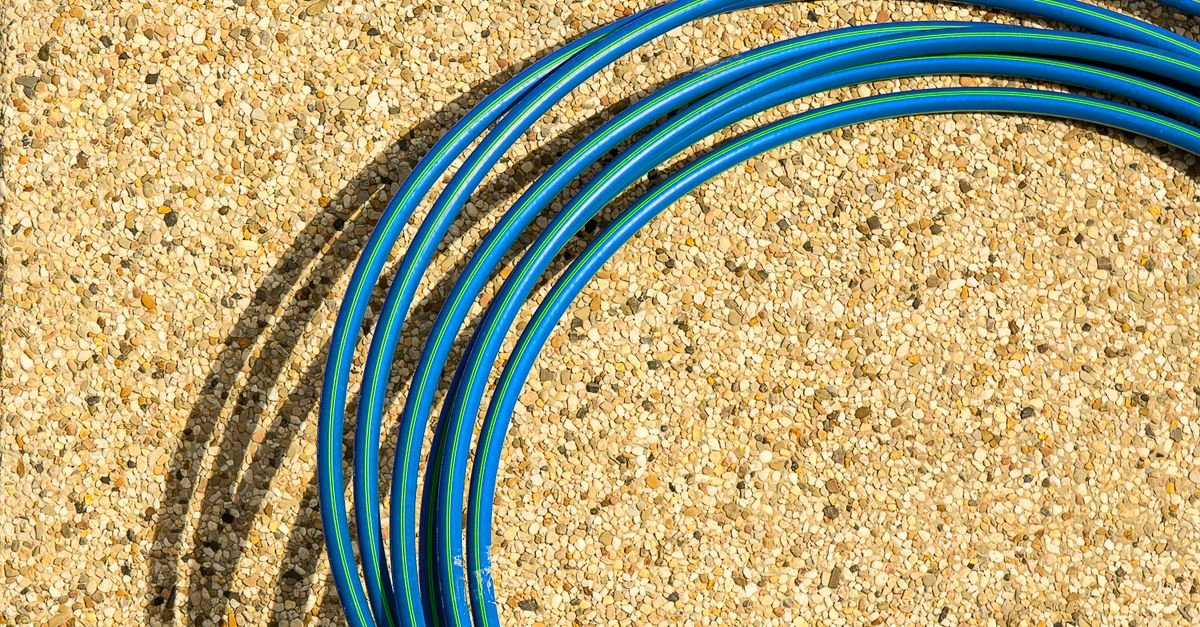
| Material | Flexibility | Weight | Marks surfaces | Cold behaviour | Best for |
| PVC | Poor | Light | No | Goes stiff and kink-prone | Occasional use, mild weather |
| Rubber | Very good | Heavy | Yes, black rubber scuffs | Stays flexible | Heavy use, abrasive ground |
| Polyurethane | Good | Light | No | Stays flexible | Residential work on finished surfaces |
PVC is what comes in the box. Cheap, light, and possessed of a memory like a spring — it holds the shape of whatever coil it shipped in and fights you about everything else. In cold weather it stiffens far enough to take a set rather than bend. Fine for a couple of weekends a year.
Rubber is the contractor answer. It drapes rather than coils, survives being dragged over gravel, and stays supple when cold. The costs are weight, and a black cover that leaves scuff marks on exactly the surfaces you were hired to clean.
Polyurethane sits between: close to rubber for abrasion resistance and cold flexibility, close to PVC for weight, and it does not mark. It costs more, which is the entire reason it is not standard.
Clean a driveway twice a year and the hose in the box is fine. Wash siding, decking and pavers and polyurethane earns its price the first time you do not have to go back over a scuff.
Non-Marking Is a Cover Compound, Not a Colour
Non-marking refers to the compound of the outer cover, not the colour. A grey hose is not automatically non-marking, and a black one is not automatically a marker. Colour is a strong hint — makers use grey or blue precisely so it stands out on the shelf — but the spec is printed on the hose or the packaging, and that is what to read.
Marking is carbon black in the cover transferring onto a lighter surface under abrasion. You get it on white vinyl siding, painted decking, light pavers, pool surrounds and garage floors. It looks like a pencil line, it usually scrubs off, and that is not the point. The point is that you now have a second job.
The field test takes ten seconds: press a loop flat against a light-coloured paver and drag it a foot. A grey line means you own a marking hose. Note that non-marking is a cleanliness spec, not a strength spec — it says nothing about the reinforcement underneath.
Burst Rating Is a Destruction Test, Not a Number You Buy On
Two numbers get printed on hose packaging and they mean very different things. Working pressure is the maximum the hose is designed to run at continuously — the number you buy on. Burst pressure is where a sample of that hose was taken into a rig and destroyed. It is a quality-control figure, not a rating you may use, and treating it as headroom is how hoses fail.
In hydraulic hose, SAE J517 sets a 4:1 design factor — minimum burst at four times stated working pressure. Consumer pressure washer hose is not obliged to meet that standard, and the ratio on a discount hose can be tighter. Which is exactly why the marketing leads with the burst number: it is four times larger and it is not a promise.
Buy on working pressure, 25–30% above what your machine produces: a 3,000 PSI machine wants 3,750 PSI or better. That margin absorbs the spike every time you release the trigger and the unloader dumps flow — a real, repeated event.
And the margin is not paranoia. A hose losing its reinforcement does not always split open; sometimes it develops a pinhole, and a pinhole on a 3,000 PSI line is a needle-fine jet you can barely see. That jet is easily capable of breaking skin and driving water into the tissue underneath, which is a surgical emergency rather than a cut — and the window for a good outcome is hours, not days. So never run a hand down a pressurised hose hunting a leak. Release the trigger, shut the machine down, find it dry.
Kinks, Coils and the Memory a Hose Keeps
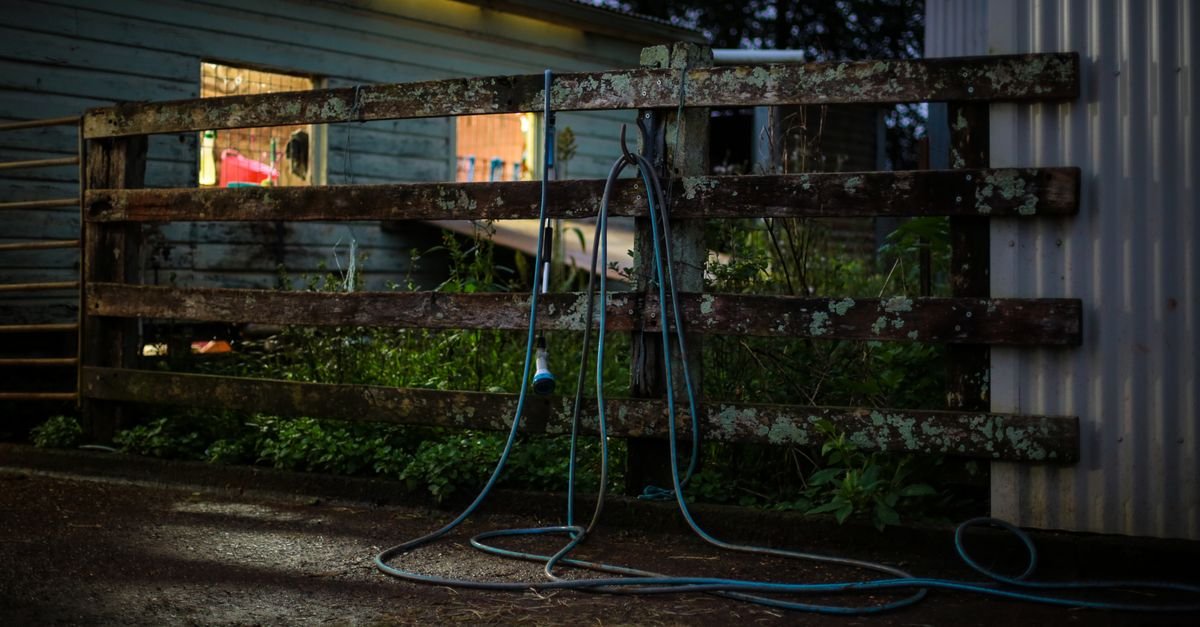
A kink is a permanently collapsed section of bore. Under pressure the hose usually pushes itself back open, so you often will not notice — but the reinforcement there has been folded past where it was designed to go, and that is where the hose eventually fails.
Why they happen, in rough order of frequency:
1. Coiling the same way every time. One direction builds twist along the length. Enough twist and it folds. Figure-eight it instead, which cancels the twist on alternate loops.
2. Cold. PVC stiffens below about 40°F and takes a set rather than bending. Run a minute of water through it before you drag it around.
3. Tight radius at the gun and the machine. Both ends get whipped around. Bend restrictors exist for exactly this.
4. Storing it compressed. A hose crushed under something in a shed comes out with that shape in it.
5. Driving over it. Self-explanatory, and common.
The storage rule that matters most is seasonal. Water left in a hose over winter freezes and expands, doing there what it does in a pump head — except the hose usually survives and the pump does not. Drain the hose when you drain the machine, and anywhere that freezes, treat winterizing as mandatory.
Is Your Hose Length Costing You Pressure? Run This Check
If the machine feels weak, work through this in order. The hose is fourth on the list for a reason.
1. Change the nozzle. A partially blocked tip is the most common cause of a machine that has lost its edge, and swapping takes five seconds. If pressure returns, you have found it.
2. Check your inlet. Every pressure washer has two hoses, and for this step it is the other one. The garden hose feeding the machine must deliver at least its rated GPM with headroom. A kinked, undersized or 100-foot inlet hose starves the pump, and a starved pump cavitates — slow permanent damage, producing exactly the “feels weak” symptom blamed on the high-pressure side.
3. Do the arithmetic before anything physical. Find your GPM in the loss table above and work out what the hose is actually costing. For most homeowners that is 25–50 PSI on a machine producing 2,500, which is not a problem. At 4 GPM through 100 feet of 1/4 inch, it might genuinely be.
4. Then test it. Fit the shortest hose you own, same distance, same surface. No change means the hose was never the issue. A visible difference gives you a measured reason to upsize the bore — not shorten the length.
Most of the time this ends at step one or two. If not, the wider low pressure diagnosis covers the unloader and the inlet filter.
FAQ
Does a longer pressure washer hose reduce pressure?
Yes, but far less than people expect at homeowner flow rates. Hydro Tek’s published chart puts the loss through 100 feet of 3/8 inch hose at 25 PSI at 2 GPM — about one percent of a 2,500 PSI machine. Loss rises steeply with flow, so at 6 or 7 GPM the same hose costs 220–300 PSI per 100 feet. Length multiplies the loss; flow creates it.
Is a 1/4 or 3/8 inch pressure washer hose better?
Neither is better in the abstract. Match the bore to your flow: 1/4 inch for 0–3.0 GPM, 3/8 inch for 3.0–8.0 GPM. On a 1.5 GPM electric machine a 3/8 inch hose is heavier, stiffer and delivers no extra pressure. On a 4 GPM machine a 1/4 inch hose is the restriction.
Can I use a garden hose as a pressure washer hose?
No. Garden hose is typically rated well under 100 PSI and a pressure washer produces 20 to 40 times that. It will rupture. Garden hose belongs on the inlet side, feeding the machine, and nowhere else.
Can you connect two pressure washer hoses together?
Yes, provided both are rated for your machine’s working pressure and you use a proper high-pressure coupler. Losses add, and if the bores differ, the narrower hose sets the limit for the whole run.
How long does a pressure washer hose last?
There is no honest hours figure — it depends almost entirely on handling. What kills hoses is kinking, UV exposure, freezing with water inside and abrasion from being dragged over concrete. A hose coiled loosely, drained and stored out of sunlight outlives one that lives in a heap by years.
Can a pressure washer hose be repaired?
No. The reinforcement holds the pressure, and once it is cut, kinked or corroded, nothing applied from outside restores it. If it is leaking or bulging, replace it.
Match the Bore to the Gallons, Then Worry About the Feet
Find your machine’s GPM. Under 3, keep the 1/4 inch hose, and buy 50 feet of polyurethane if you clean anything light-coloured. Over 3, go to 3/8 inch and check the working pressure rating clears your machine by a quarter. That is the whole decision, and it takes longer to read than to make.
The rest — friction tables, burst ratings, two industry charts that disagree by a factor of two — is worth knowing mostly so you can stop worrying about it. If your hose is the right bore for your flow, it is not why the driveway is taking so long. That will be the nozzle. It almost always is.