Last Updated on October 6, 2026 by Umar Farooq
The best steam pressure washer for you is the one whose listing says where it put the thermometer — because almost every temperature advertised in this category was measured inside a sealed boiler, and the number that reaches your grout line is a different and smaller one.
Type the phrase into a marketplace search and the results come back with no sense of scale. A plastic canister that weighs what a vacuum weighs. An enamelled Italian boiler three times as heavy. A machine on pneumatic tyres with a burner and a two-and-a-half-gallon-a-minute pump. A carpet extractor with a recovery tank. All four answer to “steam”, and the listings do very little to tell you which one is in your basket.
The class question itself is settled on steam cleaner vs pressure washer, which established that the phrase covers three different machines. Nobody had checked that against the catalogue, so I read every steam listing I could reach and wrote down what each one was willing to publish. It turns out to be four machines, not three — and one of them cannot make steam at all, in its own first bullet.
Water Boils at 212, and Every Bigger Number Is Indoors
Start with the physics, because it decides what a temperature claim can mean.
Spirax Sarco, which has built steam systems for a century, states the baseline plainly: “At atmospheric pressure the saturation temperature is 100 °C. However, if the pressure is increased, this will allow the addition of more heat and an increase in temperature without a change of phase.” Heat the vapour past that point and you get the other category — “Temperature above saturation temperature is called the degree of superheat of the steam” (Spirax Sarco, what is steam).
So there are two ways a machine gets water above 212°F, and both happen inside a pressure vessel. Neither survives the orifice, because the steam leaves into a room at atmospheric pressure.
One manufacturer explains that sequence on the record about its own machine. Dupray’s specification for the Tosca describes a boiler “pressurized to 5 times the atmospheric pressure to increase the water’s boiling point to 302ºF / 150ºC”, after which “Steam is then superheated to 316ºF / 160ºC resulting in the driest vapor possible, at only 5% water content.”
Three things in that sentence appear in no listing in this census. The high temperature is bought with pressure. The last few degrees are superheat. And “dry steam” is a percentage rather than a yes or no, with five per cent water the honest figure for a good machine — which Spirax Sarco explains: “to produce 100% dry steam in an industrial boiler designed to produce saturated steam is rarely possible, and the steam will usually contain droplets of water.”
So a listing leading with 300°F has not told you it is hotter than one saying 212. It has told you it owns a pressurised boiler and a thermometer. Neither of those is a measurement of whatever is touching your tiles.
I Wrote Down Every Number on 28 Steam Listings
Fourteen search phrasings, every listing read in full: 28 listings, which collapse to 26 distinct machines once two duplicate pairs are set aside. The bottom two rows are the ones that matter.
| Figure | Listings that publish it |
| A temperature of some kind | 20 of 28 |
| A boiler or element wattage | 15 of 28 |
| A steam pressure in bar or PSI | 12 of 28 |
| A tank capacity and a run time together | 9 of 28 |
| A supply voltage | 4 of 28 |
| Where the temperature was measured | 2 of 28 |
| A steam output rate, by weight or volume per hour | 0 of 28 |
Nothing in this category publishes the figure a steam cleaner is actually sold on. Not one listing of twenty-eight states how much steam the machine makes per hour, in pounds, grams, litres or gallons. The specification that governs how fast you get across a kitchen floor is absent from every page, from the smallest plastic canister to the burner-fed machine at the top of the category.
What they publish instead is temperature, and two listings of twenty-eight say which end of the machine the figure came from. One of those two is a note buried in a bullet, on the listing I was least willing to link. The four machines sorted themselves out like this.
| What the listing is really selling | How to recognise it | Listings |
| Vapour steamer — canister or handheld, mains element | one wattage near 1,500, a bar or PSI figure, a tank in litres, no pump | 19 |
| Heated extractor with a vacuum | a recovery tank in gallons, extraction pressure under 200 PSI, a temperature under 212°F | 5 |
| Pressure washer with a separate steam boiler bolted on | a PSI and GPM pair *plus* an unrelated wattage | 2 |
| Hot-water pressure washer with a wet-steam mode | a temperature *rise*, four-figure PSI, 230 volts | 2 |
The spread inside that first row is the giveaway, and it is not a quality ladder. Nineteen of twenty-eight listings are one machine — a mains element heating a small pressurised tank — in bodies running from a nine-pound plastic box to a twenty-six-pound enamelled one. The heavier end of that row does not make more steam, and proving that took some arithmetic.
The Boiler Says 320 and the Tip Says 284
Two makers here publish real documentation, and both do the thing the listings refuse to do: they label the temperature by where they measured it.
Vapamore’s instruction manual for the MR-1000 Forza prints its technical data as a list, and the list carries two temperatures for one machine — “Boiler temp: 160C – 320F” and “Steam temp at tip: 140C – 284F PEAK” — alongside “Heating element: 1900W – 15AMP”, “Steam Pressure: 5BAR – 75PSI PEAK” and “Boiler capacity: 3.7LTR – 1.00 GAL”. Forty pages later a third figure appears in prose: the machine “produces steam with an output temperature between 210° to 240° degrees” (Vapamore MR-1000 Forza instruction manual).
Three hundred and twenty in the boiler. Two hundred and eighty-four at the tip. Two hundred and ten to two hundred and forty coming out. One machine, one document, a hundred and ten degrees of spread, every figure labelled with where it was taken — and the manual even says where the loss happens: “The steam temperature will condense and cool within 1” of the tool tip.”
Dupray does the same thing in a single word. Its specification table does not say “steam temperature”; it says BOILER STEAM TEMPERATURE: 316°F / 160°C, and elsewhere describes what the display shows you as “the operating internal temperature”. On its domestic Neat it declines to give an exit figure at all, saying the steam temperature at the exit point depends on the accessory used and whether it is covered with a cloth — and recommending a microfiber bonnet precisely to insulate the steam and raise the temperature at the surface.
That is the audit in one observation. Both companies here that write manuals tell you the number is internal. The twenty-six listings without manuals give you one number and no location.
Vapamore MR-1000 Forza. It earns the recommendation for that reason: you can buy it knowing what arrives rather than what is advertised. The specification behind it is genuine — a 1,900-watt element on a 15-amp circuit, a 3.7-litre stainless boiler with over three gallons of on-board water behind it, an electronic solenoid that opens the steam line at the machine rather than at the handle to keep the hose dry, and a lifetime warranty on the boiler, element and internal electronics. It suits a detailing bay, a commercial kitchen or a facilities team that will run it for hours. The first limitation is a disagreement. Its listing advertises “95 psi heated steam”; the manual says “Steam Pressure: 5BAR – 75PSI PEAK” and calls 75 psi its “industry high steam burst pressure”. Follow the manual — 95 psi would in any case imply a boiler nearer 338°F than the 320°F the same manual prints. The second is physical: 45 pounds, twenty-two inches on two sides, a product generation dating to 2015. You wheel this one to the job.
A 1,500-Watt Element Boils Two Litres an Hour
Since no listing publishes an output rate, the rate has to come from the wattage, and the conversion below is my arithmetic rather than anyone’s published figure.
Spirax Sarco supplies both numbers it needs. Bringing a kilogram of water from 0 to 100°C takes 419 kJ; turning that kilogram into steam takes a further 2,257 kJ of enthalpy of evaporation. Call it 2,676 kJ a kilogram, or about 2,613 from a tap already at 15°C. A watt delivers 3.6 kJ an hour. Divide one by the other and the category reduces to one constant: about 725 watts for every litre of steam an hour, or roughly 2,750 watts for a US gallon an hour.
| Element wattage | Most steam it can possibly make |
| 1,500 W | about 2.1 litres an hour (0.55 gal/hr) |
| 1,600 W | about 2.2 litres an hour |
| 1,900 W | about 2.6 litres an hour |
| 2,500 W | about 3.4 litres an hour |
| 3,300 W | about 4.5 litres an hour |
Apply that to the census and the range stops being a ladder. Of the fifteen listings publishing a wattage, every domestic canister — the plastic one and the enamelled Italian boiler alike — sits between 1,500 and 1,600 watts. That is not a conspiracy — it is 120 volts times twelve and a half amps, which is what a domestic socket hands you. Dupray’s manual says as much: connect it “to a 15 or 20 amp 110V/120V power outlet”, and “to avoid a circuit overload, do not operate another high-wattage appliance on the same circuit simultaneously”.
So the plastic canister and the enamelled Italian boiler make, within a tenth of a litre an hour, the same amount of steam. What the heavier machine buys you is a four-litre stainless vessel instead of a one-and-a-half-litre one, enamelled steel instead of plastic, twenty-six pounds instead of nine, a descale reminder, a drain cap and a published manual. Those are real. More steam is not among them.
The arithmetic also checks any listing giving a wattage, a tank and a run time, which four do. Three pass comfortably, and the fourth taught me something by failing until I read the manual. Dupray’s product page pairs a four-litre boiler with “up to 90 minutes”, which is 2.7 litres an hour against a 2.2 ceiling. The manual explains it: the boiler’s *volume* is four litres, but you fill it with “up to 0.5 gallon / 1.8 litres”, and its operating time is “60-90 MINUTES”. That is 1.2 to 1.8 litres an hour, which 1,600 watts supplies with room to spare. The figures close — in the document rather than on the shop page, which is this article’s argument arriving from an unexpected direction.
Dupray Tosca. The pick for anyone who wants the specification written down, because this is the only machine in the census with a complete and internally consistent published set: 1,600 W at 15 amps on 120 V, 72.5 PSI / 5 bar, boiler steam temperature 316°F, a four-litre stainless boiler on a 1.8-litre fill, seven to ten minutes to pressure, 60 to 90 minutes of operating time, 26 pounds, and a descale interval of twenty hours (Dupray Tosca product manual). It suits a cleaning contractor or a restaurant that will put real hours on it. The limitation is a discrepancy to settle first. The listing advertises “up to 320°F”; the manual’s specification table says 316°F. Take 316. The listing also promises three years with a lifetime boiler warranty while the manual’s commercial clause runs twelve months, so get the term you are being sold in writing — and at a full fifteen amps, this machine wants a circuit to itself.
GOATCLEAN heavy-duty canister steam cleaner. The plainest machine here, and it earns its place on disclosure rather than pedigree: it publishes 1,500 W, 65 PSI, 275°F, a 1.5-litre tank and up to 40 minutes, which is more than most of its neighbours manage, and its tank-and-clock figures land within a tenth of a litre an hour of what the element can physically supply. It suits grout, tiled floors and car interiors for somebody not yet sure they like steam cleaning. Two limitations. There is no manufacturer behind the name in any sense that will matter in three years, and its 275°F sits oddly beside its own 65 PSI, because a boiler held at that pressure would be hotter — so one of those two figures is not describing the steam. Treat the 40 minutes as the tank emptying, not as a duty rating.
One thing the arithmetic will not do, before anybody asks: where a listing’s rate runs *above* its wattage ceiling, the surplus left as liquid rather than vapour — but that gap is not a dryness fraction. It ignores heat lost to the casing and hose, and assumes an inlet temperature nobody publishes. A direction, not a measurement.
One of These Four Machines Cannot Boil Water
The fourth class has no slot in the three-machine taxonomy, and it owns the entire middle ground between the canisters and the pressure washers: the heated carpet and upholstery extractor, sold with the word “steam” in the title.
Five listings are these, from small portables up to walk-behinds — a diaphragm pump pushing hot solution into a fabric at between 100 and 170 PSI, with a two- or three-stage vacuum pulling it back out. On their merits they are good machines. The problem is what their own bullets say about temperature.
One portable: “Built-in 1500W steam heater produces steam up to 176°F (80°C)”. A walk-behind: “Cold water extraction system with integrated 1,200W steam heater reaching up to 208.4°F” — on a product whose own title reads “Steam Carpet Cleaner Extractor – Cold Water”. A 2,000-watt portable: a “2000W heater reaches 150°F”.
One hundred and fifty. One hundred and seventy-six. Two hundred and eight point four. Every one of those sits below the temperature at which water becomes steam at atmospheric pressure, and every one of those products is sold under the word. There is no boiler, no pressure vessel and no phase change. It is hot water, and the machine is honest about everything except its own category.
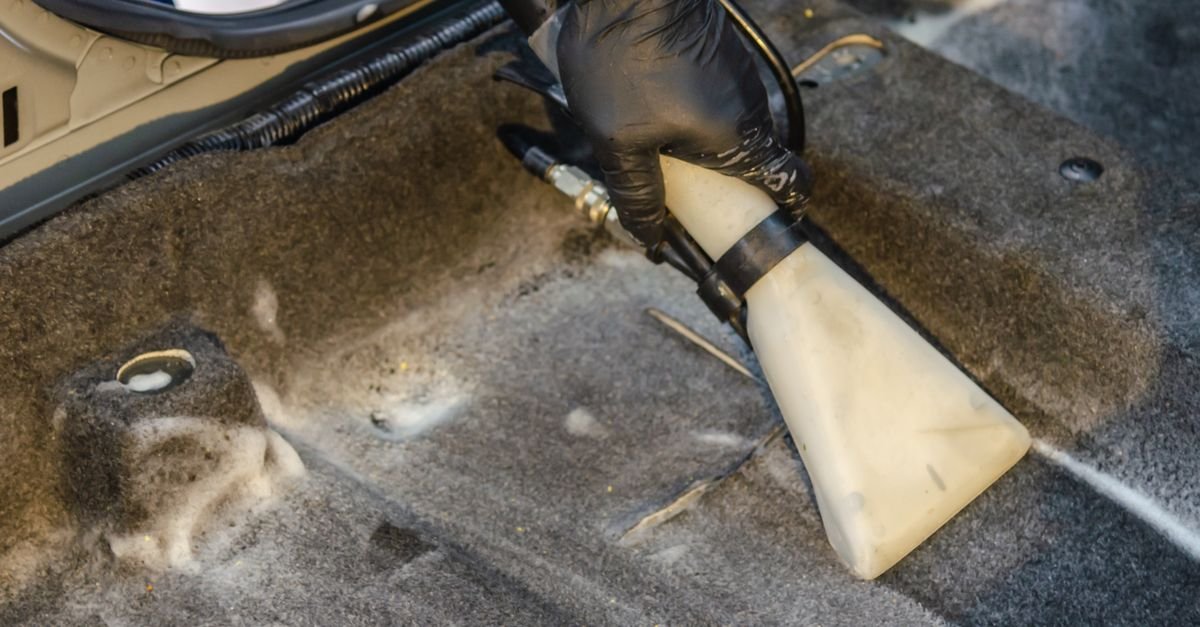
Which is a pity, because if your problem is a car interior, a sofa or a stair carpet, this is the class you want and a steam cleaner is not. Steam has no flow to carry soil back out of a fibre; an extractor exists because it does. Where that boundary falls on a vehicle is worked through on pressure washing inside a car.
Dapper Supply heated carpet and upholstery extractor, 170 PSI. The honest one of the five, which is why it is the pick: its title says “170 PSI Hot Water Cleaner” and its first bullet is headed “HEATED EXTRACTION”, not steam. A 2,000-watt heater to 150°F, a diaphragm pump at 170 PSI and 5.1 GPM, a three-stage vacuum producing 120 CFM and 130 inches of water lift, three- and four-gallon tanks, a 37-foot hose and a stainless wand with dual jets. It suits a detailer or carpet cleaner who needs soil to leave the fibre rather than merely loosen in it. Both limitations are electrical and both are instructive. The 200°F figure in its first bullet needs an external heater sold separately, so what you are buying is the 150°F machine. And it ships with “Dual 33 ft power cords (14.5–16.5 amps)” — two plugs, because one 15-amp circuit will not carry a 2,000-watt heater and a three-stage vacuum at once. That is the socket ceiling from two sections ago, made of copper.
Pick the Class First, Then Read the Wattage
With the four classes separated, the decision gets short. Work out which machine your job wants, then read the one figure that class is sold on.
| What you are cleaning | The class you want | The figure to insist on |
| Grout, tile, hobs, oven interiors, appliance seams | Vapour steamer | Element wattage, plus a published steam pressure |
| Wallpaper, window frames, painted joinery | Vapour steamer, low pressure | Tank size and hose length; pressure is irrelevant |
| Car interiors, upholstery, carpet, stair runs | Heated extractor | Extraction PSI, airflow, recovery tank volume |
| A greasy slab, a fleet, a yard, a wash bay | Hot-water pressure washer | Temperature rise above inlet, and GPM |
| A driveway, siding, a deck, a fence | Not a steam machine at all | Gallons per minute, which is the flow argument |
Wagner Spraytech 915e multipurpose steam cleaner. Of twenty-eight listings this is the only one publishing 212°F and nothing above it: the steamer “holds up to 40 oz. of water and heats up to 212°F (100°C) in under 9 minutes”. By Spirax Sarco’s figure that is precisely the saturation temperature of water at atmospheric pressure, which makes it the one number in this category measured where you are standing. Forty continuous minutes, an eight-foot steam hose, eighteen accessories, and it strips wallpaper, which is what it was built for. The limitation is the other face of that honesty. No steam pressure appears anywhere in the listing, consistent with a machine holding no pressurised boiler — and without pressure behind it, steam will not drive into a grout line the way a 4.5-bar canister does. On a tiled bathroom floor the pressurised canisters will out-clean it. On joinery, frames and wallpaper it is the right tool at the right temperature.
Dupray Neat steam cleaner — reviewed, and I am not linking it. On specification it is the best-documented domestic machine here, and its maker publishes the sentence nobody else will write down: the steam temperature at the exit point depends on the accessory used and whether it is covered with a cloth. Everything else is stated and survives the arithmetic — 1,500 W, 120 V, 12.5 A, a 54-ounce pressurised stainless boiler, 275°F and 50 psi internally, eight to nine minutes to heat and up to 50 minutes a fill, in a nine-pound body.
Then there is the recall, and it is not a footnote. On 26 February 2026 the Consumer Product Safety Commission announced a recall of about 651,145 Neat cleaners in the United States, model DUP020WNA, batch codes 0118-01 through 0425-05, because “the steam cleaner’s boiler can rupture if it is overfilled, corroded and the pressure release valve malfunctions, posing risk of burn hazards or serious injury to users or bystanders.” The notice records “15 reports of boiler ruptures, including four reports of minor burns, bruises, lacerations, and a broken wrist”, and its instruction is unambiguous: “Consumers should stop using the recalled steam cleaner immediately” and fit a free replacement safety boiler cap (CPSC, Dupray USA recalls Neat steam cleaners).
Stock shipping now carries the updated cap, and on that basis a link here would be defensible. I am not making it. A pressurised boiler that has ruptured fifteen times and broken somebody’s wrist is not a thing I will put a buying button on when this page already reviews three other vapour machines that work, and when the batch code that decides whether yours is affected is printed on the underside where you cannot see it until the box is open. If you already own one, stop and go and get the cap. If you want this machine anyway, you do not need me to find it for you — but read the rating label before you fill it.
NorthStar wet steam and hot water pressure washer, 2,750 PSI, 2.5 GPM. The most capable machine here, and the only one in twenty-eight listings that is genuinely two classes at once: a real pressure washer with real flow, and a burner that takes it into wet steam. It is also the only listing whose temperature figure is honest about depending on something outside the machine — an “industry-leading 150° temp rise”, with the 250°F printed as a *mode* rather than as what the machine is. Every other number in this article is a fixed figure taken somewhere the listing will not name; this one is a delta, and a delta tells you to go and measure your own inlet. Why rise beats outlet is argued on this site’s hot-water buying page and not repeated here. Two limitations. The listing names neither the electrical phase nor the burner fuel, and both decide whether the machine can stand where you mean to put it, so get them off the data plate before ordering. And the wet-steam mode buys degrees by giving back flow, so 250°F and 2.5 GPM are not available together — Cat Pumps puts the general rule in its plunger pump service manual, noting that maximum specifications refer to individual attributes and it is not implied that all maximums can be performed simultaneously.
A Model Number Can Be Borrowed From Another Machine
Six listings were read carefully and deliberately not linked, because a page that only recommends is a page you learn nothing from.
The one badged with another maker’s model number. A 3,300-watt tankless machine carries the best sentence in the category, without qualification. In a bullet headed “Note” it says: “The temperature of the steam drops sharply upon contact with air, the closer to the nozzle, the higher the temperature, up to 300℉ at the nozzle.” That is a seller voluntarily explaining the measurement problem this article is about. And I will not link it. Its title reads “3300W High Pressure Steam Cleaner, ZPB140 Port A Blaster”, and ZPB140 is a real model number belonging to a different machine from a different company: Supco’s Port-A-Blaster coil cleaner, published at “Volts 120 VAC”, “Watts 80 W”, “Flow Rate 0.25 GPM” and “Max. Pressure 140 PSI” (Supco ZPB140 product sheet), with Supco’s product page answering “What is maximum temperature for the water?” with 120°F. So a model number advertised on a 3,300-watt, 300°F steam machine belongs to an 80-watt cold-water pump rated to 120°F — one forty-first of the power, a hundred and eighty degrees cooler. Separately, 3,300 watts is twenty-seven and a half amps at 120 volts, and the listing publishes no voltage at all. A model number is a citation, and a citation can belong to a different machine.
The one whose two numbers disagree by seventy degrees. One canister publishes “4.5-5.0 Bar steam at up to 230 °F” — five figures, more disclosure than most of its neighbours manage. The trouble is that the two load-bearing ones contradict each other: Dupray, explaining its own boiler, puts five bar at a 302°F boiling point. A machine holding 4.5 to 5 bar is describing a vessel seventy degrees hotter than its own temperature claim.
The brand publishing two temperatures at one pressure. Three listings from the same seller, all at 4.5 bar: one at 275°F, one at 300°F, and one whose title says “4.5 Bar 300°F Steam Cleaner” while its own second and fourth bullets say 275°F. Saturated steam has one temperature at each pressure. When a listing cannot agree with its own title about which number it believes, the title is not the part to trust.
The two that really are two machines, and the one with no temperature at all. The two in the pressure-washer-plus-boiler row pair a 3,000 PSI electric pressure washer with a separate 1,500-watt steam boiler — the only products here containing two of the four classes in one shell. On the steam half they publish the wattage and nothing else: no temperature, no pressure, no boiler volume, no run time. A 2,500-watt machine manages less, leading with “Powerful 2500W High-Temp” and publishing no temperature at all. In its favour, its 3.5-litre tank and “over 30 mins non-stop” make the only duty claim in the census that *under*sells itself: at 2,500 watts the arithmetic says over an hour.
The best specification I would not buy. A 2,100-watt machine publishes “steam pressure ranging from 4 to 6 bar and steam temperatures between 140°C and 170°C (284°F–338°F)” — the only pair in twenty-eight listings where temperature and pressure move together along the saturation curve, and what a real steam specification looks like. Not linked, because 2,100 watts with no published voltage is seventeen and a half amps at 120, more than a domestic circuit carries, and that is too much machine to buy on an assumption about a plug.
And three canisters from a long-established brand, offering between them one pressure figure, no wattage and no temperature. The only specifications that separate the three are the accessory count and the advertised run time.
FAQ
Is there actually such a thing as a steam pressure washer?
Two things are sold under the phrase and only one is both. A hot-water pressure washer with a wet-steam mode is a genuine pressure washer trading flow for temperature at a restricted tip — real pressure, real gallons per minute, four-figure PSI. A vapour steam cleaner is a boiler with a hose, publishing tens of PSI rather than thousands. A PSI figure in the hundreds or thousands alongside a GPM figure means a washer; bar and a tank in litres means a steamer.
How hot is the steam at the nozzle, rather than in the boiler?
Lower, and only one manufacturer here publishes both ends. Vapamore’s manual for its commercial unit gives a boiler temperature of 320°F, a steam temperature at the tip of 284°F peak, and an output temperature of 210 to 240°F, noting the steam condenses and cools within an inch of the tool tip. Dupray declines to give a single exit figure for its domestic machine, saying it depends on the accessory and whether a cloth is wrapped round it. Treat any unlabelled figure as a boiler reading.
What wattage steam cleaner do I need?
Wattage is the only route to an output rate, because no listing publishes one. Roughly 725 watts produces a litre of steam an hour, so a 1,500-watt machine tops out near two litres and a 1,900-watt one near two and a half. A 120-volt socket caps the class at about 1,500 to 1,800 watts, which is why almost every mains steam cleaner in this category lands in the same band — and why a machine claiming much more either runs on a higher supply or on two plugs.
Does a higher bar rating mean a hotter machine?
It means a hotter boiler, which is not the same thing. Pressure is how a boiler gets water above its atmospheric boiling point, so a 5-bar machine does hold hotter water than a 3.5-bar one. What reaches the surface depends on the hose, the accessory and whether the steam is insulated on the way there.
Can a steam cleaner clean a driveway or a patio?
No, and the reason is flow rather than heat. The class is rated in litres an hour where a pressure washer is rated in litres a minute, so there is nothing to carry grit off a slab.
Is the best steam pressure washer always the biggest one?
Not for more steam — the element is on the same domestic circuit either way, and the output ceiling moves by a tenth of a litre an hour across the whole category. You are buying a larger stainless boiler, a steel body instead of plastic, a descale schedule, a drain cap, a parts list and a company that publishes a manual. Hours a week make those worth having. Twice a year does not.
212 Is the Only Figure You Will Ever Touch
Three hundred and twenty degrees is a real measurement of a real place, and that place is a welded stainless vessel you will never open. Two hundred and eighty-four is the same machine measured at the tip. Two hundred and ten to two hundred and forty is what actually leaves it, and the one manufacturer who published all three put them in a single document and labelled each one.
Everybody else hands you one number in the two or three hundreds and lets you decide where it came from. So decide deliberately: assume the boiler unless the listing says otherwise, divide the watts by seven hundred and twenty-five to learn how much steam stands behind that temperature, and check whether the machine has told you what it plugs into. Three lines of arithmetic, and you know more about a steam cleaner than its own headline does.