Last Updated on October 6, 2026 by Umar Farooq
The best generator for pressure washer duty is the one that prints both of its wattage figures and gives you something behind them, because only one of those figures has a test attached — I read eighty-two generator listings and seventy-one publish a starting or surge wattage, while none of them names a test, a measurement method or a power factor for it.
This site has told readers to run a machine off a generator for about as long as it has existed, and it has never once gone and looked at what the generators for sale actually say. So I did. Fifteen search phrasings, eighty-two unique listings, title and feature bullets read in full — the part of a listing you see before you start hunting through PDFs.
What came back was not what I expected. The number you are told to size against is published nearly everywhere and stands on nothing at all, and the number it is supposed to be matched against does not exist on the other side of the transaction.
A Census That Came Back With a Hole in It
Eighty-two unique listings. Here is what they print.
| What the listing publishes | Of 82 |
| A starting, surge or peak wattage | 71 |
| The rated or running wattage alongside it | 68 |
| A starting figure with no rated figure anywhere | 3 |
| Neither figure — one bare number and nothing else | 10 |
| A power factor | 0 |
| A test, method or standard behind the starting figure | 0 |
| ANSI/PGMA G300 named anywhere | 3 |
Read the last three rows together, because they are the finding. The surge wattage is the number the whole purchase turns on, it appears on seven listings in eight, and not one of those listings will tell you how it was arrived at. There is no measurement, no load type, no duration, no temperature, no power factor. It is a number printed next to another number that does have a test behind it, in the same typeface, with nothing to distinguish them.
The three listings that name the standard are worth holding onto, because of where they name it. AIVOLT’s 1,600-watt inverter puts “Meets strict ANSI/PGMA G300-2018 standards & EPA approved” in a bullet about emission control. PowerSmart does it twice, in a bullet headed Complete Safety: “features overload, short circuit, carbon monoxide sensor and low oil shutdown protection. Certified per ANSI/PGMA G300, ANSI/UL2201 and EPA standards.” All three cite the standard as a safety badge. None cites it as the basis of a wattage, which is the one thing in it that is a tested wattage.
And the ten that publish neither figure are not the corner of the market you would expect. They include both Honda EU2200i listings and the Yamaha EF2200iS, which are the two most respected names in the category, plus a 13,000-watt DuroMax and a 13,000-watt DuroStar. Honda’s listing gives you seven bullets covering quietness in decibels, a smartphone app, Bluetooth, run time in hours, carbon monoxide shutdown, a three-year warranty and a note for California residents. It does not mention a watt beyond the model name. You can find out how loud it is to the decibel and not how much power it makes.
The Standard’s Idea of Normal Stops at Rated
There is an American national standard for portable generators, it is free to download, and the current edition is newer than most people citing it realise. ANSI/PGMA G300-2023 was approved on 19 December 2023 and took effect on 1 January 2025, superseding the 2018 errata edition that this site’s companion page on generator sizing works from. That page sets out what the standard requires on the rating plate. I went looking for something different: what the standard thinks a generator is for.
The definitions section answers it in one line. “Normal operation — Operation at any load from no-load to rated wattage, within the rated ambient conditions for the portable generator” (ANSI/PGMA G300-2023). Normal operation stops at the rated figure. Everything the carton promises above it is, by the standard’s own definition, abnormal.
Go looking for a definition of the abnormal part and there is nothing to find. The definitions run from *Lubricants* through *No load frequency*, *Normal operation*, *Ordinary tools*, *Portable generator*, *Receptacle*, *Rated wattage* and on to the test chamber and test fuels. “Rated wattage — The output power rating of a portable generator as defined by the manufacturer.” There is no entry for starting wattage, surge wattage, peak wattage or maximum wattage. The standard has a defined term for *ordinary tools*, which it lists down to the awl, and no defined term for the number on the front of the box.
The one place the standard goes above the rated figure at all is the Overload Test, and the size of it is the surprise:
“The portable generator is operated at rated load until thermal stabilization is reached. The load is then increased to 110% of rated load, or maximum available power if protective devices or engine power do not allow the unit to operate at 110% of rated load.”
Ten per cent. That is the standard’s entire treatment of asking a generator for more than it is rated for — a tenth over, held until everything stops moving again. A pressure washer does not want a tenth over for an hour. It wants a large multiple for a second or two, which is a completely different demand, and the document that governs this product class does not have a test for it.
Nor did the 2023 revision add one. The foreword lists the changes from the 2018 edition as revised carbon monoxide shutoff requirements, new requirements for natural-gas-fuelled units, and “Other miscellaneous revisions.” The committee reopened the standard, worked through it, and left the rating plate list and the definitions exactly as they were.
PGMA is at least consistent about this. Its own consumer page describes what G300 covers as CO hazard mitigation, construction and labelling, and “Performance & durability tests: Stability and rough-handling, start/ stop and overspeed, electrical output checks, and more.” Its shopping advice is to ask “Does this model conform to ANSI/ PGMA G300?” and “learn how its CO-sensing works”, and to find the answer by checking “the safety/compliance section” of your manual (Portable Generator Manufacturers’ Association). The association tells you to look in the safety section. Three manufacturers put it in the safety section. Everybody here is behaving exactly as designed, and the buyer still ends up holding one tested number and one decorative one.
Six Times Over, but for the Protector
The standard does contain a multiple for motor starting. It appears once, and it is attached to a part most buyers never think about.
Clause 5.1.5.2 allows a manufacturer to use a supplemental protector rather than a full branch-circuit breaker in the generator’s AC output, on conditions. One of them is that “it has an overload rating classification of OL1”. The classification table then says what OL1 means: “Overload rating (OL) — Designates whether the protector or family of protectors has been tested for general use or motor-starting applications: OL1 – tested at 6 times sac rating or 10 times DC rating for motor starting application.” The “sac” is the document’s own typo and I am leaving it as printed.
So the standard knows perfectly well that motor starting means roughly six times. It writes that figure into a requirement, and the requirement lands on the little breaker in the output circuit rather than on the machine behind it. The protector has to be proven to survive six times its rating. The alternator is never asked to produce six times anything. Why six is the right number for a motor, and what it is six times of, is worked through properly on the sizing page linked above; what is new here is that an American national standard quietly agrees with it and spends the agreement on the fuse.
Not one of the eighty-two listings states which protector classification its output breaker carries. I looked, because after reading that clause it seemed worth knowing.
Best Generator for Pressure Washer: the Other Half of the Match
Now turn the problem over. Even a perfectly disclosed generator is only half a match, and the other half is in worse shape.
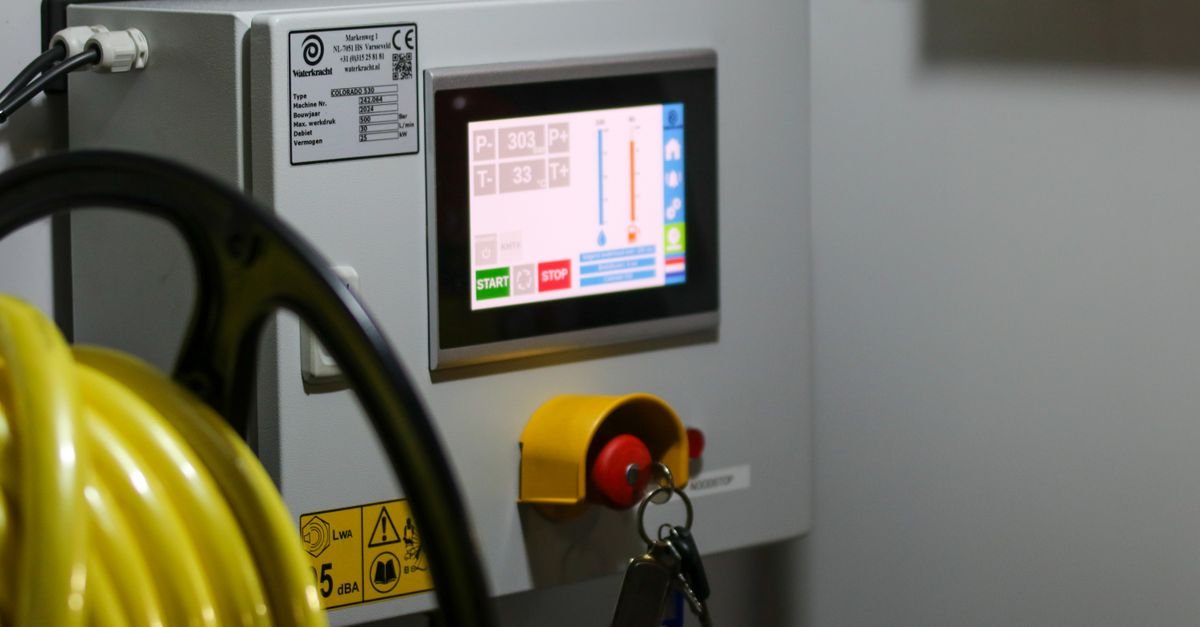
I ran the same census on the machines. Thirty-three unique pressure washer listings across eight phrasings, the same end of the category, the same reading method. Not one publishes a starting current, an inrush figure, a locked-rotor rating or a starting wattage. Eleven of the thirty-three publish an amp rating at all. None publishes an input wattage. So on two listings in three you cannot even work out the running draw, let alone the starting one, and the instruction everyone gives — match your machine’s surge against the generator’s surge — has nothing on its left-hand side.
There is one exception and it is not a listing. Active Products, which builds pressure washers, published a page in January 2025 that does the thing nobody else does: it gives machine-specific start-up wattages. “The Active 2.0 pressure washer can surge up to 3000 watts on start-up to get the motor running.” For the bigger unit: “The Active 2.3 pressure washer can surge up to 4000 watts on start-up to get the motor running.” I have attributed rather than linked that page because it sits on a shop.
It is more than anyone else publishes and it still does not close the gap, for two reasons.
The first is that the recommendation is given in a unit that does not exist. For the 2.0 the company says “we recommend using a generator with a capacity of at least 3000 watts” — and *capacity* is never resolved into rated or starting. Read it as starting watts and you are being told to match 3,000 against 3,000 with no margin whatsoever. Read it as rated watts and you are being told to buy something with roughly a 3,750-watt surge. Those are two different machines, from one sentence.
The second is that the page argues with itself in public, which is the sort of thing worth publishing rather than smoothing over. It recommends “at least 5400 watts for the Active 2.3, as this gives the unit a bit of a buffer” against a published 4,000-watt surge — and then, in the next sentence, “some users have had success with lower wattage generators, such as the Honda 2200.” That unit’s starting figure is a little over half the surge the same page just published. The reconciliation it offers is not capacity at all: “it’s important to ensure the generator’s breaker is not overly sensitive to handle the surge wattage effectively.”
The breaker. The pressure washer manufacturer’s explanation for why one generator starts the machine and an identically rated one does not is the protective device — which is the single component G300 actually specifies a motor-starting rating for, and the single component no listing in eighty-two discloses.
One other thing the machine listings do publish, and it matters more than the amps. Fifteen of thirty-three name the motor type. Westinghouse prints it in the title of two machines in the same series: the WPX3200e carries “High performance 13A universal motor” and the WPX2700e carries “High performance 13A induction motor.” Same maker, same series, same thirteen amps, and two motors that behave completely differently at the moment of starting. The electrical figure a buyer is given is identical; the generator requirement is not. How to tell which you have, and why one of them stalls where the other labours, belongs to the companion page on motor type and surge. The point for this page is narrower: the word in the title is better starting information than the number next to it, which is a strange sentence to have to write about an electrical product.
For the running side you are not entirely blind, because the socket sets a ceiling whatever the listing says. This site’s car buying guide works that out already — a fifteen-amp supply caps PSI multiplied by GPM at about 4,100 at perfect efficiency, which no motor and pump pair has ever managed. A corded machine cannot draw more than its circuit will give it. The starting half has no such backstop.
How Much Headroom Is Actually Printed?
Fifty-eight engine-driven generators in the census publish both figures, so the declared headroom can be measured rather than guessed. It is remarkably consistent, and remarkably small.
| Surge divided by rated | Engine generators |
| 1.11 to 1.30 | 44 |
| 1.30 to 1.40 | 14 |
| Above 1.40 | 0 |
Median 1.25. The lowest is 1.11 and the highest is 1.40, and that is the entire range across fourteen brands from 1,600 watts to 14,500. Whatever the surge figure is, it is not a measured property of fifty-eight different machines that happens to land inside a fifth of a decade. It is a quarter added to the rated figure, give or take, and printed larger.
Set that against the arithmetic the generator manufacturers themselves publish and the problem is plain. WEN’s instruction manual for its 4,500-watt inverter spells out the method: add the running wattage of everything you are connecting, then “Add the single highest ADDITIONAL starting wattage out of the device(s) you plan to connect”, and the total “should NOT exceed the starting wattage of 4500W”. It is a sound method. It also requires the additional starting wattage of your device, which is the number zero of thirty-three pressure washer listings carry. The manual’s worked example of a motor load is a box fan — which, as the generator industry’s own standby-power literature points out, is the easy case, because a fan barely loads its motor until it is already spinning. A pump that moves a fixed volume per revolution is the other category entirely, and that distinction is argued in full on the sizing page rather than here.
The same manual is worth reading for what it leaves out. Its specification table lists surge wattage, rated wattage, rated voltage, rated amperage, phase, frequency, weight and dimensions. No power factor — the quantity G300 requires on the rating plate, and the quantity that explains why a generator survives a surge far larger than its printed headroom. It may well be on the plate riveted to the machine. It is not in the book, and it is not in a single one of the eighty-two listings.
One class of product breaks the pattern completely. Battery power stations publish a continuous rating and a surge rating like everyone else, and seven of them in this census label both: BLUETTI at 600 watts continuous and 1,500 surge, OUPES at 2,000 and 4,500, Anker at 1,500 and 3,000, Jackery at 300 and 600. Ratios of two to two and a half, where no engine generator in the census goes past 1.40. There is no governor to bog and no frequency to droop; the surge limit is an electronic one and the makers state it plainly. The honest caveat is that a battery’s constraint moves somewhere else, and I will come to it.
The best-disclosed engine listing in the whole census, for the record, is a Generac tri-fuel unit, which is the only one of eighty-two to quantify its own headroom as a ratio — “12,500 starting watts on gas — 32% more surge capacity than running output” — and the only one to name motor-driven loads and automatic voltage regulation in the same bullet. It is also about five times the generator a thirteen-amp pressure washer needs, which tells you something about where disclosure lives in this market.
Pick the Listing That Shows Its Working
Everything above gives you one rule, and it is not the rule the category is sold on.
Buy on the rated figure, because it is the only one with a test behind it, and treat the surge figure as a declaration rather than a measurement. Then prefer, among machines of the right rated size, the listing that tells you most — both figures, the engine displacement, the fuel behaviour, the standard. A listing that shows its working is a listing you can check. A bigger number with nothing behind it is a number you have agreed to believe.
For a thirteen- to fifteen-amp corded machine, that puts you in the 3,300-to-3,800-watt rated bracket, which is also where the market’s disclosure happens to be best.
PowerSmart 3,800-Watt Dual Fuel Inverter Generator. The pick of the census on the only criterion this page accepts. It publishes four figures rather than two — 3,800 starting and 3,300 running on petrol, 3,500 and 3,100 on propane — so you can see the surge move with the fuel, which is what a surge figure ought to do. It is also one of only three listings in eighty-two to name the standard at all, and the only one to use the word “Certified” with it. The limitation, stated plainly: that certification sits in its safety bullet alongside the carbon monoxide sensor and the overload protection, so it is a claim about the machine’s protections rather than about the starting figure. And its 1.15 ratio is the smallest declared headroom in the entire census — five hundred watts between running and starting. You are buying the most conservative claim in the category, which is admirable and also means there is very little of it.
WEN 56432iX 4,500-Watt Inverter Generator. The one whose documentation I could actually read end to end, which is why its manual appears three times on this page. It publishes 4,500 surge and 3,600 rated, names a 181cc engine so the rated figure can be sanity-checked against something physical, and carries a carbon monoxide shutdown sensor. Nine hundred watts of declared headroom over rated is the most of any unit in the right size bracket. Two limitations. Its ratio of 1.25 is the census median, so the headroom is the market’s default rather than anything specific to this machine. And its own manual recommends keeping the continuous load at or below 3,240 watts — ninety per cent of rated — “to ensure steady voltage output and to prolong the generator’s lifespan,” which is the real continuous ceiling and is not the number on the box.
OUPES Mega 1 Portable Power Station. Here because it is the only class of product whose two numbers can be matched the way everybody tells you to match them: 2,000 watts rated continuous against 4,500 watts of surge, a ratio of 2.25, stated by the manufacturer in the listing. Against an 1,800-watt corded machine that is a surge margin no petrol unit in this census publishes. It is also the quiet answer for anybody whose problem is that an engine cannot run where they are working. Two limitations and the first is severe. Its 1,024 watt-hours against an 1,800-watt machine is about thirty-four minutes of trigger time by my arithmetic, before inverter losses — this is a half-a-driveway product, not an afternoon one. The second is margin: 2,000 watts continuous leaves two hundred watts over a fifteen-amp machine’s running draw, which is thin. The reason it is the battery I would point at rather than one of the others is that it accepts expansion batteries, and runtime is the only thing wrong with it.
Generac 12,500 Starting Watt Tri-Fuel Portable Generator. This one comes with a condition attached and I would rather state it than bury it: do not buy this to run a pressure washer. It is five times the machine the job needs and it weighs 219 pounds. Buy it if you want home backup and the pressure washer is one load among many, in which case it is the listing I would choose, because it is the only one of eighty-two that quantifies its surge as a ratio, names automatic voltage regulation, and says out loud what that regulation is for — “enabling reliable operation of motor-driven tools, pumps, and appliances.” Tri-fuel, electric start, carbon monoxide shutdown. The limitation is that the AVR claim is unquantified like everything else here: no dip percentage, no recovery time, no power factor.
Five Cartons I Put Back on the Shelf
A page that only ever recommends is a page you learn nothing from, so here are the ones that failed the standard this article is built on.
Honda EU2200i Inverter Generator. The hardest refusal on the page, because it is a genuinely well-regarded machine and this is not a verdict on the machine. It is a verdict on what you are given to decide with. Seven bullets, decibels to the integer, run time to the tenth of an hour, an app, Bluetooth, a warranty, a California note — and no rated wattage and no starting wattage anywhere. On the one purchase where the two wattage figures *are* the question, this listing does not enter the conversation. The Yamaha EF2200iS is in exactly the same position, and its power bullet reads “Powerful Yamaha 79cc Engine – Provides high power output.” Neither is linked, and the reason is the listing rather than the generator.
RINADURS 3,500W Peak Portable Inverter Generator. Its title says 3,500 watts peak. Its first bullet says “3300W Peak Power”. There is no running or rated figure anywhere in the listing, so the only number it publishes is the one with no test behind it, and it publishes two different versions of that. The same brand’s smaller unit is titled 2,200W and opens its first bullet with “2000W Portable Inverter Generator”. Two listings, two internal contradictions, on the one figure the page says decides the purchase. No link.
Westinghouse 4,650 Peak Watt Dual Fuel Portable Generator. Correct size, well-known name, and a detail in its own bullet that I could not get past: “4650 Peak Watts & 3600 Rated Watts (Gasoline); 4650 Peak Watts & 3240 Rated Watts (Propane).” The rated figure falls by ten per cent on propane. The peak figure does not move at all. Whatever produces a surge in a generator — engine torque, alternator saturation, the breaker’s tolerance — it is hard to see how it stays identical across a fuel change that costs ten per cent of the continuous output. Reviewed, not linked, and the PowerSmart above is linked partly because it publishes exactly this comparison and its surge figure *does* move.
AIVOLT 1,600W Super Quiet Inverter Generator. The listing that waves the standard hardest — “ANSI/PGMA G300-2018 Compliant”, named twice — and it is the 2018 edition, superseded by the 2023 revision that took effect in January 2025. Set that aside and the arithmetic ends it anyway: 1,600 starting watts and 1,260 running. A fifteen-amp pressure washer draws roughly 1,800 watts just to keep turning. The most standards-conscious listing in the census cannot run the machine at all, which is a tidy summary of how much the badge tells you.
DuroMax XP13000HX 13,000-Watt Dual Fuel Portable Generator. Thirteen thousand watts, five bullets, copper windings, a carbon monoxide alert and a fifty-amp outlet, and one single undifferentiated wattage figure. Is 13,000 the rated output or the surge? The listing does not say, and the difference between those two readings is about three thousand watts of continuous capacity. The DuroStar DS13000MX does the same thing with the same headline. At the top of this market the disclosure gets worse, not better.
FAQ
Will a 3,500-watt generator run an electric pressure washer?
Probably, and the reason the answer is hedged is the whole problem. A 3,500-watt unit in this census is typically 3,500 surge and 3,000 rated, which comfortably covers the roughly 1,800 watts a fifteen-amp machine draws while running. Whether it covers the start depends on a starting figure your machine almost certainly does not publish. The one manufacturer that does publish one puts a two-gallon-per-minute machine at 3,000 watts of start-up surge, which a 3,500-watt unit clears — and then recommends 5,400 watts for its larger model.
How do I find my pressure washer’s starting watts?
Usually you cannot. Of thirty-three pressure washer listings I read, none published a starting current, an inrush figure or a starting wattage, and only eleven published an amp rating. Check your own manual and your data plate first, since the listing is not the manual. If both come up empty, work from amps times volts for the running load, read the motor-type word if the listing gives one, and buy more rated headroom than the arithmetic says you need.
Does a generator have to meet ANSI/PGMA G300?
No. It is a voluntary American national standard, and conformity is a claim a manufacturer chooses to make. Three of eighty-two listings made it. The standard is also narrower than the name suggests for this particular purchase: the association’s own consumer page describes it in terms of carbon monoxide sensing, construction and labelling, and durability testing, and tells shoppers to look for it in the safety section of the manual.
Is a battery power station a better match than a petrol generator?
For matching numbers, measurably yes. The battery stations in this census that publish both ratings declare surge capacities of two to two and a half times their continuous output, where no engine generator published more than 1.40 times. For working for two hours, no. A kilowatt-hour of storage against an 1,800-watt machine is a little over half an hour of trigger time, and the engine unit will simply be refuelled.
Does the surge wattage on the box mean anything at all?
It means the manufacturer is willing to stand behind that figure, which is not nothing. What it does not mean is that anybody measured it the way the rated figure is measured. Across fifty-eight engine generators publishing both numbers, the ratio sat between 1.11 and 1.40 with a median of 1.25, which is a narrow enough band to suggest a convention rather than fifty-eight independent measurements.
Should I just buy a much bigger generator and stop worrying?
It works and it costs you in a currency nobody mentions, which is weight. The 4,000-to-6,000-watt units in this census state weights from 48 to 107 pounds, and that is before the pressure washer, the hose and the water. Going up two brackets to buy certainty about a number nobody publishes means carrying a second heavy machine to every job.
Why did my machine start on one generator and refuse on another of the same wattage?
Three candidates, and the rated wattage is not one of them. The generator’s own output breaker may be the thing opening rather than the engine faltering — which is the explanation the one pressure washer maker that publishes surge figures offers. The two units may differ in how output frequency is controlled. Or your machine may have an induction motor rather than a universal one, in which case a supply it cannot quite break away from leaves it stalled rather than labouring. Those mechanisms are set out on this site’s generator sizing page, and if the machine is humming rather than turning, that symptom has its own shortlist.
One Engine Can Already Turn the Pump
Three sources describe what happens when an electric pressure washer meets a generator, and all three leave out the number the buyer needs. The standard defines normal operation as everything up to the rated figure and tests ten per cent past it. The generator listing prints a surge figure a quarter above rated with no method attached. The pressure washer publishes nothing at all, unless you own an Active, in which case you get a figure and a unit mismatch. Somewhere in that chain the buyer is asked to perform a comparison that nobody involved has supplied both halves of.
Which is why, for the reader who is about to buy a generator purely so a corded machine can reach the far end of the garden, the honest answer is to stop and count the engines. You would be buying a petrol engine to spin an alternator to push current down a cable to turn an electric motor to drive a pump, when a petrol engine three feet away could turn the pump directly. Every one of those conversions has a figure attached and the surge is the only one nobody prints. The case for picking an engine or a socket in the first place is laid out in electric versus gas, and if the real problem is that your outlet is too far away rather than too weak, extending the water instead of the power costs a little inlet flow and no torque at all. If the outlet is close enough but the breaker keeps opening, that is a circuit problem with its own three answers and a generator does not appear in any of them.
Somewhere between PGMA’s definitions list and the sticker on your own pump there is a figure that would settle this in one line, and nobody has ever printed it. So work the generator’s rated wattage against your machine’s amps, add more headroom than feels reasonable, and read the motor word if the listing gives you one. If a thirteen-amp machine still refuses to break away on a unit with three thousand rated watts behind it, that is not arithmetic you got wrong. It is arithmetic you were never handed both halves of.