Last Updated on September 26, 2026 by Umar Farooq
Removing paint overspray concrete has soaked up is a different job from removing a paint spill, and the difference is geometry rather than chemistry: overspray arrives as thousands of separate droplets, each one a complete coating in miniature, spread across an area far too large to treat one dot at a time.
Every page I could find on this subject files overspray with graffiti and paint spills, hands you a bottle of stripper and a PSI number, and moves on. Two of the three I read use the word “overspray” and then never once distinguish it from a tin tipped over on the path. That is the whole problem, because the two jobs have almost nothing in common except the colour.
A spill is one thick, continuous film with a hard edge. Overspray is a mist that landed. It is thinner than a spill by a wide margin, which makes it genuinely easier to remove — and it covers a hundred times the area, which makes it genuinely harder to remove. Those two facts pull in opposite directions, and which one wins is decided almost entirely by how many minutes have passed since it landed.
Spraying Wastes More Paint Than It Applies
Start with the thing that makes overspray inevitable rather than unlucky. An archived EPA technical profile on coating application in automotive refinishing defines it plainly: “The waste paint directed outside the main spray pattern and not deposited onto the vehicle surface is referred to as overspray.”
Then it gives the proportion, and the proportion is the surprise. “Conventional spray guns equipment has a transfer efficiency in the range of 20% to 40%, and therefore most of the paint becomes an over spray” (EPA, *Use and Substitutes Profile for Isocyanates*, control technology chapter). Transfer efficiency, in that document’s own definition, is the ratio of coating solids that land on the part to the solids that left the nozzle. At 25% you are spraying four times the paint you are applying.
That figure is from a spray booth, on a car, with an air-atomised gun, and it does not transfer directly to a painter with an airless rig on the side of a house — the same document credits high volume low pressure guns with at least 65%. The shape transfers, though, and the shape is the point: the mist is not a mishap at the edge of a competent job. It is the majority product of the process, and somebody has to decide where it goes.
One more line from that document reorganises where you should be looking. “In addition, atomized paint can be pulled away from the car surface by compressed air currents deflected by the car surface and the painting technician, and appears to ‘bounce back’. The bounce back can account for 20% of the 60% of the paint which does not reach the car surface when conventional spray guns are used.”
A third of the paint that misses did not sail past the target. It hit the target, came back off it, and fell. So on a house wall the heaviest deposit on the ground is usually in the first few feet out from the wall, not way out where you were watching the breeze. If you are trying to work out where the overspray on your slab came from, measure from the wall outward, not from the fence inward.
A Drift Field Is Thousands of Separate Coatings
Here is what actually reaches the concrete, and it is worth being precise about, because every removal decision downstream depends on it.
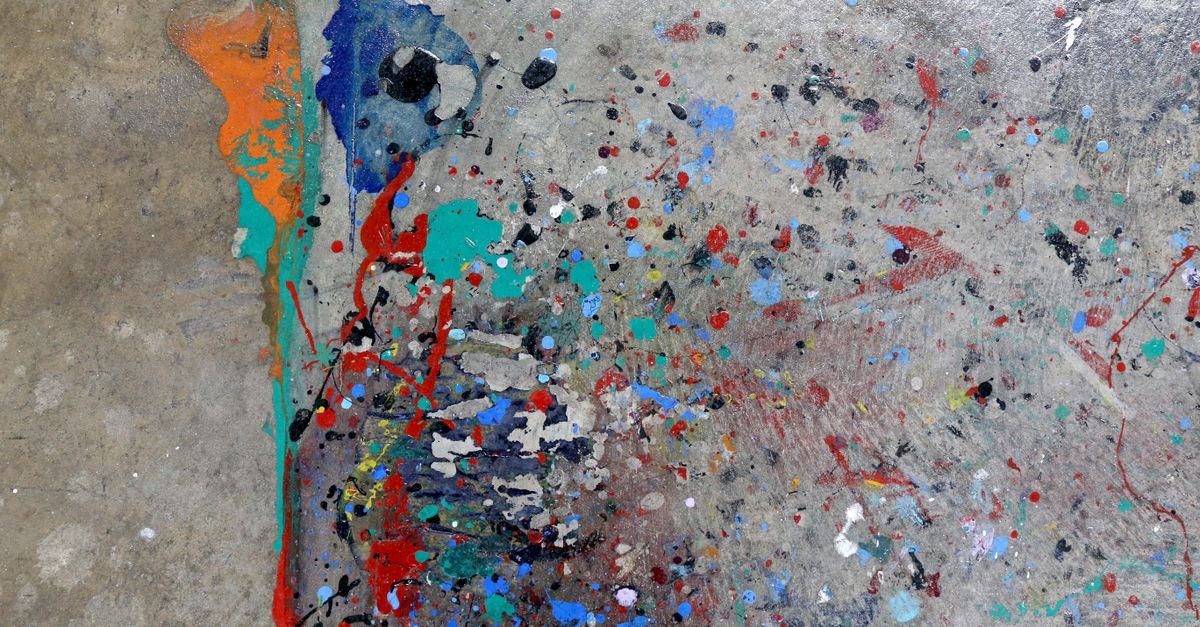
Benjamin Moore’s own data sheet for its exterior 100% acrylic low lustre finish specifies airless application at 1,500 to 2,500 psi through a tip of 0.013 to 0.017 inch (Benjamin Moore, *ben Exterior 100% Acrylic Low Lustre Finish 542*, technical data sheet). Thirteen thousandths of an inch is about a third of a millimetre. Paint forced through an orifice that size at two thousand psi does not leave as drops. It leaves as a cloud, and a cloud has no interest in your intentions.
Now the thickness. That same sheet gives a recommended film build of 3.8 mils wet and 1.3 mils dry. Sherwin-Williams specifies its Duration exterior acrylic satin at 5.3 to 6.4 mils wet for 2.0 to 2.4 mils dry, on its own product data sheet. So a proper coat of exterior paint — the thing the chemistry was designed around — is somewhere between roughly 95 and 160 micrometres of wet material, laid down continuously.
A drift droplet gets none of that. It arrives alone, flattens to whatever one droplet’s worth of paint will cover, and is thickest at its centre and nothing at all at its rim. I am reasoning from the film-build figures rather than quoting a measurement here, but the direction is not in doubt: a deposit built one droplet at a time is a small fraction of a spec coat at its deepest point, and it has no neighbouring paint to draw on. Each dot is a whole coating, complete and alone, doing the entire job of adhesion on a contact patch you would need reading glasses to see.
Which gives you a diagnosis you can make from standing height.
| What the slab looks like | What it is | What it changes |
| Thousands of separate dots, denser nearer a wall or fence, and finer the further out you walk | A drift field from spray application | Thin, removable early, and far too widespread to spot-treat |
| One continuous film with a defined edge, often with runs or a thicker rim | A spill or a tipped tin | Thick, a coating job, and small enough to attack locally |
| Deliberate continuous strokes, heavy build, legible shapes | A tag | A different page and a different chemistry |
Size grading with distance is the reliable tell, and it follows from the physics: the big droplets have the momentum to fall out of the air early, while the fine ones travel. A drift field therefore gets finer the further you walk from the source. A spill has one edge and no gradient at all.
I went looking for a published droplet size for architectural overspray landing on paving, on the assumption that somebody must have measured it. Nobody has, as far as I can find. The measured size distributions that exist in the literature were done in spray booths, on industrial primers, with guns nobody paints a house with. There is no number for the thing in your driveway, which is worth saying out loud rather than borrowing one from a booth and hoping.
Coalescence Is the Step That Does Not Run Backwards
This is the argument the whole page hangs on, and the manufacturer names the mechanism for you in two words. Under “Dries By”, the Benjamin Moore sheet says: Evaporation, Coalescence. Not drying. Two processes, and only the first one is reversible.
The coatings literature is specific about what the second one is. A latex film forms in three stages — “(1) the concentration stage; (2) the compaction stage; and (3) the gradual coalescence stage” — and the paper is blunt about which stage is the door shutting: “It is, however, the work of coalescence, stage II, that is the main focus of the present paper, for it is at this point the process becomes irreversible” (K.L. Hoy, *Coalescence and Film Formation from Latexes*, Journal of Coatings Technology, February 1996).
Irreversible. That is a peer-reviewed coatings journal describing, in one word, why soap and water works on wet overspray and does nothing whatever on the same overspray tomorrow. Before critical packing the particles are still separate objects suspended in water. After it, they deform against each other and weld, and there is no undo. Nothing on a hardware store shelf sells you an undo either, which is a shame, because it would sell extremely well.
The same paper notes that the appearance of dryness is not the finish line: “Although the film has the appearance of being dry, coalescence continues for some time, and the paint film properties continue to develop for several days.” Benjamin Moore puts a practical number on the far end of that — “Painted surfaces can be washed after two weeks” — which is the maker’s own answer to when a finished film can take a hose without damage.
Now the part that decides your afternoon, and it is a thickness argument. Sherwin-Williams’ sheet states that “drying and recoat times are temperature, humidity, and film thickness dependent.” Both makers quote about one hour to touch and four hours to recoat at normal temperatures, and both figures are for a film of a few mils. Hoy’s paper notes that stage-one water loss “mimics the rate of evaporation of water alone”, running at “about 85% of that of pure water” — and evaporation is a surface process, so its rate does not care how deep the puddle is.
Put those together and the arithmetic is mine rather than anyone’s published figure: if water leaves at a roughly fixed rate per unit area, the time to reach the irreversible stage scales with how thick the wet film was. A drift deposit a tenth the thickness of a spec coat gets there in something like a tenth of the time. On a porous slab it is worse again, because water also leaves downward into the pores rather than only upward into the air. Every mechanism points the same way: overspray on concrete coalesces faster than the same paint on a wall, not slower.
So how long do you actually have? Nobody publishes a number, and now you know why they can’t — it depends on the droplet thickness, the temperature, the humidity and how thirsty the slab is. What both data sheets do say is the same word. Sherwin-Williams: “Clean spills, spatters, hands, and tools immediately after use with soap and warm clean water.” Benjamin Moore: “Clean up with warm soapy water.” Neither offers you a day, or two days, or a weekend. The instruction is *immediately*, and having read the film-formation mechanism, I think that is honest rather than lazy.
Which brings me to the one opinion I will push hardest on this page. On overspray, the only variable you meaningfully control is minutes. Not the nozzle, not the pressure, not which bottle you buy. A bucket of warm soapy water and a stiff brush inside the hour beats every product on the shelf applied tomorrow, and there is no equipment purchase that recovers the difference.
Removing Paint Overspray Concrete Has Already Absorbed
If the window closed, the next question is how much of the deposit is sitting on the slab and how much is in it. That distinction — and it decides everything — is worked through properly in removing graffiti, which carries the conservation sources on porosity, the published pressure ceilings for masonry, and why a mark can survive the paint that made it.
Two things are specific to horizontal flatwork and belong here rather than there.
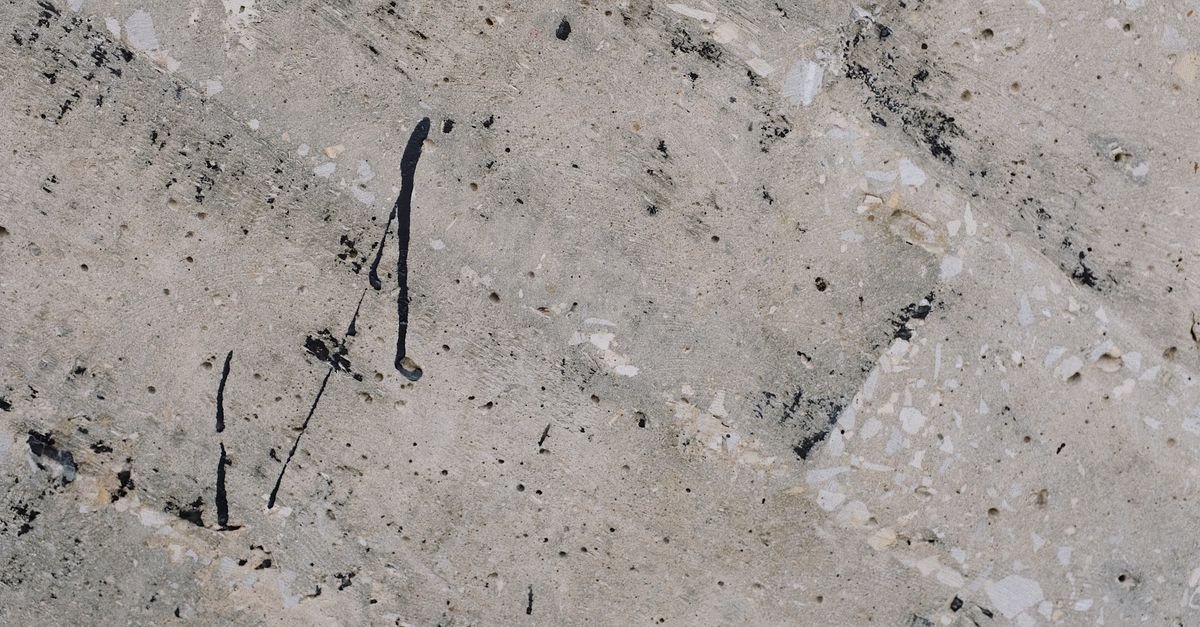
The first is the finish. A broom-finished slab is a field of parallel grooves, and after any wash the residue you are left with is concentrated in them — a fan tip arriving at an angle has the least effect at the bottom of a groove, and that is also where rinse water sits rather than sheets. This is reasoning from the geometry rather than a published finding, but it explains something readers keep reporting: the slab looks clean standing up and looks like a failure from a garden chair. If it reads better at eye level than at knee level, the dots are in the grooves.
The second is the direction of the rinse, and it runs backwards from most of this site. Rinse water carrying dissolved or softened pigment, taken across dry clean concrete, gets one last chance to soak in — the full case for that inversion is argued on the graffiti page linked above and is not repeated here. On a graded driveway the practical version is: wet the run-out first, work from the high side downslope so the pigment-bearing water always moves onto concrete that is already saturated, and never work uphill into a dry patch you have not reached yet.
A sealed slab is the good case, because the droplets landed on the sealer instead of the pores, and you are removing paint from a film rather than from a mineral. A bare slab is the hard case. Either way the coating families, the stripper chemistry, the mechanical ladder and the pre-1978 lead question all live on cleaning paint off concrete, and the pressure figures that a slab tolerates before the jet starts cutting cement paste are set out in how much PSI to clean a concrete driveway. None of that changes because the paint arrived as a mist.
Nobody Spot-Treats Five Thousand Dots
Here is the limit, stated plainly, because the alternative is letting you discover it on a Saturday. On bare flatwork with a dried drift field, there may be no good answer at all, and the reason is area rather than adhesion.
A drip is a square inch. You can scrape it, dab a stripper on it, take it back with a wire cup brush, and accept one slightly lighter, slightly rougher spot that nobody will ever find. Every mechanical option on that ladder works precisely because the mark is small enough that the damage you trade for it is also small.
A drift field is fifty to five hundred square feet of concrete in which painted and unpainted material alternate at millimetre scale. That changes the arithmetic completely, because every method that removes dried paint from bare concrete removes some concrete with it. Apply that to the dots only and you have swapped a stipple in paint for a stipple in etched cement paste — permanent, in a random pattern, and impossible to match later. Apply it uniformly across the whole area and you have not cleaned a driveway, you have resurfaced one.
This site’s usual warning about cleaning one patch in isolation, set out in cleaning stains from concrete, cuts the other way here. Normally the advice is to work out to the nearest expansion joint so the clean area does not read as a bright rectangle. On a drift field there is no patch to work out from. The thing you want to remove is interleaved with the thing you want to keep, on a scale smaller than any tool’s footprint.
So the honest ladder on bare flatwork is short:
- Caught wet or within the hour — warm water, detergent, volume, a stiff brush, and no equipment decisions at all. This is the version that works.
- Caught late and light — a fine, thin, widely spaced field on a driveway that sees traffic and weather. Leave it. It is thinner than a coat of paint was ever meant to be, it has nothing under it holding it on, and time takes it off more evenly than you will.
- Caught late and heavy — the whole area gets treated as one decision: ground, resurfaced or deliberately coated. Not five thousand small decisions.
The middle rung is the one people skip, and it is usually the right one. Deciding to do nothing about a faint stipple is a defensible outcome, not a defeat, and it is the only option on this list with no risk of making the slab worse.
Where Is the Wind Limit on the Can?
Which leaves prevention, and prevention has an odd hole in it that I did not expect to find.
Both exterior acrylic data sheets I read are precise about conditions. They give a temperature floor — 35°F for the Sherwin-Williams product, 50°F for the Benjamin Moore one. They give a dew-point margin of at least 5 degrees. Benjamin Moore gives a relative humidity ceiling below 90%. Sherwin-Williams gives a rain window: avoid using if rain or snow is expected within two to three hours. Four separate published conditions, each with a number.
Neither publishes a wind speed. Benjamin Moore mentions wind exactly once, and it is filed under drying rather than drift: windy conditions appear alongside direct sunlight and low humidity as “Severe Conditions” that may call for an extender to be added to keep the paint workable. The trade’s own document treats wind as an open-time problem, not as a question about where the mist lands.
The figures circulating for this — under 8 mph, under 10, under 15 — come from painting contractors’ blogs quoting one another. I could not find any of them in a manufacturer document or a standard, which does not make them wrong, but does mean nobody has stood behind one. A number repeated by forty sites with no source attached tells you about the sites.
So in the absence of a published threshold, the EPA figure is the one to act on. If most of what leaves a conventional gun never lands where it was aimed, the useful question is not whether there will be overspray — there will — but which surfaces you have decided to donate. Cover, weight the edges, and cover further out from the wall than feels necessary, because bounce-back puts the heaviest fall close in. On a slab, lay the sheeting dry and tape the seams: mist finds a seam, and plastic on a wet slab slides underfoot with real commitment.
There is also an equipment decision that happens before the sheeting comes out. NIOSH testing in an equipment manufacturer’s facility found that with an HVLP gun, “particulate over spray concentration was reduced by a factor of 2, and that there was a 30% increase in the ratio of paint film thickness to mass of paint applied.” Halving the mist and getting more film for the same paint is a better result than any dust sheet delivers, and it costs nothing except picking up the other gun.
FAQ
Will a pressure washer remove paint overspray from concrete?
While the paint is still wet or barely set, yes — and so will a hose and a brush, which is the honest comparison. Once coalescence has run, the machine is removing concrete rather than paint, because a properly formed acrylic film survives the pressures that flatwork tolerates. The washer’s real job here is carrying away a deposit that detergent has already released.
How long do I have before the overspray is permanent?
Nobody publishes a figure, and the mechanism explains why: it depends on how thick the droplets are, the temperature, the humidity and how absorbent the slab is. Both manufacturer data sheets I read say to clean spatters immediately with soap and water, with no time attached. Treat the first hour as the job and anything after that as a bonus.
Is overspray easier to get off than a paint spill?
Early, much easier — it is a fraction of the thickness of a proper coat and has no reservoir of paint keying it down. Late, harder, because a spill is one small area you can attack locally and a drift field is hundreds of square feet of alternating painted and bare concrete. The thickness helps you; the coverage does not.
My painter says it will wear off. Is that true?
For a fine, thin, widely spaced field on a trafficked driveway, often yes, and more evenly than any spot treatment. For a dense deposit, a sheltered patio or a slab nobody drives on, no — you will be looking at it for years. Which one you have is a question about density and traffic, not about who said it.
What about overspray on a sealed concrete floor?
Better news. The droplets landed on the sealer, not in the pores, so you are lifting paint off a film rather than out of a mineral. The catch is that whatever softens the paint may also soften the sealer, so you can end up recoating the floor. Test somewhere nobody looks, and expect the sealer to be the thing that decides the method.
Can I grind or sand just the spots?
You can, and it is the trap on this page. Grinding a dot removes cement paste under it, so you finish with a field of small etched pits in the shape of the overspray — the same paint, the same pattern, in the wrong material, and permanent. If abrasion is the answer, it has to be applied to the whole area as one decision.
The Only Easy Version Is the Wet One
Two manufacturers, two data sheets, and one word between them: *immediately*. Having read what coalescence actually is, I no longer think that word is a hedge. It is the only instruction that survives the fact that a droplet a few micrometres deep reaches the irreversible stage of film formation long before a brushed coat on a wall does.
Everything else on this page follows from that. A mist is thin, which is the good news, and it is everywhere, which is the bad — and the moment the thin part stops mattering, the everywhere part is all you have left. Five thousand dots interleaved with the concrete you are trying to keep is not a cleaning problem with a harder setting available. It is a question about resurfacing, and the only reason it does not look like one is that it happens to be the colour of a stain.
The dots are glossy or they are not, and that is the only branch on this page. Glossy means the water has not finished leaving and a bucket of warm soapy water is still the entire method. Matt means coalescence has run, at which point you are choosing between a stipple you learn to live with and a slab you resurface — a decision made at knee height in good light, not at a hire counter.