Last Updated on September 26, 2026 by Umar Farooq
Cleaning a limestone patio is unusual among stone jobs because there is nothing inside the slab to lose — no gas voids, no factory fill, no bedding plane waiting to part — which sounds like good news right up to the moment you work out what that leaves.
It leaves the surface. On a sawn and honed limestone flag, the flat even face you are looking at was made in a factory by grinding, and it is the whole of what you can damage. There is no texture underneath it to fall back on and no second material to blame. Whatever the wash takes off the top is simply gone, and the slab beside it still has its face on, which is how you find out.
Two neighbouring pages already own most of the chemistry here, and I am going to hand both of them their territory rather than re-argue it. Why acid and calcium carbonate cannot be kept apart — and which bottle is allowed near which slab — is settled in our guide to patio cleaning solution, and if you take one thing from it, take the one-drop identification test. The stone that looks like limestone but is full of holes is travertine, which fails in a completely different direction and has its own page on cleaning a travertine patio.
What is left is what nobody writes down: what limestone actually is, why its damage shows up as a change in colour rather than a change in shape, and what to do about a slab that has already started letting go.
A Seabed With No Hollows Left In It
Limestone is compacted marine debris. Shell, coral, and above all the skeletons of animals that lived on a shallow sea floor, buried, compressed and cemented back together with more of the same mineral they were made of. That is not a poetic framing — it is the reason the stone behaves the way it does.
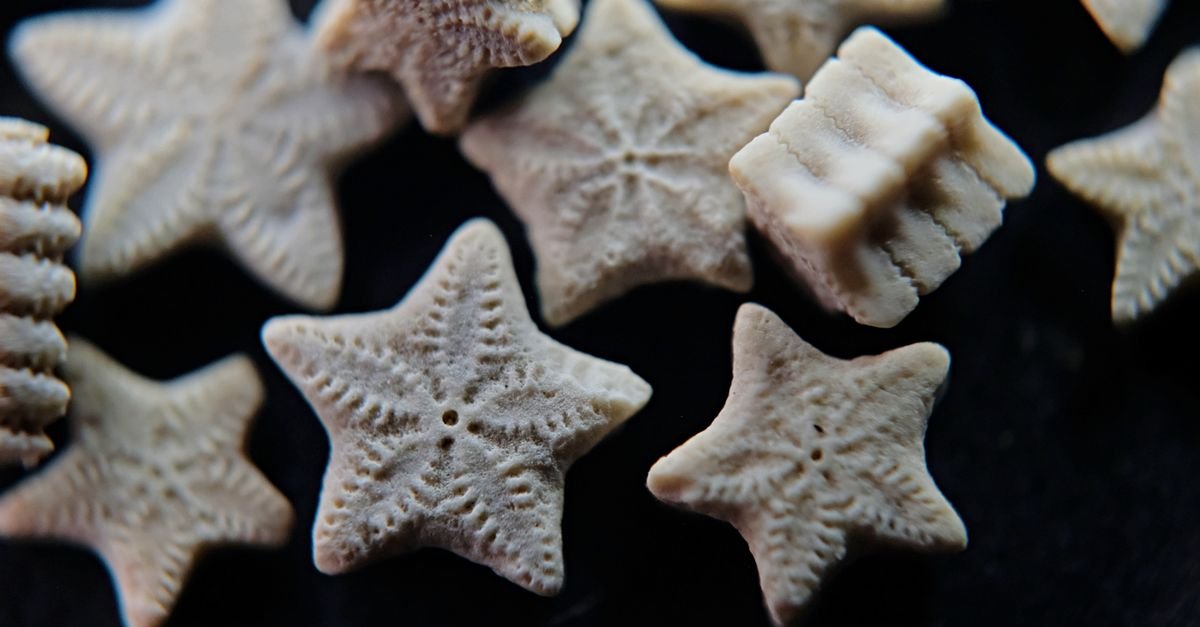
Those little five-pointed stars are crinoid columnals — segments from the stems of sea lilies, which are animals rather than plants, and which shed stem discs by the million. A great deal of the world’s building limestone is substantially made of them. If your patio has faint pale circles, commas and shell outlines a shade lighter than the stone around them, you are not looking at staining. You are looking at the remains of the thing.
The Indiana Limestone Institute, whose members quarry the Salem limestone that clads a fair proportion of the American Midwest, says the quiet part out loud: “Natural variations in color, grain structure, and fossil content are inherent characteristics of the deposit.” Inherent. Not a defect, not a mark, and not something a stronger cleaner is going to shift. I mention it because scrubbing at a fossil is one of the more common ways people put a bright patch on an otherwise even slab, and the fossil is still there underneath.
The structural point matters more. The same Institute describes the material this way: “Salem Limestone possesses a remarkably uniform internal structure that allows it to be cut and carved in virtually any direction without splitting along natural layers” (Indiana Limestone Institute, specifying limestone). Read that as a list of things you do not have to worry about:
- No bedding plane parallel to the face. Sandstone and slate are sold as paving precisely because they split into sheets, and a jet driven across an edge with a lamination already slightly open lifts a scale that never goes back on. The delamination case is made in full in our guide to cleaning a flagstone patio. It does not apply here.
- No gas voids. Travertine’s cavities came from bubbles trapped in a spring deposit. A marine limestone has a fine, even pore network instead — plenty of absorption, no caverns.
- No fill. Because there are no surface voids to plug, there is no cementitious or resin plug in your paving that can erode out before the dirt does.
So the first decision on travertine, filled or unfilled, has no equivalent here. Limestone paving arrives as one material all the way through.
One honest gap. Limestone is specified in North America under ASTM C568, which sorts it into three density classes, and the Institute states that Salem stone “is classified as a Type II (Medium Density) Dimension Limestone.” That is as far as I can take it. The standard itself sits behind a paywall, the absorption and density limits for each class circulate widely in search results, and the only readable copies I could find were unauthorised mirrors. I have not read C568, so I am not going to quote numbers out of it. What you can take from the classification is qualitative and still useful: the trade sorts limestone by how dense it is, low-density limestone exists and is sold, and two pale cream slabs can be meaningfully different rocks.
For identification at the patio, look at a broken corner or a cut edge in daylight, dry. Limestone shows a uniform fine matrix — closer to compacted chalk than to anything grainy — usually with shell or fossil fragments visible in it, and no layering. Sandstone shows sand grains you can feel. Travertine shows holes. The UK market mostly sells grey-blue and black-brown Indian limestones with a riven or sawn finish; the cream and buff Jurassic stones from Portland, Purbeck and the French and Portuguese quarries turn up honed. They are all the same mineral and they all behave the same way under a wand.
A Honed Surface Remembers Every Arc You Leave
A riven flag has a naturally split face with a shallow relief to it. A honed flag does not. It is sawn from the block and then ground with progressively finer abrasive until it is flat and evenly matte, and that even matte is a manufactured state — the surface is at a controlled roughness, and it looks the way it looks because of that roughness rather than in spite of it.
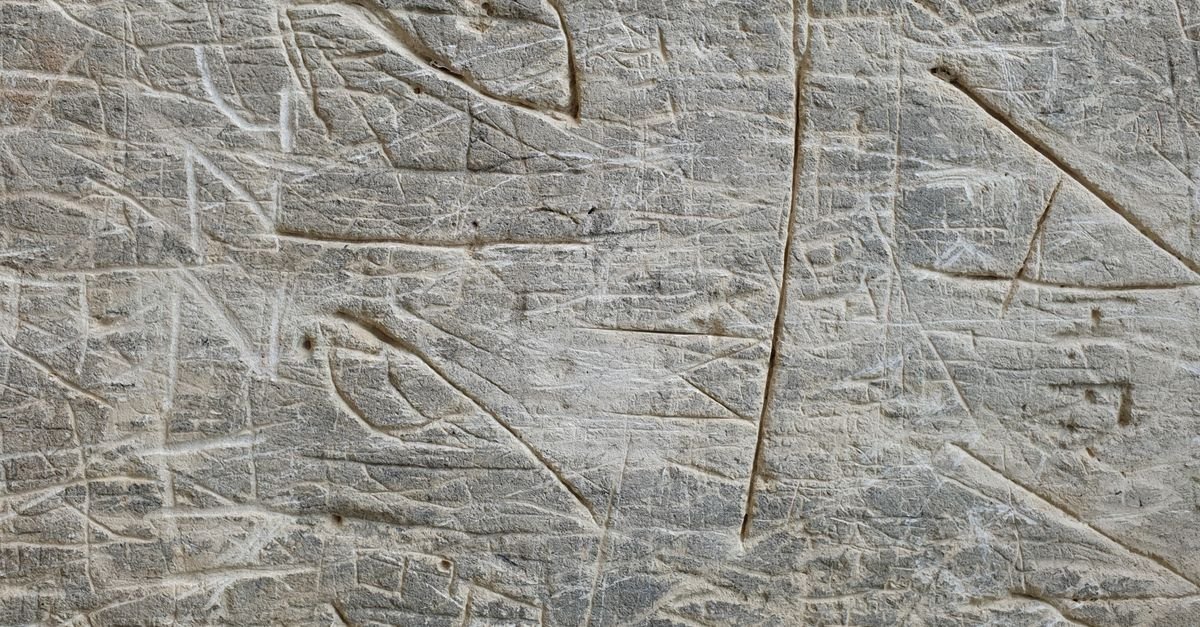
Here is why that is the whole problem. A matte surface scatters light in every direction, and how bright it looks depends on how rough it is at a scale you cannot see. Change the roughness in one place and you change the tone in that place. You do not get a dent or a chip — you get a patch that is a slightly different shade of the same colour, with a boundary, in a shape that matches whatever you were doing with the wand. A rotary head leaves overlapping crescents. A wand held too close leaves a stripe. A surface cleaner rushed at one end leaves a band. All of them are invisible while the slab is wet and all of them appear as it dries.
This is the exact opposite of travertine’s problem. A tumbled, open-pored slab has no reference tone to lose because it never had an even one. A honed limestone patio is four hundred square feet of even tone, and evenness is the only thing that makes an uneven patch visible.
Historic Environment Scotland put a national heritage body’s name to what abrasive cleaning does to a worked stone surface, in its INFORM guide on the risks of cleaning sandstone. Its list of consequences from water washing, grit blasting and rotating discs reads, verbatim: “‘pitting’ of small holes on the stone’s surface”, “disfigured architectural detail”, “erosion of sharp edges and loss of definition”, and “the complete loss of the mason’s original surface tooling” (Historic Environment Scotland, Cleaning Sandstone: Risks and Consequences).
That last one is the sentence to sit with, and I am extending it rather than quoting it at you. On a carved building the tooling is the mason’s chisel work. On your patio the tooling is the factory honing — same category of thing, a deliberate surface finish applied once, at the only point in the material’s life when anyone had the equipment to apply it evenly.
The guide adds a consequence that runs the other way from what you would expect, and it is the reason a hard wash can make next year worse. Cleaning, it says, “can promote biological growth by encouraging rainwater to penetrate into the stone” by making the surface rougher. Roughen a limestone face and you have given the next colony more surface to grip and more water to sit in. The patio looks cleaner in June and greener in March.
And then the figure that made me go back and check I had read it properly. The same document reports that research “identified numerous cleaned buildings where the rate of decay is six to ten times faster than adjacent buildings that were not cleaned”, and that in the worst cases “25 – 50% of all the stone in the cleaned walls may now require replacement.” I want to be precise about what that is and is not. It is Scottish sandstone tenements, cleaned in the 1960s and 1970s with grit blasting and strong chemicals, assessed decades later. It is not your patio at 1,500 PSI on a Saturday. But it is the only place I have found anyone measure what cleaning costs a porous stone surface over a long horizon, and the direction of the number is not ambiguous.
Marshalls, which manufactures paving rather than conserving cathedrals, arrives at the mild version of the same conclusion in its own guidelines: power washers “used to excess … can damage the paved area and shorten its service life.”
Here is the opinion, and it is the one that changes how you read your own results. On honed limestone, “it came up much lighter” is not a review. It is a damage report. Removing a few microns off a uniform matte carbonate surface is *how you make it lighter* — there is no intermediate step where the dirt leaves and the stone stays put. Historic Environment Scotland lists “irreversible bleaching” among the long-term effects of chemical cleaning and describes the result as unnaturally “bleached” or “tinted” stone surfaces. A limestone patio that has come up dramatically brighter than you remember it has not been restored to its original colour. It has been given a new one, and it will not go back.
The check that settles this, and it takes thirty seconds. Find a slab that lives permanently under a bench, a planter or a step overhang, and compare it in the same light and at the same viewing angle to one in the open. On sound honed stone the sheltered slab is dirtier but the same tone underneath. If the exposed slabs are noticeably paler, duller or more open-looking than the protected one, the finish has already gone from them, and everything below applies with more force.
Weathered Limestone Comes Away One Grain at a Time
Bedded stones fail in sheets. Limestone fails in grains, and the conservation trade calls the result sugaring, because that is exactly what it looks and feels like — a surface that has turned to coarse, loose crystal.
The mechanism is a consequence of the material being made of one mineral. The calcite grains are cemented together by calcite, so whatever is attacking the stone attacks the cement between grains at the same time as the grains themselves — and the cement is the thinner, more exposed, higher-surface-area part of the arrangement. It goes first. Once it has gone, the grains are still there and still hard, and they are sitting on the surface held by almost nothing.
Then you arrive with a machine. And this is the part worth being clear about: on a sugaring patio, the pressure washer does not cause the decay. It collects it. A season’s worth of already-loose grain leaves in ten minutes, the slab looks freshly sawn for a fortnight, and it is now measurably thinner than it was. Do that every spring and you are not maintaining a patio, you are operating a very slow lathe.
Two things accelerate the underlying decay, and one of them is water you supplied. Historic Environment Scotland names, among the long-term effects of cleaning, “unsightly white deposits (efflorescence) resulting from residual deposits (salts) being drawn out of the sandstone to crystallize on the surface.” Soluble salts already sitting in a porous stone are mobilised by whatever wets it and re-crystallise as it dries. Crystal growth inside a pore is a mechanical load applied from within, and on a stone whose failure mode is the loss of cohesion between grains, it is precisely the wrong load. I could not find a published crystallisation pressure figure for paving-scale limestone from any source I could legitimately read, so take that as a mechanism rather than as a number.
How to spot it before the wash rather than after. Do not go by the face — a sugaring slab and a sound one look similar from standing height when both are dirty. Go by the arrises, the sawn edges where two faces meet. A sound honed flag has a crisp square edge that catches a fingernail. A sugaring flag has an edge that has gone soft and slightly rounded, and the joint line beside it reads wider than the joints elsewhere on the patio, because both slabs have retreated from it. Second tell: watch the run-off during your test patch. Grey-green water is algae leaving. Pale grey-white silt with no colour in it, arriving steadily rather than in a first flush, is stone leaving.
Where it starts. Under a downpipe outlet. At the nosing of a step. Along the drip line where a roof edge or a gutter joint throws water onto the same eighteen inches of paving several hundred times a year. Wherever one patch gets wet far more often than the rest, that is where the surface goes first, and those are the slabs to take off the wash list entirely — brush, neutral soap, warm water, and accept that they will not match.
The black, flat, ink-like discs that turn up on pale stone are a separate problem and a separate organism. That is lichen, chemically anchored into the top of the stone rather than sitting on it, and the honest treatment plan is in our guide to removing lichen. Pressure is not it.
Is Rock Salt Safe on Limestone? Marshalls Says Both
I went looking for a manufacturer’s position on de-icing salt on limestone paving and found one manufacturer holding two positions, in two live documents, at the same time. This is worth publishing rather than tidying up, because you are going to hit both of them.
Marshalls’ *Gardens & Driveways Cleaning & Maintenance Guidelines* puts rock salt in the safe column: “Rock salt can be applied to most of Marshalls’ concrete and natural stone products without risk of damage, however once the area has dried out after any thaw, you may notice some temporary discoloration caused by the salt material. Normal weathering should soon remove such discoloration.” The only outright prohibition in that document is for a specific product family — “rock salts must not be used on Marshalls’ wet cast concrete products” (Marshalls, Gardens & Driveways Cleaning & Maintenance Guidelines).
The company’s separate patio and driveway aftercare booklet says the opposite, and names your stone while doing it: *”Never use common salt to de-ice reconstituted stone or limestone. Specific products are formulated for this purpose.”*
Same manufacturer. One document says natural stone is fine and the risk is a temporary stain; the other says never, on limestone specifically. I have not found anything reconciling them, and I am not going to pretend one of them does not exist.
For what it is worth, the two documents are answering different questions. The guidelines are describing appearance on a timescale of weeks — the salt leaves a white bloom, weather removes it. The booklet is making a materials call on a timescale of winters. Given everything in the section above, I would follow the booklet on limestone, and the reason is the failure mode rather than the chemistry: sodium chloride does not dissolve calcite, so this is not the acid problem in a different coat, but it does go into solution, travel into the pore network and crystallise there as the slab dries. On a stone that fails by losing cohesion between grains, adding a repeated internal mechanical load to the surface layer is the specific thing you would least like to do. The concrete version of this argument — where the damage is surface scaling rather than grain loss, and where the industry has named which salts are worst — is covered in removing salt stains from concrete.
The guidelines are genuinely useful on the alternatives, which almost nobody publishes for stone paving:
| De-icer | Marshalls’ position | The catch |
| Rock salt (sodium chloride) | Fine on most concrete and natural stone; banned on their wet cast products | Temporary white discoloration; the booklet says never on limestone |
| Purer marine salt | Non-toxic | “Corrosive to steel and aluminium, as well as being harmful to vegetation and can leave a white residue on the paving” |
| Urea-based granules | “Can be used on all Marshalls’ paving products”, non-corrosive to metals and surfacing | “May release ammonia and nitrates into water courses”, and more expensive |
One timing rule falls out of all this, and it is the opposite of what most people do. Wash a limestone patio in spring, after the salting season has finished and the stone has had a chance to dry out. Washing it in November puts a large volume of water into a porous surface immediately before you start putting salt on it and immediately before the first hard frost, which is three loads arriving on the same square foot in the same fortnight.
Cleaning Limestone Patio Slabs at Garden-Hose Pressure
The method is short because most of the work on this surface is deciding not to do things. What follows assumes you have already picked your cleaner from the patio cleaning solution guide above — pH-neutral stone soap for routine dirt, a weak hypochlorite for the green, and nothing acidic at any dilution.
1. Sweep it bone dry, joints included. Grit dragged across a honed face by moving water is an abrasive, and this is the one stone where the finish is the asset.
2. Wet everything before anything. All of it, including the half you are not doing yet. A dry honed slab drinks cleaner unevenly and dries as a tide line you can still see in August.
3. Give the chemistry the full dwell and keep it wet. Five to ten minutes, misted again if the edges start going matte. If the rinse is having to do removal work, the dwell was short.
4. Agitate with nylon, in two directions. Never a wire brush — Historic Environment Scotland’s only endorsement of manual cleaning is for “a stiff natural bristle brush (not a wire brush)”, and steel filaments left in a pale carbonate stone rust into orange freckles a fortnight later.
5. Rinse wide, far and moving. A 40-degree tip and nothing narrower, eighteen inches minimum and more on anything that failed the arris check, wand always in motion, working across the joints on the diagonal rather than along them.
6. No rotary or turbo head, at any pressure, at any distance. A rotary head’s entire function is to deliver a concentrated jet as a swept arc. On a matte face, a swept arc is a visible arc.
On the PSI number, I have to leave you with a gap. I went looking for a published cleaning-pressure ceiling for limestone paving from the stone institutes, from the paving manufacturers and from the specification that governs the material, and there is not one. The figures circulating on the consumer pages — 1,000, 1,200, 1,500 — have no source attached to any of them. The only defensible published pressures in this territory are conservation numbers written for historic masonry, and those are set out where they belong, on the flagstone page linked above. Treat them as the direction to be wrong in rather than as a target.
And test by comparison, not by absence. The usual advice is to try a hidden corner and check nothing bad happened. That does not work here, because the damage on this stone is a tone change and a tone change is invisible in isolation. Instead, clean one slab in the open, leave the one next to it, let both dry fully, and look at the pair from standing height with the light across them. If you can see where one stops and the other starts by anything other than dirt, turn the pressure down and lengthen the dwell.
FAQ
Can you pressure wash a limestone patio?
Yes, at low pressure, with a wide tip, held well back, and only as the rinse after chemistry has already done the removing. The stone has no voids and no bedding planes, so it will not lose fill or lift a flake — but a sawn and honed face is a manufactured surface finish, and a jet that alters its roughness alters its colour permanently. On riven or tumbled limestone the risk is lower, because there is no even tone to disturb.
What PSI is safe for cleaning limestone paving?
Nobody publishes one, which is worth knowing before you trust the figures that appear without sources on every other page about this stone. Start at garden-hose pressure on an exposed slab, compare it dry against its untouched neighbour, and climb only while the two still match. The published pressures for natural masonry come from building conservation, are written for irreplaceable stonework, and sit far below any contractor figure you will be quoted.
Why has my limestone patio gone lighter after cleaning?
Because a proportion of the surface left with the dirt. On a fine-grained carbonate stone there is no clean break between the soiling and the stone, and a uniform matte face gets its colour from its micro-roughness, so anything that roughens or removes the top few microns reads as a colour change. Historic Environment Scotland lists irreversible bleaching among the documented long-term consequences of cleaning stone. A dramatic brightening is not the original colour re-emerging.
Are fossils in my limestone patio a defect?
No, and they are not stains either. Limestone is accumulated marine skeletal debris, so shell outlines, pale circles and the five-pointed crinoid stars are the stone itself showing through. The Indiana Limestone Institute treats variation in fossil content as an inherent characteristic of the deposit rather than a fault. Scrubbing one is a good way to put a bright patch around something that will still be there afterwards.
Can I use rock salt on a limestone patio in winter?
Marshalls publishes both answers. Its cleaning and maintenance guidelines say rock salt can go on most of its natural stone products without risk of damage, causing only temporary discoloration; its patio aftercare booklet says never use common salt on limestone. I would follow the booklet, because salt taken into the pore network crystallises as the slab dries, and a repeated mechanical load inside the surface layer is the specific thing a stone that sugars cannot absorb. Urea-based granules are the alternative the same guidelines clear for all their paving.
Nothing Puts a Honed Face Back On
Limestone is the one patio stone with nothing inside it to lose. No bubble voids, no factory plugs, no layer waiting to lift at an open edge — which is why every other guide’s list of warnings misses the only thing actually at risk. All of this stone’s vulnerability lives in the factory grinding that made the face flat and even, and behind that grinding there is nothing but more limestone, crinoid stems and shell fragments and compacted seabed, with no reference tone left to match the slab beside it.
Which makes the method dull on purpose. Wet it, dose it, wait the ten minutes out, work it with nylon, and rinse it at a pressure you would not bother mentioning to anyone. Then put a fingernail on the arrises again next spring. If they are still square, it worked — and the patio coming up a shade less bright than the internet promised you is exactly what that cost.