Last Updated on September 26, 2026 by Umar Farooq
Cleaning stamped concrete means accepting that you are not cleaning concrete. You are cleaning a film of acrylic sealer, sitting on a colour layer that may be an eighth of an inch deep at best, sitting on a pattern whose low points hold water your slab cannot drain. Use a mild detergent, a brush and a rinse. If a machine has to come out, use the lowest setting that moves the dirt, a 40-degree fan tip, and expect to reseal afterwards.
I went looking for a published maximum cleaning pressure for stamped concrete — from a decorative concrete manufacturer, a sealer maker, or the trade body representing the contractors who install it. There is no such number. What there is instead is a published *minimum*, from the Decorative Concrete Council, and it is 3,500 psi. That figure travels well, usually as evidence that stamped concrete is tougher than people say.
It is not a cleaning figure. It is the pressure the trade uses to take the sealer off a stamped slab before putting a new one on.
The Colour on a Stamped Slab Is Three Different Materials
Almost every guide to this surface says the colour “sits on top” and leaves it there. That is one third right, and not the third you would guess. There are three ways a stamped slab gets its colour, they go to three different depths, and the toughest of them is the shallow one.
Dry-shake colour hardener is a powder broadcast by hand onto fresh concrete and worked in with a float. Concrete Network describes the mix as “pigments, finely graded silica sand, wetting agents, and portland cement” — so it is not a pigment you dust on, it is a thin cementitious topping you cast in place. Engineer Jeff Potvin gives the dimensions on the same page: “Color-hardener is a layer that can be up to 1/8″ thick and have a compression strength up to 8,000 psi which is twice the strength of the concrete base. The surface is now stronger and more wear resistant than regular concrete, the surface is also less permeable, preventing the intrusion of water, salts and other stains.” Coverage runs half a pound to a pound of powder per square foot.
Resist the arithmetic that number invites. It is tempting to put 8,000 psi next to your machine’s 3,000 and feel reassured, and it is wrong: one is a compressive strength measured on a cured specimen in a press, the other is a water pressure at an orifice. They do not convert. What the figure honestly tells you is that a hardened surface is denser and less absorbent than the grey slab beneath it, which means the colour layer is also the layer doing the stain resisting.
Integral colour is pigment mixed through the whole load at the batch plant. The colour goes all the way down, which sounds like the safe option and carries a cost the same page names plainly: “With integral coloring, surface strength is not improved and may wear faster after stamping.” So the version whose colour is only in the top eighth of an inch has the harder surface, and the version coloured all the way through has the softer one. Integral colour does mean you cannot wash the colour off. It does not mean you cannot wash the *surface* off, and the surface is what you are looking at.
Powdered antiquing release is the accent colour in the grout lines, and it is the one that really is a residue. It goes down as a bond breaker so the rubber mat lifts cleanly, and the colour is a by-product: the remaining powder gets pressed into the surface paste during stamping. Concrete Network puts the removal at “about 70% to 80% of the release is washed away after the concrete hardens,” and the Decorative Concrete Council is stricter still — before sealing, “it is imperative that 75% or more of the release be removed,” with a 15-to-1 to 20-to-1 water-to-muriatic-acid wash recommended to do it.
Read that twice, because it changes how you treat the low points of your pattern. The antique colour in your joints is the twenty or twenty-five per cent of a powder somebody was *trying* to get rid of. It is a stain in paste rather than a coating, there is no reservoir of it underneath, and no product puts it back. Unlike the hardener, there is no eighth of an inch in hand.
One more thing about the hardener, because it decides whether your slab is the strong case or the fragile one and you cannot tell by looking. The bond between the colour layer and the concrete is made on pour day, by hand, in whatever light was going. Concrete Network’s technical column has a homeowner whose year-old stamped pool deck was shedding colour “in pieces ranging from penny to quarter size” in one section and wearing perfectly everywhere else. The diagnosis was floating: “Waiting too long, after most of the water evaporates and the concrete becomes too dry, will create a weak, thin layer of color.” The section that failed was poured late in the day, under poor light, and rushed.
The repair prescribed for it is the part to remember. Where the colour was already loose, the advice was high-pressure water or sandblasting to take all of it off and start again with an overlay. On a marginal hardener layer, your pressure washer is not a risk to the finish — it is the trade’s chosen tool for removing it.
If you want pressures by concrete finish rather than by colouring system, the PSI table for concrete driveways has a row for every finish including this one, and it is the page that owns those figures.
The Trade Names a Power Washer Exactly Once
Stamped concrete is almost always sealed, and sealed with the vulnerable kind. The Decorative Concrete Council — a specialty council of the American Society of Concrete Contractors, so the trade body for the people who pour these patios — states it flatly: “Topical film-forming sealers are the most used option for stamped concrete projects due to their color-enhancing properties.” A film on top, because a film is what makes the colour look wet and rich. The penetrating sealers that survive rough treatment are the ones that do not enhance colour, which is precisely why they are not on your patio.
So the sealer is the wearing surface, and the question worth asking is what the people who install it say about cleaning one. They have published it twice, for two different audiences, and the answer is the same both times.
The homeowner-facing document is the DCC’s *Concrete Sealer Expectations & Maintenance Guide*, a leaflet a contractor is meant to hand over with the finished patio. Its maintenance instruction, verbatim: “Occasional cleaning of your surface with a mild detergent (dish soap), a little elbow grease, and a thorough rinsing will provide the best maintenance for your concrete.” Oil and grease get a degreaser, rust and leaf stains get a mild acidic product, mildew gets household bleach, sap and tar get a spot cleaner. There is no pressure washer in the list.
A power wash appears in that leaflet exactly once, in a different paragraph about a different job: “Prior to any resealing the area should be systematically cleaned with a walk behind scrubber, power wash, or thorough hand scrubbing.” The longer trade version, the DCC Sealer Selection and Application Guide, uses the identical sentence in the identical place.
That is where the 3,500 psi comes from too. In the best practice note on sealing stamped concrete, published in *Concrete International* in March 2025, the line reads: “Using a power washer with a minimum pressure of 3500 psi (24 MPa) is the most effective and efficient cleaning method.” It sits under the heading *Surface Preparation/Pre-Application*, three paragraphs before the sealer goes on. The same document says what that pressure is for when it lists how to deal with a failed coating: “Loose, flaky, or discolored acrylic sealers should be removed using one of these methods: sand/soda blast, high-pressure washer, or chemical stripper.”
Sand blasting, soda blasting, chemical stripper, pressure washer. That is the company your machine keeps in the trade’s own documents.
The glossary at the back of the Selection Guide quietly finishes the argument. It defines *High Pressure Water Blasting* as “a process for cleaning or roughening concrete surfaces using a stream of water delivered at high pressure, typically above 2,500 psi.” Cleaning or roughening, above 2,500 psi. The general annual driveway setting most people already use is the bottom rung of a process the trade files under surface profiling.
So here is the opinion, and it is narrower than the usual advice to go gentle: on a sealed stamped slab, a pressure washer is a resealing tool rather than a cleaning tool. Not because it is too strong, but because both figures the trade publishes for this surface are stripping figures and neither is a maintenance figure. If you bring the machine out anyway, plan the afternoon as the first step of a reseal you have decided to do, rather than as a wash you hope to get away with.
There is a second failure that has nothing to do with taking the film off, and it is the one people describe as “it looked fine and went cloudy two days later.” The Selection Guide separates it from efflorescence and names it: “sealer whitening occurs when moisture (water vapor or solvent) is trapped in the layers of sealer.” Its prevention note is a single clause aimed squarely at you: “In decorative applications ensure that cleaning steps do not leave behind excessive moisture on the slab.” A jet drives water into every weakness in a film, and a film that survives with water behind it is the definition of the fault. The repair is a solvent wash if you are lucky and a strip-and-reseal if you are not.
All of which the trade has already priced. It calls the sealer “a sacrificial coat”, reminds the owner that sealers are “scratch and stain resistant”, not “scratch and stain proof”, and puts reapplication at two to three years on high-traffic, UV-exposed surfaces against four to five on lighter traffic and interiors. The two DCC documents do not quite agree, incidentally: the Selection Guide’s troubleshooting section says an acrylic “will realistically last somewhere between 2-3 years on a surface experiencing minimal traffic or UV rays”, which is the case the other figure puts at four to five. Take the shorter number if you are budgeting, and take the disagreement as a fair sign that nobody is promising you a decade. Choosing between the two sealer families, and the calendar that follows, belongs to driveway cleaning and sealing. A worn film also reads as a stain and gets treated as one, which is in the list of marks on concrete that are not stains at all.
Every Grout Line Is a Little Wall Facing Your Wand
The pattern is why people reach for a machine, and it is also why the machine is the wrong shape for the job. Both halves come from the same geometry.
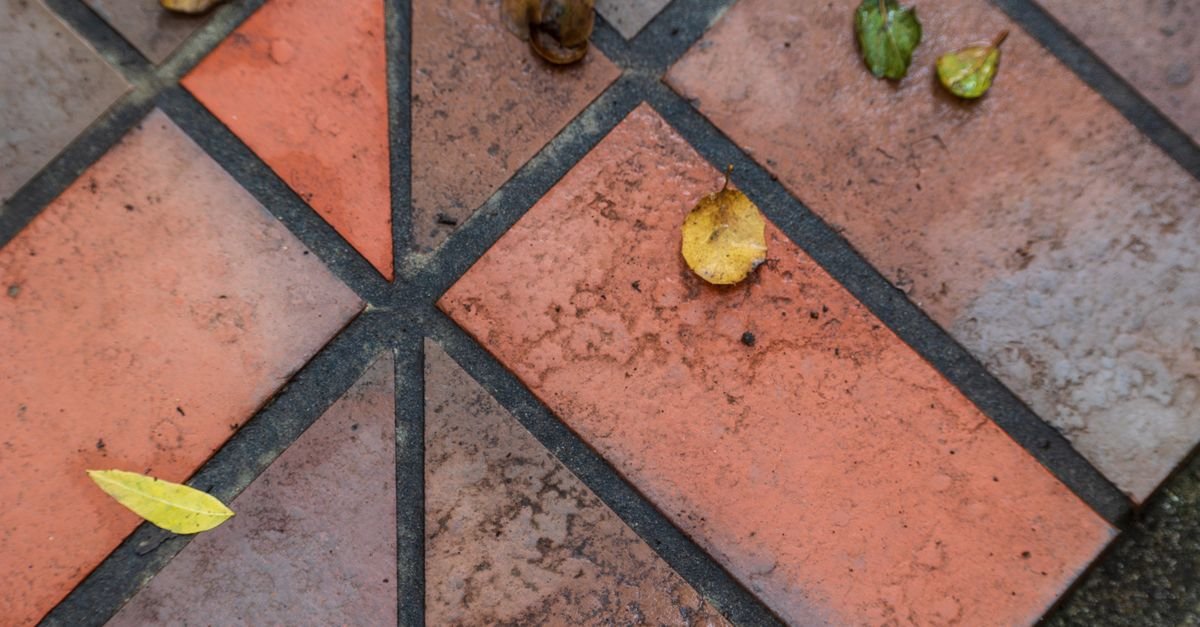
A broom-finish slab is flat. A fan tip held a foot above it meets the surface at a shallow angle, so most of the jet’s energy goes along the concrete rather than into it. That glancing geometry is doing quiet work in every safe-pressure figure you have ever read, and nobody mentions it because on flat concrete you cannot avoid it.
A stamped pattern removes that protection. Every grout line and every deep relief cut has a vertical wall in it, and a wall turns a glancing jet into a direct one. The same nozzle, at the same distance, on the same slab, hits the flats obliquely and the joint faces square on. That is where the release colour is. It is also where the sealer film is thinnest and least supported, because a coating sprayed and back-rolled across a textured surface goes on thin over an edge and thick in a hollow.
The trade treats those low points as a separate problem from the rest of the slab, which is the clearest evidence that they behave differently. Two details from the ASCC preparation sequence say so. First, mechanical contact rather than pressure is the recommended way to get release powder out: “The use of a low-speed floor buffer machine and scrubbing pad/brush can also be helpful when removing excess powder release.” Second, and more telling, once the washing is done a leaf blower is used “to remove all standing water from the slab as well as saw cuts,” with 12 to 24 hours of drying after that. The joints are named separately from the slab because the slab drains and the joints do not.
Put that next to the whitening mechanism and the sequence writes itself. The dirt you are aiming at is in a channel that holds water, and water left in that channel under a film sealer is the published cause of a cloudy patch. So the step that matters most after cleaning stamped concrete is not the rinse — it is getting the rinse water out of the pattern before the sun closes the film over it.
One note on rinse direction, because this site is consistent about it and there is a case here where the rule flips. Wash a stamped patio with detergent and the normal house order applies: apply bottom to top so the solution does not run down dry concrete in stripes, then rinse top to bottom and let gravity help. But if you use the dilute acid wash the DCC describes for release removal, the rinse water carries dissolved release powder and cement paste rather than dirt, and that is the case where you rinse bottom to top instead — the graffiti article owns that argument and explains why it runs backwards from everything else here.
The joints also grow things, which is the other reason people fetch a wand. Live moss in a grout line does not respond to pressure so much as redistribute, and the sequence for moss on concrete — kill it, wait, sweep it off dead — works better in a pattern than anywhere else, because a stamped joint is a seed bed with walls.
The Colour Wears Off the Tops First
This is the part no method fixes, and it is worth checking before you buy anything.
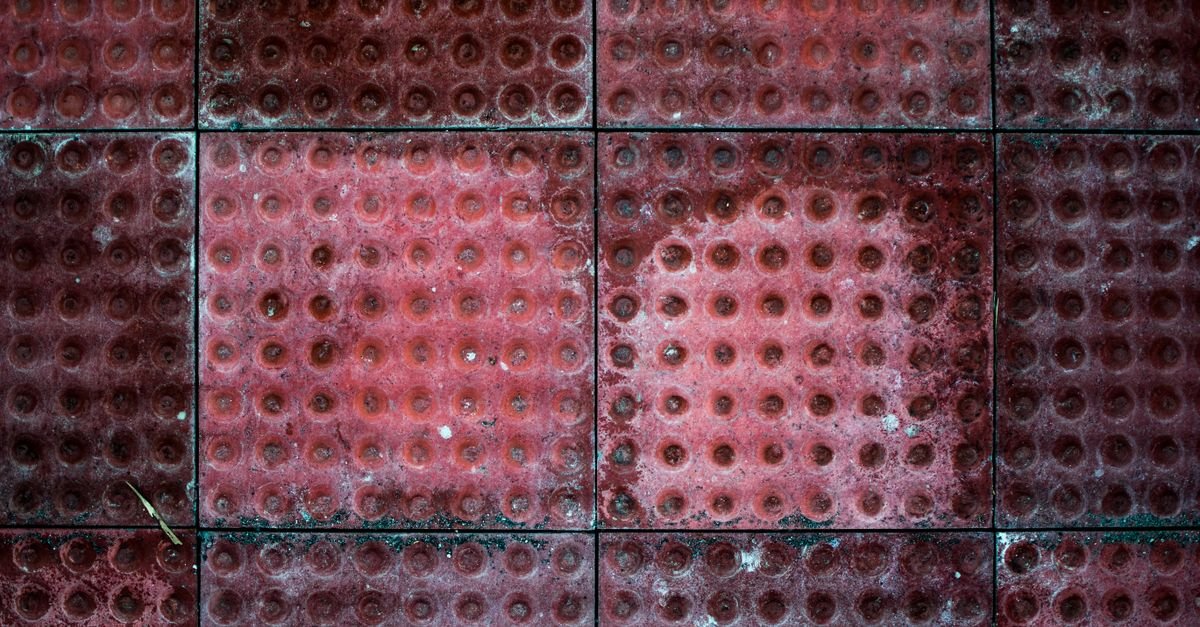
Relief concentrates wear. Feet, furniture, tyres, grit and sunlight all land on the high points and mostly miss the hollows, so a stamped slab does not fade evenly — it fades on the tops. With a dry-shake hardener you have an eighth of an inch of coloured material to lose and grey concrete under it. With integral colour the pigment goes all the way down, but the surface paste carrying the finish is the part that “may wear faster after stamping,” so the pattern goes soft-edged and chalky while staying the right colour, which is its own kind of tired.
The DCC gives a free test for telling wear from dirt and it takes a bucket of water: “Faded areas, patchiness, and multiple color shades, especially when the surface is wet, are all signs of a surface needing new sealer.” Wet concrete normally hides everything, so the direction of the test is what makes it useful. If wetting the slab evens it out, you have dirt. If wetting it makes the blotchiness *more* obvious, you are looking at a coating that has gone in patches, and no amount of cleaning changes a coating’s thickness.
If the tops have gone grey while the joints still hold their antique colour, that is wear, and washing will not bring it back. Colour brings it back — a tinted sealer, an antiquing product, or in the bad cases a stampable overlay. Pressure changes nothing except how fast the rest of the pattern joins in.
Mild Detergent, a Brush, and a Rinse That Does Not Pool
The trade’s own method has four steps and no trigger in it. This is that method with the stamped-specific detail put back in.
1. Clear it dry. Sweep or blow the pattern out before anything gets wet, and get into the joints. Wet leaf litter in a grout line turns into tannin, and a wet pattern full of grit is an abrasive slurry waiting for a brush.
2. Mild detergent and warm water. Dish soap in a bucket is the DCC’s own recommendation, not a compromise. Match the product to the mark for anything that survives it: a degreaser for oil, a mild acidic cleaner for rust and leaf stains, household bleach for mildew, a spot cleaner for sap and tar. Getting that family right matters more here than on bare concrete, because you have fewer second attempts.
3. Agitate, and agitate the low points hardest. A stiff deck brush across the flats and into every joint. The DCC’s other suggested tool for the hollows is a low-speed floor buffer with a scrubbing pad, which nobody has ever bought on impulse, but it tells you what the contact is doing: the pattern comes clean by rubbing rather than by pressure. Work bottom to top on any slope so the solution does not run ahead of itself.
4. Rinse, then dry the joints. Rinse top to bottom with a hose, then go back and move the standing water out of the pattern and out of any saw cuts, with a blower if you have one and a broom if you do not. This separates a clean patio from a cloudy one, and it is the step everybody skips because the slab already looks finished.
If a machine still has to come out — and on a badly neglected patio it sometimes does — set it up as damage control rather than as cleaning. The lowest setting the unit has, a 40-degree fan tip, a foot or more of standoff, constant height and speed, no narrow tip anywhere near a grout line, and a test patch under where a table sits. Then watch the rinse water: grey and gritty means paste, white flakes mean the sealer has started coming off, and at that point the decision has been made for you and the rest of the day is a reseal. If the slab is unsealed, or the test patch shows the sealer is finished anyway, the arithmetic changes — there is no film left to peel, and the only thing left to protect is the eighth of an inch of colour.
FAQ
Can you pressure wash stamped concrete?
You can, and the trade’s published guidance does not ask you to. The Decorative Concrete Council’s maintenance instruction for a sealed decorative surface is a mild detergent, a brush and a thorough rinse; the only place a power washer appears in its documents is the preparation step before a reseal. If you use one, treat it as the first step of a resealing job, with the lowest setting and a 40-degree tip.
What PSI is safe for stamped concrete?
Nobody with standing in the field publishes one, which is worth saying plainly because plenty of pages quote a figure. The two pressures the DCC does publish for this surface are a 3,500 psi minimum for stripping a slab before sealing, and a glossary definition putting “cleaning or roughening” above 2,500 psi. Both are stripping numbers. Widely repeated industry guidance for decorative and sealed concrete sits around 1,500 to 2,000 psi with a 40-degree tip at 12 to 18 inches, which is a reasonable place to start — but treat it as the consensus of practice rather than as anybody’s specification.
Why did my stamped concrete go white or cloudy after washing?
That is sealer whitening, and it is moisture rather than damage. The DCC defines it as moisture or solvent trapped in the layers of sealer, and its prevention advice for decorative work is explicit that cleaning steps should not leave excessive moisture behind on the slab. A stamped pattern makes it likelier because the joints hold water the flats shed. A solvent wash sometimes opens the film long enough for the moisture to escape; otherwise it is a strip and reseal.
Can I use bleach on stamped concrete?
For mildew, yes — the DCC’s own cleanup list names household bleach for it. What bleach will not do is touch oil, rust or general grime, and the more you use the more sodium ends up in your planting beds. Rinse thoroughly, keep it off metal fittings, and never let it meet an acidic cleaner. The full method for bleach on concrete covers mixing by jug strength.
How often does stamped concrete need resealing?
The trade body’s rule of thumb is every two to three years on high-traffic, UV-exposed surfaces and four to five on lighter traffic and interiors, with the caveat that its two documents disagree — one gives two to three years even for minimal traffic. Both add that reseals should happen as needed rather than on a fixed calendar, and both warn that resealing too often builds up film that is expensive to remove. The wet-slab patchiness test is a better trigger than a date.
Will pressure washing remove the colour from stamped concrete?
It depends which colour system you have and how well it was installed. A properly floated dry-shake hardener is a dense eighth-inch layer and is not coming off in one afternoon. A hardener applied too late or floated badly can shed in coin-sized pieces, and the published repair for that condition is high-pressure water or sandblasting to remove the rest. The antique release colour in the grout lines is the fragile one in every case, because it is a residue pressed into paste with nothing behind it.
What is the best cleaner for a stamped concrete patio?
Mild dish soap in warm water, applied with a brush, for almost everything. It is the DCC’s answer and it is the right one, because what you are cleaning is a film of acrylic a few thousandths of an inch thick and most stronger products are formulated to take that film off. Concrete floor cleaners in particular often remove a thin layer of sealer by design, so read the label for anything that says it strips or etches.
Do I have to reseal after cleaning stamped concrete?
Not after a detergent-and-brush wash, which is part of why that is the recommended method. After a pressure wash, plan on it. You will not know how much film came off until the slab dries, and a partly stripped acrylic is more conspicuous than the dirt was, because it goes blotchy exactly where the jet dwelt longest.
Save the Machine for the Day the Sealer Goes
A stamped patio is a thin stack of decisions somebody else made on one afternoon: an eighth of an inch of coloured cement floated in by hand while the slab was still workable, a bond breaker that was mostly washed away on purpose and left its colour in the grout lines by accident, and a film of acrylic over both of them that the people who sell it call a sacrificial coat. Cleaning stamped concrete well is mostly a matter of respecting that order, and the order runs the other way from the tools in the garage.
The one number worth carrying out of this page is 3,500 psi — not as a permission, but as a warning label. It is the only pressure figure the trade publishes for your patio, and it exists so that a contractor can get the old sealer off before the new one goes on. Anything that number is capable of, it is capable of on a Saturday, with dish soap sitting unopened under the sink.