Last Updated on September 26, 2026 by Umar Farooq
Cleaning travertine patio pavers safely turns on one question the first page of search results never asks: is your travertine filled or unfilled — because the filler is not stone, and under a jet it leaves before the dirt does.
Every guide on this topic says roughly the same four things. Sweep first. Use 1,200 to 1,500 PSI and a wide tip. Use a pH-neutral cleaner made for stone. Reseal afterwards. None of that is wrong, exactly. It is just written as though travertine were a slightly soft version of concrete, when what you are standing on is a rock with holes all the way through it, a proportion of which have been plugged with a different material by a machine in a factory.
The Natural Stone Institute fields that question often enough to have written a handout for it, and that handout is the most useful document I found on the whole subject, because it describes what fails and in what order. Nothing on the search results page mentions it.
The wider stone-identification work — which rock is it, sand-set or mortared, and the vinegar drop test — lives in our guide to cleaning a flagstone patio and in patio cleaning solution. This page is about the one stone where the holes decide everything.
Travertine Is Limestone With the Holes Left In
Travertine is not a stone in its own right. It is a kind of limestone, separated from the rest by where it was made rather than what it is made of.
The Natural Stone Institute’s *Dimension Stone Design Manual* puts it plainly in its travertine chapter: travertine “is a varietal name for a kind limestone formed under special conditions of deposition,” classed as a chemical sedimentary rock and “deposited as precipitates in terrestrial (land) environments, as opposed to limestone, which is the cemented or recrystallized accumulation of calcareous organic debris deposited on the sea bottom.” Ordinary limestone is compacted shell and skeleton from an ancient seabed. Travertine is calcium carbonate that dropped out of warm, mineral-loaded fresh water around a spring. Your patio is a hot spring that stopped.
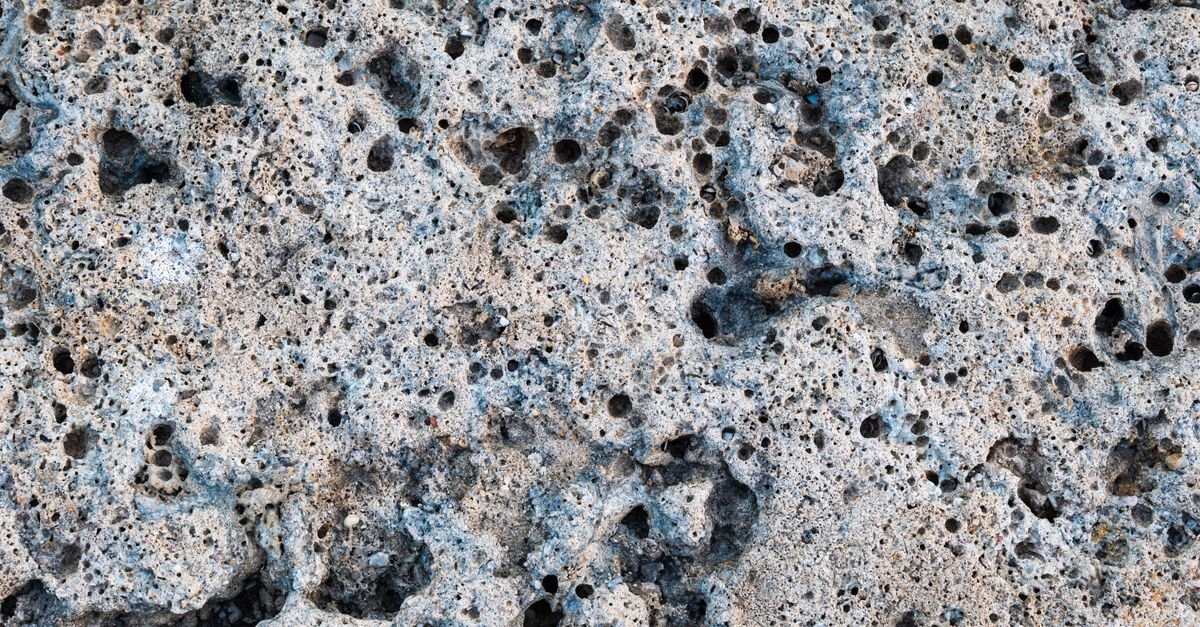
That origin is what gives it the holes. Gas came out of the water while the mineral was settling, and the bubbles are still there. The Natural Stone Institute calls the voids the result of “trapped gasses during their formation” and says flatly that this is “a common characteristic of all true travertines” (Travertine Voids, NSI technical handout). The design manual describes the texture as “very porous, often cavernous on a scale of inches.” Cavernous. On a scale of inches. That is the trade body’s own word for the material under your barbecue.
So the first job is not choosing a nozzle. It is working out which of the two travertines you own.
Filled travertine has had those surface holes plugged and ground flat. Look across the slab at a low angle in daylight and you will see pale ovals and commas that are slightly smoother, slightly flatter, and very slightly the wrong colour. Run a wet finger over one: the fill usually darkens differently from the stone around it.
Unfilled travertine is the tumbled, open-pored paver sold for pool surrounds and patios, where the holes are the point and the grip they give bare wet feet is a selling feature. It looks like a sponge that went to finishing school.
Both are common outdoors, and the Natural Stone Institute notes that filling is much the more common treatment overall. They fail in opposite directions, which is why guessing is expensive: the filled slab loses fill, the unfilled slab loses the thin roofs over voids you cannot see yet.
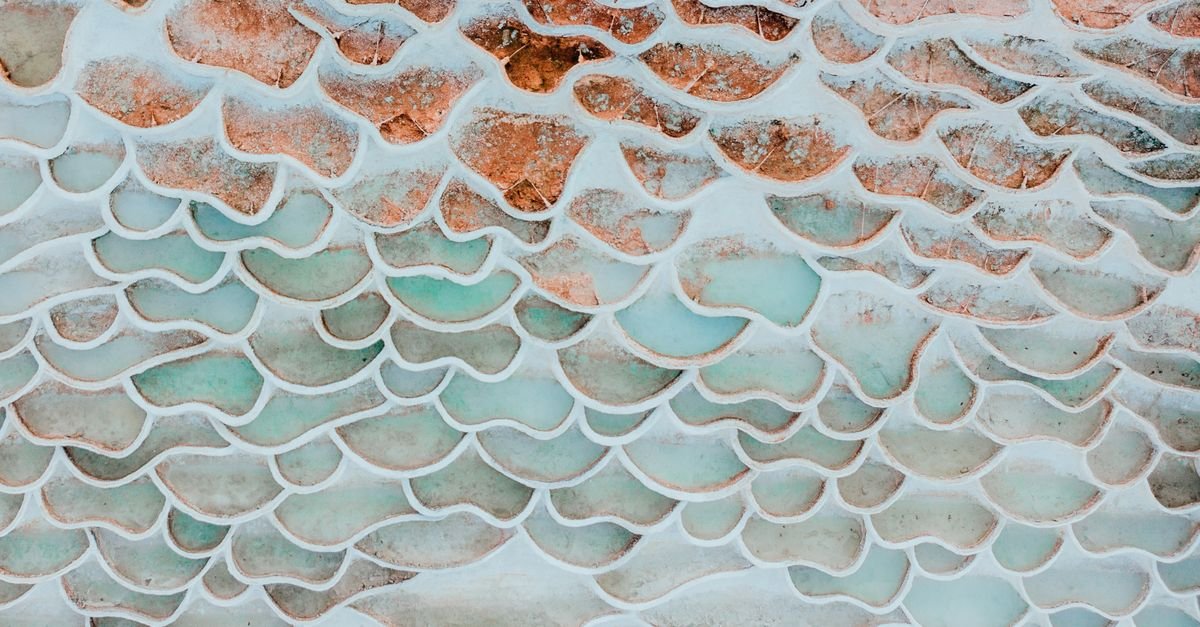
(Pamukkale, the white terraced pools in Turkey that everyone has had as a screensaver at some point, is travertine still being made. Same process, same mineral, several hundred thousand years earlier in its career, and not yet cut into 16-inch squares.)
The Voids You Cannot See Have a Thin Roof Over Them
Here is the mechanism that makes travertine different from every other patio stone, and it is published, and almost nobody repeats it.
When travertine is filled at the factory, only the voids that break through the face get filled. The Natural Stone Institute’s handout describes it exactly: “all voids that ‘window’ through the face of the stone slab are filled,” then ground flush, while “voids occurring within the stone slab do not get filled in this process, since there is no way for the fabricator to access them.” Fair enough — you cannot fill a hole you cannot reach.
The problem is the ones that sit just below the surface. The Institute again, and this is the sentence the whole article hangs on:
“A very thin shell of stone provides a roof over this void, and when a small concentrated load is applied at this point, the fragile shell of stone yields to the load and fractures into the void space.”
A roof. Over a cavity. A few millimetres thick, invisible from standing height, scattered across the slab in numbers nobody can count. The design manual says the same in its own words — “holes may appear after installation due to thin wall cavities at or near the exposed surface of the stone,” and those cavity holes “may open because of heavy foot traffic.”
The examples the Institute gives for the concentrated load are hard non-pneumatic wheels and spike heels, in a hotel lobby. Note what those two have in common: a small contact patch carrying real force. A pressure washer is not on their list, because the handout was written for facility managers, not for someone with a 2,800 PSI machine in the garage. I am extending their mechanism rather than quoting it. But the extension is not much of a stretch — a 40-degree fan held at a foot delivers its entire force through a band a few millimetres wide, and a rotary or turbo head delivers it through a point that is moving.
Two more details from that handout matter to you. First, cross-cut travertine — “fleuri” in the trade, cut parallel to the bedding so the pattern is flowery rather than linear — “will have a higher incidence of these than would vein cut, and today’s market seems to be dominated by fleuri.” Patio pavers are overwhelmingly cross-cut. Second, the Institute describes the first stretch of a travertine floor’s life as “akin to a ‘break-in’ period,” during which the barely-subsurface voids get found and opened, and after which new holes become rare.
Which gives you a genuinely useful expectation to hold. If a handful of small new holes appear after your first proper wash, on a patio that is only a season or two old, that is the break-in the trade already documents, and the fix is filling them in place — the Institute says filling voids as they become visible is “both acceptable and common practice.” If holes keep appearing every single time you wash, the pressure is the cause, not the calendar.
The Fill Is a Different Material and It Leaves First
Now the part I did not expect to find written down, and which changed how I think about this surface.
The same handout gives a second explanation for holes appearing in a travertine floor: “surface voids in the material were filled in the fabrication process, but overly aggressive maintenance practices are dislodging or eroding the filler.” And then the recommendation, verbatim: “I would suggest reviewing the maintenance with your staff to ensure that spray nozzle pressures and stiff brushes are not removing filler or grout materials.”
Spray nozzle pressures. That is the natural stone trade body’s technical director naming water pressure as a cause of filler loss — indoors, in a hotel lobby, with the kind of spray-and-extract machine a cleaning contractor pushes around a floor. Those run at a pressure your pressure washer produces before the trigger is fully back.
So what is the fill actually made of? The design manual lists the options: “natural (gray colored) or tinted portland cement, and clear or colored epoxy or polyester resins,” and notes that unless somebody specified otherwise, matching coloured portland cement is what gets used. The handout puts it the same way — “cementitious or resinous.”
Both have a problem outdoors.
A cement fill is a plug of mortar sitting in a hole in a rock. It has no reinforcement and no key beyond the shape of the void, and its thermal behaviour is not the stone’s. The design manual makes that point directly about setting mortar: “the thermal coefficient of mortar expansion is greater than that of stone,” and in paving installations that stress “is often sufficient to break the bond between the stone and the substrate.” If a mortar bed can be pushed off a slab by nothing more than summer and winter, a coin-sized cement plug in a hole is not a fixture for life either.
A resin fill has a spec sheet you can read, and it is worth reading. Tenax, which makes a filler sold specifically for this job, describes its travertine filler as “a semi-solid polyester filler specifically formulated for repairing, rebuilding, gluing, and filling travertine and similar porous natural stones” — and then, in the same paragraph, “recommended for interior use only. Not suitable for temperatures below 32°F.” The same manufacturer sells a separate outdoor epoxy line, which tells you the interior-only line is a real limit rather than boilerplate. The default travertine filler is not an outdoor material.
None of that means your patio is about to disintegrate — plenty of filled travertine sits outside for decades. It means the fill is the weakest thing on the surface, weaker than it was when it was new, and a machine that removes the softest material first will find it before it finds the algae.
So check. Press a plastic scraper firmly into three or four filled voids near an edge or under a planter. Sound fill feels like the stone; failing fill gives, crumbles, or lifts as a disc. Then rinse a square foot at your intended pressure and look at the ground: grey grit or pale flakes in the run-off is the fill leaving, and nothing puts it back.
The opinion, and I will state it plainly. On filled travertine, the pressure washer is the wrong primary tool, and the trade body’s own cleaning method says so without ever mentioning a machine. The design manual’s cleaning clause for travertine reads, in full: “The stone shall be washed with fiber brushes, mild soap powder or detergent, and clean water, or approved mechanical cleaning process.” Fibre brushes and soap. That is the specification. A deck brush and a bucket clean a filled travertine patio slightly slower than a wand and cost you no plugs at all, and on this surface that trade is not close.
Acid Takes the Fill and the Stone at Different Rates
The general case — why acid and calcium carbonate cannot be kept apart, and why the descaler that works on a shower screen etches the stone — is argued in full in vinegar for cleaning hard water stains, and I am not going to re-run it here. Travertine is calcium carbonate, acid dissolves calcium carbonate, and the damage is etching, which is a permanent change in the surface rather than a stain you can have another go at.
What is specific to travertine is that a filled slab gives the acid two different things to eat.
The stone is calcite. A cement fill is hardened portland cement paste, which is also attacked by acid, but not at the same rate or in the same way. Pour an acidic cleaner over a filled travertine paver and you do not get an evenly dulled slab — you get a relief map, plugs standing proud or sunk below the face, a hundred small shadows where there used to be a flat surface. An epoxy or polyester plug barely reacts at all, which is worse: the stone around it retreats and the fill stands up like a stud.
The design manual flags a failure mode you are more likely to meet than you think. It warns that when brickwork above travertine is being cleaned, “strong acid compounds used for cleaning brick will burn and discolor the travertine.” That is not a warning about what you put on the patio. It is a warning about what runs down onto it from the wall. If you are acid-washing brick or render above a travertine terrace, the terrace is downhill of the job.
And the manual’s own position on the whole category is short: sandblasting, wire brushes and acids “will only be permitted under special circumstances approved by Specifying Authority.” Marshalls, the paving manufacturer, says much the same about garden products in its aftercare guide — “many common patio cleaners and brick acids are hydrochloric acid based and are not appropriate on most of our products.”
Cleaning Travertine Patio Pavers: Angle the Jet, Do Not Aim It
If you are going to use the machine — and most people are, including on unfilled travertine where the case against it is much weaker — the geometry matters more here than the pressure does.
Marshalls publishes a short power-washing procedure in its patio and driveway aftercare guide, and one line in it is worth more than every PSI figure on the search results page: “Do not direct the power washer directly onto the surface. Use at a 30° angle or use a rotary scrubbing attachment.” The rest of the procedure is sweep first, low pressure setting, “do not use an oscillating lance,” test an inconspicuous area, and check the jointing afterwards.
Put that next to the Natural Stone Institute’s thin-shell mechanism and the reason clicks into place. A perpendicular jet puts its whole force straight down onto the roof of whatever void happens to be under it — the exact geometry of a small concentrated load. Swing the wand to a shallow angle and most of that force becomes shear across the face instead, which is the direction dirt sits and the direction a thin stone roof is strongest. The angle is not a nicety. It is the difference between pushing on a lid and sliding across it.
The rest of the method:
- Sweep it bone dry first, including the joints. Grit driven across an open-pored stone at pressure is an abrasive, and travertine is soft enough to care.
- Wet the whole area before any chemistry goes down, so the cleaner cannot soak into one dry patch and sit there.
- Let the cleaner do the removal. The chemistry-then-dwell-then-brush sequence set out on the flagstone page above transfers unchanged; the only travertine amendment is that a stiff nylon brush needs to be worked across the holes rather than into them, and never a wire one.
- Rinse at the lowest pressure that clears what the chemistry already killed, 40-degree tip, at least 12 to 18 inches back, wand moving, no turbo head at any distance.
- Check the joints afterwards and refill what came out. Travertine pavers are usually sand-set with tight joints, and the sand replacement sequence is in our guide to power washing pavers.
On the PSI number, I have to be honest with you. I went looking for a published cleaning-pressure ceiling for travertine from the Natural Stone Institute, from the ASTM C1527 specification the industry writes for this stone, and from the paver suppliers who sell it. There is not one. The 1,200 to 1,500 PSI figure that circulates on every travertine cleaning page has no source attached to it anywhere I could find, and the only place the stone industry mentions spray pressure at all is as a cause of damage. The site’s own paver table puts travertine at 800 to 1,200 PSI with a 40-degree tip, which is a defensible working figure rather than a published limit, and I would treat the bottom of that range as the target rather than the floor.
A Porous Stone in a Freezing Climate Is a Tray of Reservoirs
An unfilled travertine paver is, structurally speaking, a tray of small reservoirs with a stone lid. That is fine in Florida, where most of it is sold as pool deck paving. It is a different proposition in a climate that freezes.
The design manual’s number here is worth quoting carefully, because it is narrower than it first looks: it says the diagenetically altered limestone that gets marketed as travertine “may have high porosity, often up to 40% or more.” That is not a figure for all travertine, and it is not a figure for your specific pavers. It is the stone industry telling you the upper end of what can legitimately arrive on a pallet labelled travertine, and 40% void space in a paving material is a lot of somewhere for water to go.
The manual’s instinct about held water is consistent wherever it comes up. Writing about anchor holes drilled into travertine, it says care must be taken to ensure that “any holes capable of retaining water are filled after use to prevent water collection and freezing.” A hole that holds water is treated as a defect to be closed. An unfilled paver is a few hundred of them by design.
So the practical rules are about timing rather than technique:
- Wash in a warm dry spell, and give it days. A soaked travertine patio going into a hard frost is the one avoidable version of this failure. Water expands by about nine per cent when it freezes, and it does that inside the voids whether or not the surface looks dry.
- Do not use rock salt to de-ice it. Marshalls is unambiguous: “never use common salt to de-ice reconstituted stone or limestone.” The design manual says the same thing on the installation side — “salt shall not be used for the purpose of melting ice, frost, or snow on the stone pieces.”
- Treat any hole that appeared last winter as the site of the next one. Once a void is open to the sky it fills with water, grit and organic debris, and it stays wetter than the stone around it for longer.
That is the argument against washing a travertine patio in November because it looks grim and you have a free Saturday. It will look better for a fortnight and then spend three months as a freeze-thaw experiment with your name on it.
FAQ
Can you pressure wash a travertine patio?
On unfilled tumbled travertine, yes, at low pressure with a 40-degree tip, held well back and angled across the surface rather than aimed at it. On filled travertine, you can, but the Natural Stone Institute names spray nozzle pressure as a cause of filler loss and specifies fibre brushes and mild detergent as the cleaning method for this stone. A deck brush costs you an hour and costs you no fill.
What PSI is safe for travertine pavers?
Nobody in the stone industry publishes one, which is worth knowing before you trust the 1,200 to 1,500 PSI figure that every travertine cleaning page repeats without a source. Our own paver guidance puts travertine at 800 to 1,200 PSI with a 40-degree tip at 12 to 18 inches, and on a filled or weathered patio the sensible move is to start at garden-hose pressure on a hidden slab and climb only while nothing changes.
Can you use vinegar or bleach on travertine?
Not vinegar, not ever, and not any other acid — travertine is calcium carbonate, so an acid dissolves the surface rather than cleaning it, and on a filled slab it takes the stone and the fill at different rates and leaves a pitted relief instead of a flat face. Dilute sodium hypochlorite is a different question: it is alkaline, it kills organic growth, and it is the basis of most stone-safe patio treatments, but it needs a full pre-wet and a thorough rinse.
Why are new holes appearing in my travertine after cleaning?
Two published causes, and they need different responses. Subsurface voids with a thin stone roof open under concentrated load, which the Natural Stone Institute describes as a break-in period that tails off — filling those as they appear is normal practice. Or the factory fill is being eroded out of voids that were already plugged, which is not a break-in period, and which will carry on for as long as you keep washing at that pressure.
Should you seal travertine pavers after cleaning?
The advice genuinely conflicts and you should know that rather than being handed one side of it. The US paver trade recommends resealing travertine every few years, on the grounds that open voids collect water and staining. Marshalls states in its own aftercare guide that it “does not recommend the use of any form of sealant on our products if installed externally.” Different stones and different climates, but both positions are published by people who sell paving, and a sealer applied over a damp porous stone traps what is underneath it.
Ask Whether It Is Filled Before You Pull the Trigger
One check decides this whole job and it takes about two minutes at the edge of the patio. Press a scraper into three or four filled voids. If the fill is sound, wash gently, at a shallow angle, with the chemistry doing the removing. If the fill crumbles, the machine will finish what the weather started, and the honest answer is a brush, a bucket of neutral soap and an afternoon.
Travertine is two materials pretending to be one, and the weaker of them is the part holding the surface flat. Almost everything written about cleaning this stone treats the pressure as the variable. The variable is the fill.