Last Updated on September 26, 2026 by Umar Farooq
Removing tree sap is a solvent problem, not a pressure problem. Resin is not water-soluble, so a pressure washer pointed at a sap blob achieves nothing except damage to whatever the sap is sitting on. Going closer, narrower or higher does not change that.
Park under a pine for one night and by morning the bonnet carries a constellation of amber dots that a wet sponge slides straight over. The instinct then is to fetch something with more force behind it, because the sap is obviously stuck and force is obviously what unsticks things. Follow it and you finish the afternoon with the sap still there and a dull patch of clearcoat beside it.
So: the three surfaces people actually ask about — a car, a deck, a driveway — and the chemistry that lifts sap off all three. The machine gets a section too, just not the one you expected.
Why Water Cannot Move Resin at Any Pressure
Sap is not dirt sitting on a surface. It is a two-part chemical product the tree made on purpose, and knowing what is in it tells you what will shift it.
Conifer sap is oleoresin, which plant physiologists describe as “a defensive secretion composed of monoterpene olefins (turpentine) and diterpene resin acids (rosin)” (Funk et al., *Plant Physiology*, 1994). Turpentine is the thin volatile part that smells like Christmas. Rosin is the sticky solid — the same material violinists rub on a bow, which tells you how keen it is to let go of things.
Neither half has any interest in water. Alpha-pinene, the commonest monoterpene in the mix, has a measured water solubility of 2.49 mg/L at 25 degrees C, and the same record lists it as soluble in alcohol, chloroform, ether and fixed oils (PubChem, alpha-Pinene, CID 6654). A 2.5 GPM machine pushes about nine and a half litres a minute, so a full minute of output could, in laboratory conditions, dissolve roughly 24 milligrams of pinene. About one drop of sap.
Pressure does not move that number. Pressure buys mechanical force, and the thresholds sit the wrong way round for it: cars are safe at 1,200–1,900 PSI, softwood decking gives up at 500–600, and cured rosin gripping a clearcoat’s texture needs more than either. The pressure at which the sap leaves is higher than the pressure at which the surface leaves. That is the whole reason this is not a pressure job.
Like dissolves like. Oldest rule in the chemistry book, and the one aisle in the shop that has never heard of it is the one selling machines.
Fresh Sap Is a Liquid; Cured Sap Is a Rosin Barrier
Here is the detail that decides how hard your afternoon will be, from the same paper.
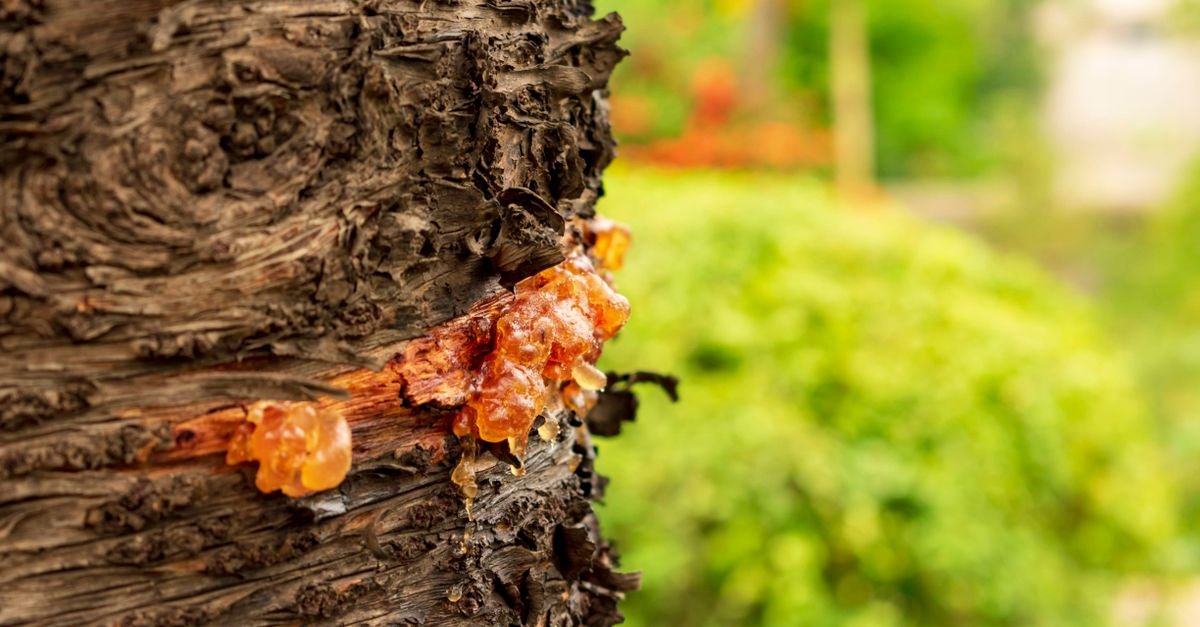
The tree uses “the volatile monoterpenes as a solvent for the mobilization and deposition of resin acids at the wound site to seal the injury with a rosin barrier after the evaporation of the turpentine.” Read that with a paintbrush in mind: a tree makes a solvent-borne varnish that sets by evaporation. Fresh sap is rosin still dissolved in its own thinner. Cured sap is what is left once the thinner has gone, and it is a sealed barrier by design, because sealing a wound was the point. Sun then cross-links the remainder, which is why a dot that wiped off with a damp cloth in June needs a clay bar in October.
| How old the sap is | What it usually takes |
| Hours, still tacky and glossy | Warm water and shampoo, ten minutes of soaking |
| A few days, firm but not brittle | Isopropyl alcohol at 50:50, under a soaked cloth |
| Weeks, hard and dull | Bug-and-tar remover, warmth, several dwell cycles |
| Months, with a shadow around it | Solvent, then decontamination, then a polish |
Timing beats technique by a wide margin. Same drop, same cloth, same person, and roughly forty times the work — set entirely by how many weekends you let pass.
The Order of Gentleness, From Soap to Mineral Spirits
Four things dissolve tree sap. They are not alternatives, they are a ladder: start at the bottom, stop at the rung that works.
| # | Solvent | What it actually is | Where it stops being safe |
| 1 | Warm water and detergent | Surfactants that emulsify the soft outer layer | Does nothing to cured rosin |
| 2 | Isopropyl alcohol, 50:50 with water | A small organic solvent resin acids dissolve into | Can haze a finish if left to evaporate on it |
| 3 | Bug-and-tar or citrus (d-limonene) remover | Mild distillates or terpenes plus surfactants, formulated finish-safe | Strips wax and sealant |
| 4 | Mineral spirits (white spirit) | A straight petroleum distillate | Dissolves oil-based finishes as readily as sap |
The reason you never start at rung four is written into rung four. Mineral spirits is superb on sap because it is superb on everything in that chemical family — and a lot of what sits under your sap is in that family.
Heat helps. Scrubbing does not. A solvent has to diffuse into the resin first, and diffusion is faster warm — so work on a sun-warm panel rather than a hot one, or lay a cloth wrung out in hot water over the spot for a minute. Then put the solvent-soaked cloth on top and leave it: thirty to sixty seconds for fresh sap, several minutes for old. Wipe once, in one direction, and lift.
A soaked cloth sitting on a blob looks exactly like somebody who has given up. It is the only part of the job currently working. Scrubbing is the opposite of help: until the resin dissolves it is a hard solid, and dragging a hard solid across a finish is sanding with extra steps.
Removing Tree Sap From a Car Without Hazing the Clearcoat
Clearcoat is the thinnest layer on the car and it is doing all the UV protection, so the aim on paint is the weakest solvent and the least rubbing the job allows.
1. Wash the panel first. Grit around a sap dot gets dragged through it the moment you wipe. The full order is in car cleaning jet wash, and the pre-rinse is the step protecting you here.
2. Warm the spot, do not bake it. A panel too hot to rest a hand on flashes your solvent off before it diffuses anywhere.
3. Isopropyl alcohol at 50:50, on a folded microfibre, laid over the dot. Wait. One straight wipe. Inspect.
4. Repeat rather than press. Three cycles at rung two beat one aggressive cycle at rung four.
5. A proud blob comes off with a plastic razor blade or a fingernail through a cloth. Metal blades belong on glass and nowhere else.
6. Mineral spirits only on something you have decided to re-wax, because it takes the wax and the sealant with it.
Two honest notes. The dull ring left after the sap finally goes is usually not sap — it is clearcoat recording where the sap was, and that is a polishing job. And I went looking for a coatings-industry limit on isopropyl alcohol against cured clearcoat and found detailer blogs citing each other, one saying 50/50 is harmless indefinitely, the next saying 91% clouds paint on contact. So I will not hand you a threshold I cannot stand behind: dilute it, dwell, wipe, never let it dry on the paint, and test on a door jamb.
No tip on your machine removes sap. A turbo nozzle does not dissolve resin; it moves the damage from the sap’s account to yours.
Deck Sap: The Solvent That Cleans Your Brush Also Cleans Your Finish
On a deck the constraint is not the wood, it is whatever is on the wood — and the finish makers give the problem away in their own cleanup instructions.
Penofin, a penetrating oil finish, says plainly: “Penofin is an Oil-Based product. Clean brushes and other application materials with mineral spirits or paint thinner” (Penofin application guidance). That is a warning wearing a helpful hat. The solvent that gets an oil finish off a brush gets it off a board too, in a patch the exact shape of your rag.
- Bare or weathered timber. Mineral spirits is fine; there is nothing to lose. Expect a lighter patch that weathers back over a season.
- Penetrating oil finish. Stay on rung two or three. If spirits is unavoidable, plan to re-oil that board.
- Film-forming stain, varnish or paint. Strong solvents soften the film. Soap, warmth and a plastic scraper, and accept a faint residue over a wrinkled patch of finish.
There is also a trick that runs the other way from everything above. Chill it. Rosin is brittle cold, so a bagged ice cube held on a blob for two minutes usually lets a plastic scraper pop the whole thing off in one piece, taking no finish with it. Heat to dissolve, cold to lift — worth more on a deck than any bottle on the shelf.
Pressure fails here twice. Sap does not care about 600 PSI, and what high pressure does to the timber *around* a blob is raise the surface fibre into a fuzzy patch. Then you own a furred board and a lump of sap, which is worse than where you started. Limits by material are in cleaning decks.
Is Your Concrete Sealed? That Changes the Solvent
Concrete is the one surface here where you can genuinely reach for the strong stuff — unless somebody sealed it, and the test that tells you takes thirty seconds.
Put a tablespoon of water on the slab. Soaks in within half a minute, the concrete is bare. Beads, and there is a film on top. That test and the stain families behind it are in cleaning stains from concrete.
On bare concrete, mineral spirits or acetone dissolves sap and the slab does not object. The catch is porosity: the resin has wicked into the pores, so wiping lifts the visible blob and leaves a shadow. That shadow is a poultice job — solvent mixed into a fine inert powder, spread thick, dried, scraped off, usually more than once.
On sealed concrete, understand what a solvent-based acrylic sealer is: a film held together by its own carrier solvent, which is why xylene is sold specifically to re-melt an existing acrylic coat and bring the shine back. A film that can be deliberately re-melted can be accidentally re-melted, so your sap solvent takes a glossy divot out of the sealer instead. Hot alkaline degreaser, a stiff brush, two or three cycles, and a slower afternoon.
One product does nothing on either: bleach. Sodium hypochlorite is aimed at organic colour, and sap’s problem is not its colour, it is the tack. Pale the amber and the tack stays, quietly collecting grit until it is dark again by August.
Where the Pressure Washer Earns Its Place
None of this makes the machine useless. It makes it a rinse tool, which is what it was always best at, and it has three real jobs in a sap removal.
Before. Pre-rinse the surrounding area so grit near the sap is gone before any cloth starts moving. That is the highest-value thing pressure does all day, and it happens before you touch the sap.
After. Rinse the dissolved resin and spent solvent off before either dries back down. Dissolved sap left to evaporate in place re-deposits as a sticky film over a far larger area than the original blob — the same failure as letting detergent dry, and just as irritating to fix.
Across a large area. On a driveway under a pine, where hand-treating three hundred drops is absurd, degreaser plus dwell plus a rinse at flatwork pressure is the only sane method. A hot-water machine earns its keep there, because heat is the one thing the machine itself contributes.
Settings come from the substrate, never from the sap: a 40-degree tip at 18 inches on a car, 500–600 PSI on softwood, 2,500–3,000 PSI with a surface cleaner on flatwork. Red and turbo have no role at all. And that rag full of white spirit is hazardous waste — sealed container for the wipes, detergent over the treated area, then the general rinse.
FAQ
Will a pressure washer remove tree sap?
No. Resin is not water-soluble at any pressure, and the force needed to shear cured sap off a surface is higher than the force that surface survives. The machine is genuinely useful either side of the job — pre-rinsing grit away, then rinsing dissolved resin off afterwards — but it will not remove the sap itself.
What is the best thing to remove tree sap?
Isopropyl alcohol at roughly 50:50 with water handles most sap on most surfaces and is the safest thing that actually works. Fresh sap often comes off with warm water and detergent alone. Hard old sap needs a bug-and-tar remover, then mineral spirits — and mineral spirits removes any oil-based finish it touches.
Will tree sap damage car paint if I leave it?
Given enough sun, yes. Sap cures and cross-links under UV, shrinking onto the clearcoat’s texture, and the usual result is a sap-shaped dull mark that stays after the sap is gone. That mark is etched clearcoat, not residue, and no solvent lifts it — it needs polishing. Removing sap within a few days avoids the whole thing.
How do you get tree sap off a deck without damaging the stain?
Chill it rather than dissolve it. Hold a bagged ice cube on the blob for two minutes, lift the brittle lump off with a plastic scraper, then clean the shadow with warm water and detergent. If a solvent is unavoidable on an oil-finished board, expect to re-oil that spot — mineral spirits is what the finish makers specify for cleaning their own product off a brush.
Does hot water remove tree sap?
Not on its own, but it makes every solvent work faster, because warming resin lowers its viscosity and speeds up how quickly a solvent diffuses into it. That is why a hot-water machine is a real advantage on a sap-covered driveway. Warm, not scalding, and never on a hot panel.
Reach for a Solvent, Not the Trigger
Sap is the clearest case on this site of a rule that holds nearly everywhere: chemistry decides whether the job is possible, and pressure only decides how much collateral damage you do finding out. Water cannot dissolve resin — 2.49 milligrams in a litre is the ceiling — so no dial on the machine is an answer here.
What is an answer is dull and reliable. Get to it early. Warm it. Start with soap, move to diluted alcohol, escalate only if you must, and know what is underneath before the mineral spirits comes out. Then let the cloth sit doing nothing visible for a minute, which is the part everybody skips.
The clock matters more than the solvent. Fresh sap comes off with warm water and detergent; sap that has had a summer of sun on it has cross-linked down into the clearcoat and leaves an etched, sap-shaped mark that nothing on this page will lift. That one is a polishing job rather than a cleaning one, and it is worth saying so plainly. On anything oil-finished, know which finish it is before the mineral spirits comes out, because that bottle removes finish as readily as it removes resin.