Last Updated on September 25, 2026 by Umar Farooq
Algae on siding cleaning goes wrong for one reason: people treat it like mould, and algae is not a fungus. It is a photosynthesiser. It makes its own food out of sunlight, which means it does not obediently hide in the shade, it does not care about the pollen film you keep hosing off, and it will not appear where you have been told to look for it.
Go and stand at the north-east corner of your house. Nine times out of ten that is where the green is — not the deep north wall, not behind the hedge, but the corner that catches the early sun. That is not a coincidence.
Algae Is a Plant, and That Changes Where It Grows
Mould and algae come off the same wall with the same bucket, which is why almost every article treats them as one problem. Biologically they are about as far apart as two things on a wall can be.
Mould is a fungus — a heterotroph — it cannot make food, so it has to find some, which is why how to remove mold from vinyl siding spends so much time on the organic film that lands on your cladding. Take the food away and the colony starves.
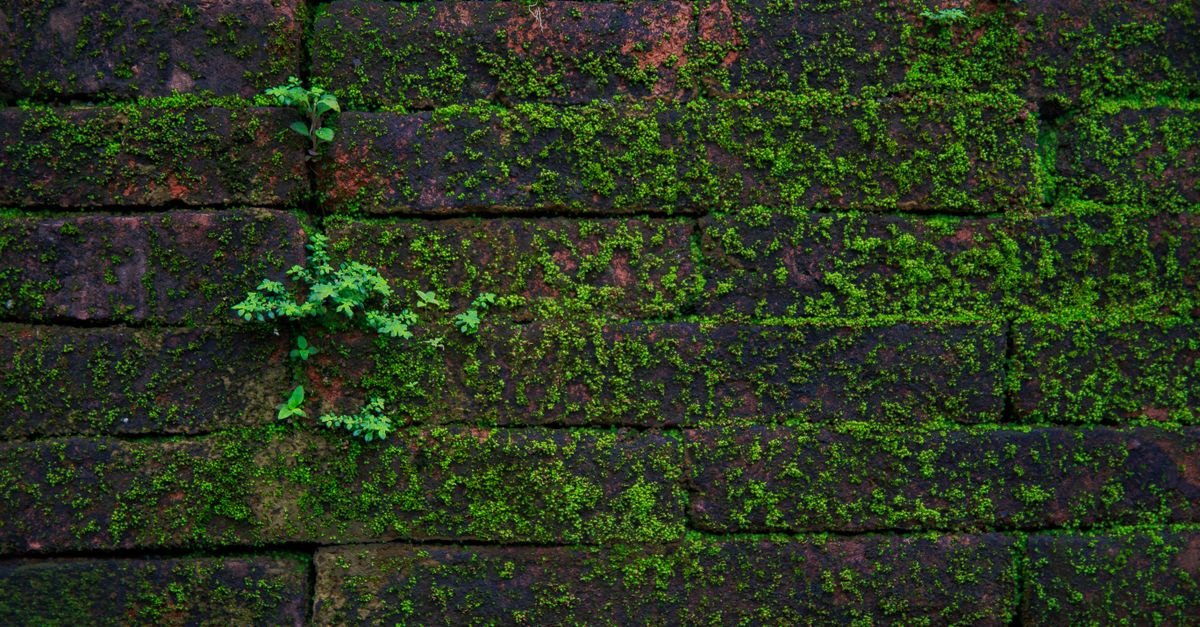
Algae does not need your pollen. It builds its own sugars from carbon dioxide, water and light, and the only item on that list your wall supplies is the water. You cannot starve it. There is nothing to withhold.
That single difference reorganises the problem:
- Mould’s limiting factors are food and moisture. Both are things you can remove.
- Algae’s limiting factors are light and moisture. You can remove exactly one of those, and it is not the light.
It also explains something people find genuinely confusing. Mould will happily grow in the permanent dark under a deep soffit, behind a downspout bracket, in the gap between a shutter and the wall. Algae will not. Go and look at those spots on your own house — the darkest places are usually the cleanest green-wise, because a solar-powered organism in total darkness is just a damp stain waiting to die.
(Strictly, half of what we call algae is not a plant either. It is cyanobacteria, which are bacteria that learned photosynthesis about two and a half billion years ago. Nobody is going to correct you from the garden.)
Green in the Shade, Black in the Sun
Two very different organisms get called algae on a house, and the colour tells you which one you have.
Green is true algae — chlorophytes, the same broad group as pond scum. Chlorophyll, no sunscreen, and it burns. Research on building façades finds green algae dominating low-irradiance and shaded walls, exactly where a plant with no UV protection would end up.
Black, brown or grey-streaked is usually cyanobacteria, most famously *Gloeocapsa magma* — the organism responsible for the dark streaks on asphalt roofs. It solves the sunlight problem by building a dark pigmented sheath around itself. The black is not dirt. It is sunscreen, and it is better at making it than I am at remembering to apply mine.
That sheath is why the two colours end up in different places on the same house:
| What you see | What it is | Where it sits | What it is telling you |
| Even green film, slightly slimy when wet | Green algae | Shaded and part-shaded walls, low wall, behind planting | The wall stays wet for long stretches and still gets some light |
| Dark streaks running downward, often from the roof line | Cyanobacteria | Sun-exposed walls under a shingle roof edge | Roof runoff is seeding the wall from above |
| Dark patch with a fuzzy, raised edge | Not algae — that is mould | Anywhere, including full darkness | A moisture source, not a light problem |
| Powdery green-grey crust that will not wet out | Lichen | Old masonry, north-facing sills | Decades, not seasons. Leave it to a specialist |
A study of a building surface across two seasons found the balance flipping with the weather. Through a wet, dim autumn and winter the green algae ran away with it — 87.1 µg/cm² cumulative against 47.3 for cyanobacteria. In the drier, brighter spring the order reversed, 4.1 against 3.3, and both were a twentieth of the winter figure (Influence of climatic factors on cyanobacteria and green algae development on building surface).
Cyanobacteria tolerate drying out. Green algae do not. That is the entire green-versus-black story, and it holds on a roof, a fence and a wall.
The North-East Quadrant Gets It First
Here is the opinion on this page, and it is the one that saves people from cleaning the wrong wall: the wall that grows algae fastest is not the darkest wall on your house — it is the wall that is still wet when the sun reaches it.
The mechanism is simple once you say it out loud. Photosynthesis needs light and liquid water in the same cell at the same moment. A dry algal cell in bright sun is not growing; it is enduring. The façade research puts it plainly — water availability is the most important factor for any of these organisms, and light is the key factor for the photosynthesisers specifically. Neither alone does much. The overlap is what counts.
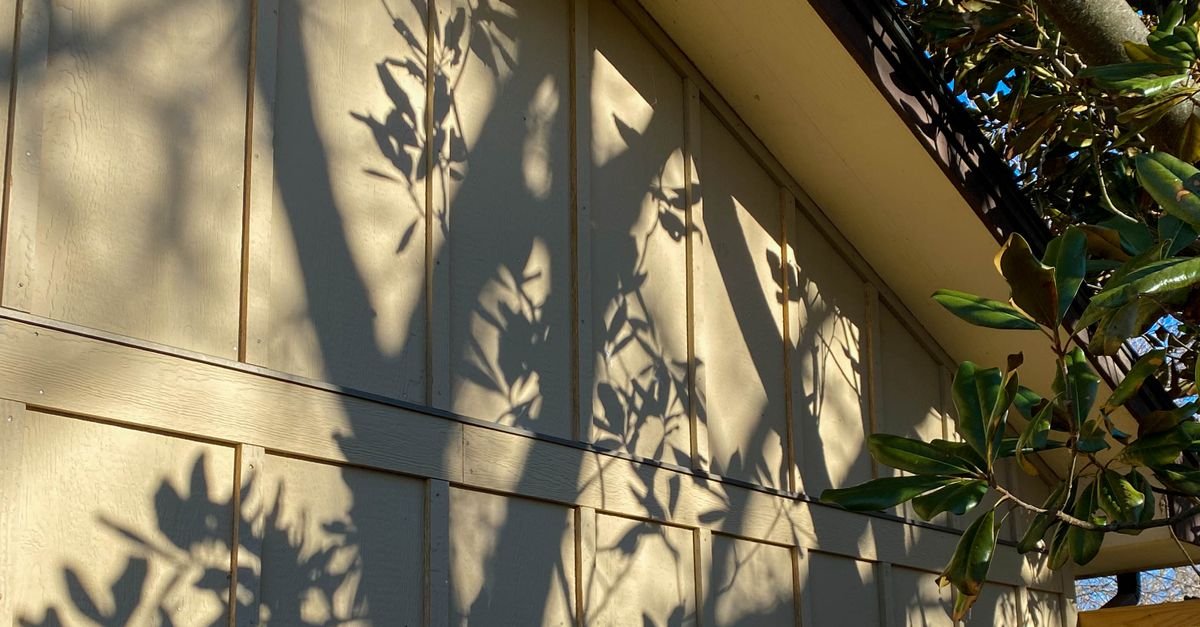
Now walk it round the compass with dew on every elevation at 5am:
- East. First light lands at six in the morning on a wall still carrying last night’s dew. Two or three hours of wet, lit wall, every single clear morning of the year.
- South. Peak light at midday, by which point the dew burnt off hours ago. Bright, dry, hostile.
- West. Afternoon sun on a wall that dried at ten. Then it re-wets after the light has gone.
- North. Wet all day, but only diffuse light. Growth happens — slowly, and it is mostly the shade-loving green.
The north-east quadrant sits on the join: enough morning light to drive photosynthesis, and the longest overlap with a wet surface. If your east elevation has green on it and you have been told algae is a shade problem, this is the missing piece.
It also explains the dawn sprinkler, which is not merely wetting the wall — it is wetting the wall at the precise moment the light arrives.
Why the Bottom Three Feet Goes First
Look at almost any algae-stained wall and the growth has a sharp top edge somewhere between two and three feet off the ground. That edge is not a tide mark. It is how high rain bounces.

Soil is where algae actually lives in bulk. Every storm that hits a path, a patio or a stretch of compacted ground rebounds upward and throws soil — and the algae in it — straight onto the bottom courses of your cladding. The splash zone is not somewhere algae happens to survive. It is somewhere the weather re-seeds several times a year, free of charge.
Stack the drying problem on top. The bottom of a wall is the slowest part to dry, because it gets the grade, the mulch, the path holding moisture and whatever the downspout is doing. Wet for longer, inoculated more often, and — unlike the shaded top of a north wall — usually in decent light.
Three fixes, in the order they pay: a gravel drip strip or planted border to soak up the rebound where paving throws it; a downspout extended at least 1.5 metres clear of the foundation; and mulch kept 150mm below the bottom course. Then re-aim any sprinkler head that touches the house. Sprinklers should water grass.
Algae on Siding Cleaning: What Actually Kills a Photosynthesiser
Good news, for once: algae is far easier to remove than mould, for a structural reason rather than a chemical one. Mould pushes hyphae down into a paint film or a wood cell, which is why a proper kill can still leave a grey shadow. Algae sits on top as a biofilm — a slime layer glued to the surface rather than growing into it. Oxidise it and it lets go. On vinyl or coated metal you will often watch the green sheet off the wall in the rinse, intact, like wallpaper giving up.
So the method is unglamorous and it works:
- Wet the plants and the ground below first, and wet them again when you finish. Runoff kills far more shrubs than overspray does.
- Apply a sodium hypochlorite solution with a surfactant in it, bottom to top, so the wall never has a dry stripe under a wet one. The mix itself — strength, surfactant, and the one combination that produces chlorine gas — is covered in sodium hypochlorite for pressure washing. I am not restating ratios here.
- Let it dwell without drying. Five to ten minutes is the working range, and the dwell is the kill. Re-mist any area that starts going dry at the edges.
- Rinse top to bottom at the lowest pressure that shifts it. Gravity is doing half the job.
Two things not to do. Do not reach for a brush, and do not reach for pressure. ARMA’s guidance on roof algae is worth reading across to walls: “DO NOT use a power washer or any type of brush or broom to clean algae from the roof surface” (ARMA, Algae Discoloration of Roofs). A stiff brush on a biofilm does what a squeegee does to a spilled drink — relocates it, grinds the pigment into the surface texture, and carries live cells into the clean sections you just finished.
Pressure is the same trap it always is. Vinyl tops out around 1,300–1,600 PSI with a 25 to 40 degree tip, and what psi pressure washer for vinyl siding has the per-material figures — but a film that lets go on its own does not need any of it. Use the machine to apply and to rinse. The chemistry already won.
Does It Eat the Siding, or Just Sit on It?
Here the honest answer splits by material — and every guide I read on this topic gave one blanket answer to a question that has two.
On vinyl and coated metal, algae is cosmetic. PVC is not food, and more to the point algae was never looking for food in the first place. What it does do is hold a film of water against the panel for longer than bare cladding would — which does not hurt the vinyl, but does hand the next tenant a better-prepared room. Algae is the advance party for mould, not its rival.
On mineral surfaces it is not cosmetic at all. A 2025 metabolomic study of green algal biofilms on building materials found oxalic acid, acetic acid and citric acid in the biofilm itself, and described a two-tier process: “rapid, acid-driven mineral degradation is followed by biofilm-mediated persistence and the chronic accumulation of aesthetic and structural damage.” Those acids chelate the calcium, magnesium, iron and aluminium holding the material together (Assessing the potential for biogeochemical deterioration of building materials by green algae).
| Cladding | Is the algae doing harm? | What you are actually protecting |
| Vinyl and polymer | No | Appearance, and the drying time of the wall behind it |
| Coated aluminium and steel | No, unless the coating has already chalked | The paint film |
| Stucco, render, mortar | Yes — acid attack on the binder | The surface of the material itself |
| Fibre cement | Yes, at the coating and the cement matrix | The factory coating, then the board |
| Brick and natural stone | Slowly, at the mortar joints first | The pointing |
| Bare or stained timber | Indirectly — it holds water on wood | The wood, via the moisture it retains |
So “is it just ugly?” has a real answer, and it is: on plastic, yes. On anything that started life in a kiln or a mixer, no.
It Comes Back Faster Than Mold Does
Mould on a non-porous wall is a multi-year problem. Algae is a seasonal one, and this is the part people take personally. The same façade study recorded cyanobacteria concentrations spiking within hours of a rain event, and cumulative growth across a wet autumn running twenty to thirty times the spring figure. That is an organism operating on a timescale of days, not years.
In practice, on a shaded or north-east elevation in a wet climate, expect a visible green cast back within one growing season. On an open, sunny, well-drained site, two to three years is realistic. A wall never quite goes back to zero either — you remove the film, not every cell in the surface texture, and the survivors are a far better starting population than anything arriving on the wind.
Which means the thing that changes your interval is not a stronger mix. It is drying hours.
FAQ
Is the green stuff on my siding algae or mould?
Colour and texture settle it. Algae is an even film, green, slightly slimy when wet, and it will be somewhere that gets at least some daylight. Mould is fuzzier, more often a defined patch, and it grows happily in complete darkness — under soffits, behind brackets, inside shaded gaps. If it is green and out in the light, it is algae.
Does algae damage vinyl siding?
No. PVC is not a food source and algae does not need one, so on vinyl the problem is appearance plus a film of water held against the panel. On stucco, render, fibre cement or mortar the answer changes, because the organic acids in the biofilm genuinely attack mineral binders.
Will vinegar remove algae from siding?
It lightens a thin film and does very little to an established one. Household vinegar is around five percent acetic acid — and acetic acid is one of the acids the algae itself produces, which should tell you how impressed it is. Sodium hypochlorite or a percarbonate cleaner does the actual oxidising.
Can I pressure wash algae off siding?
You can, and you do not need to. Algae sits on the surface as a film rather than growing into it, so a soft wash at low pressure removes it completely once the chemistry has worked. Pressure adds risk — driving water behind laps, marking panels — for no gain on a contaminant that lets go on its own.
Why is the algae only on one side of my house?
Because that elevation gets light and stays wet at the same time. Shade alone produces mould; light alone produces nothing. The overlap — most often an east or north-east wall holding dew into the morning sun, or any wall fed by a dawn sprinkler — is what produces algae.
Does the roof cause the algae on my siding?
Often, yes, on the elevations under a shingle roof. *Gloeocapsa magma* colonises asphalt shingles and then washes down with every rain, seeding the wall below. If your dark streaking starts at the roof line and fades downward, the wall is a symptom and the roof is the source.
Starve the Water, Not the Light
Every effective thing you can do about algae comes from one sentence: it needs light and water together, and only one of those is yours to take away.
So do not spend the weekend chasing shade. Spend it on drying hours. Get the downspout water away from the foundation, put half a metre of daylight between the shrubs and the wall, stop the sprinkler wetting the cladding at dawn, and clear whatever is holding a drip line along the eaves. Then wash the wall properly once, with chemistry and a dwell rather than a brush and a grudge.
The bleach cleans the wall you are looking at. The downspout decides what you will be looking at next October.