Last Updated on September 24, 2026 by Umar Farooq
A siding cleaning solution is three things — sodium hypochlorite, a surfactant and water — and for a typical house wall it wants to land near 1% chlorine at the surface, which is about one part 12.5% pool chlorine to eleven parts water, with a couple of ounces of surfactant stirred in per five gallons.
That is the whole answer. The reason it takes another two thousand words is that almost every recipe on the internet is handed over like a folk remedy: two-thirds of a cup of this, a quart of that, and no explanation of why. So people substitute. They swap the surfactant for dish soap, double the bleach because the wall is very dirty, and add a splash of vinegar because vinegar cleans things. That last one is why this article has a section with a warning in it.
I went and read what a siding manufacturer actually publishes, because I wanted to know whether the trade mix and the consumer mix are different animals. They are not. They land within a rounding error of each other, which was the most useful thing I found all week.
Three Ingredients, and Only One of Them Cleans
Sodium hypochlorite is the only part of the mix that kills anything. The black on a north wall is not dirt — it is a living colony, usually mildew or algae, with roots into the surface film. Hypochlorite oxidises it, the colour goes, and what is left rinses away. No amount of scrubbing does that. You just move the pigment around and call it progress.
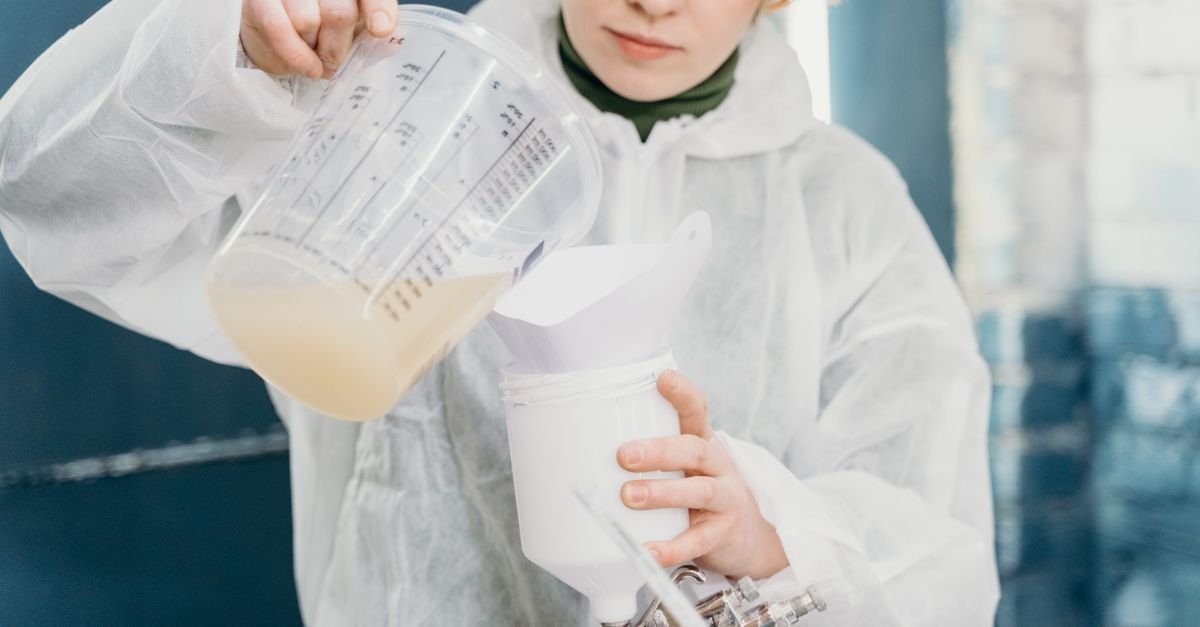
The surfactant does not kill. Its job is time. Water and bleach have enough surface tension to bead and run, so a mix sprayed onto a vertical wall is on the ground in about fifteen seconds — roughly fifteen seconds short of what the chemistry needs. A surfactant drops that surface tension so the mix flattens out and clings, and it also lifts the greasy road film that the hypochlorite would otherwise have to eat through first. There is a whole article on what a pressure washing surfactant does and which ones chlorine destroys, because some of them do not survive contact with it.
Water is the ingredient people forget is an ingredient. It is not filler. It is the part that keeps the mix at a strength your siding, your window gaskets and your shrubs can survive, and the concentration you dilute to is the single decision that determines whether this job goes well.
So: one part does the work, one part buys it time, and one part stops it doing too much work. Skip the surfactant and you have made expensive rain.
The Recipe a Siding Manufacturer Actually Publishes
Most of the recipes circulating online have no author. This one does. CertainTeed, a siding manufacturer with an obvious interest in you not destroying its product, publishes a mildew formula: one-third cup of laundry detergent, two-thirds cup of trisodium phosphate, one quart of 5% sodium hypochlorite and three quarts of water (CertainTeed, How to Clean Vinyl Siding). It adds, in the same breath, that “greater concentrations may cause damage to vinyl siding.”
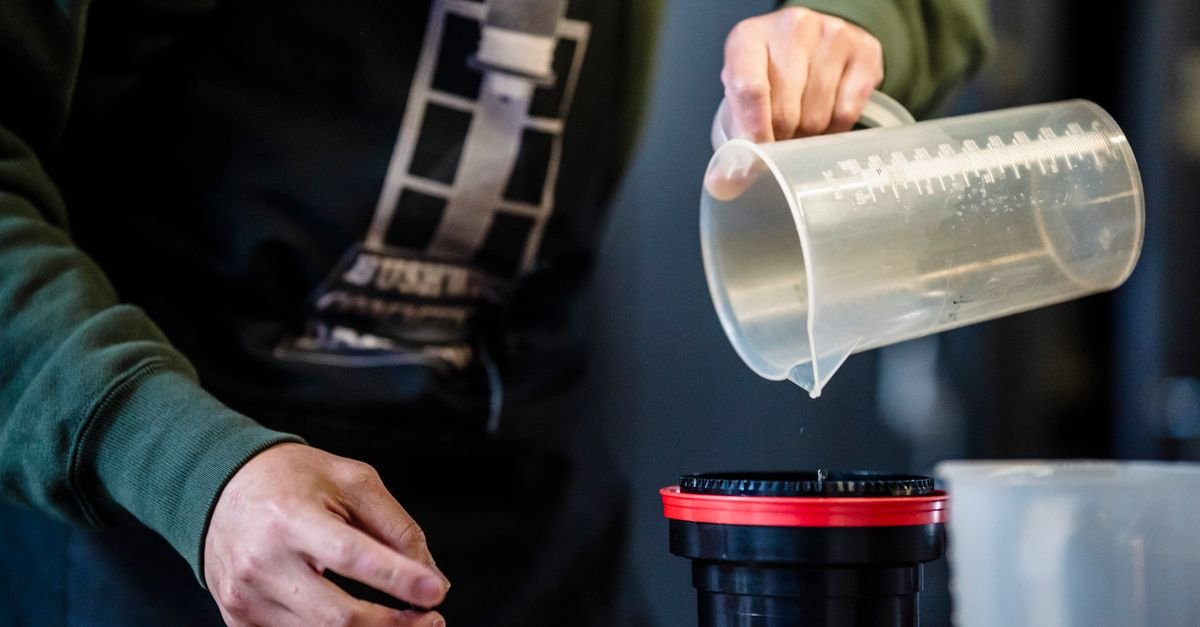
Now do the arithmetic, because nobody else does. One quart of 5% bleach in a gallon of finished mix is a quarter of the volume at 5%, which is 1.25% sodium hypochlorite at the wall. The soft wash mix professional house washers run sits at roughly 1%. A manufacturer’s bucket recipe and a contractor’s tank recipe are, within a rounding error, the same solution. That agreement is worth more than either number on its own, because two groups with completely opposed incentives arrived at the same strength.
The other two ingredients are doing the surfactant job in household form. The laundry detergent supplies the surfactants. The trisodium phosphate is a strong alkaline cleaner that cuts grease and helps lift chalky oxidation off older vinyl and painted board. If you cannot get TSP, or would rather not handle it, phosphate-free TSP substitutes sit in the same aisle for the same purpose. They are milder, and you will scrub more.
One caveat on that recipe: it is written for a bucket, a soft brush and a garden hose. CertainTeed does not recommend power washing vinyl or polymer siding at all. If you are using a machine anyway, the mix is still right — the delivery is a separate argument, and it lives in power washing siding.
Matching the Mix to What Is Actually on the Wall
Before you mix anything, go and look at the wall from two feet away. Most people reach for bleach on a house that is simply dirty, which is a bit like taking antibiotics for a bruise.
| What you are looking at | What it actually is | What the solution needs |
| Even grey-brown film, worst near the road | Road film, pollen, dust | Surfactant and water. No bleach at all. |
| Green and patchy, worst low down and on shaded walls | Algae | Sodium hypochlorite near 1%, plus surfactant |
| Black speckles or streaks on north-facing walls | Mildew or mould | Sodium hypochlorite near 1%, longer dwell |
| Chalky white residue on your hand after touching it | Oxidised vinyl or paint binder | Detergent and TSP, agitation with a soft brush |
| Orange-brown fan stain under a sprinkler or fixing | Iron staining | An oxalic acid product — never the same day as bleach |
| Dark streaks directly under gutter joints | Tannin and asphalt runoff | Surfactant and dwell. Bleach barely touches it. |
Two of those rows do not want bleach, and one of them must never meet it. That is the entire argument for looking first. A wall that is only dirty comes clean with a surfactant and a rinse, and you will have spent nothing, killed nothing and not had to water the garden twice.
The two acid rows are worth a second look before you go shopping. An iron stain and a bleach mix are separate jobs on separate days, and the reason for that is further down this page.
Mixing for a Whole House Instead of a Bucket
A gallon of mix cleans a shed. A house needs the same chemistry measured in five-gallon batches, and the ratio depends entirely on which bleach you bought — which is where most mixes go wrong, because “one part bleach to four parts water” means two completely different things depending on the jug in your hand.
| Bleach strength | Parts water per part bleach | Strength at the wall |
| 12.5% (pool chlorine, SH) | 11 | ~1.0% |
| 10% (SH) | 9 | ~1.0% |
| 8.25% (concentrated household) | 7 | ~1.0% |
| 6% (standard household) | 5 | ~1.0% |
| 5% (the strength CertainTeed specifies) | 4 | ~1.0% |
Add the surfactant last, after the water and the bleach are already in the container. Put it in first and you will spend ten minutes watching foam climb out of a bucket while the useful part of the mix waits in the jug. Two to four ounces per five gallons is the usual dose, and the sodium hypochlorite mix ratios article carries the strength tables for roofs and concrete if you are working past the walls.
Here is the one opinion I will push hard on this topic: when the mix is not working, add time, not chlorine. Hypochlorite is a concentration-and-contact product. Doubling the strength does not halve the dwell. It roughly doubles what runs into your beds, what sits in your window gaskets, and what the manufacturer has explicitly told you may damage the siding. A 1% mix left on for eight minutes beats a 3% mix rinsed off after two, and it costs less. Every “the bleach did not work” account I have read closely describes a mix that ran off the wall in twenty seconds. The failure was cling, not strength.
Mix what you will use, and mix it the day you use it. Heat and sunlight are what weaken hypochlorite, not the calendar — a translucent jug that spent August in a truck bed is a different product from the one on the label, and you will not find that out until you are halfway up a gable wondering why nothing is happening.
Vinegar and Bleach on the Same Page
I read through the highest-ranking homemade siding cleaner articles to see what people are being told. Several of them list a vinegar-and-water recipe and a bleach-and-detergent recipe on the same page, a few hundred words apart, with nothing in between to say the two must never be combined. That is not a small editorial gap. That is a page that will eventually cost somebody an afternoon in an emergency room.
ATSDR states it plainly: sodium hypochlorite “releases chlorine gas when it comes in contact with acids” (ATSDR, Medical Management Guidelines for Chlorine). Vinegar is an acid. So is oxalic acid wood brightener, so is muriatic, so is most rust remover, and so is a surprising share of the hard-water-stain products sold for glass. Ammonia is a separate problem with a different gas and a similar outcome, and ammonia is in a lot of glass cleaner.
The part people miss is that the bucket is not the only place the two can meet. A pump sprayer that had an acid in it last month still has acid in the wand. A downstream injector still holds whatever you ran through it last. A wall you rinsed with an acid brightener an hour ago is still carrying it in the laps. If acid has touched the kit or the wall, flush both properly and do the bleach on a different day. The garden will thank you for the extra rinse anyway.
What a Jug of Shop-Bought Siding Cleaning Solution Costs You
There is nothing wrong with buying it ready-made, but you have to read the back of the bottle, because a shop-bought siding cleaning solution comes in three genuinely different kinds and the front label rarely tells you which one you are holding.

Complete mixes carry their own oxidiser and their own surfactants. Dilute and go. Bleach-free mixes — usually built on an oxygen or peroxide chemistry, and usually the ones marketed as kinder to planting — are gentler, genuinely better around a border, and slower on established black mildew. Bleach-boosted mixes are a surfactant and additive package that expects *you* to supply the household bleach, and the dilution on the label only makes sense once you have added it. Buying the third kind and using it neat is the most common reason a bought product “did nothing.”
The honest comparison is not the shelf price. It is the price per gallon of finished solution, and every label gives you the dilution you need to work that out while you are standing there. A concentrate that makes 40 gallons is a different proposition from one that makes four. Do the division before the till and the answer is usually obvious.
Mixing your own wins on volume, on control of strength, and on choosing a surfactant that survives chlorine. Buying wins in three real situations: when you would rather not keep a jug of 12.5% hypochlorite in the garage, when the job is one shaded gable rather than a whole elevation, and when a hose-end bottle is the only applicator you own. None of those is a failure of nerve. A hose-end bottle that actually gets used beats a perfect tank mix you never make up.
The industry note nobody prints: the polymeric siding trade body lists a set of products that damage siding outright — furniture cleaners, liquid grease removers, nail polish remover, undiluted chlorine bleach, and anything carrying organic solvents (PEPA, Cleaning and Maintenance). Undiluted chlorine bleach appearing on a list beside nail polish remover should settle the go-stronger argument on its own.
The Plants Die of Thirst, Not Chlorine
The advice to wet your plants before you start is everywhere, and the reason behind it almost never is. So people do it badly: one quick pass with a hose, ten minutes before mixing, then three hours of work.
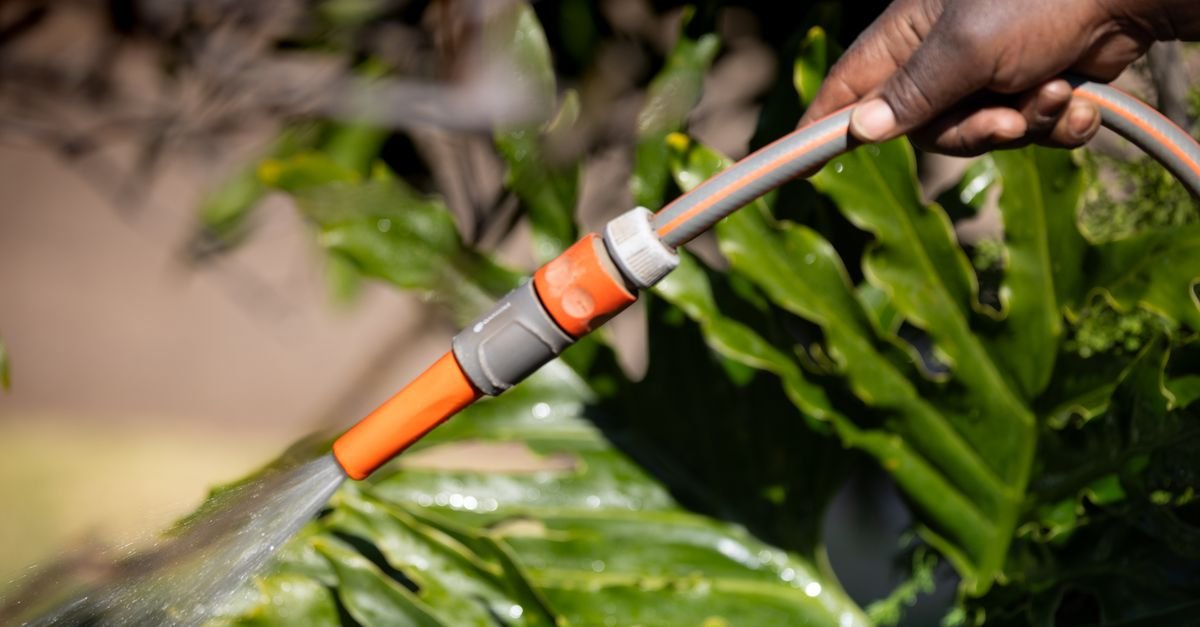
Two things are going on. Wet leaves shed a chlorine mix instead of holding it, so contact time on the foliage stays short. And saturated soil has nowhere to put more liquid, so runoff moves sideways across the bed and away rather than down into the root zone. Dry soil does the opposite. It takes everything you give it, straight to the roots, and holds it there. A dry bed under a wall you are washing is a sponge pointed at the wrong thing.
So the instruction is not “wet the plants.” It is: soak the beds and the foliage until water stands briefly on the soil, re-soak anything that dries out while you work, never let the mix dry on a leaf, and give everything a long rinse when you finish. Aim runoff at lawn rather than at a storm drain or a border. If a shrub sits close enough to the wall that it will catch spray whatever you do, wet it, cover it loosely while you treat that section, then uncover and rinse — a tarp left over a plant in full July sun is its own kind of problem.
FAQ
What is the best cleaning solution for siding?
For algae or mildew, sodium hypochlorite diluted to roughly 1% with a surfactant added so it clings. For ordinary dirt and road film, a surfactant and water with no bleach at all. The wall tells you which. Bleach on a merely dirty wall is wasted money and an unnecessary rinse.
What is the correct mix ratio for a siding cleaning solution?
It depends on the bleach strength, which is why single-ratio advice goes wrong. To land near 1% at the wall: one part to eleven parts water for 12.5% pool chlorine, one to five for standard 6% household bleach, one to four for 5%. Add two to four ounces of surfactant per five gallons, last.
Can I use vinegar to clean siding?
On light mildew a diluted vinegar solution does something, and it is a reasonable choice if you are worried about planting. What you must not do is use it in the same sprayer as a bleach mix, in the same bucket, or on the same wall the same day. Acid plus sodium hypochlorite produces chlorine gas.
Will a bleach siding cleaning solution damage vinyl?
Diluted, no. CertainTeed publishes a mildew recipe that works out at about 1.25% sodium hypochlorite and warns that greater concentrations may cause damage. The polymeric siding trade body separately lists undiluted chlorine bleach among the products that damage siding. The dilution is the safety margin, not an economy measure.
Do I need TSP in a siding cleaning solution?
Only for chalky oxidation and greasy films. TSP is a strong alkaline cleaner, not a biocide, so it does nothing to the black growth most people are actually fighting. Phosphate-free substitutes do the same job slightly more slowly.
How long should a siding cleaning solution sit before rinsing?
Five to ten minutes, and never long enough to dry on the surface. If it dries you get streaks and you get no more killing, because dry chemistry has stopped working. On a warm wall in direct sun, re-wet the section rather than stretching the dwell.
Can I mix a batch and keep it for next weekend?
Mix what you will use. Dilute hypochlorite keeps better than the trade believes when it is stored dark and cool, but the surfactant and the strength both drift, and a part-used jug left warm and in the light is the quickest route to a mix that quietly does nothing while you blame the wall.
The Bucket Decides, Not the Machine
Nearly every siding job that goes badly went wrong before anyone pulled a trigger: wrong strength, no surfactant, and no proper look at what was growing there. Get the bucket right and the rest is patience and a rinse in the correct direction.
And if you are standing in the garden with a sprayer, trying to remember what was in it last time — empty it, flush it, mix fresh. That is a cheap five minutes.