Last Updated on September 26, 2026 by Umar Farooq
Removing chewing gum is a temperature job, not a pressure job, because gum base is not a stain and not a grease — it is synthetic rubber, and rubber absorbs a jet of water instead of releasing from it.
Point a wand at a flattened grey disc and you can watch the problem happen. The gum does not leave. It stretches, thins, goes slightly paler, and settles back down over a wider area than it started with. You have not removed anything. You have rolled it out.
The pages ranking for this query will tell you to bring 3,000 to 4,000 PSI and a rotary nozzle in to six inches. The paving manufacturers and the national programme that actually pays to clean gum off high streets buy something else entirely, and what they buy is heat.
Gum Base Is Synthetic Rubber, and the Regulation Says So
You do not have to take anyone’s word for what is in gum, because the US government publishes the list. 21 CFR 172.615 defines chewing gum base as a “nonnutritive masticatory substance,” and then names every substance a manufacturer is allowed to build it from.
Under the heading Masticatory Substances, the synthetic column reads: butadiene-styrene rubber, isobutylene-isoprene copolymer (butyl rubber), paraffin, petroleum wax, polyethylene, polyisobutylene, polyvinyl acetate (21 CFR 172.615, Chewing gum base). Butadiene-styrene rubber is SBR — the same elastomer family as a car tyre sidewall. Butyl rubber is what an inner tube is made of. Polyisobutylene is the tack polymer in duct tape.
The regulation also puts a size on the chains, which is where the stretch comes from. Polyisobutylene must have a minimum molecular weight of 37,000, measured by the Flory method. Polyvinyl acetate needs a minimum of only 2,000, and the permitted polyethylene sits between 2,000 and 21,000. So the elastomer is built from chains an order of magnitude longer than anything else in the mix, tangled like a bag of fishing line — and long tangled chains are precisely what lets a material take a large deformation and pull itself back. That is the definition of rubber, and the reason your nozzle achieves nothing.
A second list in the same section matters more than it looks. Under Plasticizing Materials (Softeners), the CFR permits glycerol esters of gum rosin, wood rosin, tall oil rosin and polymerised rosin, plus lanolin, rice bran wax and stearic acid. Under Terpene Resins, it permits “polymers of a-pinene, b-pinene, and/or dipentene.”
Rosin and alpha-pinene are the two halves of pine sap. The softener in a stick of gum is the purified industrial version of what a conifer makes to seal its own wounds, which is why removing tree sap is the right reference for the resin side of this chemistry and its solvent ladder covers it properly. It is the wrong reference for the rubber, and that is the separation: sap is rosin with the thinner gone, so a solvent dissolves it. Gum is rosin blended into an elastomer, and an elastomer does not dissolve — it swells, goes gluier and spreads.
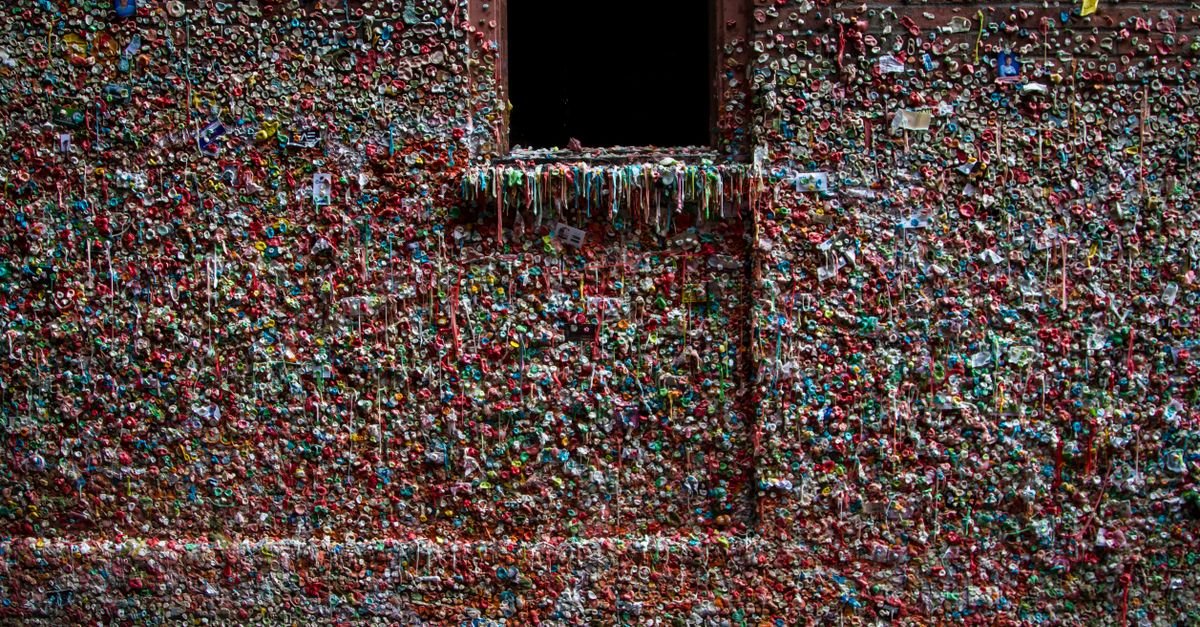
Worth sitting with, too: a gum blob on a pavement is a lump of tyre-grade rubber, wax and polyethylene. Keep Britain Tidy, which runs the UK’s national gum clean-up, describes gum as breaking down “extremely slowly, potentially contributing to microplastic pollution.” Nobody set out to litter plastic. They bought it in a foil wrapper from a newsagent.
Removing Chewing Gum With Pressure Alone Just Smears It
Here is the mechanism the SERP skips. A jet of water delivers an impulse — force over a very short time — and what a material does with that impulse decides everything.
Concrete is stiff and brittle, so the impulse goes into fracture. Dirt is a loose aggregate held by weak bonds, so the impulse breaks the bonds and the water carries the pieces off. An elastomer does neither. It converts the impulse into strain, stores part and dissipates the rest as heat inside itself, then relaxes. The gum yields, flows sideways under the jet and re-adheres in a thinner film across a larger footprint. The bond to the concrete was never the weak link; the gum’s own willingness to deform was.
Which is why the standard advice reads the way it does. The pages ranking for gum removal tell you to “rent or buy a power washer with at least 3,000 PSI,” that “a pressure setting between 3,000 and 4,000 PSI is usually strong enough,” and to bring “a 15-degree or rotary nozzle” in to around six inches. Every one of those numbers is a response to the gum not coming off, and none addresses the reason it did not.
Now read what a paving manufacturer publishes about the same machine. Marshalls’ cleaning and maintenance guidelines for garden paving and driveways say the washer “should be used on a setting which is sufficient to remove the dirt without causing any further distress. A low-pressure setting is recommended,” and then, specifically: “Do not direct the power lance directly down on to the paving, as this can result in loss of jointing material and cause damage to the surface of the unit.” The recommended technique is the lance “at a shallow angle, not greater than 30 degrees across the diagonal (i.e. not parallel to joints).” It also warns that “certain high-pressure jetting machines have been known to mark or damage the surface of certain wet cast paving material” (Marshalls, Gardens & Driveways Cleaning & Maintenance Guidelines).
So the SERP’s method — a narrow or rotating tip, aimed straight down, at six inches, at four thousand PSI — is a point-by-point inversion of what the company that made the slabs asks for. This is the one strong position on the page: there is no pressure setting at which a gum blob leaves a porous paving surface before the paving surface does. A rotary nozzle at six inches will eventually clear the spot, and what it clears is a shallow bright crater the size of a coin, which is a different and more permanent problem than the gum.
Pressure has a role here. It is the last step, not the first.
Cold Makes It Brittle: Freeze Spray Beats an Ice Cube
Marshalls publishes the actual method twice, in two different documents, and both times the first lever is temperature rather than force.
The older guidelines are blunt: “Chewing gum is a particularly difficult substance to remove from hard surfaces. Newly discarded gum can be scraped off by using a mechanical scraper but hardened gum can only be removed by both freezing the gum and chiselling it from the surface of the paving or utilising a hot water/steam cleaner.” The current Patio & Driveway Aftercare Guide gives the same sequence in a stain matrix: scrape the gum off the surface; “for more stubborn gum, use a freeze spray on the area and then chip off the surface”; then “clean down using hot water and steam clean to remove the stain.”
Note the tool. A freeze spray, not an ice cube. The distinction is real and it is arithmetic: an ice cube cannot go below 0 degrees C, because that is where it stops being ice, and a cube melting on warm paving is delivering its heat-of-fusion to the slab rather than to the gum. An aerosol freeze spray works by evaporative cooling and reaches well below zero in a few seconds, on the gum only, without wetting anything.
What the cold changes is not the rubber. The elastomer chains stay flexible far below anything a household method reaches. What stiffens is everything around them — the waxes, the rosin esters, the stearic acid. Chill that phase and it goes from a soft matrix to a rigid one, the composite’s modulus climbs and the tack collapses. A tacky solid fails cohesively, which is what smearing is. A rigid solid fails at the interface, in one piece. Cold does not make gum easier to cut; it moves where the break happens.
Two things follow. Use a plastic scraper or a wooden wedge at a low angle and let the edge lift rather than cut — a steel blade on broom-finished concrete takes the high points of the finish with the gum. And work fast, because the brittleness window is short on a warm slab and you get one attempt per chill.
I went looking for a published brittleness or glass-transition temperature for gum base, so I could tell you how cold is cold enough. Outside patent filings, which give a softening range rather than a brittle point, there is nothing. So I am not going to hand you a threshold. Spray it, then let the wedge tell you: a chilled blob resists the edge and then goes all at once, where a warm one just drags.
Heat Has to Clear 93 Degrees C, Not 200 Fahrenheit
The other direction works too, and this is where the regulation earns its place a second time, because the CFR does not just list what is in gum base — it specifies the temperatures at which those ingredients stop behaving like solids.
From the same section, for the softeners: glycerol ester of partially hydrogenated gum or wood rosin, “a minimum drop-softening point of 79 degrees C.” Glycerol ester of polymerized rosin, “a minimum melting-point of 80 degrees C.” Glycerol ester of wood rosin, “a softening point (ring and ball) of 80 to 88 degrees C.” Methyl ester of rosin, partially hydrogenated, “a drop-softening point of 88 degrees C to 96 degrees C.” Stearic acid, “a minimum drop-softening point of 102 degrees C.” Sodium and potassium stearates, “a minimum drop-softening point of 109 degrees C.” The permitted Fischer-Tropsch paraffin has “a congealing point of 93 to 99 degrees C.” And the natural terpene resin, “softening point minimum 155 degrees C.”
Those are specifications for permitted ingredients rather than a measured property of the blob on your drive, and that caveat matters. But they establish the band, and the band is the useful thing: the stuff holding a gum blob together starts giving up somewhere between about 80 and 110 degrees C, and part of it does not give up below 155.
Now convert the number the gum-removal pages quote. Hot-water pressure washing “typically around 180 to 200 degrees F” is 82 to 93 degrees C — my arithmetic, from their figure. That clears the bottom of the band and nothing else. It softens the low-melting rosin esters and leaves the stearates, the paraffin and the terpene resin untouched, which is precisely the experience people report: the gum goes soft and sticky, comes away in strings, and leaves a film.
This is what the steam setting is for, and why it exists. A hot-water machine’s steam tip is a low-flow tip — fewer gallons per minute for the same burner means a higher outlet temperature, which is a straight trade of volume for degrees. Gum is one of the few homeowner-scale soils where that trade is the right one, because the target temperature is above what a standard hot-water tip delivers. That article also owns the general rule for when heat is worth its fuel, and the disposal problem that comes with anything you melt; both apply here unchanged.
A homeowner cold-water machine has no move in this section at all. It cannot reach 80 degrees C, it cannot reach 155, and turning the pressure up does not substitute for either. If you do not own heat, you are in the previous section: chill it and chip it.
One caution the temperature argument brings with it. Everything softening between 80 and 110 degrees C is also what makes the gum sticky, so the moment it goes plastic it will transfer to anything that touches it — a brush, a boot, a knee. Work with the lance, keep the traffic off, and rinse the softened material away rather than wiping it.
What the Paving Keeps After the Gum Has Gone
The gum is the easy part. The mark it leaves is the part nobody warns you about, and Marshalls names it without softening it: the steam clean at the end of its own sequence is there “to remove the stain.” Not the gum. The stain.
On porous paving, a removed blob usually leaves a disc, and it goes one of two ways. Darker, when the softeners have wicked into the pores — those rosin esters, the lanolin, the rice bran wax, all of them oily and all of them with months of foot pressure and summer heat to drive them in. That is an oil-family mark in a porous mineral surface, which is the hardest class of stain there is. Or lighter, when the gum has acted as a mask: the slab around it has spent two years collecting traffic film, rain dirt and weathering, and the square centimetre underneath has not.
The second mechanism is not gum-specific, and it is already sourced properly elsewhere on this site. Removing graffiti carries the conservation literature on ghosting — including Historic Environment Scotland on removal taking “the patina of surface grime and pollution products” with it and leaving a patchy appearance — and the honest conclusion that on porous masonry a shadow is often the best available outcome. That argument belongs there; take it as read here.
What is gum’s own case is the shape of the problem. A tag is large, irregular and one event. Gum is small, circular, and arrives one piece at a time over years, so a frontage ends up with a dense field of discs at roughly shoe spacing. Cleaning one is a spot repair on a soiled surface, which is the situation that produces a visible patch. Cleaning all of them is an area clean, and an area clean is the only version that comes out even.
To chase a dark disc, use a degreaser with real dwell rather than more pressure — the stain families, the porosity spot test and what sets a mark permanently are set out on the concrete stains page, and a gum shadow sits in the oil family there. I could find no primary source measuring how much of a gum disc is recoverable, so I will not invent a percentage. Expect the lump to come off completely and the disc partially.
Four Places Gum Lands, and What You Get Back
The substrate decides the outcome more than the method does, and the four surfaces people actually ask about behave very differently.
| Where the gum is | What makes it awkward | What actually works | What you get back |
| Broom-finished or brushed concrete | The texture is a grid of ridges the gum has flowed around and into | Freeze and chip, then steam the residue | Lump gone, faint disc usually stays |
| Clay or concrete block paving with sand joints | A blob on a joint line is anchored to loose sand, not to a unit | Freeze and lift; re-sand the joint afterwards | Good, if you accept refilling the joint |
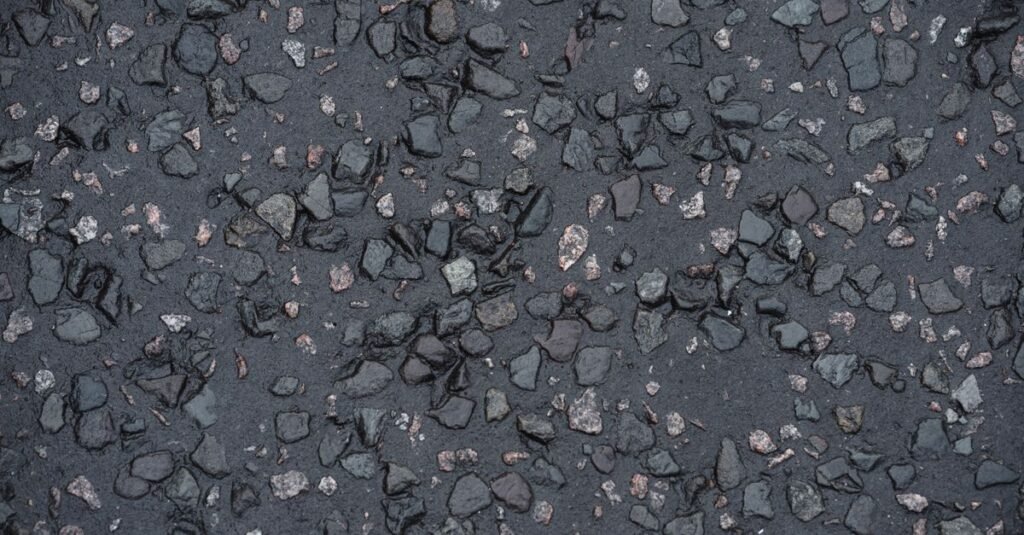
| Asphalt, tarmac or a sealed drive | The binder is a petroleum product, so gum solvents attack the surface too | Cold methods only — freeze and chip, no solvent, no steam | Good on the gum, easy to ruin the surface |
| Wet cast, decorative or coloured paving | The show face is a thin mortar layer with the pigment in it | Freeze and chip, gently, test first | Best-case removal, worst-case damage |
Two of those rows are where the mistakes cost money. Asphalt is the trap: bitumen and a citrus or petroleum gum solvent are close relatives, so whatever softens the gum softens the binder holding the aggregate in place, and what looks like a successful removal is a shallow sink mark that collects water and grit for the rest of the drive’s life. Heat is the same problem in a different form. Cold, a plastic wedge, patience, and living with the residue. Wet cast and decorative units are the ones Marshalls singles out for jetting damage, because the colour and texture live in a thin skin on top — remove three millimetres of that and you have exposed grey. Test a freeze-and-chip where the furniture sits before doing it where the visitors walk.
One note on rinse direction, because the site has a rule about it and gum sits on the awkward side. Most gum work is flatwork, where the only questions are which way the water drains and whether the residue ends up somewhere it should not — and on a public path that is a permit question, not a preference. But on steps, a kerb face, a wall or a bench, the rinse water is carrying softened gum base rather than dirt, and softened gum base re-deposits as a tacky grey film on anything dry it runs across. So rinse upward, bottom of the run to top, keeping everything below the working line already wet. That is backwards from every siding article here, and the reason is what is in the water rather than the geometry of the wall.
Seven Million Pounds a Year, Spent on Steam
If you want to know whether pressure or temperature removes gum, look at what gets bought by the people who have no option to give up.

The UK government’s own figures, published when Defra set up the Chewing Gum Task Force with Keep Britain Tidy: “Estimates suggest the annual clean-up cost of chewing gum for councils in the UK is around £7 million and according to Keep Britain Tidy, around 87% of England’s streets are stained with gum.” The scheme is funded to “up to £10 million” by gum manufacturers including Mars Wrigley and Perfetti Van Melle, spread over five years, with grants of up to £70,000 per council partnership (Defra, new funding to remove chewing gum stains from our high streets).
Seven million pounds a year, and eighty-seven per cent of the streets still marked. That is not councils being bad at cleaning. It is a material that is genuinely hard to remove and a mark that survives the removal — the two claims this page has been making since the first paragraph.
What the grants buy matters too. Keep Britain Tidy describes gum removal as “often requiring specialist equipment like high-pressure steam cleaners” — high pressure *and* steam, with the steam doing the chemistry and the pressure doing the carrying. Nobody spending public money on this buys a cold four-thousand-PSI machine and a rotary nozzle, and the reason is not budget. It is that the cold machine does not work, and leaves a crater while failing.
For a homeowner with six blobs on a path the translation is cheaper: a can of freeze spray, and the machine out at the end to rinse.
FAQ
Will a pressure washer remove chewing gum from concrete?
Not on its own, and not without a cost. Gum base is a synthetic elastomer, so a jet is absorbed as deformation — the blob thins and spreads rather than releasing. Cold machines are the worst case, because the only way to shift the gum is to remove the concrete surface under it. A hot-water machine helps, and a steam setting helps more. On any machine, the washer’s real job is rinsing the softened residue away after cold or heat has done the work.
What temperature does chewing gum come off at?
The FDA’s specifications for permitted gum-base ingredients put the softening points of the rosin-ester softeners between 79 and 96 degrees C, stearates at 102 to 109, the permitted paraffin congealing at 93 to 99, and terpene resin at a minimum of 155. Hot-water pressure washing at the commonly quoted 180 to 200 degrees F is 82 to 93 degrees C, which clears the bottom of that band and not the top. That is the mechanical reason gum goes stringy and sticky under hot water instead of releasing cleanly.
Does freezing chewing gum really work?
Yes, and a paving manufacturer publishes it as the method: freeze the gum and chisel it off, or use a hot water and steam cleaner. Use an aerosol freeze spray rather than an ice cube — a cube cannot get below 0 degrees C and wets the slab while it melts. The cold stiffens the waxes and resins around the rubber so the blob breaks away at the surface in one piece instead of smearing. Lift it with a plastic scraper, never a steel blade.
Why is there still a circle where the gum was?
Because two things happened while the gum sat there. The oily softeners in the gum base wicked down into the pores, which leaves a darker mark; and the gum masked that patch of paving from two years of weathering and traffic film, which leaves a lighter one. Either way it is a mark in or under the surface rather than a film on it. A degreaser with long dwell will fade a dark disc. Nothing reliably removes a pale one except cleaning the whole area so it matches.
Can I use a solvent or a citrus cleaner on gum?
On concrete, carefully. On asphalt or a sealed drive, no. Bitumen is a petroleum product and so are most gum solvents, so the cleaner that softens the gum softens the binder holding the surface together and leaves a sunken patch. On sealed or coated paving the solvent can re-melt the sealer. Test somewhere hidden first, and remember that a solvent swells an elastomer rather than dissolving it, so it makes gum gluier before it makes it removable.
The Gum Comes Off Long Before the Disc Does
Two numbers decide this job and neither one is a PSI figure. The softeners in gum base start letting go somewhere above 79 degrees C and part of the resin fraction holds on until 155, which is why a steam setting works and a hot tap does not. And an ice cube stops at 0 degrees C, which is why a can of freeze spray beats the thing in the freezer tray.
Pick one end of the thermometer, use a plastic wedge, and keep the lance for the rinse. Then look at what is left, because that is the decision the rest of this page was really about: a lump of tyre-grade rubber comes off a slab completely, and the oily circle it pressed into the pores for two summers mostly does not. On a path with six blobs, cleaning the whole path is what makes them disappear. On a frontage with six hundred, that is why the council’s seven million pounds keeps getting spent.