Last Updated on September 25, 2026 by Umar Farooq
Pressure washer water hammer is the pressure spike that travels back up the hose when you release the trigger: the water in the line is still moving at roughly 13 feet per second, the gun shuts in a few thousandths of a second, and that momentum has nowhere left to go except into pressure. You feel it as a thump through the gun, hear it as a bang somewhere behind you, and occasionally watch the hose kick sideways on the driveway.
The question everyone arrives with is whether it is breaking something. The answer has two halves. A soft thump on release is the system working as designed, and every machine with a trapped-pressure unloader makes one. A hard metallic bang that jolts your wrists or has got worse over a season is a different conversation, because the spike behind it is loading your fittings above the number printed on the machine.
This page is about that one event. If you are trying to *name* a noise instead — gravel, grind, whine, tick — the sound-to-fault map on the noisy pump page is the better start. And to be clear: this is not a steady vibration while you spray, nor a machine sitting over its rated pressure all the time. It is a single event at the instant flow stops.
Why Stopping Water Is Harder Than Starting It
Starting water moving is easy; the pump gets a whole revolution to do it. Stopping it is the violent half, because water will not get out of the way.

Water is, for practical purposes, incompressible. Not literally — squeeze it hard enough and it gives — but at 3,000 PSI the water in your hose has been compressed by roughly one percent. One percent is not a shock absorber. It is a rounding error with opinions.
So when the trigger valve shuts, the column of water behind it has momentum and one percent of squash in which to lose it. Instead, the layer arriving at the closed valve piles into the layer ahead of it, that into the next, and a front of raised pressure marches back up the hose towards the pump. The University of Florida’s extension circular on irrigation systems frames the same event plainly: “Shock waves in pipe systems can result from sudden changes in flow”. Sudden change in flow, converted into pressure, travelling as a wave. The wave reflects off the pump, comes back, and dies away inside a fraction of a second. What you heard was the first arrival.
Pressure Washer Water Hammer Has an Equation Behind It
This is the satisfying part, because unlike most pressure washer folklore it has been settled arithmetic since about 1900. The relation is the Joukowsky equation, ΔP = ρ·a·ΔV: pressure rise equals fluid density, times the speed of the pressure wave in that particular pipe, times the change in velocity. Three terms. One is fixed — water is water. The other two are yours.
Start with velocity, because you can work yours out in thirty seconds. A gallon is 231 cubic inches, and a standard 1/4-inch consumer hose has a bore area of about 0.049 square inches. At 2.0 GPM that is 7.7 cubic inches leaving the gun every second through 0.049 square inches, which is about 13 feet per second. A 1.2 GPM electric machine sits nearer 8 ft/s; a 4 GPM gas machine on 3/8-inch hose lands around 11.6. The homeowner range runs roughly 8 to 16 ft/s.
Hold that against what the same circular recommends for irrigation mains: “Limit maximum operating velocities to 5 per sec. In no case should the velocity exceed 10 per sec.” Your hose runs at one-and-a-half to three times the ceiling a piping engineer would set. Not a defect — a short flexible hose is a different animal from a buried main — but it explains why the event is this loud on a device this small.
Now the honest part, because this is where the internet would hand you a fake number. Wave speed decides how big the spike is, and it depends on the stiffness of the pipe wall. I went looking for a published wave speed for a high-pressure washer hose and found none — not from a hose maker, not from a machine manufacturer, not in the hydraulics literature. So I will not tell you your machine spikes to a specific PSI. What I can do is bracket it. The University of Florida publishes maximum surge pressures for plastic pipe of 8.1 to 20.3 PSI for every 1 ft/s of velocity change in PVC, and 4.0 to 10.2 in polyethylene, depending on wall thickness. Run 13 ft/s against the PVC band and you get roughly 105 to 265 PSI of surge on top of whatever the hose was already holding. Right order of magnitude for a flexible-walled line, and as it happens the same neighbourhood as the trade’s own rule of thumb further down. A bracket, not a specification for your hose.
One more caveat from the source that gives the equation: Joukowsky is [“often conservative, [but] it is not always so.”](https://www.datacor.com/resources/can-you-trust-the-joukowsky-equation-for-waterhammer) It can be exceeded when vapour cavities collapse, when friction packs pressure into a long line, and when reflected waves arrive back in phase. The tidy number is a starting point, not a ceiling.
Three Things Are Already Soaking Up the Spike
If 13 ft/s of water stopping dead converted fully to pressure every time, nothing on a pressure washer would survive a season. Three things absorb the event before you ever hear it.
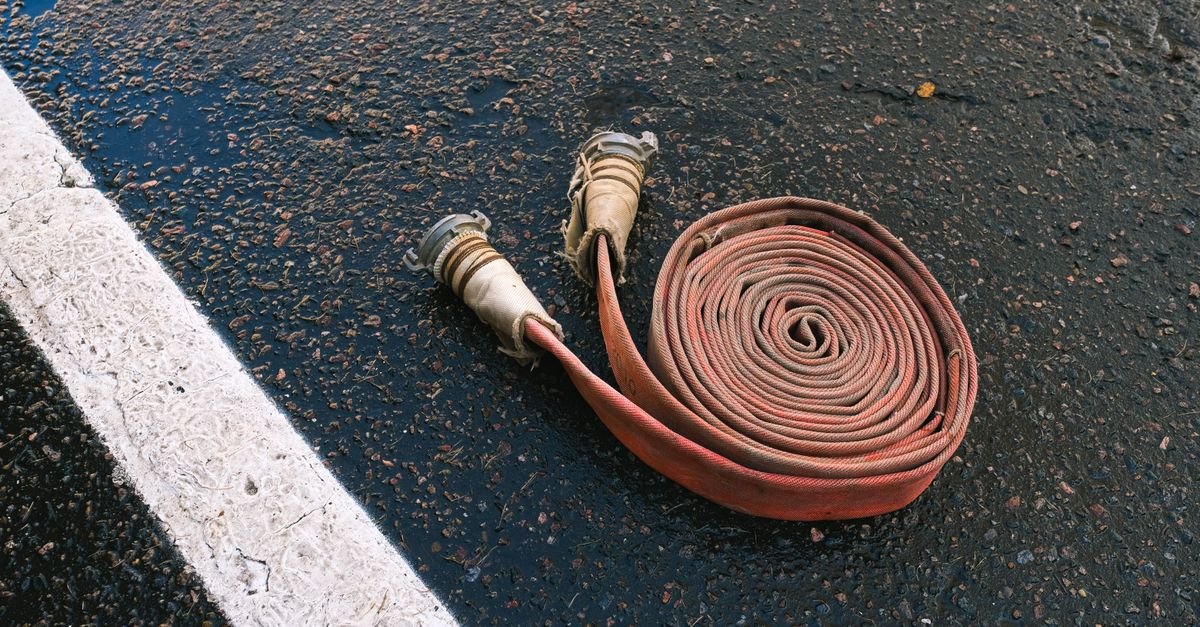
The hose wall, doing more than the other two combined. A pressure wave travels at about 4,850 ft/s through water in rigid steel pipe. Put the same water in a pipe whose wall stretches and the wave slows sharply, because energy goes into expanding the pipe instead of compressing the fluid — the Florida figures imply only a few hundred ft/s in thin-walled plastic, and rubber is more compliant still. Every foot of your hose is a spring, and fifty feet of spring is why the spike arrives as a thump rather than a hammer blow.
The unloader, which reacts to the spike on purpose. On the trapped-pressure design almost every homeowner machine uses, the pressure rise when the gun closes is not a side effect — it is the signal. It shoves a piston over, the pump dumps to bypass, and the event is finished.
An accumulator, if you have one. Most consumer machines do not. Commercial rigs often carry a small nitrogen-charged bladder in the discharge line whose whole job is to be the compressible thing water can push into. If yours has one and still bangs, the bladder has likely lost its charge or split, and no amount of trigger technique fixes that.
What Turns a Thump Into a Bang
Look back at ΔP = ρ·a·ΔV and the aggravating factors fall out almost automatically. Anything that raises wave speed, raises velocity, or makes the closure faster makes the spike bigger.
| What changed | Which term moves | Effect |
| Stiffer, less elastic hose | Wave speed up | Larger spike, same machine |
| Higher flow through the same bore | Velocity up | Larger spike |
| Smaller-bore hose at the same GPM | Velocity up | Larger spike |
| Longer hose | More stored moving water | Heavier thump, slower to settle |
| Trigger snapped rather than eased | Closure beats the wave | Full spike instead of a partial one |
| Unloader slow, gummy or set high | Spike not relieved promptly | Bigger, and repeated |
The closure-speed row is the least intuitive and the most useful. Whether a closure counts as “sudden” is not a human judgement — it is measured against how long the wave takes to reach the far end of the line and return. On fifty feet of flexible hose that round trip is on the order of 80 to 100 milliseconds, and a trigger released by its spring shuts in far less. As far as the water is concerned, the valve slammed instantly. The irrigation guidance for a comparable event is blunt about what gentle looks like: “No valve should ever be closed in less than 10 seconds; 30 seconds or more is preferable.” Nobody is taking ten seconds to let go of a pressure washer trigger. But the direction is the point — half a second instead of the spring is a real reduction, not a placebo.
Here is the opinion, and it will annoy somebody selling hose. A steel-braided replacement hose is marketed as an upgrade, and for abrasion and kink resistance it is. For water hammer it is the opposite. Surge scales directly with wave speed, wave speed rises with wall stiffness, so a less elastic line raises the spike your fittings see on every release. I cannot give you the factor — neither wave speed is published anywhere I could find — but the sign of the change is not in doubt. If you swapped to a stiffer hose and the bang got harder, that is not your imagination and it is not a fault in the new hose. It is the shock absorber you removed.
The Crimp, the O-Ring and the Valve Seat
The spike is brief, and briefness is why people dismiss it. But it is not a single event. It is a fatigue cycle, applied every time you let go — hundreds of times on one driveway, tens of thousands over a machine’s life.
Where it lands, roughly in the order things fail:
- O-rings at every threaded joint. Each spike pushes the ring harder into its groove and releases it. Enough cycles and the rubber takes a set, extrudes into the clearance gap, and weeps at a pressure it used to hold. A joint that seals cold and weeps once you start triggering is usually saying this.
- The gun’s own valve seat. The ball or poppet inside the trigger gun is the surface that actually stops the flow, so it is the surface the whole event happens against — and the first to wear into a shape that no longer seals.
- The hose at its crimp. This is where high-pressure hose overwhelmingly fails, and pressure cycling is a large part of why: the ferrule is a stiffness discontinuity and the hose flexes against it on every pulse. That has its own page on hoses bursting, and it is why the industry tests hose by impulse cycles rather than static burst pressure alone.
None of that is a reason to panic about a soft thump. It is a reason to care about a hard one.
Let the Trigger Close Itself
Three fixes, in order of cost: zero, zero, and about twenty dollars.
Ease the trigger shut instead of snapping it. Let the lever come back under your finger over roughly half a second rather than letting the return spring do it. It is the only fix here that works on every machine, needs no parts, and attacks the ΔV term directly. Two driveways and it is a habit. It also stops the hose whipping on release, which your shins will notice before you do.
Check that the unloader is actually unloading. With the machine running, release the trigger and listen. On a gas machine the engine note should audibly drop as the pump stops fighting. If it does not change, or the bang comes with the engine lugging, the valve is not relieving the spike — and a gummed piston is a far more common cause than a dead valve.
Get a gauge on it before you touch the adjuster. Ultimate Washer publishes the trade’s number: “You never want more than a 10% spike in pressure when you let go of the trigger.” On a 2,500 PSI machine that is 250 PSI — satisfyingly, the same neighbourhood the Joukowsky bracket landed in. The same source warns what winding the unloader spring down harder actually achieves: “you won’t get any more working pressure with the trigger engaged but when you let go of the trigger you will get a high spike pressure that is dangerous and could damage your pump.” If that knob is moving, the full procedure lives on the page for pressure washer unloader valve adjustment, and step one is fitting the gauge.
FAQ
Why does my pressure washer bang when I release the trigger?
Because the water in the hose is still moving and the gun stops it in milliseconds. That momentum becomes a pressure spike travelling back up the hose as a wave, and the bang is the wave arriving. On a machine with a trapped-pressure unloader a modest thump is normal — it is the signal that trips the valve into bypass. A hard bang that jolts the gun or moves the hose means the spike is larger than the system is comfortably absorbing.
Is water hammer bad for a pressure washer?
A small amount is unavoidable and the design assumes it. A large spike is not harmless, because it loads the hose, the fittings and the pump’s discharge valves above working pressure on every release. The damage is fatigue rather than a single failure, so it shows up as O-rings weeping, a gun that stops shutting off cleanly, and eventually a hose failing at the crimp.
Does a longer hose make pressure washer water hammer worse?
It makes the event heavier and slower to settle rather than sharper. More length means more moving water to absorb, and the wave takes longer to finish its round trip — but more hose is also more total elasticity. In practice people notice a long hose as a deeper, duller thump instead of a sharp crack.
Can I fit a water hammer arrestor to a pressure washer?
Not the plumbing ones. Domestic arrestors are designed for supply lines at 50 to 80 PSI and carry garden-hose threads, roughly an order of magnitude below a pressure washer’s discharge side. The high-pressure equivalent is a pulsation dampener or accumulator, which commercial machines sometimes carry and homeowner machines rarely justify.
Why does the hose jump or kick when I let go of the trigger?
Same event, seen rather than heard. The wave briefly raises the pressure inside the hose, and a pressurised hose tries to straighten itself, so a hose lying in loops flicks as the wave passes through it. It is more noticeable with a stiffer hose and a long run, and it is one more argument for releasing the trigger gradually.
How much should the pressure spike when the gun closes?
The trade guideline is no more than about 10% above working pressure — 250 PSI on a 2,500 PSI machine. You cannot judge that by ear; it needs an inline gauge on the discharge side, watched at the moment of release. If the needle jumps well past 10%, or past the pump’s rated pressure at all, the unloader is set too high or is not relieving properly.
Does an electric pressure washer get water hammer too?
Yes, usually more gently. Electric machines move less water, so hose velocity is nearer 8 ft/s than 13, and the spike scales with that velocity. Many also use a total stop system that cuts the motor on release. The event still happens — it is just smaller.
A Soft Thump Is the System Doing Its Job
This is not a fault code. It is momentum arriving somewhere it cannot keep going, and every hydraulic system on earth has the same problem. Yours handles it with fifty feet of rubber and a spring-loaded piston, and most of the time that is enough.
So the test is not whether it makes a noise, but whether the noise has changed. A thump you have felt through the gun since the machine was new is a machine behaving. A bang that hardened over a season, arrived with a stiffer hose, or turned up alongside fittings that have started to weep is the spike getting past the things that used to absorb it.
And if you take nothing else from an article with an equation in it: let go of the trigger like you mean it, not like you have been startled. Your O-rings have no other advocate.