Last Updated on September 25, 2026 by Umar Farooq
Pressure washer pump noise sorts into six sounds a person can actually tell apart — gravel, a rhythmic knock, a metallic grind, a high whine, a regular tick and a low growl under load — and the quickest way to narrow yours down is to notice what the noise does when you let go of the trigger. Two of those six mean stop now. One of them usually means nothing is wrong at all.
The reason this is hard is not that the sounds are subtle. It is that nobody agrees on the words. *Cleaner Times* opened a 2025 piece on pump troubleshooting by conceding exactly that: “person A may hear something that sounds like a knocking rod while person B may be reminded of marbles clattering,” and both of them are standing next to the same machine. So a page that tells you what “rattling” means has already guessed at the hardest part of the job.
This one is organised the other way round. Where the sound comes from, and what changes it, are things you can establish in ninety seconds without a tool. The name you would give it is the last thing that matters. (I read four manufacturer troubleshooting tables looking for a noise section. Three of them file every sound the machine can make under the single heading “knocking,” which is not a diagnosis so much as a shrug in a table cell.)
One boundary, because three pages here keep meeting. A slow rise and fall you can hear with the gun closed is surging, a control loop that has lost its damping. A hard beat you feel through your wrists while spraying is pulsation. This page is about the quality of the sound, not its rhythm.
The Trigger Is the Only Diagnostic You Have in Your Hand
Before you name anything, do three things. None of them require the machine to come apart, and between them they cut the list roughly in half each time.
One: open and close the trigger, and listen for what changes. This is the single most useful split on the page. A pump only does real work when water is leaving the gun, so a fault that lives in the pumping chambers — starved inlet, valves, packings — gets louder or rougher on the trigger and eases when you release it. A fault in the rotating assembly behind the pump head does not care what you do with the gun. It is turning at the same speed either way.
There is a second thing this test tells you, and it comes from the trade rather than a manual. Robert Piedade of A.R. North America gives it as a check on the unloader: “if you close the spray gun and do not notice a change in the engine’s tone, odds are the unloader is regulating and not unloading.” On a healthy gas machine, releasing the trigger should audibly unload the engine. If it does not, bypass water is being squeezed through a valve that will not open properly — and Piedade puts the consequence in degrees: that water can climb from 70°F to 145°F in as little as 45 seconds. An engine note that does not change is itself a symptom.
Two: work out which end of the machine it is coming from. Adam Leyendecker of Valley Industries–Comet Pump splits the pump by ear into two locations: “the most common symptom is a sound coming from the check valve chambers on the front of the pump,” which he attributes to a stuck or broken check valve, and then “a grinding or banging noise coming from the crankcase of the pump. This can be caused by a bearing or connecting rod failure.”
Front of the pump is water. Back of the pump is oil and metal. Put a hand flat on the pump head, then on the crankcase, then on the engine block, with the machine idling and the trigger released. You are feeling for where the vibration is strongest rather than listening, because at arm’s length your ears are getting the engine too.
Three: note whether it is there from cold. A noise present on the first trigger pull of the day is geometric — a blockage, a kink, a wrong tip, something loose. A noise that arrives after five minutes is thermal, which points at seals softening, oil thinning, a belt warming up, or bypass water heating.
A Sound-to-Fault Map for Pressure Washer Pump Noise
Here is the whole thing on one screen. Read down the left column until something matches, then go to that section.
| What you hear | Most likely cause | Changes with the trigger? | Stop now? |
| Gravel, marbles, a bag of stones | Starved or leaking inlet — cavitation | Yes, strongly | Yes |
| Rhythmic knock, like a car engine | Loose or failing crank bearing, worn connecting rod | No | Yes |
| Metallic grind or scrape | Bearing failure already under way | No | Yes |
| High whine or screech | Belt slipping on a belt-drive machine, or a dry bearing | No | Soon |
| Regular tick or click at the pump head | Valve not seating, or debris under a valve | Yes | No, but fix it |
| Low growl, only under load | Plunger and packing wear | Yes, only present under load | No |
| Loud but steady, no distinct note | Probably nothing | Gets louder under load | No |
Two columns in that table do more work than the first one. If the noise does not change with the trigger, everything in the water path is innocent and you are looking at the drive end. If it only exists under load, the drive end is innocent and you are looking at the water path. That is a genuine fork, and it costs nothing.
Gravel and Marbles Mean the Inlet, Every Time
If the noise is loose, granular and irregular — the sound people reach for words like gravel, marbles or shingle to describe — the pump is not getting enough water, and it is eroding itself while you listen to it.

Derek Majewski of Cat Pumps describes it as a knocking noise “that may sound like a bag of marbles in the drive-end of the pump.” Pumptec, which builds plunger pumps, files the same sound under rattling: “A rattling sound inside a pump may be caused by damaging cavitation, resulting from imploding internal gaseous bubbles due to restricted flow, improper pressure, or other issues.” One event, two vocabularies.
The mechanism and the damage it leaves behind are covered on the page for pressure washer cavitation. What belongs here is the identification, and two tells separate it from everything else in the table:
- It answers to the water supply within seconds. Open the tap the rest of the way, or free a kink, and the noise changes almost immediately. Nothing in the drive end responds that fast to anything.
- It is ragged rather than metronomic. A worn bearing keeps time. Cavitation staggers. If you can count it, look further down this page.
Majewski’s instruction when you hear it is the one to follow, and it is a walk rather than a repair: review “the entire inlet section of the pumping system from the water source to the pump’s inlet,” checking for a clogged inlet filter, sticking check valves, kinked inlet hoses, or fittings that have come loose and are letting air in through the threads. Pumptec adds the same point from the other side — “Air leaks in inlet plumbing can create very loud noises” — and note that an air leak on the suction side leaves nothing on the floor to find. It is the only leak on the machine that is completely invisible.
Knocking Like a Car Engine Points at the Crank End
A knock is different from gravel in one specific way: it keeps time. One beat per revolution of the crankshaft, deep, and coming from behind the pump head rather than from the chambers at the front.
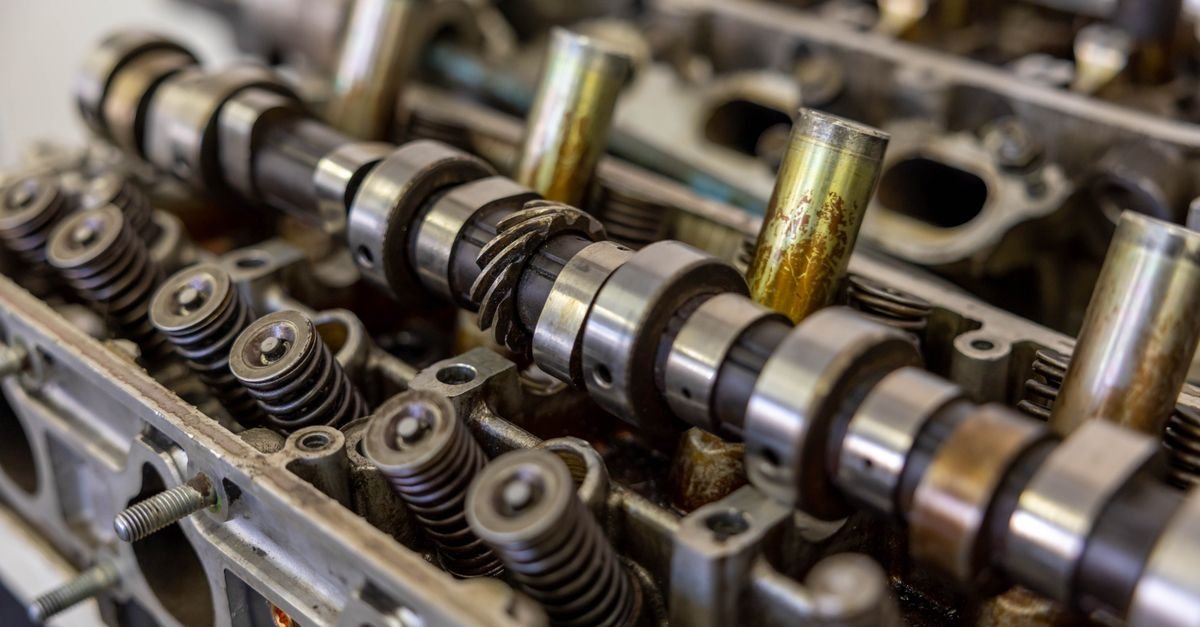
The mechanism is clearance. A crankshaft runs in its bearings with a fit measured in thousandths of an inch, and the oil film in that gap is what keeps metal off metal. Wear the bearing, or let the oil stop doing its job, and the shaft gains a little room to move. Every time the load reverses, the shaft crosses that gap and arrives at the other side of the bearing. That arrival is the knock.
Pumptec names the commonest route into it, and it is not mileage, it is water. “Water contamination could cause connecting rods to open up. The pump will knock like a car engine, especially with the change of speed/load and the starting and stopping of the motor.” That sentence connects two symptoms most owners treat as unrelated: milky oil in the sight glass, and a knock six weeks later. If your pump knocks, pull the oil fill and look at what is in there, because water in a pressure washer pump’s oil is a cause of this noise rather than a coincidence alongside it.
The same source lists two cheaper things that knock, both worth eliminating first:
- Low oil. Pumptec is blunt about where that ends: “The resulting low oil levels will cause the pump to wear out and could even cause the connecting rod to blow out the top.” Check the level before you check anything else. It is the only item in this section that is free.
- A loose plunger slot. “If a plunger slot is loose, each time the cam goes around it will impact the plunger more, causing noise.” The wobble-plate equivalent of a rod knock, and it sounds much the same.
And one that is not the pump at all: a pump or engine that has worked loose on its mounts. Pumptec notes that “if a pump isn’t properly secured to the equipment, it can cause components to rattle or bang around.” Four bolts and a spanner, and you have either fixed it or ruled it out.
Grinding Has Already Cost You the Bearing
A grind is not a knock that got worse. It is a different event. A knock is one impact per cycle with clearance either side of it. A grind is continuous contact — metal dragging on metal, usually with a rough edge to it, and often rising and falling in pitch with engine speed rather than with what the trigger is doing.
That pitch relationship is the confirmation. Anything that tracks engine RPM and ignores the gun lives in the rotating assembly — bearings, crankshaft, drive coupling and, on a belt machine, the pulleys. Leyendecker’s crankcase entry covers the two serious outcomes in one line: a bearing or a connecting rod failure.
Here is the uncomfortable part. A starved inlet damages the pump *while* it makes the noise; a grind means the damage has already happened. The clearance has gone, the oil film with it, and what you are hearing is two surfaces wearing each other away at whatever speed the engine is turning. Every extra minute puts more metal particles into the oil, and those particles then circulate to every other bearing in the case. Pumptec makes the general point plainly: “Particulates in the lubricant could scratch and damage a pump system, resulting in noise.” A failing bearing manufactures its own.
So grinding is the one sound on this page where the honest instruction is not “investigate.” It is: shut the engine off and investigate cold. A grinding bearing is not going to improve between now and the end of the driveway, and a seized drive end turns a bearing job into a pump.
A burning or hot-metal smell alongside it is corroboration rather than a separate fault — Leyendecker lists a burning or smoking smell as an indicator of low oil in the crankcase, and low oil is how most bearings reach the grinding stage.
What Whines, and Why Only Two Things Can
A high, continuous note — whine, screech, squeal, however it lands for you — is a narrower diagnosis than any of the others, because on a pressure washer only two things can produce one.
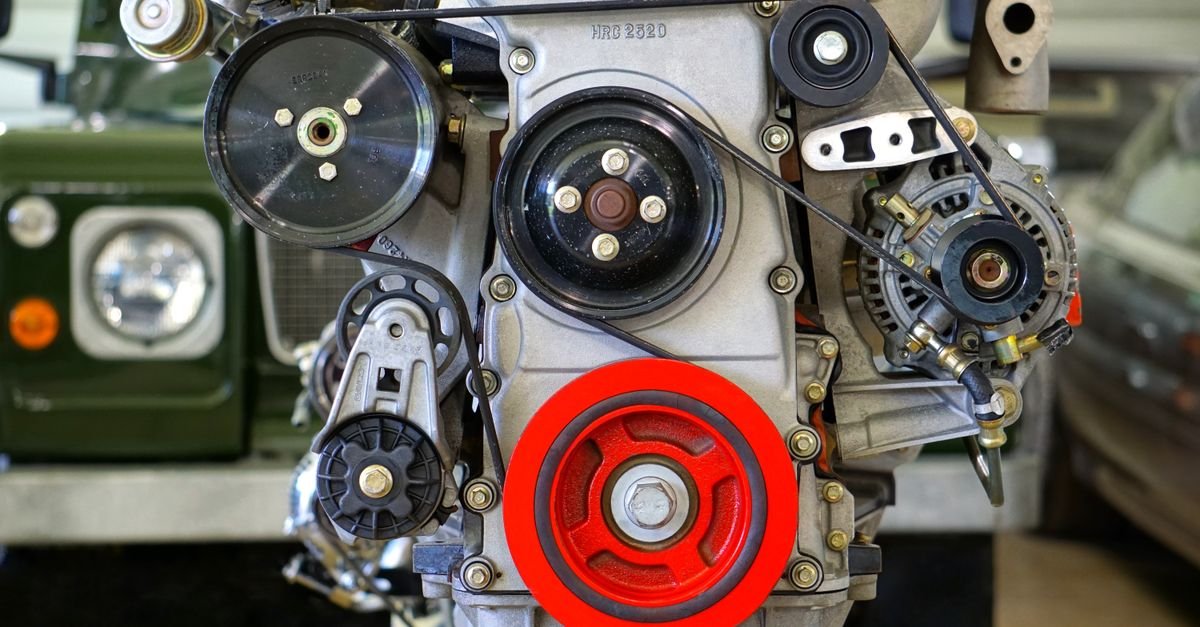
A belt, if your machine has one. Most homeowner machines are direct drive — the pump bolts straight to the engine shaft, and there is no belt to squeal. Larger and commercial units use a belt and a pair of pulleys, and a belt squeals for exactly one reason: it is sliding where it should be gripping. The friction between rubber and pulley groove is what transmits the torque, and when tension drops, or oil or dust gets into the groove, the belt slips and the slip radiates as a high note. The tell is timing. A belt squeals loudest at the moment the load arrives — the instant you pull the trigger — and often quietens once it has caught. That is the opposite of a bearing, which does not know the trigger exists. Belt slip is its own fault with its own fix, and it is not a pump fault at all.
A dry or failing bearing, before it gets to grinding. Bearings do not always announce themselves with a crunch. An early-stage bearing, or one running with insufficient or contaminated grease, will often sing first — a steady whine that rises and falls with engine speed and is completely indifferent to the gun. If the note tracks RPM and the machine is direct drive, you are back in the previous two sections, just earlier in the story than most people are when they start searching.
The separating question takes ten seconds: does the note change when you pull the trigger? Belt, yes. Bearing, no. If the machine has no belt, you have your answer without having to ask.
Can You Count the Tick? Then It Is a Valve
A regular, light tick or click from the front of the pump — countable, fast, and metallic in a small way rather than a large one — is the friendliest noise in this article. It is a check valve that is not sealing, and it is usually a piece of grit.
Each plunger sits under two small spring-loaded valves, one in and one out. They open and close on every stroke, which they do silently when the sealing face lands flat. Put a grain of sand or a flake of hard-water scale under one and it lands on an edge instead, and an edge makes a noise. Leyendecker puts the check valve chambers at the top of his list of audible symptoms precisely because it is the most common thing a pump does out loud.
The good news is what it takes to fix. Leyendecker’s account of the low-pressure version of the same fault applies here too — hard water deposits, chunks of rubber pulled off the inside of a garden hose, or fragments of old seal migrating into the valve chambers — and his remedy is to take “the valve cap off each chamber and cleaning it out and putting it back together. Most of the time the valves don’t even need to be replaced.”
Two honest caveats. This noise is easy to confuse with an early cavitation rattle, and the split is the one from earlier: a tick keeps time, cavitation staggers. And a valve that is not seating also loses you that cylinder’s output, so if the tick arrived alongside a drop in pressure or a beat in the lance, that is one fault reported twice.
A Growl You Only Hear Under Load
The last of the six is the quietest and the easiest to dismiss. The machine idles normally and sounds normal in bypass, and then you squeeze the trigger and a low, rough undertone appears underneath the engine. Release, and it is gone.
Load-only noise means the noise is being made by whatever is resisting the load, and that is the plungers, the packings and the sealing faces around them. High-pressure packings wrap tightly around each plunger and carry the entire pressure differential. As they wear, the fit goes from a smooth sliding seal to something that stutters and drags, and drag at a few thousand strokes a minute is a growl. Pumptec’s cam bearing entry describes the neighbouring version of the same wear: “If a pump is nearing the end of its life, the plunger slot and cam bearing that’s attached to the end of the motor can wear out.”
This one is not urgent in the way a grind is. It is a wear indicator, and it usually arrives with company you can check for in a minute: a weep from under the pump head, pressure sitting a little below where it used to, or oil starting to haze. A pump growling under load with dry seals and full pressure has years in it. A pump growling under load with a weep and a soft spray is telling you the seal kit is due.
The thing not to do is chase it with the unloader knob. Turning the pressure up makes the growl louder and the packings wear faster, which is an expensive way to feel better about a noise.
Your Pump Is Meant to Be This Loud
Some fraction of the people reading this have nothing wrong with their machine at all. They bought a pressure washer, ran it for the first time, and discovered that a device which moves several gallons a minute to three thousand pounds per square inch is not a quiet appliance.

Pumptec is refreshingly direct about this. Noise is partly a design consequence, not a fault: “While not a problem, high flow — especially at low pressure — is more prone to noise and should be expected at some level. As you go up in performance, especially flow, you’ll get more noise. Higher flow rate pumps have larger plungers with more movement because the cam is offset farther than with smaller pumps, creating more vibration and noise.” The bigger machine you bought because it had the better numbers is louder *because* it has the better numbers.
It also publishes the bands. An electric or battery pump “should have a consistent hum and will generally operate around 80-85 dB or lower,” while “some gas-powered pumps can be over 100 dB due to their internal combustion engines, requiring hearing protection.” Those are pump-industry figures rather than pressure-washer-specific ones, but the order of magnitude sets up the number that changed how I think about this topic.
NIOSH’s recommended exposure limit for noise is 85 A-weighted decibels averaged over an eight-hour workday, and the exchange rate it uses is steep: “For each 3 dBA increase in noise level, NIOSH recommends reducing the exposure duration by half.” Run that arithmetic against a gas machine at 100 dB. Fifteen decibels over the limit is five halvings, which takes eight hours down to about fifteen minutes a day.
So here is the opinion, and it is not the safety-poster version. Ear defenders on a gas pressure washer are not only protective equipment. They are a diagnostic instrument. Every sound in the table above is a small, specific note sitting underneath a very loud broadband engine, and an ear that has spent forty minutes in 100 dB has lost the sensitivity it needs to pick a tick out of a roar. That is part of why so many noises are reported as having “started suddenly” — often they did not, the owner simply stopped being able to hear the early version. A cheap pair of over-ear defenders lets you run the machine for two hours and still hear what it is doing at the end. Nothing else on this page costs less or does more.
Two calibration points for anyone genuinely unsure. A healthy axial pump is loud but *featureless* — a steady drone with no note you could pick out and hum. And noise that changed matters more than noise that is merely present. Pumptec frames its whole list that way: the noises worth investigating are the ones “that begin suddenly or increase in volume over time.” If it has sounded exactly like this since the day you bought it, it probably is this.
FAQ
Why is my pressure washer pump making a knocking noise?
Two very different faults produce a knock. If it is ragged, comes from the front of the pump and changes when you open the tap or free a kinked hose, it is a starved inlet — the pump is cavitating and doing damage right now. If it keeps regular time, ignores the trigger and comes from the crankcase behind the pump head, it is a bearing or a connecting rod, and low or water-contaminated oil is the usual reason. Check the oil level and colour before anything else.
What does a bad pressure washer pump sound like?
There is no single sound, which is why location matters more than the word you would use. Industry guidance splits it by where the noise comes from: a sound from the check valve chambers at the front of the pump points at a stuck or broken valve, while grinding or banging from the crankcase points at a bearing or connecting rod failure. Front of the pump is usually cheap. Back of the pump usually is not.
Is it normal for a pressure washer pump to be loud?
Often, yes. Higher-flow pumps are inherently noisier because the plungers are larger and the cam throw is longer, so a bigger machine is louder by design rather than by fault. What matters is character, not volume: a healthy pump makes a steady, featureless drone with no note you could pick out. A sound that started suddenly, or has grown over a season, is the one worth chasing.
Why does my pressure washer get louder when I release the trigger?
On a gas machine, releasing the trigger should make the engine sound *less* loaded. If the note does not change at all, the unloader may be regulating rather than genuinely unloading, which means bypass water is being forced through a restriction and heating fast. If instead you hear a new rhythmic cycling that only exists with the trigger closed, that is a bypass question rather than a pump noise question.
Can I keep using a pressure washer that is making a grinding noise?
No. Grinding is continuous metal-to-metal contact rather than an intermittent impact, so unlike most faults it is not equally bad in an hour’s time. A bearing that has begun to grind is shedding particles into the oil, and those particles reach every other bearing in the crankcase. Shut it down and diagnose it cold.
Why does my pressure washer pump squeal or whine?
If the machine is belt driven, a high note that appears the moment you pull the trigger and settles afterwards is almost always belt slip — tension, glazing or contamination in the pulley groove. On a direct-drive machine there is no belt, so a whine that rises and falls with engine speed and ignores the trigger is a bearing running dry or contaminated. The trigger test separates them in ten seconds.
Does pump noise always mean I need a new pump?
Not remotely. Two of the commonest noisy-pump findings, a starved inlet and debris under a check valve, need no parts at all. The first is a walk along the hose and an inlet filter rinse; the second is a valve cap off, a clean and a reassemble, and most of the time the valves are reusable. The noises that genuinely mean parts are the ones from the crankcase.
A Sound Is a Location, Not a Part List
Every manufacturer troubleshooting table is organised by component, because that is how spare parts are sold. Your ear is not organised that way. It knows roughly where a noise is and roughly what changes it, and those two facts are enough to get you to the right half of the machine without opening anything.
So do it in that order. Open and close the trigger. Put a hand on the pump head and then on the crankcase. Note whether it was there from cold. Then pick the row in the table that matches, and only then decide whether you are about to spend ten seconds on an inlet screen or an afternoon on a crankcase.
And if it is grinding, you already know. Let go of the trigger and turn it off. You can read the rest of this after the noise has stopped.