Last Updated on September 25, 2026 by Umar Farooq
A pressure washer surface cleaner not spinning has lost thrust, not power — the bar is turned by the recoil of its own two jets, so anything that blocks, shrinks, unbalances or starves those jets takes the motor away, and far and away the most common culprit is a single partly blocked nozzle you can clear in four minutes with a piece of wire.
The reason this fault is so confusing is that nothing looks broken. The machine runs. Water comes out. The disc slides across the slab exactly as it did last summer. It just leaves a set of overlapping arcs behind it instead of an even finish, which is a strange thing for an attachment with no moving parts to complain about.
Worth clearing up one thing before we start, because the search results mix them together: a turbo nozzle that has stopped spinning is a different repair with a different mechanism — that one is a single jet driven round the inside of a ceramic seat by the water entering off-centre. A surface cleaner has no seat and no cone. It has two jets pointing backwards and a bearing at the top, and that is the whole drivetrain.
Reaction Force Is the Only Motor It Has
There is no gearbox in there. No belt, no electric motor, nothing that a warranty department would call a mechanism.
The bar under the dome is a hollow tube with a nozzle at each end, and those nozzles are canted a few degrees off vertical, pointing opposite ways. Water leaving a nozzle at speed pushes the nozzle the other way. Two of those pushes, at opposite ends of a bar, produce a couple — and the bar turns. That is the entire design.
The force each jet generates is the mass of water leaving it per second multiplied by the speed it leaves at. Hold that sentence, because the rest of this article is just a list of ways to reduce one of those two numbers.
The only thing resisting rotation is the bearing at the top, and a healthy one resists very little. J. Racenstein’s technical guide to surface cleaner swivels puts professional units at 2,000-plus RPM at 4,000 to 5,000 PSI, which is fast enough that the individual jet paths blur into a single wet disc. A bar doing 200 RPM is not doing a tenth of the cleaning. It is drawing legible curves.
Lift It, Squeeze the Trigger, Watch Both Jets
Every diagnosis below comes out of one test, and it takes ninety seconds. Do not skip it and start unscrewing things.
Shut the machine off, close the tap, and squeeze the trigger until the hose goes slack. There is stored energy in a charged hose and it does not care that you are only having a look. Spin the bar with a finger and note how it feels — free, gritty or immovable. Then tip the head onto its side, restart the machine and pull the trigger with the open face angled down at the slab a few feet away.
This is the one moment in a surface cleaner’s life when its jets are not behind a skirt, so wear eye protection and point the open side at nothing you care about. Then read what it does.
| What the test shows | What it means |
| Bar spins fast, both jets throw the same distance | The head is fine. The problem is under it — downforce, skirt or surface |
| Bar turns slowly, both jets equal but short and soft | Flow. Either the machine or the supply feeding it |
| Bar hunts and wobbles, one jet throws visibly shorter | One blocked or worn nozzle. The usual answer |
| Bar does not move, jets look normal | Seized swivel, or something jammed against the bar |
| Bar does not move, both jets fan wide and lazy | Nozzles too large, or worn past their orifice size |
| Bar does not move, water dribbles out of both | Upstream supply or pump problem, not a head problem |
One extra question decides more than any of the above: did it ever spin properly? A head that has never worked on this machine is a sizing problem. A head that worked for two seasons and stopped is a blockage, a bearing or a supply change. Those are different articles’ worth of effort and people routinely spend an afternoon on the wrong one.
One Blocked Jet Halves the Thrust and Unbalances the Bar
This is the answer far more often than anything else, and it is the one people believe least, because the nozzle looks clean from the outside.
Each jet supplies half the torque. Lose one and you have not merely halved the drive — you have converted a balanced couple into a single off-centre push, which shoves the bar sideways into its bearing instead of round it. J. Racenstein’s guide is blunt about where that ends up, noting that one clogged nozzle “creates asymmetric force that vibrates the swivel apart.” So a partial blockage is not only the reason the disc has gone slow. It is also quietly working on the one expensive part of the assembly.
What gets in there is rarely dramatic: grit that slipped past the inlet screen, scale off the inside of an old galvanised line, a fleck of rust, a mud wasp’s mud if the head lived in a shed, and — depressingly often — a tail of PTFE tape wound too far down the thread at the last nozzle change, shredded off and parked in the orifice. Nothing here is exotic; it is the same short list that blocks a wand tip, arriving at an orifice half the size.
Clearing it depends on which kind of head you own, and this catches people out. Screw-in MEG-style tips come out with a wrench, get soaked and cleared from the back, and go back in. Pressed-in consumer nozzles do not. Simpson’s own instructions for its 15-inch surface scrubber say flatly, “Do not attempt to remove the nozzles as damage may occur”, and tell you instead to clear them in place with “a section of steel wire about 26 gauge or smaller (0.020″),” then flush the head through with a garden hose. Turn yours over and look before you reach for a spanner. A nozzle boss that has been swaged will not thank you for the attention.
Two rules whichever type you have. Push debris out the front, in the direction the water goes, never further in. And never open the orifice with a drill bit — a tip you have reamed by half a thousandth is now a different size from its partner, which is the next section’s problem.
Pressure Washer Surface Cleaner Not Spinning Is Usually a Flow Problem
Here is the opinion, and it will annoy somebody who has just bought a 4,200 PSI machine: the spin is bought in gallons per minute, not in PSI, and if the head never once turned properly on your machine, the machine is the fault rather than the head.

The mechanism is in the thrust equation from earlier — mass per second, times speed. Pressure only buys you the speed half, and it buys it on a square-root basis, so doubling your PSI gets you about forty percent more jet velocity. Flow buys you the mass half directly: double the gallons per minute and you double the water being thrown backwards every second. That asymmetry is the whole reason a 2,800 PSI machine at 4 GPM spins a 16-inch head happily while a 4,000 PSI machine at 1.6 GPM will not turn it at all, no matter how impressive the number on the box.
Manufacturers say so, once you find the page. Alkota’s guidance on matching a cleaner to the equipment recommends a 12 to 20-inch head for a 4 GPM machine and 24 to 30 inches for 5 to 8 GPM, and says of the small end of the market that 2 to 3 GPM machines are “simply not big enough for a surface cleaner attachment.” That is a manufacturer telling you not to buy the accessory, which is not a thing manufacturers enjoy doing.
If the head used to spin and now does not, the flow has gone missing somewhere between the tap and the pump rather than out of the specification. Kinked garden hose, half-open bib, a packed inlet screen, a hose too long or too narrow, or a well pump that cannot keep up. Work through what to do when the pressure washer is not getting enough water supply, because a starved pump will fail a surface cleaner long before it fails a wand.
And if you are still deciding what diameter your machine can carry, the sizing argument lives in the surface cleaner guide rather than here.
Two Tips That Do Not Match, and One Fitted Straight
Nozzles are the only consumable in the assembly, and almost nobody treats them as one.
Too large an orifice and system pressure falls through the floor. Ultimate Washer puts the outcome plainly: “If your nozzle is too large for your pumps, you will not have enough water pressure to effectively clean your surface; you may as well be using a garden hose.” The jets go soft, velocity collapses, and the bar sits there. Too small and the same source warns you “will create too much back pressure and wear out your pump prematurely” — the unloader dumps to bypass, flow through the head drops, and the bar stalls from the opposite direction.
Getting the size right is one division. Take the machine’s rated GPM and split it by the number of nozzles on the bar, then read a nozzle chart at your working pressure. Ultimate Washer’s worked example: “if your system produces 6 GPM but your cleaner requires 3 nozzles, the GPM you look for on the chart is 6 divided by 3, or 2 GPM.” A two-nozzle head on a 4 GPM machine therefore wants two 2-GPM tips, not two 4-GPM ones, and fitting the latter is one of the more expensive ways to make a head stop turning.
Three more failure modes worth checking while the tips are out:
- A mismatched pair. One replaced tip and one original produce unequal thrust. The bar hunts, vibrates and writes an off-centre pattern into the slab. Change both, as a set, every time.
- Two tips of the same size but different wear. Same effect, harder to spot, because they have the same number stamped on them.
- A nozzle fitted straight. On heads where the tip screws into a plain threaded boss rather than a pre-angled one, it is entirely possible to tighten a tip until its spray plane is vertical. All of its thrust then points at the concrete and none of it points round the circle. The head cleans one immaculate stationary ring and never moves. Sight along the bar from the end: each jet should lean by the same amount, in opposite directions, and if one looks upright it is.
Does the Bar Turn Freely With the Water Off?
If the hand-spin from the test felt gritty, notchy, or like turning a tap that needs a washer, the swivel is where your torque is going.
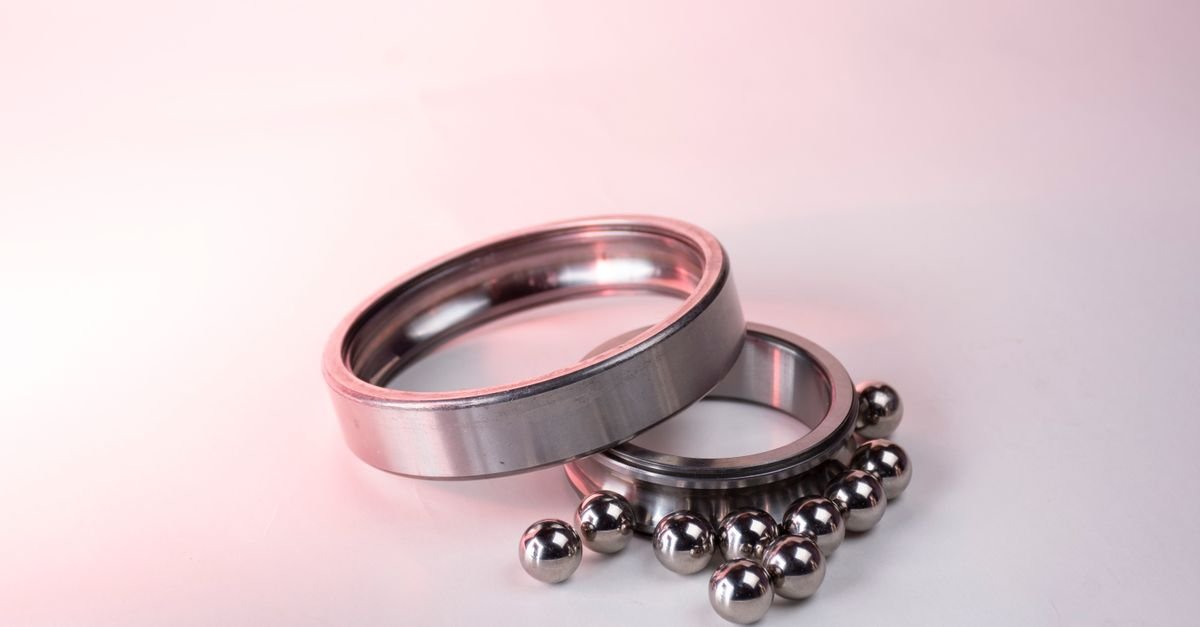
It is a rotary union: a joint that carries pressurised water from the stationary handle into the spinning bar without letting it out. Consumer heads generally run plain bushings; professional ones run ball bearings, and J. Racenstein splits the greaseable from the sealed. For the greaseable kind the published interval is “one to two pumps of high-temperature lithium-based grease every 10 to 12 hours of operation,” which is a rather shorter interval than the zero hours most homeowners are currently managing.
A good bearing coasts. Flick the bar and it should carry on for two or three turns. What you are looking for instead:
- Gritty or notchy. Grit has been through the race. Grease will quieten it for a weekend; a bearing kit or a new swivel is the actual fix.
- Stiff after storage. Common on a head put away wet and left all winter. Sometimes it frees off and runs. Sometimes the corrosion has already scored the running surfaces.
- Wobble in the shaft. Play you can feel by rocking the bar means the bearing or the shaft is worn, and a wobbling bar puts its jets at varying heights, which shows up as banding on the slab.
One related symptom to name without going into it: a swivel whose high-pressure seal has worn will bleed water internally, so less of your flow reaches the nozzles and the jets throw shorter even though nothing is blocked. A weep hole dripping steadily while the machine runs is the giveaway. And a word of warning about the most popular internet fix — thin penetrating oil sprayed into a swivel is gone within seconds of the water coming on. It will make the bar turn on the bench and change nothing on the driveway.
What Gets Caught Under the Skirt
Tip the head upside down and look inside the dome. Nobody does this first, on the grounds that it would be embarrassing, and it is regularly where the problem has been sitting the whole time.
The bar clears the underside of the housing by a small and unforgiving margin. Landscape gravel dragged in from a border, a length of string trimmer line, a wood screw, a bottle cap, a sweetgum seed pod, a fragment of the mortar you have just washed out of a paver joint — any of them will stop the bar dead or reduce it to a quarter turn and a stop.
The skirt gets in on it too. Rubber skirts curl inward as the edge ages and can end up inside the bar’s path rather than outside it. Brush skirts pack with slurry, which dries to roughly the consistency of grout and sets the bristles in a shape they were never meant to keep.
The subtler version: work a paver patio and joint sand mixes with water into a paste inside the dome, so the bar turns through wet sand rather than air. Thirty seconds with a garden hose through the housing after every job prevents the whole category.
Stop Leaning on It
A surface cleaner is designed to float. Its own weight sets the standoff between the nozzles and the slab, and the casters or skirt hold that height whether you are fresh or forty minutes in.
Push down on the handle and three things happen at once. The skirt compresses onto the concrete and drags. The bar sits closer to the surface, so more of the rebounding water hits its underside, and rebounding water pushes back against rotation rather than helping it. And on heads with a floating deck, hard downforce can bring the housing onto the bar. The disc gets slower the harder you insist, which is why people insist harder.
Surface texture does the same without your help. Heavy broom-finish concrete, exposed aggregate, chamfered pavers and tile with raised grout lines all grab at the skirt. A head that spins beautifully on a smooth garage floor and sulks on a paver patio is not faulty; it is being asked to drag a rubber ring across a washboard. Lift the leading edge slightly, slow down, accept a second pass.
One more habit worth breaking: standing still. Park the disc over one spot and the slurry it makes has nowhere to go, so the jets end up firing into their own dirty water. It also concentrates two jets on one ring of concrete for as long as you stay there, which is how a surface cleaner manages to leave marks on a slab in the first place — the whole taxonomy of those marks is in what a pressure washer leaving streaks is actually telling you. Keep walking.
FAQ
Why does my surface cleaner spin slowly and leave circles?
Because the bar is turning too slowly to blend its own jet paths. At working speed the two jets overlap into a continuous wet disc; below roughly a couple of hundred RPM you start seeing the individual passes, and they show up as arcs once the slab dries. Check one nozzle against the other first — an uneven pair slows the bar and marks the surface in the same single fault.
How fast should a surface cleaner spray bar spin?
Fast enough that you cannot pick out individual jets, which on a professional head means north of 2,000 RPM according to J. Racenstein’s swivel specifications. There is no dial and no readout. The practical test is whether the bar looks like a blur or like a bar.
Can I use WD-40 or penetrating oil on a surface cleaner swivel?
To free a seized bearing on the bench, yes, as a way of getting it moving. As a repair, no. Thin penetrating oil is displaced by water within seconds of the trigger coming on, so the bearing runs dry again immediately. Greaseable swivels want high-temperature lithium grease at the published interval; sealed ones want a bearing kit or a replacement.
Why did my surface cleaner stop spinning right after I changed the nozzles?
Three likely reasons, in order. PTFE tape wound too close to the end of the thread has shredded and blocked an orifice. The new tips are a different size from what the head wants, or from each other. Or one has been tightened past its intended angle so its jet points straight down. Take both back out and compare them side by side before assuming the head has failed.
Do surface cleaner nozzles wear out?
Yes, and faster than people expect on hard water or gritty supply. An eroded orifice flows more water at lower pressure with a wider, softer pattern, so thrust falls and cleaning falls with it. The symptom reads as a tired machine rather than a tired tip. Replace them in matched pairs and keep a spare set.
Is a surface cleaner that will not spin covered under warranty?
Usually not, because the common causes — blocked nozzles, grit through the bearing, wrong tip sizes — are classed as maintenance rather than defect. A swivel that fails in normal service inside the period is a fair claim. A nozzle with a tape tail in it is not. Check the terms first, since some manufacturers treat a removed nozzle as a modification.
Clear the Jets Before You Blame the Pump
Work it in the order the test gives you. Nozzles, then flow, then the bearing, then whatever is lying inside the dome — and only then start thinking about the machine. Four of the seven causes above cost nothing but a piece of wire and the willingness to turn the head over.
If it never once spun properly on this machine, though, no amount of wire is going to help. That is not a fault. That is a 16-inch head politely declining to be run on a garden tap’s worth of water, and it has a point.