Last Updated on September 25, 2026 by Umar Farooq
A ladder saver nozzle is a large-orifice soap tip that throws cleaning solution forty feet or more from ground level, and the number that decides how far it actually goes is your machine’s GPM, not its PSI. That sentence is the entire product, and it is also the part the listings skip.
The tool is named after what it removes rather than what it does, which is unusual and honest. Nobody needs a nozzle. People need to not be on a ladder holding a charged hose at the point where the gutter meets the fascia. A shaped stainless tip that costs about thirty dollars is a remarkably cheap way to delete that moment from the afternoon — provided it is bolted to a machine that can feed it, and provided you know the three things it cannot do.
So let us take it apart: what the thing physically is, the mechanism that sets its range, what it genuinely reaches, and where the honest edge of it sits.
A Ladder Saver Nozzle Is a Soap Tip, Not a Pressure Tip
The first correction, and it reverses most people’s assumption. This is not a high-pressure nozzle. It is a low-pressure one, deliberately.
Downstream soft washing works by running your cleaning solution through an injector fitted after the pump, where a venturi draws chemical into the water stream. That draw only happens when pressure at the tip drops far enough, which is why the fat black soap nozzle that came in the bag exists at all — the pressure washer soap nozzle has the widest orifice in the set and the lowest resulting pressure. Trade guidance for downstreaming puts the working target at roughly 100–300 PSI at the nozzle, with the soap draw ratio landing somewhere around 10–20% depending on the injector, the hose run and the tip (Outdoor Cleaning Store, downstream basics).
Fit a narrow high-pressure tip and the injector stops drawing. You get clean water at impressive pressure and no chemical, which on an algae-streaked wall is a very energetic way to achieve nothing.
So the ladder saver sits in the soap family. It keeps the orifice large enough to hold tip pressure down in injector territory, and then does one extra job: it shapes what leaves the tip so the stream holds together for longer than a 65-degree fan ever could. Large orifice, tight pattern. That combination is the whole trick, and it is why a normal soap tip gets you eight feet and this gets you forty.
Why a Long Stream Dies as Mist
A jet of water does not stop because it runs out of push. It stops because it stops being a jet.
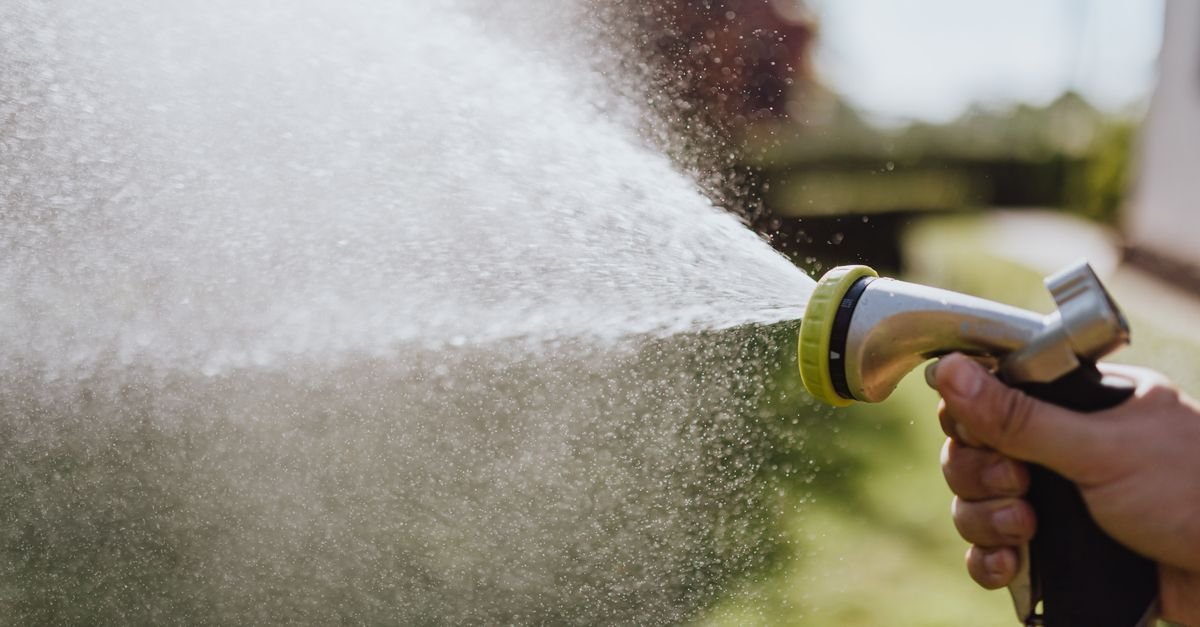
Water leaving an orifice at speed is unstable. Surface tension and air drag pull at the edges of the column, and past a certain distance the column breaks into ligaments, then into droplets, then into airborne mist. That is atomisation, and once it happens the water has effectively stopped travelling in the direction you aimed it. It is now weather.
Two things delay it. The first is stream coherence — a tighter, better-formed pattern holds its shape further. The second is sheer volume, because a thicker column of water has more mass per unit of surface exposed to the air, and takes longer to be torn apart. A wide fan tip atomises almost immediately by design, which is exactly what you want at three feet from siding and exactly what you do not want at thirty.
This is the mechanism the trade discussions keep circling. Long-range tips are described as tightening the stream to reduce atomisation, and the balancing act is explicit: keep the pressure at the injector low enough that it still draws chemical, but not so low or so wide that the stream turns to fog on the way up. Getting both at once is the reason the thing is a machined stainless part rather than a moulded plastic one.
Reach Comes Out of the GPM Column
Here is the opinion, and it will save someone thirty dollars and an afternoon.
PSI does not buy you reach. Flow does. A ladder saver bolted to a 1.4 GPM electric machine will not throw forty feet, no matter what the box on the machine says about 2,000 PSI, because there is not enough water in the column to survive the trip. The tip is not underperforming. It is being asked to build a rope out of a trickle.
The published range tells you this if you read it carefully. The ProTool version is rated for machines from 1,000 to 6,000 PSI and claims 40 to 50 feet (J. Racenstein, ProTool ladder saver shooter tip). Notice that the PSI window is enormous and the distance is a single range. If pressure set the range, the figure would scale across a six-to-one pressure spread. It does not, because the variable doing the work is the volume passing through the orifice, and every seller’s fine print says the same thing in the same words: distance depends on the GPM of your pressure washer.
Practically, the floor is around 4 GPM, which is prosumer gas territory. At 2 to 2.5 GPM you will get useful extra reach over a soap tip — call it the difference between the top of a garage door and the top of a single-storey wall — but not the second-storey figures in the product photos. Below about 2 GPM you are buying a paperweight in a nice finish.
Shooter Tip, J-Rod and Gutter Wand Are Not the Same Purchase
Four products share this aisle and only two of them share a job. It is worth separating them before spending anything.
Ladder saver / shooter tip / long-range chemical nozzle. One tip, quick-connect, no moving parts. Delivers solution at distance. These three names describe the same category, and the wording varies mostly by who is selling it.
J-rod. A J-shaped bar carrying four quick-connect tips at once, so an operator can flip between soap and rinse angles without walking back to the hose and changing nozzles with wet gloves. It is a tip *holder*, not a long-range device. A J-rod with a long-range tip on one leg does both jobs; a J-rod alone does not add a foot of reach.
Gutter wand. A rigid curved lance that hooks over the lip of a trough and points a jet along the run. Different tool, different physics, different failure mode — it moves debris along a gutter rather than delivering chemical to a wall, and it is covered properly in the manual gutter cleaning tool comparison.
Telescoping extension pole. Adds reach by adding length, not velocity. It works, and it puts the reaction force of the wand at the far end of a lever above your head, which is its own conversation.
The ladder saver is the only one of the four that buys distance without buying either length or a climb.
Fitting One to the Wand You Already Own
Mounting is the least interesting part of this tool, which is a compliment.
Almost all of them are 1/4-inch quick-connect, the same plug fitting as your coloured tips, in stainless rather than plated brass because they spend their lives full of sodium hypochlorite. It pushes into the collar on the end of your existing wand. That is the installation.
What matters more is what sits upstream of it:
1. A downstream injector in the line. Without one there is nothing to draw chemical and you are shooting plain water a long way. Most gas machines have one built in; many electrics do not.
2. Hose run and bore. Every additional foot of hose costs pressure, and a long run of narrow bore quietly reduces the flow arriving at the tip. If reach is disappointing, shorten the hose before blaming the nozzle.
3. The high-pressure hose, not a garden hose. Obvious, occasionally forgotten at the point where an extension gets improvised.
4. Somewhere for the runoff to go. Everything you apply at height comes back down at ground level, onto plants, paths and whatever is parked nearby. Wet the planting first, rinse it after.
Pull the trigger once at the ground before aiming upward. A tip that has been sitting in a bucket of bleach since last summer will happily deliver a solid stream of crystallised sodium hypochlorite into your own face, and the ground has no opinion about it.
Forty Feet on Paper, Less on a Breezy Tuesday
Now the honest part, which the product pages are not built to carry.
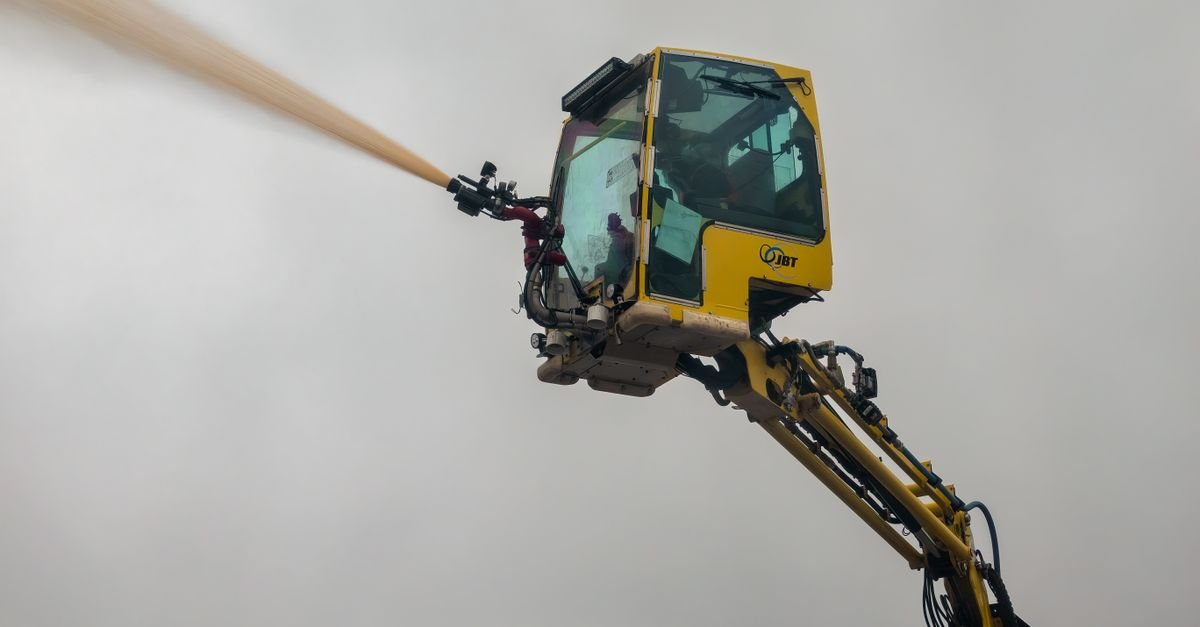
Limit one: the figure is a throw, not a working reach. Forty to fifty feet describes how far water travels before it stops travelling. The distance at which it still arrives as solution rather than drifting damp air is shorter — reports from people testing these on still days cluster around the mid-forties at best, and “still day” is doing heavy lifting in that sentence. Any breeze at all takes the top off it, because by the time a stream has gone thirty feet it has partly become droplets and droplets go wherever the air goes.
Limit two: horizontal and vertical are different numbers. A tip that throws forty feet along the ground does not deliver forty feet straight up. Gravity is decelerating the column the whole way, and the last part of the arc is the weakest, slowest, most atomised part. Standing back to get a better angle helps the trajectory and costs you concentration at the target.
Limit three: what lands is thinner than what left. A downstream injector is already diluting at roughly 10–20%, and the flight adds entrained air and evaporation. Solution that would sit as a wet film at six feet arrives at thirty feet as a damp haze that starts drying immediately. Soft washing works on dwell time, and dwell time needs a surface that is actually wet.
None of this makes the tool bad. It makes the honest working envelope for a homeowner machine something like a single-storey wall, a garage gable and the underside of an eave — not a three-storey Victorian.
Half of Ladder Falls Are From Six to Ten Feet
The safety case for this nozzle is not dramatic, and that is precisely why it works.
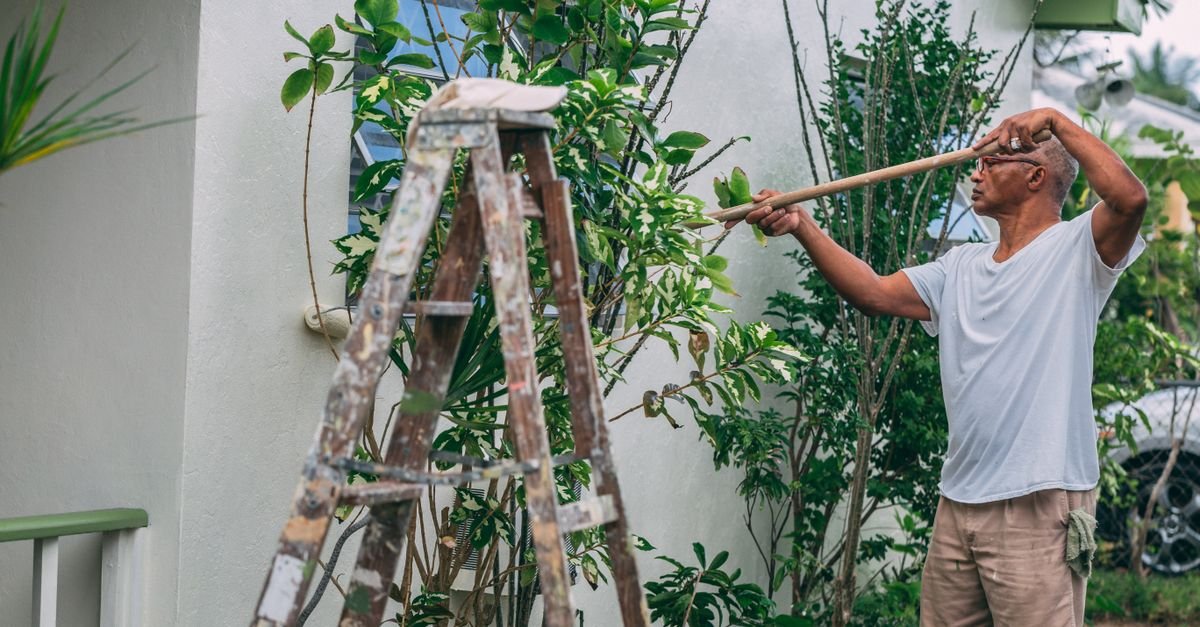
I went looking for the height that actually puts people in hospital, expecting roof height. It is not roof height. CDC’s analysis of US occupational ladder fall injuries for 2011 recorded 113 fatalities and an estimated 34,000 nonfatal injuries treated in emergency departments — and of those emergency department cases, nearly 90% were falls from under 16 feet, with falls of 6 to 10 feet accounting for 50% of them (CDC MMWR, Occupational Ladder Fall Injuries). Six to ten feet is the second rung from the top of a stepladder. It is gutter height on a bungalow.
That data is occupational, so it describes crews rather than homeowners, and I am not going to stretch it into a claim it does not make. What it does establish is the shape of the risk: the dangerous height is the unremarkable one, the one nobody puts a harness on for. A tool whose only function is to let you stand on the lawn is aimed at exactly that band.
There is a second-order benefit that gets less attention. A wand under load pushes back, and absorbing that recoil while standing on a ladder means your balance is being managed by the hand that is also holding the trigger. Removing the ladder removes that problem entirely rather than mitigating it.
Where It Earns Its Keep and Where It Wastes an Afternoon
Match the tool to the job and it is one of the better thirty-dollar purchases in this category. Mismatch it and it is a stainless ornament.

It does well on:
- The painted outer face of gutters and downspouts, where the staining is a surface film.
- Soffits and fascia boards, which are close to vertical, close to the eave, and awkward from any ladder position.
- Upper courses of siding on a single-storey run, where the alternative is moving a ladder nine times.
- Spider webs and nests in eave corners, which are a delivery problem rather than a cleaning problem.
- Wetting a surface down before and after a chemical dwell, which is most of the actual labour in soft washing.
It does badly on:
- Anything requiring agitation. Chemistry plus dwell plus rinse removes biological growth; it does not remove a wet mat of leaves, and no amount of reach changes that.
- Clearing a blocked gutter trough. Debris does not leave through the downspout, it packs into it.
- Asphalt shingles. Aiming any stream upward at a lapped roof puts water under the laps, and the granules in your gutter are the receipt.
- Precision. At thirty feet you are painting with a fire hose, and the windows, the neighbour’s car and the hydrangeas are all inside the pattern.
If your list is mostly the second group, the answer is different kit rather than a longer tip, and the roof cleaning equipment rundown covers what each tier actually reaches.
FAQ
What PSI do I need for a ladder saver nozzle?
Almost any. The published compatibility range runs from 1,000 to 6,000 PSI, which tells you pressure is not the constraint. Flow is. Aim for a machine at 4 GPM or above for the advertised distances, expect partial results at 2 to 2.5 GPM, and expect very little below 2 GPM.
Will it work on my electric pressure washer?
Usually not well. Homeowner electrics run about 1.2 to 1.6 GPM, and most have no downstream injector, so you lose both the volume that carries the stream and the mechanism that puts chemical in it. You will gain a few feet over the black soap tip and that is roughly the whole story.
Is a ladder saver nozzle the same as a shooter tip?
Yes, in practice. “Ladder saver”, “shooter tip”, “long-range chemical nozzle” and “tall reach tip” all describe a large-orifice, tight-pattern tip built to deliver downstreamed solution at distance. A J-rod is a different item — a four-tip holder — although the two are frequently sold side by side and sometimes combined.
Can I use one to clean my gutters out?
Not really, and this is the most common mismatch. It delivers solution to the outside of a gutter beautifully. Inside the trough, a jet slides a wet mat of debris along the run until it jams the outlet, which converts a visible problem into a hidden one.
Does it need special chemicals?
No. It runs whatever your downstream injector is already drawing, typically a diluted sodium hypochlorite and surfactant mix. Because it is stainless it tolerates that better than plated fittings do. Flush it with clean water after every use — the failure mode for these tips is crystallised chemical narrowing the orifice, which quietly costs you the reach you bought it for.
The Tool Removes a Climb, Not a Scrub
A ladder saver nozzle is a delivery device with one genuine talent: it puts cleaning solution somewhere your feet are not. Judge it on that and it is excellent value. Judge it on cleaning power and it will disappoint you, because it has none — the chemistry does the work and the tip is just the postman.
Before you buy one, go and read the GPM figure on your machine rather than the PSI figure on the box. That number is the whole prediction. If it starts with a 4, order the tip and stay on the grass. If it starts with a 1, keep the thirty dollars and spend it on a longer dwell time and a bit of patience, neither of which cares how far away you are standing.