Last Updated on September 26, 2026 by Umar Farooq
Cleaning trash cans properly means warm alkaline detergent, ten minutes of dwell and a long brush — because the film inside a bin is a bacterial biofilm anchored to the plastic, and a jet of water does not remove an anchored film so much as redistribute it, including onto you.
That runs against the instinct of everyone who owns a pressure washer. A bin is plastic, it lives outdoors, nothing you can do will damage it, and it is revolting. Every condition that normally argues for restraint is missing. So the wand comes out, and three minutes later the bin looks better while the driveway, the fence and the person holding the trigger are all measurably worse.
I went looking for a published procedure for cleaning something genuinely contaminated inside a genuinely enclosed shape, and found it in food-safety guidance for processing plants — an industry that has spent decades learning how to clean surfaces with living colonies on them without spreading those colonies round the room. Two of its recommendations are about our tool, and neither is flattering.
This page covers the inside of a wheeled bin, a kitchen can, and the lid of both. The smell is a separate job with a separate mechanism, and how to remove mildew odor already owns what removes an odour rather than masking it.
The Grey Film in a Bin Is a Bacterial Colony With a Scaffold
Run a gloved finger down the inside wall of an old bin. What comes off is not dirt. Dirt is loose, has no structure, and water moves it. This has the consistency of something that was built.
Wheeled bins are injection-moulded from high-density polyethylene to EN 840, the European standard for mobile waste containers, and HDPE becomes a good surface to attach to as soon as it stops being new. A bin leaves the factory smooth. After a few winters of frozen bags dragged out and a shovel edge scraping the base it is not smooth any more, and every scratch is a sheltered site for the next colony.
What follows has a documented sequence. A 2025 review of biofilms in food processing environments describes it beginning with “the reversible attachment of free-floating microorganisms to a surface”, and then: “If conditions are favorable, the attachment becomes irreversible, involving the production of adhesins.” The colony then builds a matrix around itself — extracellular polymeric substances, “composed of a complex mixture of biopolymers, including polysaccharides, proteins, lipids, and extracellular DNA” — and that matrix is structural: “The EPS provide the structural framework of the biofilm, facilitating the adhesion of cells to surfaces and to each other” (Persistent Threats: Biofilm Formation, Control, and Economic Implications in Food Processing Environments, PMC12388178).
Read “irreversible” literally. It is not a polite word for stubborn. The film is glued down by polymers the organisms manufactured for the purpose, and rinsing is a shear force applied to something engineered to resist shear.
Two consequences follow, and the second is why this page exists.
Spraying disinfectant into a dirty bin and shutting the lid does less than it feels like it does. The review is specific about why: the EPS matrix “acts as a physical barrier, impeding the penetration of sanitizers and shielding embedded microorganisms from chemical and thermal treatments.” Cells inside a mature biofilm show “increased resistance to antimicrobial agents up to 1000-fold compared to their planktonic (free-floating) counterparts.” That is not a claim that disinfectant is useless. It is a claim about order: the biocide works on what it reaches, and until the matrix is physically broken, most of the colony is not in that category.
Cold weather is not doing you the favour you have been told it is. Half the advice online says outdoor bins need cleaning less often in winter because cold slows bacterial growth. For the residents of a damp plastic box that is only partly true — the review notes that psychrotrophic bacteria including *Pseudomonas putida*, *P. fluorescens* and *P. aeruginosa* “tend to form enhanced biofilms at refrigeration temperatures (6–10 °C).” What genuinely slows in winter is the smell, because volatile compounds are less volatile when cold, and that is a change in your nose rather than in the bin.
What the bin does supply, by design, is the other condition the review names: “High relative humidity plays a critical role in promoting biofilm formation by creating a moist environment that facilitates bacterial adhesion.” A closed lid over a wet base is a humidity chamber with a handle on it. We will use that deliberately later, which is the only good news here.
The Bacteria Count Everyone Quotes Has No Study Under It
There is a figure circulating on this topic and you will meet it within two clicks: a trash can interior carries 411 different bacterial colonies per square inch, attributed to NSF, usually dated 2019. A companion claim says 78% of wheeled bins test positive for antibiotic-resistant bacteria.
I went looking for both. What NSF actually published is the 2011 NSF International Household Germ Study: 22 volunteer families, 30 household surfaces, each swabbed over about three inches by three inches, tested for coliforms, yeast, mould and staph. Real study, stated methodology, and I read the summary in full. A trash can is not one of the thirty items, and there is no per-square-inch colony count anywhere in it.
What is in it is more interesting than the number being quoted. Coliforms turned up on 77% of dish sponges and rags, 45% of kitchen sinks, 32% of counter tops and 18% of cutting boards — the germiest object in an average house is the thing you clean with. So the 411 is a number citing a study that does not contain it, which is worse than a number with no citation at all, because the citation is the thing that stops people checking. I could not trace the 78% either. Both live almost entirely on the websites of companies that wash bins for a living.
That does not make your bin clean. It means the honest case is the mechanism above, plus one well-documented body of research on what happens when you aerosolise this kind of material — which concerns people who do it forty hours a week, and which is the next section.
What Comes Back Out of a Bin When You Jet It?
Here is the one strong opinion on this page, and it is the opposite of what a pressure washing site is supposed to say. The machine belongs at the end of this job, and starting with it is the most consequential mistake available. Two sources from fields with no interest in each other point the same way.
The first is the US Food and Drug Administration’s draft guidance on controlling *Listeria monocytogenes* in ready-to-eat foods — nonbinding recommendations for industry, issued January 2017, and I read the PDF rather than a summary. High-pressure water appears twice, both times as the problem. To keep aerosols off exposed food, “personnel should not use high-pressure water hoses during production in areas where RTE foods are exposed or after equipment has been cleaned and sanitized.” And on drains, the closest thing in a factory to the inside of a bin: “Avoiding use of high-pressure hoses to clear or clean a drain, because use of such hoses could create aerosols that could spread contamination throughout the room” (FDA, Control of Listeria monocytogenes in Ready-To-Eat Foods: Draft Guidance for Industry).
The same document lists scenarios that could lead to contamination, and two entries sit a few lines apart: “Waste bins in the RTE area are not properly maintained, cleaned and sanitized” and “Indiscriminate use of high-pressure hoses in cleaning.” The agency independently identified the bin as a harbourage site and the high-pressure hose as a spreading mechanism. It never puts the two together, because in a factory nobody was going to. On a driveway, we do.
It also gives a distance, which I did not expect to find anywhere. On the risk of contaminating a neighbouring production line: “in general, the risk of contamination from overspray increases when using low pressure within 20 feet and when using high pressure within 30 feet.” Thirty feet is worth pacing out. On most driveways it takes in a car, a front door, a window that is open because it is warm, and the bin’s neighbour.
The second source measured it. A study of swine workers in the *Annals of Occupational Hygiene* sampled exposures while emptied barns were power washed, and states the mechanism flatly: “Given the contact of highly accelerated water droplets onto areas to be cleaned, this operation necessarily dislodges and aerosolizes material settled onto flooring, gates, and other surfaces.” Median personal endotoxin exposure during power washing was 40,350 EU m⁻³, against 12,150 EU m⁻³ for loading hogs out. The recommendation: “Either respirator use or a reduction in exposure time is recommended while performing these tasks” (Assessment of Swine Worker Exposures to Dust and Endotoxin during Hog Load-Out and Power Washing, PMC3415068).
Now scale it, because the honest version is smaller than the dramatic one. That is a barn: hours of work, a floor that held pigs, a room of dried manure dust. A 240-litre bin held a fortnight of kitchen scraps and takes three minutes. The dose is not comparable and I will not pretend otherwise — nobody appears to have measured bioaerosol exposure from washing a household bin. What transfers is the word *necessarily*. This is not a risk factor that might apply; it is what a jet does to a settled film, in a barn or in a bin.
One way the bin is worse, and this part is geometry rather than a citation, so treat it as mine: a barn wall is flat and the room is large, whereas a wheeled bin is a closed box about eighteen inches across with one opening, you are standing at that opening, and every surface you aim at angles back toward it. There is nowhere for the spray to go except out past your face.
What that buys in practice is modest and worth doing anyway: gloves, sealed eye protection rather than glasses, outdoors and never in a garage, upwind if there is any wind, and the machine held back for the job the next two sections define. The family of argument is the same one removing bird droppings makes about wetting a deposit before disturbing it — wet, slow and low first, velocity last.
Warmth, Alkalinity and Ten Minutes Standing Still
The FDA document does more than say what not to do. It sets out a seven-step sanitation sequence, which is the argument this site makes about chemistry before pressure, written by people with a budget for getting it wrong.
Dry clean first, using “appropriate tools (such as brushes, scrapers)” to take off heavy soil. Pre-rinse and scrub “working from the top of the equipment down.” Then the step that matters: “Soap and Scour — Apply foam cleaner… from the bottom of the equipment to the top… Scour equipment to remove any residues, and avoid the drying of the foam cleaner.” Then post-rinse “in the same order that the foam cleaner was applied.”
Three things in there are worth pulling out.
Detergent goes on bottom to top and the rinse comes top down. That is the house rule on this site, arrived at independently by a federal food-safety agency. The reason is the same in a bin as on a wall: solution running down a dry surface leaves clean stripes that set. The wrinkle is that a bin is a container, so the rinse has nowhere to drain — which is why it gets tipped rather than rinsed standing up. Water left in the base is the next colony’s starter kit.
The scouring step is not optional. Physical abrasion sits between soap and rinse because that is what breaks an anchored matrix, and pressure is not a substitute: a jet applies force for a few milliseconds per square inch as it sweeps past, where a brush applies it for as long as you keep pushing.
“Avoid the drying of the foam cleaner.” Five to ten minutes of dwell without drying is the standard for every chemical on this site, and a bin is the one place it costs nothing. Shut the lid. The enclosed shape and trapped humidity that grew the film will hold your detergent wet as long as you like — the only time that property works in your favour.
Then temperature, where the consumer version hits a published wall. For a shared cleaning system the FDA recommends you “maintain the temperature of an alkaline cleaning solution at or above 71 degrees C (160 degrees F).” A domestic water heater is commonly set between 120 and 140°F, so a bucket from the hot tap is warm rather than hot by that standard. The machine cannot close the gap either: Kärcher publishes 104°F as the inlet limit for its electric pressure washers, and what happens above a machine’s rated inlet temperature is a seal and cavitation problem, not a cleaning benefit. The heat source here is a kettle.
One honest limit, because heat is easy to over-claim. Warmth sterilises nothing — the same matrix that blocks sanitizers shields the cells inside it from “thermal treatments”, in the review’s phrase. Heat works on the soil, thinning the fat binding the film together and speeding the detergent’s chemistry. It makes the scouring easier rather than unnecessary.
And bleach, since it is in every set of instructions on this subject. Sodium hypochlorite kills what it contacts, which in a filmed bin is the outer layer and not much else; the dilution, the shelf life and the absolute rule against mixing it with anything acidic are set out on the power washing chemicals page. One thing worth flagging, because half the bin recipes online do it: several recommend vinegar in one paragraph and bleach in the next. Do not let those two meet in a bucket.
Cleaning Trash Cans on the Driveway: Seven Moves, One Trigger Pull
Seven steps. Six of them involve no machine at all, which is a slightly embarrassing thing to publish here and is nonetheless what the sources say.
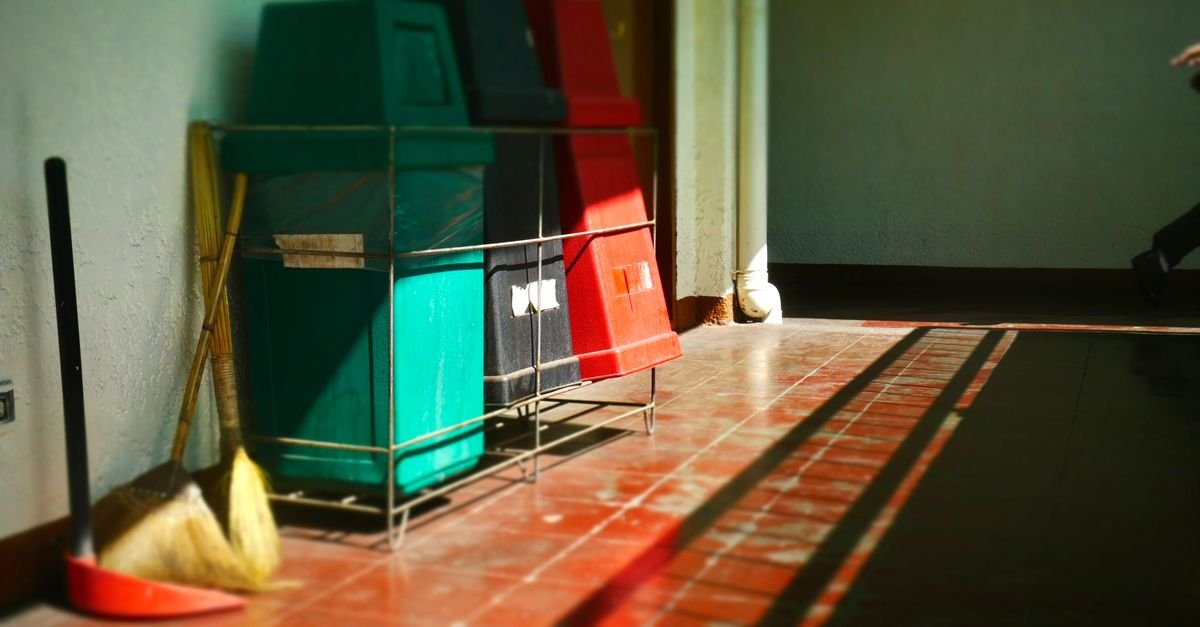
1. Time it for the morning after collection. An empty bin, a full day of daylight, and the longest possible gap before anything new goes in. Any other day and you are washing a bin that will be refilled by lunchtime.
2. Dry clean first, before any water. Tip out the loose debris and lift the set material off the base with a plastic scraper. Water on a dry crust turns something you could have picked up into a paste that bonds to the plastic, and this is also the step that stops you rinsing solids into a drain later.
3. Wet it gently, standing to the side. A garden hose on an open end, or a watering can, aimed down the inside wall rather than across it. The point is to soften rather than to shift.
4. Warm alkaline detergent, from a bucket. Two or three inches of hot soapy water in the base, and the walls and lid wetted out by hand with a long-handled brush. A general-purpose alkaline cleaner beats dish soap on greasy residue; dish soap is fine on a kitchen can.
5. Shut the lid and leave it ten minutes. This is the dwell step and it is free. Go and do something else. Check nothing.
6. Scour properly, and get the three places nobody does. Long brush, two directions, firm pressure — you are breaking a matrix, not wiping a surface. The neglected spots, worst first: the underside of the lid, where condensate collects and drips back down; the rim gutter the lid seats into, a channel that holds liquid by design; and the corners of the base, where the moulding radius means a flat brush never quite lands.
7. Rinse, tip, drain, dry with the lid open. Rinse top down, then lay the bin on its side so the water leaves instead of pooling, and leave it open in the sun. Drying is what stops the colony re-establishing before the next bag.
Where the machine legitimately fits. Two places. The outside of a bin is ordinary plastic and washes like any other — 40-degree white tip, a couple of feet back, no turbo nozzle. And the final rinse of the inside, once the film is off and what remains is suspended soil rather than an anchored colony, with the bin already on its side, the wand outside the mouth rather than in it, and you standing to one side. A rinse tool at the end of a job it should not have started.
If it is dry and still smells, that is a different problem with its own page: absorbed odour compounds leave porous material over days, which is what how to remove mildew odor works through.
Thirty Gallons of Foul Water, and Nowhere Obvious to Put It
You have now produced the highest organic-load runoff a homeowner makes with a garden hose: food residue, the detergent, whatever the detergent lifted, and the broken-up biofilm. This is not siding rinse water with a bit of algae in it.
The one destination it must not have is the storm drain, and the geography is against you — the kerbside gully is usually a few feet from where the bin already stands, which makes it both the path of least resistance and the worst available choice. A storm drain has no treatment stage in it at all. Where wash water may legally go, why that is decided by your municipality rather than by any federal rule, and the phone calls that settle it for your address are worked through on pressure washing runoff rules.
The practical version is short. Work over grass or gravel where the water can percolate, not on pavement that falls to the kerb, and pick ground that is not already saturated, because soil only filters water it can accept. Keep it downhill of anything you intend to eat. With no vegetated ground in reach — a townhouse frontage, a walled yard — this becomes a bucket job: scour with as little water as you can, then tip the contents into a toilet or utility sink, which drains to a treatment plant rather than a creek.
FAQ
How often should you be cleaning trash cans?
Monthly for a kitchen can and every one to two months for an outdoor wheeled bin is where most guidance lands, but the real trigger is whether liquid has escaped a bag. One split bag resets the clock whatever the calendar says. Do not stretch the interval much in winter either — the smell drops off in cold weather, while several of the bacteria that colonise a damp bin form biofilms perfectly well at fridge temperature.
Can you pressure wash a trash can?
You can, and it is the wrong first move. A jet does not remove a film that is chemically anchored to the plastic; it fragments it and throws it into the air, which is why the FDA’s *Listeria* guidance recommends against high-pressure hoses for cleaning drains specifically because they “could create aerosols that could spread contamination throughout the room.” Use warm detergent, ten minutes of dwell and a brush to break the film, then bring the machine in for the final rinse with the bin on its side.
Does bleach clean a trash can?
It disinfects rather than cleans, and the distinction decides your afternoon. Sodium hypochlorite cannot lift a greasy film, so on an unwashed bin it treats the outer surface of the colony and stops. Use it after the detergent and the brush, at the dilution on the label, and never in the same bucket or session as anything acidic — vinegar included, which several bin-cleaning recipes cheerfully recommend two paragraphs apart.
Will vinegar and baking soda clean a wheeled bin?
They help with the smell and do very little to the film. Vinegar is a weak acid and a mild biocide, bicarbonate of soda is a weak alkali and a very soft abrasive, and mixing the two leaves you carbon dioxide and a solution weaker than either. As a post-wash odour measure in a dry bin, bicarbonate is genuinely useful and completely unquantified.
Why does my bin still smell after I cleaned it?
Usually one of two things. Either it is not dry, and a smell returning on the first warm afternoon is absorbed compounds leaving the plastic rather than new growth. Or you cleaned the barrel and not the lid: the underside of the lid and the rim channel it seats into are where liquid collects, and a brush pushed straight down never touches either. Check the rim gutter with a finger before concluding the wash failed.
Is it safe to wash a bin in the garage?
No, for two separate reasons. A gas machine in an enclosed space is a carbon monoxide risk whatever you are washing. And what a jet lifts out of a bin stays airborne in a closed room instead of dispersing, then lands on everything in it. Do this outdoors, with a breeze if you can get one.
Do bin cleaning services do anything I cannot?
The genuinely different thing they own is a truck that catches the water and takes it away, which solves the disposal problem on a walled frontage with no vegetated ground. The cleaning itself is hot water, detergent and mechanical agitation in a closed chamber — the three things this page describes, done to a bin that is not in your hand.
Warm Water, a Long Brush, and the Morning After Collection Day
The instinct that brings people here is that a bin is disgusting and therefore needs force. It is disgusting and it needs the opposite, and the reason is one word in a biofilm review: the attachment is irreversible, so the colony is glued on by polymers it built and shear does not lift it. Warm detergent, the lid shut for ten minutes, a long brush in two directions, a rinse with the bin on its side, an afternoon of sun with the lid open.
The thing to change tomorrow, if you change nothing else: do the lid. The underside of a bin lid and the rim channel it seats into hold standing liquid by design, they are the two surfaces a brush pushed straight down the barrel never reaches, and they pass within eighteen inches of your face every time you lift it. A bin washed everywhere except its lid will smell again by the weekend, and you will blame the barrel.